


CHUWI is a Shenzhen-based PC brand that's been around since 2004, delivering affordable devices in the form of laptops, tablets, and, more recently, mini PCs.
While I've tested CHUWI laptops in the past, the AuBox X 256V that the company sent me is its first mini PC I've had a chance to test.
It's super compact, it features a snappy Intel Core Ultra Series 2 CPU, and it has lots of ports to work with.
I've been using the CHUWI AuBox X on my desk for a few weeks now; here's what you need to know before buying.
Why you can trust me

Why you can trust me
Cale Hunt
I have ten+ years of experience testing Windows PCs, and I'm always happy to give an unbiased opinion of new hardware after thorough, real-world testing.
CHUWI had no input, nor saw the contents of this review, prior to publication.
How much does the CHUWI AuBox X cost?
CHUWI's AuBox X is available now to buy directly from CHUWI's store.
The more affordable model, featuring an Intel Core Ultra 5 226V CPU, 16GB of RAM, and a 512GB SSD, costs $679 — that's with tax included.
The high-end model that I'm reviewing here, with an Intel Core Ultra 7 256V CPU, 16GB of RAM, and a 1TB SSD, costs $829. Again, that's with tax included.
CHUWI is offering an exclusive $80 discount for Windows Central readers. When checking out, use code WindowsCentralAuBoxX.
These configurations are effectively locked; if you want more storage, you can upgrade after purchase. Memory is, unfortunately, soldered to the chip and not upgradeable.
Here's a quick look at the specs that make up the CHUWI AuBox X 256V, as reviewed.
Swipe to scroll horizontally
| Row 0 - Cell 0 | CHUWI AuBox X (256V) |
CPU | Intel Core Ultra 7 256V |
GPU | Intel Arc 140V (integrated) |
NPU | 47 TOPS |
RAM | 16GB LPDDR5x-8533 (soldered) |
SSD | 1TB M.2 PCIe 4.0 NVMe (upgradeable) |
Ports | 1x USB4, 1x USB-A 3.2 (Gen 2), 4x USB-A 3.2 (Gen 1), 1x USB-A 2.0, 2x HDMI 2.1, 1x DisplayPort 1.4, 3.5mm audio, 2.5Gb Ethernet, 1x USB-C (power) |
Wireless | Wi-Fi 6E, Bluetooth 5.4 |
Dimensions | 5.05 x 5.05 x 1.59 inches (128.4mm x 128.4mm x 40.5mm) |
Weight | 1.27 pounds (580g) |
Is the CHUWI AuBox X built well?

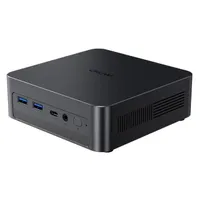
The AuBox X uses a magnesium alloy chassis, meaning it gets the durability perks of metal without weighing much. Indeed, at just 1.27 pounds (580g) and measuring only 5 inches square, it's one of the tinier PCs we've tested here at Windows Central.
And although it takes up little room on a desk, I appreciate that CHUWI tosses in a VESA mounting panel. You can quickly mount the PC onto the back of a monitor or the underside of a desk, further saving room.
The AuBox X uses a magnesium alloy chassis, meaning it gets the durability perks of metal without weighing much.
The magnesium shell has venting on either side to feed the single internal fan with cold air, while hot air exhausts out the back. That's an optimal setup.

Unfortunately, the fan does get relatively loud when the CPU is under load. While running Cinebench tests, I measured approximately 61dBA directly behind the PC where hot air exhausts. From about a foot away, the volume dropped to about 51dBA, which is a lot more respectable.
In any case, unless you have the PC mounted under your desk (or elsewhere out of the way), you're going to hear the fan when the PC is working.
The AuBox X's port selection is plentiful, but I wish for more USB-C

This tiny mini PC has more ports than you might expect, but they're not necessarily the ports you want.
The front of the device features a single USB4 port, and that's it for the USB-C form factor, other than the 100W power input on the back.
Otherwise, the front panel has dual USB-A — one 3.2 Gen 2 at 10Gbps and one 3.2 Gen 1 at 5Gbps — a 3.5mm audio jack, and a power button.

Native video output on the back of the PC is decent, with DisplayPort 1.4 and dual HDMI. However, there are some quirks.
Something I've never seen before is a warning that the DP 1.4 port can't be plugged in or out when the PC is turned on; it needs to be powered down before use.
CHUWI also lists both HDMI ports as using the 2.1 standard, yet one is FRL and the other TMDS. Considering TMDS is an HDMI 2.0 technology, it means that you're actually only getting one HDMI 2.1 port with full 48Gbps bandwidth.
This mini PC should nevertheless support three external displays. I tested using one 4K and one 2.5K display, and the PC had no issues.

I appreciate the inclusion of a 2.5Gb Ethernet port for speedy wired internet, and there are plenty of USB-A ports to work with. If only those USB-A ports on the back climbed above 5Gbps.
As I mentioned, it would be nice to have extra USB-C connections on the back of the PC.
How is the CHUWI AuBox X's performance?

Aside from a bit of fan noise, I don't have much to complain about regarding the CHUWI AuBox X's performance.
Its Intel Core Ultra 7 256V CPU, which launched in late 2024, remains a solid performer with 8 cores and a boost clock up to 4.8GHz. Although it has a base TDP of 17W, CHUWI designed the system to be capable of jumping up to 37W for short bursts. That's as high as this chip goes.
I wouldn't buy this PC for gaming, but it can certainly hold its own in lighter titles.
Also on board is an integrated Arc 140V graphics chip, providing a respectable amount of power for such a small device. It compares well to the discrete NVIDIA GTX 1650 and can even give the RTX 3050 a run for its money in certain games. I wouldn't buy this PC for gaming, but it can certainly hold its own in lighter titles.
CHUWI markets the AuBox X as an AI PC, and indeed it is capable of running local models thanks to its Neural Processing Unit (NPU) hitting 47 TOPS of power. The PC is Copilot+ certified.
The biggest drawback in terms of AI (and overall) performance is the capped 16GB of LPDDR5x RAM. There's no way to upgrade memory since it's integrated with the chip; be wary of this limitation when buying for AI workloads.
Image 1 of 3

I ran several benchmark tests to get an idea of general performance compared to other PCs we've recently tested.
In Geekbench 6, the Core Ultra 7 256V that lends itself to the AuBox X 256V's name performed quite well, delivering strong single-core performance and showing plenty of space for all cores to function.
Cinebench 2024 was largely the same, with the Core Ultra 7 256V pulling ahead of the similar 258V. And as for the SSD, well, no complaints from me thanks to stellar read and write speeds.
Cracking open the CHUWI AuBox X 256V to see what's inside

Removing the bottom panel via four captive screws, I took a chance to poke around inside the mini PC.
Presented immediately are three M.2 slots: two for storage and one for the Wi-Fi 6E card. Both SSD slots fit full-size 2280 drives, so no issues there.
The rest of the device is fairly locked down. The Intel Core Ultra 7 256V has integrated RAM, so there's no option to upgrade after purchase.
Should you buy the CHUWI AuBox X?

You should buy this if ...
✅ You're interested in a capable mini PC with AI smarts via the 47 TOPS NPU.
✅ You don't have much space on your desk and want a super compact PC.
You should not buy this if ...
❌ You want a PC that can handle a life of gaming.
❌ You want a PC with more upgradeable components; a traditional desktop is still a better choice.

CHUWI's AuBox X 256V is competitively priced at $829, and you can knock a further $80 off by using code WindowsCentralAuBoxX at checkout. The PC is built well, offering solid performance for regular and AI tasks.
My complaints — fan noise, not enough USB-C ports, and a 16GB cap on RAM — should be taken into consideration before buying, but they're certainly not dealbreakers.
If you do want a great mini PC with more RAM, something like the Geekom A9 Max we tested remains a top option. Its Ryzen AI 9 HX 370 CPU is AI-capable, and the system includes 32GB of memory. It does, however, cost $1,399 these days, nearly twice as much as the AuBox X.

CHUWI's AuBox X is a super compact mini PC offering strong general and local AI performance. It has a decent selection of ports (although I do wish for more USB-C), it's competitively priced, and it's built well. Just make sure you don't need more than 16GB of RAM.

Join us on Reddit at r/WindowsCentral to share your insights and discuss our latest news, reviews, and more.
