


惯性聚合 高效追踪和阅读你感兴趣的博客、新闻、科技资讯
阅读原文 在惯性聚合中打开

推荐订阅源

酷 壳 – CoolShell
酷 壳 – CoolShell
H
Hacker News: Front Page
P
Palo Alto Networks Blog
T
ThreatConnect
Apple Machine Learning Research
博客园_首页
T
True Tiger Recordings
P
Privacy & Cybersecurity Law Blog
B
Blog
IT之家
IT之家
Last Week in AI
Last Week in AI
F
Full Disclosure
Hacker News: Ask HN
Hacker News: Ask HN
C
Comments on: Blog
Microsoft Azure Blog
C
Cybersecurity and Infrastructure Security Agency CISA
Microsoft Security Blog
博客园 - 【当耐特】
N
News and Events Feed by Topic
NISL@THU
NISL@THU
腾讯CDC
雷峰网
雷峰网
Security Latest
Security Latest
李成银的技术随笔
M
Microsoft Research Blog - Microsoft Research
L
LangChain Blog
L
Lohrmann on Cybersecurity
cs.CL updates on arXiv.org
C
Check Point Blog
Y
Y Combinator Blog
Recent Announcements
博客园 - Franky
N
News | PayPal Newsroom
V
V2EX
A
About on SuperTechFans
The Register - Security
月光博客
月光博客
奇客Solidot–传递最新科技情报
奇客Solidot–传递最新科技情报
Google Online Security Blog
MyScale Blog
MyScale Blog
Cisco Talos Blog
Cisco Talos Blog
Vercel News
Vercel News
WordPress大学
WordPress大学
C
Cyber Attacks, Cyber Crime and Cyber Security
The Hacker News
The Hacker News
IntelliJ IDEA : IntelliJ IDEA – the Leading IDE for Professional Development in Java and Kotlin | The JetBrains Blog
爱范儿
爱范儿
A
Arctic Wolf
L
LINUX DO - 最新话题
freeCodeCamp Programming Tutorials: Python, JavaScript, Git & More

Captivate Unlimited Podcast Hosting & Analytics

Captivate & DAX US Launch Unified Monetization Suite for US Creators Apple Video Podcasting: Best Practices to Get The Most From The New Tech Apple Video Podcasting, powered by HLS: what is it and what does it mean for your podcast? Captivate Announced as Day One Launch Partner for Apple’s New HLS Video Release Introducing Captivate Assistant: The Most Useful AI Podcasting Assistant Yet; Grow Your Audience AND Save Time! 3 Low-Effort Ways to Promote Your Podcast (and Grow Listeners) this Autumn Captivate Unveils Ad Marketplace, Online Podcast Recording Platform and Integrated Audio Editing Tools Captivate Launches New Podcast Submission Process for Apple Podcasts Captivate Releases Sync V3 Make Money Podcasting: How to Successfully Monetize With Podcast Sponsorship And Advertisements Make Money Podcasting: How to Monetize Your Podcast Through Listener Donations World First: Captivate Podcast Hosting Platform Achieves IAB Tech Lab Podcast Measurement 2.2 Certification Captivate 2.5: Upgraded UI and Brand New Features to Make Your Podcast Even More Successful 8 Quick Ways to Build A Community Using Your Podcast GarageBand vs Audacity for Podcasting: Pros, Cons and Similarities Video: GarageBand For Podcasters – Tutorial, Tips and Tricks 7 Common Podcast Sponsorship Mistakes – Plus How to Avoid & Fix Them! 12 Best Podcast Logos & Artwork Examples (That Actually Engage Listeners) Video: Podcast Logos vs Cover Art (Roles and Differences Explained!) Video: How to Write a Podcast Script (And 5 Reasons Yours Doesn’t Work!) How to Write the Perfect Podcast Intro Script: Hook and Engage Listeners Video: How Podcasters Make Money (PLUS 5 Reasons You Don’t) - Captivate Unlimited Podcast Hosting & Analytics Is Apple Podcasts Free for Podcasters? Plus 8 Easy Steps to Upload your Podcast to Apple Ultimate Podcast Production Guide 2024 – How to Successfully Produce a Podcast How to Write a Perfect Podcast Episode Summary – Plus Tips, Benefits & Examples Changing Podcast Host Without Losing Subscribers, Listeners PLUS How to Move Your Analytics 80 Best Engaging & Interesting Podcast Interview Questions for Guests Captivate Launches Support For Apple Podcasts Subscriptions Spotify Launches 2023 Wrapped for Podcasters What is a Podcast? Plus 10 Reasons You Should Start One Today! What are Podcast Chapters? How do they Improve Listener Retention? YouTube Launches Its RSS Upload Tool for Podcasts – What Does This Mean for Podcasters? Podcast Branding 2024 Guide: How to Build a Podcast Brand & Benefits 43 Engaging Podcast Topics & Ideas Based on Show Format or Type – Including Examples 9 Best Ways to Promote a Podcast on Social Media – Plus FAQs Answered Podcast Downloads 2024 Guide: What is Good & How to Get More? Podcast Categories 2024 Guide – Get Discovered on Spotify, Apple and More How to Get on Podcasts – Plus Nailing your Pitch and Guest Interview How to Create Engaging and Powerful Podcast Taglines 2024 – Plus Examples Google Podcasts to be Discontinued in 2024 – Time to Say Goodbye How to Host Engaging and Powerful Podcast Interviews with Your Guests MP3 vs WAV – What is the Best File Format for Podcasts? How Much Money Do Podcasters Make in 2024? Plus Examples & How To Do It How to Record a Podcast Remotely 2024 Guide – Remote Podcast Setup How to Use Podcasts for Marketing and Branding Podcast Headphones 2023 Guide – 6 Best Headphones for Podcasting Podcast Equipment Essentials and Setup for Beginners and any Budget – Plus Advanced Extras How to Analyze and Track your Podcast Analytics Formats & Types of Podcast Explained – 10 Examples Plus Pros and Cons How to Publish a Podcast to Spotify, Apple Podcasts and Any Directory – Where to Upload & Distribute Podcast RSS Feeds 101: A Beginner’s Guide – What They Are & How They Work What are the best podcast apps? Both free and paid! Podcast Keyword Strategy: How to Uncover High-Impact Keywords to Boost Your Reach Podcast Calls to Action (CTAs): Converting Listeners into Engaged Fans Apple Launches iOS 17 – New Features for Apple Podcasts & Podcasters How to Start & Build a Podcast with No Audience and From Scratch – (Tips & Examples) How to Get Quality Podcast Backlinks in 2023 Planning Podcast Episodes 2023 Guide – Templates, Outlines & Format Tips Patreon Alternatives – Best Podcast Subscription Platforms (is Apple Podcast Subscriptions the Best?) Make Money with Podcast Subscriptions & One-Off Donations Easily with Captivate The Easiest Way to Start a Video Podcast (& Why You Shouldn’t Wait) How to Start or Move your Podcast to YouTube – 5 Easy Tips Podcast Networks Explained – Everything You Need to Know! [2024 Guide] What is Podcast Hosting? Everything You Need to Know! YouTube Music for Podcasts: Boost Your Discoverability Today with New Features How to Find the Ideal Podcast Episode Length for Your Show Podcasting 2.0 Explained: RSS Enhancements for the Independent Podcaster How to Optimize Your Podcast Guest Appearance for Search Grow Your Audience Using a Podcast Avatar and 13 Other Techniques 4 Main Reasons Stopping Podcasters from Launching – Which Blocker is Stopping You? How to Edit and Record a Podcast in GarageBand Best Podcast Voice Tips and Advice by Voice Coach and Podcaster Nic Redman Making Your Podcast Hosting Even Better Value Best Podcast Tips & Advice from Podcasters 2022/23 for International Podcast Day How to Write the Perfect Podcast Script (plus Examples & Templates) Captivate are Platinum Sponsors of the APVA Awards 13 Best Podcast Recording Software 2023 (including remote) – Reviewed by Podcasters We Interviewed 11 Attendees about The Podcast Show 2022 Podcast Show 2022 Roundup – Interview with Captivate’s MD Mark Asquith Descript for Podcasters Tutorial: Everything you need to know Facebook Is Stopping Podcast Services – Why & What To Do Next? In-Depth Review of Alitu for Podcasters – How it makes recording and editing easier Captivate Supports Podchaser’s #Reviews4Good April 2022 – Raising Money for #ChefsForUkraine 2021 A Year in Review: Your Big Podcast Achievements and ours! What is Dynamic Ad & Content Insertion in Podcasting? Video: Captivate's AMIE Dynamic Ad Insertion Technology for Podcasters [Overview] - Captivate Unlimited Podcast Hosting & Analytics Recommended Podcasting Tools & Resources Video: How to Use the Free Podcast Guest Booking & Interview Management System - Captivate Unlimited Podcast Hosting & Analytics Free Interview Management & Guest Booking Platform for Podcasters Captivate Shareable Podcast Player V2 is Here! Introducing Cross-Promotional Feed Drops & Network Features for Every Captivate Podcaster Video: How to Grow Your Podcast with Captivate Growth Labs - Captivate Unlimited Podcast Hosting & Analytics Learn How to Grow & Monetize Your Podcast with Captivate Growth Labs Video: Get Listed on Apple Podcasts, Spotify + More - Captivate Unlimited Podcast Hosting & Analytics Video: How to Publish an Episode: Captivate Podcast Hosting Tutorial - Captivate Unlimited Podcast Hosting & Analytics Video: Dashboard Overview | Captivate Podcast Hosting Tutorial - Captivate Unlimited Podcast Hosting & Analytics Video: How to Create A Podcast | Captivate Podcast Hosting Tutorial - Captivate Unlimited Podcast Hosting & Analytics Captivate 2.0: A New Look, New Features and New Podcasting Possibilities! Podcast Intro & Outro – How to Make Yours Ear-Grabbing Podcast PLUS 4 Real-Life Examples! Write an Engaging Podcast Description that Turns Scrollers into Listeners (Plus Examples)
Demystifying Podcast Advertising: Ultimate Guide – Plus Tips for Podcasters to get Advertisers
2023-07-26 · via Captivate Unlimited Podcast Hosting & Analytics

Reading Time: 11 minutes

With over 460 million podcast listeners, podcast advertising is an incredibly worthwhile investment for companies and brands. At the end of 2022, according to Statista podcast stats, 82% of marketers said they plan to invest in podcast advertising, with spending expected to hit $1.74 million by the end of 2023.

With these stats in mind, podcast advertising (when done right) can prove to be an effective way for podcasters to make money.

In this guide, we’ll explain everything you need to know about podcast advertising, including what it is and how you can start making money, even if you don’t have a massive audience.

What is podcast advertising?

Podcast advertising is as simple as the name implies – advertising on podcasts. Companies and brands pay podcasters to promote their goods and services during promotional ad breaks in content – exactly the same principle as a TV ad.

We’ll look at all the different forms of podcast ads, talk about why so many podcasters do it and run through some best practices.

Why advertise on podcasts

From a podcaster’s point of view, using adverts in your podcast is a fantastic way to monetize – it’s easy and builds relationships with brand partners. From an advertiser’s point of view, podcasts are brilliant to sponsor because a great deal of them centre on the host’s personality and the relationship they have with their audience. If a well liked and trusted host endorses a product, service or brand, this will go a long way with their listeners, and the credibility will lead to greater sales.

Podcasters can also advertise on other podcasts – this is a great way to grow, especially by selecting podcasts that have similar audiences or topics.

How effective is podcast advertising?

Podcasting is actually proven to be one of the most effective mediums on which to advertise: according to a 2023 study by Ad Insights media, “68% of consumers are more likely to consider a product or service after hearing about it on a podcast”.

This beats YouTube, at 62%, social media in general at 61% and then terrestrial TV and radio down at 54% and 49% respectively.

When we consider what sets podcasting apart from other media, this makes complete sense. Regular podcast listeners will have built a connection with the hosts, and over time faith and trust in their opinions will grow. If a host recommends a product, service or brand, chances are you’re going to check it out. 

Why is podcast advertising effective?

One reason why advertising on a podcast is effective is what we discussed above: the trust involved in the relationship between a podcaster and their listeners. This factor will have a far greater impact with regards to, say, a comedy show where people are listening for the presenter, than a genre-based or educational show, where people are there for the facts or the topic, but it can be seen at work across the board.

Another reason is simply the reach of podcasting as a medium – 200 million Americans listen to podcasts each week, and 50% of those listen to more than 9 episodes on a weekly basis. That’s a huge, highly engaged audience – there’s no wonder it pays dividends for advertisers.

Who benefits from podcast advertising?

  • Brands, businesses and organisations: this may be stating the obvious, but the return on investment for advertisers can be incredible. The podcast they’re advertising on doesn’t even have to have a massive listenership, as long as the listeners are a) engaged and b) the podcast and the advertiser share a target demographic.
  • Podcasters. Of course, the podcaster being sponsored is the biggest benefactor, as they’re receiving the payment, but all podcasters benefit from an increased perception of podcasting as a profitable avenue to advertise in. The more brands realise this, the bigger the pie for all podcasters.
  • Listeners. If podcasters behave shrewdly and endorse products they truly believe in, listeners can be introduced to some brilliant new goods and services that may otherwise have passed them by.

Types of podcast advertising

  • Basic ad insertion/sponsorship. This is the most familiar form of advertising, given that it’s the most common. It’s super simple: advertisers pay an agreed amount for a podcaster to either play a pre-recorded advertisement or to give a testimonial about their product or service.
  • Affiliates. Podcasters can set up an affiliate link for a given product or service, and then when someone uses that link to purchase it, the podcaster gets a cut of that payment. This is different from regular advertising as the podcaster only receives payment if their promotion results in sales – it’s like being on commission. For example, you can sign up to become a Captivate Affiliate here.
  • Branded podcasts. This type is less common and refers to a business creating its own podcast. The end goal is to drive revenue for the business but to also increase engagement, raise brand awareness and create an opportunity to connect with your customers and community. For example, Sephora has #LIPSTORIES, Shopify has Masters, and even McDonalds jumped on this bandwagon with The Sauce.

Where are podcast ads inserted?

There are three main areas in which to insert adverts:

  • Pre-roll: This is before the main body of your podcast, as part of the introduction.
  • Mid-roll: This is during the main body – think of it as the ad break in the middle of a television episode.
  • Post-roll: Yep, you guessed it – post-roll is the section after the main content of your show, and your outro.

Where you insert ads depends on the length and format of your show, and what has been agreed with an advertiser. There are arguments for why any of these sections are best, but it’s really just down to your own personal preference.

Pre-roll will generally have the most ears, as that’ll be when everyone is listening, mid-roll lends itself better to more natural, spoken ads by the host, and post-roll has the benefit of an engaged audience who’s just heard a fantastic episode. The added bonus with mid-roll is that it’s harder for savvy podcast listeners to skip.

You should also make sure to put a link to any advertiser you mention in your show notes – that makes it easier for listeners to check out the product, brand or service, as they don’t have to search it out for themselves. Fewer steps for them to take means more people will actually do it!

This is super easy with Captivate. In Marketing Links, create an attribution link to send people to your advertiser’s landing page. This link can be dynamically inserted into show notes using Captivate shortcodes. Sign up for a free trial today!

What are the different cost models for podcast ads?

  • CPM stands for Cost Per Mille. With mille being the Latin term for 1000, this is the cost for every thousand impressions. This is a commonly used measurement in advertising. An impression refers to an audience member being reached, so CPM works out the cost of how many people will be reached by the ad.
  • CPA stands for Cost Per Acquisition. This means a fee is paid every time the advertisement results in a sale (this will be logged and tracked by something like a UTM or a Captivate affiliate link). Being based on results, this is pretty similar to an affiliate model, though it’s just administrated differently
  • Flat rate is nice and simple – advertisers agree a fee with podcasters, and they pay that fee regardless of how many people purchase the product or service or see the advertisement.

How are podcast ads inserted?

There are two main ways of inserting ads into your podcast – let’s take a look!

  • Baked in. These ads are read out by the host as part of their script. They sound legitimate and natural, and have more of a testimonial or endorsement feel than a traditional pre-recorded advertisement.
  • Dynamic. Dynamic ads are pre-recorded and can be inserted at any point in an episode. This is super useful as it allows you to change ads on your old episodes, so if you get a new sponsor you can show their ads across your whole back catalogue.

Captivate has an unparalleled dynamic ad insertion engine called AMIE – as well as replacing any other dynamic ads across your whole catalogue, you can actually cut out your baked-in ads and replace them with new ones using our Ad Painter technology. 
Read more about AMIE here!

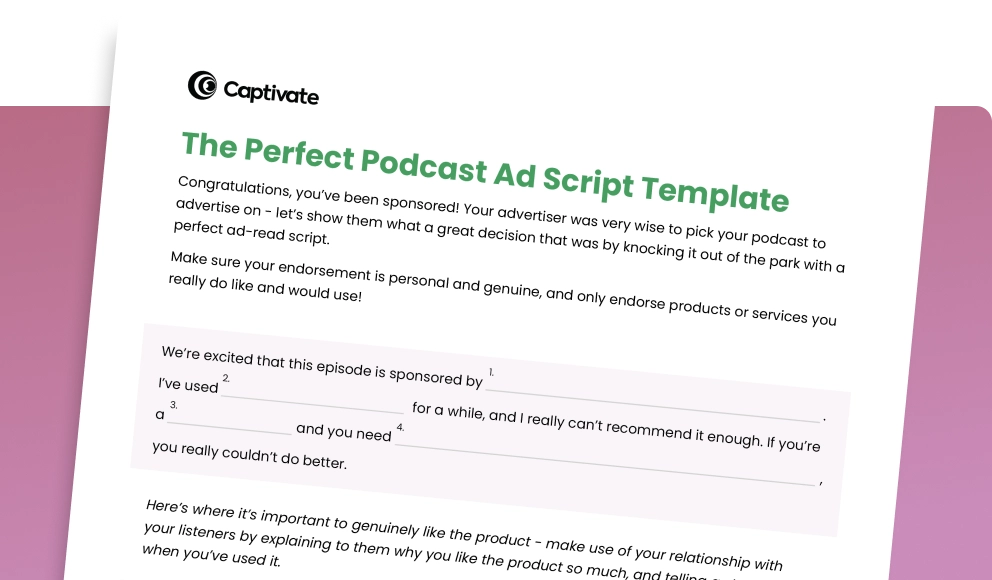
Podcast Ad Script Easy-To-Implement Template

Download The Perfect Podcast Ad Script Template right now,
for free!

"*" indicates required fields

100% secure. We never share your email

How to measure ROI on podcast advertising

There are a few different ways to measure the return on investment (ROI) of your podcast advertising, such as:

  • Promo codes – this is the most common method and involves the host (or brand, depending on how the ad was recorded) sharing a code with listeners to get a discount or free trial, this promo code can then be measured.
  • UTMs – Urchin Tracking Module (UTM) codes are small snippets of text that are added to the end of a URL so that performance can be tracked.
  • Captivate Affiliate Links – this is the easiest way. Set up an affiliate link in Captivate, insert the destination URL and create a short, branded and memorable link to include in show notes, social media posts etc. All affiliate links are measured in Insights in Link Analysis
  • Post-Conversion Surveys – after a conversion, you can do a post-conversion survey, where you ask a simple question, “How did you hear about us”. This is another way to track conversions.

Measuring ROI is important, especially if you want to retain your advertisers. You can also use ROI data for previous advertising campaigns as a reference when pitching to new sponsors.

Tips for getting advertisers on your podcast

  1. Know your audience 

    You need to know exactly what your demographic is in order to pitch successfully to advertisers – you’ll have far more success if you can prove to them that you’re both interested in reaching the same audience. A great way to do this is to understand your podcast’s listener avatar.

  1. Pitch sensibly

    Knowing your audience is half the battle – you then have to apply that knowledge. So, if you’re a dental podcast, you’d have more luck pitching to advertisers in the dental industry than, say, car dealerships. Think about the relative size of your podcast and the company you’re pitching to, as well. If you’re an indie dental show with a thousand monthly listeners, probably don’t pitch to Colgate – they’re too big a fish. You’d have better luck with a company on a similar scale to your show.

  1. Use Captivate’s Sponsor Kit

    We make it as easy as possible for you to get a successful sponsorship – our one-click Sponsor Kit presents all the necessary details about your show in a professional, accessible format. It’s like a media pack specifically for your show, showing your listenership stats and more and lending you the credibility of a proper designer. Read more about Captivate’s free Sponsor Kit here!

  1. Do your research

    Who are you pitching to? What is important to them? What are they passionate about? Find out what matters to them, causes they have supported, and tailor your pitch.

  1. Persistence – don’t give up

    If you get a no, or no answer at all, don’t give up. It may take time before you successfully pitch and get yourself a brand that wants to advertise with you. It will take a few no’s, or ignored pitches but don’t give up. If a brand doesn’t answer the first time, don’t be afraid to follow up.

  1. Use your connections

    Go through your existing connections. You may know someone who works for or is connected with a brand that you would love to have as a podcast advertiser. Ask them to do an introduction on your behalf and get the ball rolling.

  1. Look for affiliate opportunities

    There are loads of companies that offer affiliate programmes. Check out your favourite products, tools, brands and services. Do any of them offer an affiliate programme that they are advertising on their website?

  1. Sell your podcast!

    Most brands will ask about your download numbers, but make sure to include all the other reasons why your podcast is worth sponsoring. Maybe you don’t have huge download numbers, but you have an extremely engaged audience – show this to the advertiser with evidence of your social media following and UTM data from your previous ad campaigns.

Common podcast advertising mistakes to avoid

Let’s look at what not to do with podcast advertising.

Not researching your audience

As we mentioned above, having a clear picture of who your audience is and what they’re interested in will significantly raise the likelihood of your advertising pitch being successful. Even if you do somehow get a sponsor on board without showing how your demographics interlink, whether that’s through your incredible numbers or sheer charm, they probably won’t stick around for long as your conversion rate will be rubbish.

Listeners who are presented with ads which aren’t relevant to them won’t be rushing to spend their money on that product, the sponsor won’t see enough return on their investment, and they’ll walk. Research, research, research!
Another article we think you'd like...

Reading Time: 8 minutes Four of Captivate’s advisors lend their experiences of podcast sponsorship, lend advice and tell you what to do when securing sponsors for your podcast.

Going overboard

Would you watch a television programme with an advert break every 5 minutes? No? So don’t fill your podcast to the seams with advertisements! Be sensible with it: stick to one or two adverts per episode, or you’ll quickly ruin the trust and credibility you built up with your audience over your podcasting career.

Poor execution

If you, the podcast host, are reading the advertisement out as a testimonial, make sure you have a clear, direct and easy-to-follow Call To Action (CTA). This means you spell out exactly what the product or service is, why your listeners would want it and how they access it. Regarding the last point, always include a link in your show notes to your advertiser’s product and let listeners know it’s there!

Poor advert placement

We’ve already discussed the pre-, mid- and post-roll sections in which you can put your podcast adverts, so we’ll keep this nice and brief: don’t put the adverts in an awkward place. If you’re dynamically inserting your advertisements, make sure it’s during a natural break in your flow, not in the middle of a sentence, story or word. Listen back and make sure the ad feels natural.

Not measuring performance

With advertisers and businesses in general, it’s all about the bottom line. They’ve got to be able to justify spending money on placing ads in your show, and you can make that nice and easy for them by tracking!

We touched on UTMs above, but basically, they’re an easy way of tracking clicks on a given URL. When you’re including a link to your sponsor’s product in your show notes, using a UTM for that link allows you to empirically prove to that sponsor that your listeners are clicking through to their products, and how many of them are doing it. This makes it far easier for them to see what they’re getting for their money.

Advertise on a podcast yourself

Advertising on other podcasts is an effective way to grow your own podcast. Bear in mind the lessons we’ve learned above – when selecting a podcast to advertise on, don’t just consider download numbers and make sure to measure your ROI. Consider other factors, like the overlap of your topic and intended audience with theirs and how engaged their listenership is. Advertising on a podcast can really give you a boost!

If you’re looking to advertise your own podcast, consider offering a trailer swap with the show you’re looking at rather than a straight monetary transaction – even if you don’t have a budget, you still have something to offer in the form of your own engaged audience.

Podcast Advertising Terminology

Glossary of podcast advertising terminology

  • CPM: Cost Per Mille. Refers to an advertiser paying per thousand impressions the ad makes.
  • Impression. An advert being seen or heard by a listener.
  • CPA: Cost Per Acquisition. Refers to an advertiser paying every time an advertisement results in someone actually buying their product or service.
  • Pre-roll. The intro section of your show.
  • Mid-roll. The main body of your show.
  • Post-roll. The outro section of your show.
  • Dynamic Ads. Ads that can be inserted and changed via an ad insertion engine. These allow you to swap out ads across your old episodes.

Podcast Advertising FAQs

How much does it cost to run an ad on a podcast?

There’s no single answer to this – it will cost a different amount for a sponsor to advertise on Joe Rogan’s podcast than it will on your neighbour Bob’s. It’s not even just about your audience size – if you’ve got a small, engaged audience in a particular niche you can still make good money on advertising. Start pitching to sponsors, see what they offer and ask other podcasters in your niche. We’re a friendly bunch!

How much should I charge for pre, mid and post-roll ads?

We’d echo the above answer – it’s best to do some market research on your own niche, as it’s totally impossible to give an answer that will be suitable for every podcaster!

How long are podcast ads?

The quicker the details of an advertisement can be accurately conveyed, the better – you don’t want to be taking up too much of your listeners’ time, they’ll just tune out. Try to keep your ads under a minute.

Can you have more than one podcast ad running at the same time?

Yes, you can have more than one sponsor at a time and mention them both in an episode.  This is very common. The only reason you wouldn’t be able to have multiple ads is if you’ve signed an exclusivity agreement with a particular advertiser.

Takeaway

Podcast advertising is a fantastic way to monetize for podcasters, and a large, engaged market for advertisers. Podcasting is a massive industry already, and it’s only getting bigger – on top of this, podcast consumers are one of the most receptive markets to ads out there.

You don’t have to be a massive show to be sponsored – as long as you know your audience and you can prove to advertisers in your niche that you’ll be able to get them sales, you’ll be sponsored in no time. When you do, make sure to respect your listeners and not constantly bombard them with ads, and they’ll pay that respect forward with trust in your recommendations.

Make sure you’re working with advertisers who are interested in the same target audience as you – you’ll have far more success in actually getting a sponsor, and your listeners won’t get hit with irrelevant ads. Keep these tips in mind and you’ll be making money before you know it!

Podcast Ad Script Easy-To-Implement Template

Download The Perfect Podcast Ad Script Template right now,
for free!

"*" indicates required fields

100% secure. We never share your email