





Reading Time: 10 minutes
Unsure what dynamic content and ad insertion or DIA means in podcasting? Maybe you’ve heard people in the industry talking about it but have never been 100% what it means. Don’t fret, we have your back. This article will explain what it is, how to use it for your podcast and the main benefits.
AMIE Module 2.0 is live in the Captivate dashboard! Insert three pieces of content for each pre, post and mid-roll slot, plus our DAX integration. Watch the explainer video:
As a serious independent podcast creator, it’s important that you have a full toolkit available to help grow your audience, monetize, simplify workflows and make certain processes quicker and easier. Dynamic content and ad insertion is a great example of this.
Great question!
With dynamic insertion, podcasters can make edits to new or already published episodes, without having to re-record. This could be used for:
Ads: You can swap out advertisements and sponsor messages across your catalogue, either in bulk using predetermined slots like pre, post and mid roll or by actually painting over and changing your recorded, baked in content.
Content: If you want to update an episode as the information has changed, you can use our Ad Painter to select a section of your recorded episode and replace it with something else. It’s so easy!
In short: with dynamic content and ad insertion, or DAI, podcasters can easily make edits to new and existing episodes, to make sure the content is up to date, without having to record the whole episode from scratch.
Podcasters can mark areas within episodes (pre, mid and post roll), where dynamic content and advertising can be inserted using a piece of software. For Captivate users, this free piece of software is called AMIE (more on this later). As its pulled in dynamically, even episodes that are already published can be updated. There’s many situations where this comes in handy, and not just for advertisers and sponsors (again, more on this later).
To better understand dynamic content or ad insertion, let’s talk about content or ads that is “baked-in”.
“Baked-in” refers to the practice of advertisements, sponsorship messages or other content segments being read out by the podcast creator during the recording of an episode.
Once published, these are then ‘baked-in’ parts of the audio and removing or replacing them typically involves re-recording and/or re-editing the entire piece of content, a time-consuming process that is often too cumbersome to achieve and hinders monetization opportunities for audio creators.
For example, a podcaster might secure a deal with a local or niche sponsor to partner with them on four episodes and where the podcaster sells them a “pre-roll” and a “mid-roll” ad slot per episode.
The podcaster will then agree on a script and a call to action with the sponsor (usually asking the listener to go to a page on a website) and, as the podcaster records their episode, they’ll read the scripts at the relevant places whilst doing the recording.
They then go ahead and publish that episode as normal and the ads are “baked-in” to the audio content.
This is a really common way that serious independent podcasters make money: they’re leveraging their audio influence to close a deal and then offering a host-read advert, or multiple adverts, in their content.
Having content that is “baked-in” doesn’t really give podcasters much flexibility, as that content will stay there, unless you re-record and then re-edit. This is where dynamic content and ad insertion comes in to save the day, as rather than baking certain messages into the content, you are dynamically inserting the content, which can be changed if needs be!
We’ve mentioned pre, mid and post roll a couple of times, but what do we mean?
When it comes to sponsorship and advertising, this is usually sold in “slots”. A “slot” is a location within your episode where an ad will appear. In the podcasting world, slots are usually called pre, mid or post roll.
Other types of content can also be dynamically inserted pre, mid or post-roll, maybe you want to tease content of other episodes, ask listeners to find you on social media, shout about an event you’re involved with etc. The options here are endless!
There’s a little flexibility in these terms that you might come across, too.
For example, a true pre-roll plays before any other content but for a podcaster who sells ads themselves and reads them out (either baking them in or dynamically inserting them later), they may class an ad within the first few minutes as a pre-roll because it comes before the main content of the episode.
The same goes for post-roll: where true post-roll plays after all other audio has finished, a podcaster who has sold a post-roll ad to a sponsor directly may class an ad after their content, but before their outro, as a post-roll.
The important thing to remember here is that there is no right or wrong or need to worry about that jargon too much, you’ll work with sponsors and ad partners to make sure that the ads are in the right place.
Speaking of jargon, there is one more acronym that you need to know:
Reading Time: 8 minutes Four of Captivate’s advisors lend their experiences of podcast sponsorship, lend advice and tell you what to do when securing sponsors for your podcast.
For example, your podcast receives 5,000 downloads per episode within the first 28-days of its release. A sponsor is willing to pay $30 CPM (aka, $30 for every one thousand downloads) per ad slot. You have one ad slot in your episode and so that advertiser will pay $150 per episode. You’ll then probably give a little to the ad partners as commission and make a fair sum for that episode.
Note: average CPM rates vary so much in podcasting and change so frequently, I have used this as a fairly realistic example. Also note, not all advertisers pay the same rates nor are ad locations valued the same (e.g. a pre-roll is usually more expensive than a mid-roll, and a mid-roll is more expensive than a post-roll).
Ad partner adverts and even agency ad partners (discussed below) are priced like this, but if you’re selling your own advertisements you don’t necessarily have to stick to this method of valuing your audience.
Many serious independent podcasters understand their value as audio influencers in a tight niche and sell their sponsor slots on a fixed-price basis regardless of downloads.
You may decide, for example, that you’d like to generate $500 per episode and offer two ad slots (maybe a pre-roll and a mid-roll), so you decide to find direct sponsors and sell each slot at $250 regardless of the number of downloads you receive per episode.
This is really common for podcasters with smaller numbers but who have generated really loyal, passionate audiences in a tight niche.
Don’t be put off by the download numbers required to make CPMs work for you, they don’t have to be the only way that you make money podcasting.
"*" indicates required fields
100% secure. We never share your email
Using a podcast hosting platform like Captivate and its AMIE (audio monetization and integration engine) technology, you simply upload your podcast, as usual, set your normal publishing preferences (date & time, any episode cover art, etc) and then use a waveform that has been generated from your audio to tell Captivate where to insert content dynamically and what content to insert.
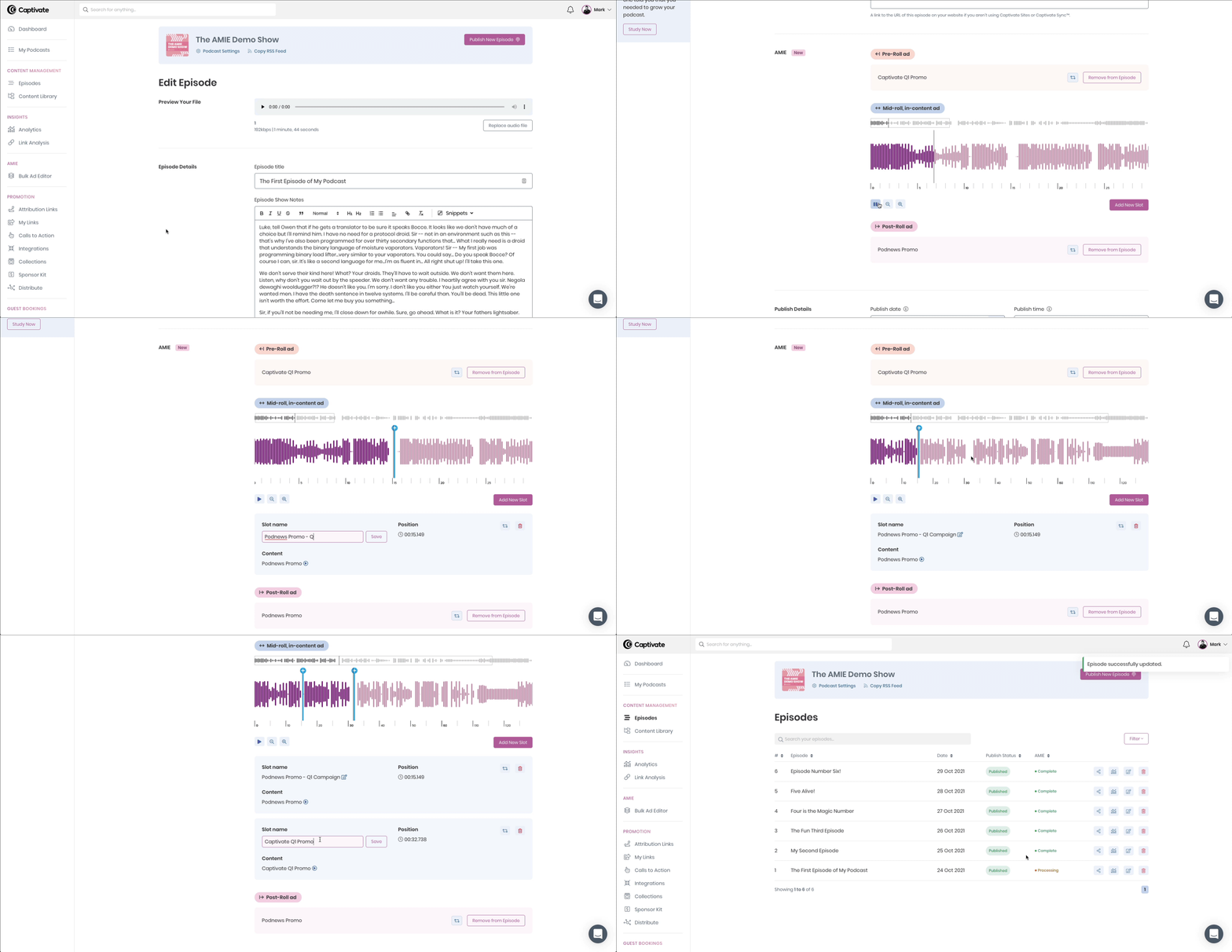
There are three places that dynamic content and ads come from:
You can also build campaigns with specific parameters (types of ad, dates to run the ads for and financial settings) that gives you a true sense of “dynamism” with your podcast monetization.
As much as you like, and you can choose whether each slot inserts content that you have uploaded yourself or an ad that comes from an ad partner like DAX.
Ads can be chained together to follow on from each other or, in the case of mid-roll (remember, that’s “in-content”) adverts, can be inserted at various points throughout your episodes.
The important thing to remember when it comes to advertisements in your podcast, though, is that your job is to create an enjoyable audio experience for your listeners. Too many adverts and even poorly placed ads can detract from that experience so be wise with your use of dynamic ad insertion.
While it is great for inserting ads, there are so many creative ways to use dynamic content insertion to make your workflow even easier. Here are some examples!
AMIE’s ad painter allows you to essentially overdub sections of your audio file – this means you can update any aspect of your episode or correct a mistake without affecting your episode analytics or having to reupload. Nice!
Got a new show, course, website or merch? You can dynamically insert a pre, post or mid-roll advert across your entire back catalogue to promote your new content. You don’t need a sponsor to use our innovative content insertion tech.
Bored of saying the same podcast introduction for every episode? Simply create your perfect podcast intro, complete with music, notables and CTAs, upload it to your content library and set it as your default pre-roll. It will then be automatically inserted before all of your podcast episodes. The same applies to your outro – just set it as your default post-roll.
AMIE is Captivate’s dynamic content insertion technology.
Standing for “audio monetization & integration engine”, AMIE is a complete suite of dynamic content tools that are included for free on every Captivate plan.
Captivate’s dynamic content insertion technology allows you to easily manage all elements of your dynamic content choices from one, simple interface. AMIE gives you the ability to manage pre-roll, mid-roll (in-content) and post-roll content within individual episodes and en masse across your whole podcast catalogue.
When developing AMIE, we knew that being able to manage pre & post-roll, mid-roll slots and even the ability to ‘paint and replace’ baked-in advertisements was vital to the busy, working podcaster like you.
Captivate’s innovative “Ad Painter” allows you to identify and ‘paint’ the regions of audio where baked-in ads exist within an episode and, either individually or in bulk, replace them with new content that Captivate seamlessly “stitches in” to the existing episode.
We also made it really easy to bulk manage all of your content, from pre and post-roll to mid-roll, across your entire episode catalogue using Captivate’s bulk ad editing tools.
Dynamic content insertion doesn’t have to be complicated and it certainly should not be reserved for the “big” podcasters or those who try to keep podcasting complicated.
Reading Time: 8 minutes Four of Captivate’s advisors lend their experiences of podcast sponsorship, lend advice and tell you what to do when securing sponsors for your podcast.
All podcasters should have access to a diverse range of podcasting tools to help them to grow and monetize their audio influence. Captivate’s core mission is to help the serious independent podcaster to achieve just that.
Check out our help articles which go into more detail about AMIE. For example, we have answered common AMIE FAQs and have a collection of articles that cover different aspects of AMIE.
With dynamic content insertion, you can swap out advertisements across your whole back catalogue with a single click, edit baked in content on your live episodes and automatically set your sponsor for future releases.
AMIE makes it easy to offer sponsorship of your whole podcast catalogue to advertisers for a given period of time, then change the sponsor when that period is up. Captivate podcasters get access to this ground breaking tool for free, changing the game with monetization and allowing you to update your episodes without having to re-record and lose your analytics.
Dynamic insertion makes it easier for podcasters to edit published episodes, giving you more flexibility and opportunities. You can change the advert played during a podcast episode when the sponsorship period is over, meaning that you can offer sponsorship of your entire back catalogue to advertisers, and you can overdub sections of your episode with our Painter tool to edit any outdated references or data.
Absolutely, and the testimonial of a trusted podcaster is likely to go far in the minds of your listeners! One study in 2022 found that 65% of podcast listeners paid attention to adverts, which is very high compared with TV at 39% and radio even lower at 38%. Spotify took this research further and found that 81% of podcast listeners take action as a result of listening to an advert.
Yes – dynamic ads cost you nothing to set up, and are super easy from a technical perspective, taking only a few clicks. They add value to your sponsors, allowing them to sponsor your whole catalogue, for very little effort on your own behalf.
Not for a podcaster, but you’ll be able to sell whole-show sponsorship using dynamic ads for a lot more than you’d be able to sell single or just future episode sponsorship.
You’ll be prompted to insert pre, post or mid roll ads whenever you’re uploading or editing an episode in Captivate, and it only takes a few clicks.
It’s completely up to you – if you feel like you want to re-do your whole episode, Captivate allows you to change the audio file without losing your analytics. If you just want to change a specific part, though, it’s way easier to just use our Painter tool to select the part you no longer want and to replace it with a new audio file, basically allowing you to overdub your episode to your heart’s content.
Yes, you can change or delete your AMIE ads en masse with the Bulk Editor using Tagged Ad Content, allowing you to swap out advertisements across your whole catalogue with a few clicks!
"*" indicates required fields
100% secure. We never share your email
此内容由惯性聚合(RSS阅读器)自动聚合整理,仅供阅读参考。 原文来自 — 版权归原作者所有。