


Reading Time: 11 minutes
For nearly twenty years, podcasting has relied upon RSS to function, thrive and grow. As podcasting continues to evolve, “Podcasting 2.0” seeks to evolve the central technology behind our medium: the RSS feed.
Podcasting 2.0 has been developing through its infancy, but as the initiatives which constitute it have started to mature and become more useful to serious independent podcasters and more widely adopted by the industry, we’ve been keeping a close eye on them, getting involved in developing them and working hard to consider the best way to implement them to help to advance RSS, but, just as importantly, to advance, balance and continually improve your podcasting experience.
We’re delighted to announce a major rollout of Podcasting 2.0 features – all of them with the thoughtful Captivate user experience and all of them implemented with a deep focus on helping you. Captivate is one of the world’s leading hosts supporting Podcasting 2.0 features and we’re delighted to continue to help you, our friends within other hosting companies, and the wider industry so that we can all make the medium that we love more functional, robust, and open.
RSS (Really Simple Syndication), is the driving force of podcasting and has been since audio files were first wrapped up in a feed and delivered via RSS all those years ago.
An RSS feed is an XML file that is easy for a computer to read and that is made up of “tags”. A tag contains information, such as the name, the “author” and the website of the podcast, plus the location of audio files that should be associated with episodes and delivered to a listening device such as your phone. An RSS can be used for delivering all sorts of data, from blog posts and news updates to, of course, a podcast.
A podcast hosting company like Captivate has RSS at its core: building your feed and making sure that it is distributed to the listening apps (Apple, Spotify, Global Player, etc) and measuring the downloads that come via that feed.
Remember this: an RSS feed is made up of “tags”, and “tags” hold information that can be read by apps. When we add tags to RSS feeds, we expand and enhance that RSS feed and, if an app chooses to support the behaviour that a tag is designed to provide, we can also add “features” to a listener or creator podcasting experience by creating new “tags” that become standardized.
“Podcasting 2.0” is most commonly thought of as the collaborative development of new “tags” for RSS feeds that bring new features to podcasting.
From here on, it’s great to think of “Podcasting 2.0 ‘tags'” as “Podcasting 2.0 ‘features'” and, as a new tag may be added to your RSS feed, a new feature may be “unlocked” that you can use within your show and, if supported, symbiotically by the apps.
We’ll run through some examples later but first, let’s go back in time a little.
Podcasting has been around since 2004 and was advanced by Adam Curry (a former MTV VJ) and Dave Winer (a software developer).
Adam and Dave wanted to find a way to download online radio broadcasts to an iPod (for the younger generation, an iPod was the revolutionary flagship portable media player released by Apple in 2001 – and we can’t believe that it’s old enough to have to explain, wow).
The term “podcast” is a portmanteau of the two words: “iPod” and “broadcast”.
In the early days, Adam and Dave used an RSS (Really Simple Syndication) aggregator software and iPodder (a program invented by Adam), to extract audio files and transfer them to an iPod so that they could be listened to.
Since 2004, the basics of the technology and how podcasts work haven’t changed a great deal. Today, each episode of your podcast has an audio file and information about each episode, plus “high-level” information about your podcast (e.g. the show name, your name, etc) and all of that information is wrapped up in that readable format from earlier: your podcast’s RSS feed. Directories such as Apple and Spotify use this RSS feed to make your podcast searchable and accessible on their platforms so that people can search for, discover and listen to your podcast. This is why, sometimes, your new episode can take a little while to appear within search results or directory listings – Apple, Spotify and the other directories may not have “read” your RSS feed since you last published an episode.
When someone presses “Follow” within a listening app, they are “following” (formerly “subscribing”) to your RSS feed directly. This is why, regardless of whether your new episode appears within search results or the Apple/Spotify listing, if someone has pressed “Follow” on your podcast, they very quickly get your new episode.
RSS worked, and continues to work, wonderfully for podcasting.
But podcasting has gone through some teenage years and, as with everything tech, advancements develop that allow us to do new things. Advancements directly related to RSS help to “enhance” your RSS feed and, whilst they aren’t fully supported by every single listening app yet (Apple Podcasts, for example), they are helping to push the medium forward.
In simple terms, Podcasting 2.0 is used to describe a collection of initiatives with the aim to advance podcasting technology and the industry. There is another aim: to keep the podcasting ecosystem as open and inclusive as possible. More on this later in the blog.
Because of the way that Podcasting 2.0 features (tags, remember) enhance your podcast and because podcasting should remain simple as tech-jargon-free as possible, we chose to group these new features and their associated settings as “RSS Enhancements powered by Podcasting 2.0” within your Captivate podcasting dashboard.
To recap an important point:
New tags are always being created, and if they’re beneficial to podcasters then they can become part of a Podcasting 2.0 release that turns those tags into supported “features”.
Hosting companies such as Captivate can then choose to make these features available to your RSS feed, regardless of if there is wide symbiotic app support for them upon release or not. Chicken… egg…
Remember: a tag provides information that apps can use to build features. If your RSS feed contains information within a specific tag, then an app developer can build a feature that respects that tag and the information within it to enhance the listener or creator experience.
This is important to continually remember: tags = features.
Reading Time: 8 minutes Learn everything you need to know about YouTube’s RSS upload tool, including how to use it and how it can help increase your podcast’s discoverability.
Podcasting 2.0 has been spearheaded by Adam Curry, who you’ve already met, and Dave Jones, a systems administrator, and programmer. They also founded Podcast Index LLC, which aims to cover expenses such as the hosting and promotion of Podcasting 2.0 initiatives. They are different entities albeit with the same, passionate team involved in them.
Podcasting 2.0 is a truly open-source, community-owned initiative. If you’re a podcaster, you’re part of it!
There are quite a few initiatives. Some are fully operational and being used by podcasters, hosts, and apps, whereas others are still in their early stages e.g. industry professionals like us and passionate podcasters are still discussing their merit and whether they warrant further development.
There are four main initiatives that are widely considered to be part of the Podcasting 2.0 movement and that are up and running:
In computer terms, an “index” is a directory that is, usually, continually maintained and contains information about the things that it indexes. Google search is an index and YouTube’s search is an index, for example.
The Podcast Index is exactly what it says on the tin: an index that contains all available podcasts with RSS feeds.
Remember earlier in the blog when we said that one of the aims of Podcasting 2.0 was to keep podcasting open?
This is why The Podcast Index was born: Apple Podcasts had become the go-to index for podcasts – the vast majority of podcasting apps would use Apple’s index to find podcasts and to populate their own search listings for listeners to browse.
Apple, a single company, had a lot of control, with no opportunity for others outside of Apple to have their say and with no real disclosure about how their system worked.
Adam launched The Podcast Index to “preserve podcasting as a platform for free speech”. This index is an open directory of podcasts that anyone can submit to, and that any app can search. The idea is that app developers will use this less centralized index, rather than Apple’s more proprietary index. Obviously, developers can still choose not to show certain content and podcasts, which is important, but that doesn’t remove it from the index altogether. There’s no total censorship.
The Podcast Namespace is where things start to get more technical. So, we know podcast RSS feeds are documents that contain podcast data and episodes, tags can be added to these feeds which are read by computers to get information about the show or each episode and that can be used to bring features to users.
For example, something you’ll be familiar with from the web is the <a href=””> HTML tag, which turns text into a link or URL, and for podcasts, the <enclosure> tag tells a podcast listening app where each of your podcast episode’s MP3 or audio files can be located so that the app can play that file when your listener presses play.
The same with the “author” tag within your RSS feed: you enter your author name to your Captivate hosting dashboard, Captivate then puts that information into the right tag (the right “place”) within your RSS feed and listening apps such as Overcast read that tag and place your name in the place that they choose within their app. They can also use that tag to allow listeners to search for all podcasts where you are the author, which is a feature of the app.
Which tags get created as part of Podcasting 2.0 and become “production” tags is agreed by a collection of people. You have technical people like us, James Cridland, Daniel J. Lewis and our friends at Blubrry and Libsyn coming up with tag ideas, and then the people who will implement or use the tags such as hosting companies and listening app developers.
This collection of tags is called the Podcast Namespace.
Tags only work if they’re symbiotically respected.
For example, if your contains the tag “podcast:live”, this means that you can add a livestream location to your podcast hosting dashboard which, in turn, will be added to this tag on a per-episode basis and used within your RSS feed. A listening app could read this tag and use it to add a feature where a “Press to View Livestream” button appears when you’re running a live taping of your show.
This is a great example of a good idea that is not too widely supported by apps, yet. Very few support it but we know that will change!
Podping helps directory apps pick up updates to podcasts and feeds quicker than traditional RSS crawling (which relies upon the listening app, say Apple Podcasts, using its own schedule to come by and check your RSS feed for new episodes – which is why your new episodes don’t appear in directories instantly).
Instead, Podping uses something called Hive Blockchain, and allows podcast hosting platforms to send out notifications instantly that a podcast feed has changed.
Best of all, Captivate supports it, and if the app that your listener listens on supports it, too, that symbiotic relationship exists and the listener experience is greatly enhanced by this feature.
Value-for-Value is a way for podcasters to receive payments directly from listeners via bitcoin. It has been designed to facilitate quick transactions and micropayments. Messages can also be sent with a boost which is called “boostagram”.
As with much of the crypto world, this has its advocates and its detractors and is worth looking into more if you’re on the more “cutting-edge” side of tech.
Podcasting 2.0 is developing through its infancy, and many podcasters won’t even be aware that it even exists, let alone what it is and why it matters.
Yes, it’s good for podcasters to be aware of Podcasting 2.0, and there are some great, well-intended initiatives, but they need buy-in from media hosts and app developers. More and more hosts are adopting Podcasting 2.0, and Captivate is one of the hosts that is leading the way, but there are some challenges and things to take into consideration.
Reading Time: 4 minutes Spotify’s 2023 Wrapped for Podcasters is officially here. Learn what it is, how to access it and how to use the data to grow listeners today!
For example, is it realistic that Apple will adopt and use something they didn’t help create? Who knows. Plus, there are other methods for ingesting podcasts into more closed ecosystems, such as direct API ingestion (Anchor -> Spotify) that don’t need RSS feeds.
Independent listening apps are more likely to adopt and embrace Podcasting 2.0, but they tend to cater to a niche community of listeners, rather than the mass market. This is something to bear in mind: we would need the vast majority of independent podcast listening apps to adopt these features to even make a tiny dent in the podcast listening app market share that includes Podcasting 2.0 features.
Podcasting 2.0 opens up the part of the podcasting industry where the majority of creators sit, decentralizes power and control, and allows for more widely-adopted standards for hosts and listening apps, but there is a long way to go – it’s vital to remember that the evolution of the podcasting industry is a long-term journey and our job is to balance support for features with the experience of podcasters, listeners and the open ecosystem.
Captivate is one of the leading podcast hosting platforms to support Podcasting 2.0. We’re all seasoned and passionate podcasters, and we’ve been excited about these features since Podcasting 2.0 first began creeping into the psyche of the industry.
We’ve taken a measured approach to implement Podcasting 2.0 features: with all new technology, there is a portion of people clamoring for it and a majority of people unaware of it. As a hosting company that puts clarity and communication with our podcasters first, it has been important to not overwhelm busy podcasters with the worry that “this is just one more thing to think about”.
We believe that many of the Podcasting 2.0 features are now mature enough and that podcasters are aware enough of the initiative for us to implement an even wider range of these initiatives whilst not burdening you, the hard-working podcaster, with concern about more work.
We’ve worked hard to adapt the features and we’re proud to be releasing a cutting-edge, secure 2.0 feature set that will tangibly benefit podcasters like you.
Captivate previously supported the following Podcasting 2.0 features:
and we have added the following:
Shortly, we’ll also be releasing full and well-designed support for the following as part of some new podcast marketing tools:
For the more technically minded, we and other industry thinkers contribute to the Podcasting 2.0 GitHub, which you may find of interest.
How to find Podcasting 2.0 within your Captivate dashboard
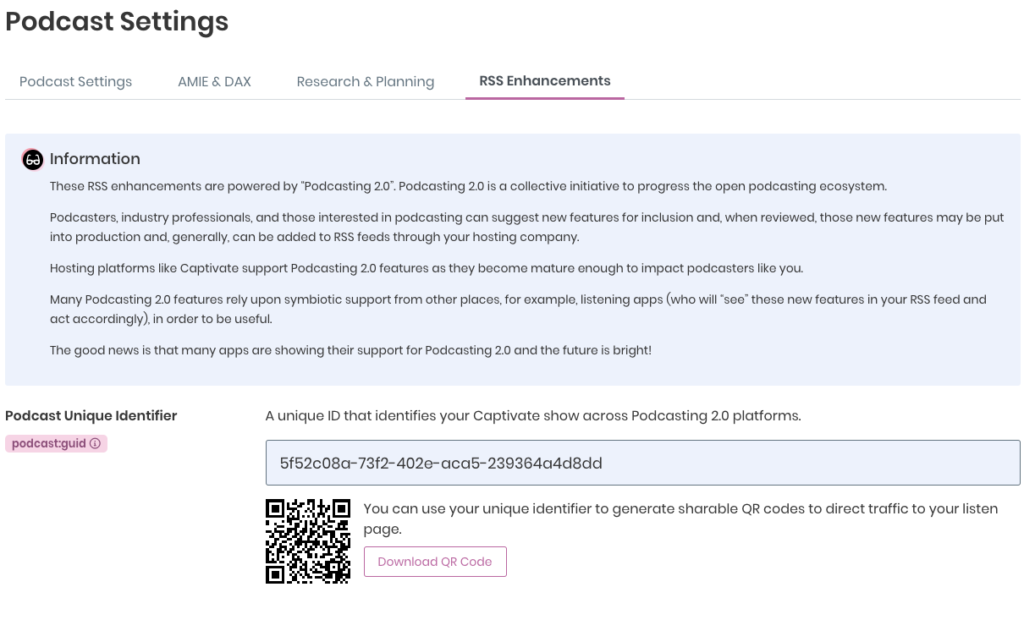
When logged into the Captivate dashboard, head to ‘Podcast Settings’ and then the ‘RSS Enhancements’ tab. The RSS enhancements are powered by Podcasting 2.0.
Captivate supports a wide range of Podcasting 2.0 features and we’ll continue to add more that are beneficial for podcasters. However, we do fully support our friends in the hosting space who continue to drive forward this initiative and give shout-outs to Blubrry and our friend Todd Cochrane for embracing the space, in particular.
More and more apps are showing support for Podcasting 2.0, and adoption and adhering to these tags will only improve in the future.
It’s still early days for Podcasting 2.0 – yes there are some great initiatives, some more mature than others, and we’re seeing more and more hosts and apps supporting it, but it is still a developing set of standards.
It takes both podcasting hosts and apps to support Podcasting 2.0. Podcasters can make tags available in their feeds via a host, but apps that are reading the feeds need to support these features by also reading and adhering to the tags.
As Podcasting 2.0 gets more mature, no doubt more podcasters, hosts and apps will adopt it, but that will take time. Most podcasters won’t have even heard about Podcasting 2.0, let alone what it is, how to implement it, and the benefits it may bring for their podcast.
We’ll continue to support Podcasting 2.0, and make tags and initiatives available in our dashboard, that have an impact on our podcasters.
Captivate users, log into the dashboard and navigate to the ‘RSS Enhancements’ tab underneath ‘Podcast Settings’, and check out Podcasting 2.0 features that you can add to your feed.
There’s explainer text for each feature, so you know what you’re adding to your feed, and what it will do.
If you want to find out more about Podcasting 2.0, check out the Podnews Podcasting 2.0 show hosted by Adam Curry and Dave Jones.
此内容由惯性聚合(RSS阅读器)自动聚合整理,仅供阅读参考。 原文来自 — 版权归原作者所有。