
惯性聚合 高效追踪和阅读你感兴趣的博客、新闻、科技资讯
阅读原文 在惯性聚合中打开

推荐订阅源

Cisco Talos Blog
Cisco Talos Blog
V
V2EX
C
Check Point Blog
GbyAI
GbyAI
D
Docker
Cyber Security Advisories - MS-ISAC
B
Blog RSS Feed
H
Hackread – Cybersecurity News, Data Breaches, AI and More
N
Netflix TechBlog - Medium
T
Troy Hunt's Blog
博客园 - Franky
Threat Intelligence Blog | Flashpoint
Microsoft Security Blog
P
Privacy & Cybersecurity Law Blog
WordPress大学
WordPress大学
The Cloudflare Blog
S
SegmentFault 最新的问题
Latest news
Latest news
Microsoft Azure Blog
P
Proofpoint News Feed
I
InfoQ
博客园 - 【当耐特】
NISL@THU
NISL@THU
A
About on SuperTechFans
T
Tailwind CSS Blog
酷 壳 – CoolShell
酷 壳 – CoolShell
The Hacker News
The Hacker News
奇客Solidot–传递最新科技情报
奇客Solidot–传递最新科技情报
Scott Helme
Scott Helme
雷峰网
雷峰网
C
CXSECURITY Database RSS Feed - CXSecurity.com
Security Latest
Security Latest
V
Vulnerabilities – Threatpost
Security Archives - TechRepublic
A
Arctic Wolf
Hacker News: Ask HN
Hacker News: Ask HN
N
News and Events Feed by Topic
IT之家
IT之家
cs.CL updates on arXiv.org
aimingoo的专栏
aimingoo的专栏
T
Threat Research - Cisco Blogs
OSCHINA 社区最新新闻
OSCHINA 社区最新新闻
阮一峰的网络日志
阮一峰的网络日志
SecWiki News
SecWiki News
大猫的无限游戏
大猫的无限游戏
S
Security Affairs
The Register - Security
www.infosecurity-magazine.com
L
LINUX DO - 热门话题
T
Tor Project blog

IDC

IDC On the Ground: Inside GITEX AI Europe 2026's Race to Build Sovereign AI Infrastructure IDC Quanta Launch: The 3-Minute Recap The strategy behind today's launch Dashboards Are Dead: The Future of Business Intelligence Lives in the Workflow Introducing IDC Quanta: The Intelligence Fabric of the AI-Enabled Enterprise How Wearables and AI Will Reshape Healthcare Who operates your meeting rooms now: AV, IT, or an AI agent? Beyond Check-the-Box: Choosing a Security Framework for the AI and Quantum Era DX Software in Transition: AI Investment Trends by Sector Japan's AI Supercycle Is Here — Are You Ready to Lead It? Beyond the Data Dump: Why Cybersecurity Metrics Are Failing, and How AI Fixes It From Wait-and-See to All-In: How SMBs Are Rewriting Their AI Story Your AI Platform Knows the Market. Does It Know Your Business, and Can You Trust It with Your Strategy? Start Here: Six Best Practices for Foundational AI Training Physical AI and Robotics Take Center Stage at Computex Taipei 2026 for Semiconductor Vendors Trump's Quantum EO: What It Means for the U.S. Market The sovereignty conversation vendors need to have - but rarely do Q&A: Your Pipeline Conversion Questions, Answered by IDC Analysts The Intelligence Gap Is Widening. Here's What the Data Says. Anthropic, Trump, and Fable 5: The Dispute That Makes the Case for Frontier AI Studies IDC Quanta: The Next Era of Tech Intelligence The $22.5 Trillion AI Opportunity Why the memory market is still tight: what comes next Indonesia PC Market Grows 9.4% in Q1 2026 Despite Component Pressures But Headwinds Are Building The Dawn of Just-in-Time Software Agent Supplier or Featureware: The Choice Every SaaS Vendor Faces Now SpaceX, Cursor, and the Race to Build the Best Coding LLM in the World NVIDIA Becomes #1 in Datacenter Ethernet Switching as 1Q26 Market Surges 39.8% to $15.4 Billion Wi-Fi 7 Captures 44% of Enterprise WLAN Dependent Access Point Revenue as 1Q26 Market Grows 15.9% to Nearly $2.7 Billion AI Is Ready. Enterprises Are Not. Vendors Need to Fix It. Smart Glasses Surge: The XR Market Is Rewriting Its Own Rules WWDC 2026: Apple’s AI Credibility Test AI Is Making MSPs More Efficient. Here’s How to Share in the Gains. The Dark Funnel: How Answer Engine Optimization is Reshaping B2B Brand Visibility Agentic AI Is Breaking Your ROI Model. Here’s How to Fix It When the Question Can’t Wait: How Kyndryl Delivers Enterprise Intelligence at Speed Why the Grey Market Won’t Disappear in the Middle East and Africa: The Case of Notebooks Print, AI, and the expanded buying committee: highlights from IDC’s Print Executive Dinner in London AI in telecommunications: Why it is becoming an infrastructure priority Do AI Markets Face a Circular Financing Problem? Enterprise Applications Will Determine the Answer. From AI pilots to business value: what EMEA digital leaders are doing differently in 2026 Why India’s PC Market Surged 31.1% in Q1 2026 and What Comes Next PC Market Enters Volatile Territory as Memory Shortage Persists Through 2027 Agentic AI Ecosystems: Navigating the Megatrend That’s Reshaping Enterprise Technology Markets Leaning into disruption: How Perficient delivers real outcomes in an AI-first world Google’s Fitbit Air and Google Health: The Software Platform Play That Matters More Than the Hardware Why Fast and Trustworthy Aren’t Mutually Exclusive in AI Research The Middle East Conflict Just Rewrote the Rules of Business Continuity Ecosystem strategy in 2026: turning AI disruption into partner-led growth Worldwide Smartphone Market to Decline 13.9% in 2026 as Memory Crisis and US-Iran War Constrain Growth The AI Supercycle Has Started. Where Does Asia/Pacific Stand? Devices at Google I/O 2026: Android XR Glasses, Googlebooks, and Gemini Intelligence Why Research Alone Isn’t Enough: The Delivery Problem No One Is Talking About Digital Accessibility in the Workplace: From Compliance to Competitive Advantage When Pinocchio Became a Real Boy: Security Platforms Have Grown Up Plotting a Future-Proof Course: How The Resorts Companies Turned a Decade of IDC Partnership into a Competitive Edge European CISO priorities in 2026: AI agents, platformization, and sovereignty Why IDC Directions Is Coming to Hangzhou — and Why You Should Be There Telcos’ Next AI Revenue Play: Monetizing Orchestrated Digital Infrastructure The Workforce Skills Gap That AI Can’t Solve for Itself The Agent Takeover: What Happens When AI Becomes the Primary User of Enterprise Software The AI Answer Gap: Why Fast Answers and Defensible Ones Are No Longer the Same Thing The Market Every Western Executive Should Be Watching. IDC’s CEO Already Is. Ecosystem Strategy in 2026: Why AI Is Rewriting Partner-Led Growth Anthropic, SpaceXAI, and the New Compute Race in AI Navigating a Market Where the Wrong Bet Has Real Consequences Renuka Drummond Named Top 10 Corporate Counsel Worldwide by OnCon Icon Awards From Labor Arbitrage to Platform-Led Outcomes: How Agentic AI Is Rewriting the IT Services Playbook EMEA IT Market 2026 – Q2 Updates: 5 Key Takeaways on AI, IT Spending and Market Trends Japan’s AI Infrastructure Market Is Heading for ¥1 Trillion and Here Is What Comes Next Asia Pacific IT Spending Outlook 2026: How the Middle East War Is Reshaping IT Budgets From Cost Optimization to Continuity: What IT Buyers Need Now and How Suppliers Must Respond AI as an Organizational Stress Test: What Will Break First in Your Operating Model? Japan’s ¥2.1 Trillion IT Modernization Wave: The Race Has Already Begun Semiconductor Market to Surge Past the Trillion-Dollar Threshold: AI Infrastructure Drives Market Growth Most AI Investments Don’t Deliver Value – Here’s What EMEA Leaders Are Missing Hannover Messe 2026: 7 Insights and 3 Pieces of Advice on Industrial AI, Manufacturing, and the Future of the Factory IDC Directions 2026: The AI Conversation Has Shifted. Here’s How to Catch Up. Coding by Prompt Is Coming to Your Business Units: What CIOs Should Do Next FutureScape 2026: Building Trust, Resilience, and Prosperity in the Agentic Future FutureScape 2026: Charting the Path to Enterprise-Wide Orchestration From Task Execution to Value Creation: What the 2026 Humanoid Robot Half Marathon Reveals About Industry Progress Europe’s AI Story Has a New Problem: It’s Actually Working AI Infrastructure Spending Caps Historic Year at ~$90 Billion in Q4 2025; 2029 Spending to Eclipse $1 Trillion Digital Sovereignty: Why “Sovereign” Is No Longer Enough FutureScape 2026: Navigating the Crosscurrents of Disruption Huawei and Apple Support China Smartphone Market Resilience as Shipments Decline 3.3% in Q1 2026 The Dirty Secret of AI in ITSM: Why Bad Data Wins Every Time Wholesale telecommunications: How platform models are reshaping the market Beyond LLMs: Why AI Strategy Now Requires Multi-Model, Multimodal, and Multi-Agent Architectures It’s a Data Thing: Retail and Restaurant AI Investments Will Miss the Mark if Not Led by Data Modernization Inference to Overtake Training by 2027 – Why Japanese First Movers Are Betting on Sovereign AI Infrastructure The productivity plateau: Why efficiency gains no longer differentiate Why I’m Excited about IDC Directions 2026 GTC 2026: Workstations enter the sidetop era Dispelling the myth of a silver bullet in sovereign AI MacBook Neo: Apple’s strategic play to disrupt the PC market AI sovereignty risk: A five-step agenda for CIOs Data pricing for AI is being negotiated without a stable model From cyber risk to business risk: How CISOs should engage the board in 2026
From Digital Access to Accessibility with AI Enablement
Erica Spinon · 2026-05-01 · via IDC

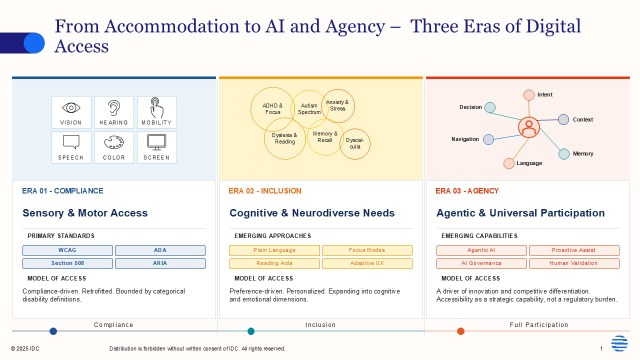
For years, digital accessibility, the practice of ensuring that digital products and services can be perceived, understood, and used by everyone regardless of ability, was treated as a compliance checkbox. That framing is no longer adequate. AI is reshaping accessibility into a strategic capability, one that is adaptive, continuous, and embedded in how people work, interact, and innovate.

As AI-enabled work becomes the norm, accessibility is no longer about supporting a small subset of users. It is about ensuring that everyone, across physical, sensory, cognitive, and neurodiverse dimensions, can fully participate in increasingly digital and AI-mediated environments. In this context, accessibility becomes foundational to productivity, inclusion, and ultimately business performance. Accessibility is also part of company culture: involving disabled and neurodiverse individuals in co-design, not just testing, creates more robust and adaptable systems. Sustaining long-term impact also requires investment in skills and culture, training employees, fostering inclusive design practices, and making accessibility a shared responsibility across teams.
The opportunity: AI as a scaler of inclusion and innovation

AI introduces a powerful opportunity to rethink accessibility at scale.

First, it enables real-time content adaptation. Capabilities such as automatic captioning, transcription, translation, and alternative text generation allow organizations to dynamically tailor content to different user needs. AI can also adjust reading levels, restructure complex information, and personalize interaction styles, supporting a broader range of cognitive and sensory preferences.

Second, AI supports continuous accessibility operations. Traditionally, accessibility has relied on periodic audits and remediation efforts. AI-driven testing tools now allow organizations to embed accessibility checks directly into development pipelines, transforming accessibility into a continuous, iterative process aligned with DevOps cycles.

Third, AI helps democratize innovation. By making tools and workflows more accessible, organizations can engage a wider and more diverse talent pool, including neurodiverse individuals and those historically underserved by traditional work environments. This expands creative input, improves problem-solving, and strengthens organizational resilience.

Finally, AI enables data-driven accessibility insights. Organizations can use AI to analyze accessibility barriers, monitor usage patterns, and measure outcomes, linking accessibility directly to business metrics such as productivity, employee engagement, and customer satisfaction.

Taken together, these capabilities shift accessibility from a cost center to a driver of innovation and competitive differentiation.

The pitfalls: Bias, complexity, and the risk of scaling barriers

Despite its promise, AI also introduces significant risks that organizations must actively manage.

One of the most critical challenges is bias in AI models. Many AI systems are trained on data and designed by teams that lack diversity. This can result in outputs that unintentionally exclude or disadvantage certain groups, particularly people with disabilities or non-standard interaction patterns. Without deliberate inclusion in design and testing, AI can reinforce existing barriers or create entirely new ones. Feedback loops that combine AI-driven insights with real user experiences are essential to countering this risk.

Another risk lies in inaccessible AI-generated content. While generative AI can produce fluent and polished outputs, these may still fail accessibility standards through improper structure, missing semantic cues, or formats that are difficult for assistive technologies to interpret. Auto-generated captions, for example, are often not accurate enough for compliance purposes.

The rise of agentic AI systems (autonomous AI that acts across workflows and applications without direct human instruction at each step) adds further complexity. If poorly designed, they can propagate inaccessible processes at scale, embedding friction into core operations rather than eliminating it.

There is also a governance challenge. As AI becomes embedded across systems, organizations must ensure clear accountability, transparency, and control over how accessibility preferences are handled, how decisions are made, and how user data is used.

Perhaps most importantly, over-reliance on automation can create a false sense of security. AI can scale testing and detection, but human validation, especially by people with disabilities, remains essential to identifying real-world usability issues.

Recommendations: Turning intent into impact

Organizations that want to lead in AI-enabled accessibility should focus on four key actions:

  • Prioritize accessibility as a design principle. Move from reactive compliance to proactive, accessible-by-design systems embedded in AI-enabled platforms and services.
  • Establish proactive AI accessibility governance. Integrate accessibility into AI governance frameworks early, ensuring inclusive workflows and avoiding costly retrofits.
  • Design for workforce adaptability and inclusion. Extend accessibility strategies beyond compliance to support diverse employee needs, including neurodiversity, aging workforces, and varying cognitive styles.
  • Act early to mitigate risk and maximize value. Early investment reduces remediation costs, strengthens trust, and positions accessibility as a strategic differentiator rather than a regulatory burden.

AI is redefining digital accessibility as a core element of how organizations operate, innovate, and compete. Those that embrace accessibility as a strategic priority will not only meet regulatory requirements but also unlock broader talent, improve user experiences, and build more resilient AI systems.

Erica Spinoni

Erica Spinoni - Senior Research Analyst, Worldwide AI-Enabled Future of Work & EMEA Practice Co-Lead

Erica Spinoni is a Senior Research Analyst for IDC’s Worldwide AI Enabled Future of Work practice, where she also contributes with regional expertise on EMEA-specific trends and dynamics. Her research helps technology vendors understand how emerging technologies reshape workforce practices…

Amy Loomis, Ph.D.

Amy Loomis, Ph.D. - Group Vice President, Workplace Solutions

Amy Loomis is Group Vice President for IDC’s worldwide Workplace Solutions.  Amy leads a team of analysts focused on the evolving nature of human resources, skills development, collaboration, and leadership across the employee lifecycle. Her research into the Future of…

Melinda-Carol Ballou

Melinda-Carol Ballou - Research Director, AI Assurance, ALM, Quality & Portfolio Strategies

Melinda Ballou delivers insights into the future of AI assurance, the impact of AI, ML and agentic adoption on agile and digital work, resilience, quality, product and software engineering, the role of technology in business and culture, and the evolution…