
惯性聚合 高效追踪和阅读你感兴趣的博客、新闻、科技资讯
阅读原文 在惯性聚合中打开

推荐订阅源

GbyAI
GbyAI
Simon Willison's Weblog
Microsoft Security Blog
Y
Y Combinator Blog
The GitHub Blog
The GitHub Blog
Engineering at Meta
Engineering at Meta
F
Fortinet All Blogs
OSCHINA 社区最新新闻
OSCHINA 社区最新新闻
A
About on SuperTechFans
Last Week in AI
Last Week in AI
月光博客
月光博客
有赞技术团队
有赞技术团队
P
Proofpoint News Feed
MyScale Blog
MyScale Blog
Martin Fowler
Martin Fowler
钛媒体:引领未来商业与生活新知
钛媒体:引领未来商业与生活新知
C
Check Point Blog
U
Unit 42
The Register - Security
奇客Solidot–传递最新科技情报
奇客Solidot–传递最新科技情报
Cyber Security Advisories - MS-ISAC
Hugging Face - Blog
Hugging Face - Blog
阮一峰的网络日志
阮一峰的网络日志
V
Visual Studio Blog
酷 壳 – CoolShell
酷 壳 – CoolShell
D
DataBreaches.Net
WordPress大学
WordPress大学
aimingoo的专栏
aimingoo的专栏
H
Hacker News: Front Page
Recent Announcements
C
CXSECURITY Database RSS Feed - CXSecurity.com
Latest news
Latest news
小众软件
小众软件
P
Palo Alto Networks Blog
PCI Perspectives
PCI Perspectives
Security Latest
Security Latest
S
Secure Thoughts
Scott Helme
Scott Helme
Threat Intelligence Blog | Flashpoint
T
Threat Research - Cisco Blogs
P
Proofpoint News Feed
M
MIT News - Artificial intelligence
Application and Cybersecurity Blog
Google DeepMind News
Recorded Future
Recorded Future
O
OpenAI News
S
Securelist
云风的 BLOG
云风的 BLOG
H
Help Net Security
T
Troy Hunt's Blog

IDC

IDC On the Ground: Inside GITEX AI Europe 2026's Race to Build Sovereign AI Infrastructure IDC Quanta Launch: The 3-Minute Recap The strategy behind today's launch Dashboards Are Dead: The Future of Business Intelligence Lives in the Workflow Introducing IDC Quanta: The Intelligence Fabric of the AI-Enabled Enterprise How Wearables and AI Will Reshape Healthcare Who operates your meeting rooms now: AV, IT, or an AI agent? Beyond Check-the-Box: Choosing a Security Framework for the AI and Quantum Era DX Software in Transition: AI Investment Trends by Sector Japan's AI Supercycle Is Here — Are You Ready to Lead It? Beyond the Data Dump: Why Cybersecurity Metrics Are Failing, and How AI Fixes It From Wait-and-See to All-In: How SMBs Are Rewriting Their AI Story Your AI Platform Knows the Market. Does It Know Your Business, and Can You Trust It with Your Strategy? Start Here: Six Best Practices for Foundational AI Training Physical AI and Robotics Take Center Stage at Computex Taipei 2026 for Semiconductor Vendors Trump's Quantum EO: What It Means for the U.S. Market The sovereignty conversation vendors need to have - but rarely do Q&A: Your Pipeline Conversion Questions, Answered by IDC Analysts The Intelligence Gap Is Widening. Here's What the Data Says. Anthropic, Trump, and Fable 5: The Dispute That Makes the Case for Frontier AI Studies IDC Quanta: The Next Era of Tech Intelligence The $22.5 Trillion AI Opportunity Why the memory market is still tight: what comes next Indonesia PC Market Grows 9.4% in Q1 2026 Despite Component Pressures But Headwinds Are Building The Dawn of Just-in-Time Software Agent Supplier or Featureware: The Choice Every SaaS Vendor Faces Now SpaceX, Cursor, and the Race to Build the Best Coding LLM in the World NVIDIA Becomes #1 in Datacenter Ethernet Switching as 1Q26 Market Surges 39.8% to $15.4 Billion Wi-Fi 7 Captures 44% of Enterprise WLAN Dependent Access Point Revenue as 1Q26 Market Grows 15.9% to Nearly $2.7 Billion AI Is Ready. Enterprises Are Not. Vendors Need to Fix It. Smart Glasses Surge: The XR Market Is Rewriting Its Own Rules WWDC 2026: Apple’s AI Credibility Test AI Is Making MSPs More Efficient. Here’s How to Share in the Gains. The Dark Funnel: How Answer Engine Optimization is Reshaping B2B Brand Visibility Agentic AI Is Breaking Your ROI Model. Here’s How to Fix It When the Question Can’t Wait: How Kyndryl Delivers Enterprise Intelligence at Speed Why the Grey Market Won’t Disappear in the Middle East and Africa: The Case of Notebooks Print, AI, and the expanded buying committee: highlights from IDC’s Print Executive Dinner in London AI in telecommunications: Why it is becoming an infrastructure priority Do AI Markets Face a Circular Financing Problem? Enterprise Applications Will Determine the Answer. From AI pilots to business value: what EMEA digital leaders are doing differently in 2026 Why India’s PC Market Surged 31.1% in Q1 2026 and What Comes Next PC Market Enters Volatile Territory as Memory Shortage Persists Through 2027 Agentic AI Ecosystems: Navigating the Megatrend That’s Reshaping Enterprise Technology Markets Leaning into disruption: How Perficient delivers real outcomes in an AI-first world Google’s Fitbit Air and Google Health: The Software Platform Play That Matters More Than the Hardware Why Fast and Trustworthy Aren’t Mutually Exclusive in AI Research The Middle East Conflict Just Rewrote the Rules of Business Continuity Ecosystem strategy in 2026: turning AI disruption into partner-led growth Worldwide Smartphone Market to Decline 13.9% in 2026 as Memory Crisis and US-Iran War Constrain Growth The AI Supercycle Has Started. Where Does Asia/Pacific Stand? Devices at Google I/O 2026: Android XR Glasses, Googlebooks, and Gemini Intelligence Why Research Alone Isn’t Enough: The Delivery Problem No One Is Talking About Digital Accessibility in the Workplace: From Compliance to Competitive Advantage When Pinocchio Became a Real Boy: Security Platforms Have Grown Up Plotting a Future-Proof Course: How The Resorts Companies Turned a Decade of IDC Partnership into a Competitive Edge European CISO priorities in 2026: AI agents, platformization, and sovereignty Why IDC Directions Is Coming to Hangzhou — and Why You Should Be There Telcos’ Next AI Revenue Play: Monetizing Orchestrated Digital Infrastructure The Agent Takeover: What Happens When AI Becomes the Primary User of Enterprise Software The AI Answer Gap: Why Fast Answers and Defensible Ones Are No Longer the Same Thing The Market Every Western Executive Should Be Watching. IDC’s CEO Already Is. Ecosystem Strategy in 2026: Why AI Is Rewriting Partner-Led Growth Anthropic, SpaceXAI, and the New Compute Race in AI Navigating a Market Where the Wrong Bet Has Real Consequences Renuka Drummond Named Top 10 Corporate Counsel Worldwide by OnCon Icon Awards From Labor Arbitrage to Platform-Led Outcomes: How Agentic AI Is Rewriting the IT Services Playbook EMEA IT Market 2026 – Q2 Updates: 5 Key Takeaways on AI, IT Spending and Market Trends Japan’s AI Infrastructure Market Is Heading for ¥1 Trillion and Here Is What Comes Next Asia Pacific IT Spending Outlook 2026: How the Middle East War Is Reshaping IT Budgets From Digital Access to Accessibility with AI Enablement From Cost Optimization to Continuity: What IT Buyers Need Now and How Suppliers Must Respond AI as an Organizational Stress Test: What Will Break First in Your Operating Model? Japan’s ¥2.1 Trillion IT Modernization Wave: The Race Has Already Begun Semiconductor Market to Surge Past the Trillion-Dollar Threshold: AI Infrastructure Drives Market Growth Most AI Investments Don’t Deliver Value – Here’s What EMEA Leaders Are Missing Hannover Messe 2026: 7 Insights and 3 Pieces of Advice on Industrial AI, Manufacturing, and the Future of the Factory IDC Directions 2026: The AI Conversation Has Shifted. Here’s How to Catch Up. Coding by Prompt Is Coming to Your Business Units: What CIOs Should Do Next FutureScape 2026: Building Trust, Resilience, and Prosperity in the Agentic Future FutureScape 2026: Charting the Path to Enterprise-Wide Orchestration From Task Execution to Value Creation: What the 2026 Humanoid Robot Half Marathon Reveals About Industry Progress Europe’s AI Story Has a New Problem: It’s Actually Working AI Infrastructure Spending Caps Historic Year at ~$90 Billion in Q4 2025; 2029 Spending to Eclipse $1 Trillion Digital Sovereignty: Why “Sovereign” Is No Longer Enough FutureScape 2026: Navigating the Crosscurrents of Disruption Huawei and Apple Support China Smartphone Market Resilience as Shipments Decline 3.3% in Q1 2026 The Dirty Secret of AI in ITSM: Why Bad Data Wins Every Time Wholesale telecommunications: How platform models are reshaping the market Beyond LLMs: Why AI Strategy Now Requires Multi-Model, Multimodal, and Multi-Agent Architectures It’s a Data Thing: Retail and Restaurant AI Investments Will Miss the Mark if Not Led by Data Modernization Inference to Overtake Training by 2027 – Why Japanese First Movers Are Betting on Sovereign AI Infrastructure The productivity plateau: Why efficiency gains no longer differentiate Why I’m Excited about IDC Directions 2026 GTC 2026: Workstations enter the sidetop era Dispelling the myth of a silver bullet in sovereign AI MacBook Neo: Apple’s strategic play to disrupt the PC market AI sovereignty risk: A five-step agenda for CIOs Data pricing for AI is being negotiated without a stable model From cyber risk to business risk: How CISOs should engage the board in 2026
The Workforce Skills Gap That AI Can’t Solve for Itself
Gina Smith, PhD · 2026-05-16 · via IDC

As enterprises move from AI pilots to full deployment, a harder problem is coming into focus. The bottleneck isn’t compute or tooling. It’s judgment. Without it, AI doesn’t make organizations smarter. It just makes them faster at making bad decisions.

Most workforce strategies haven’t caught up. When companies talk about the human skills employees need to work alongside AI, the conversation tends to collapse into the same shortlist: critical thinking, creativity, collaboration, growth mindset and so on. These are useful concepts, but they’re too vague to act on. And they are far removed from how human-AI work actually plays out.

Imagine an agent that has already triaged three incidents by the time a team lead logs in. What does critical thinking look like at that moment? What does creativity mean when a workflow designer must rearchitect a customer support process that can escalate, hand off, and learn from every interaction? Terms like “creativity” and “critical thinking” aren’t useful because they just aren’t actionable. Enterprises can’t assess them, teach them, or track whether anyone is getting better at them.

This is the gap that IDC’s new Human Skills Framework for Agentic AI is designed to address.

Breaking down the vague

The IDC Human Skills Framework for Agentic AI identifies eight clusters of human capability that organizations need to build now. Each cluster unpacks into specific, trainable subskills, the kind IT leaders can assess, teach and track.
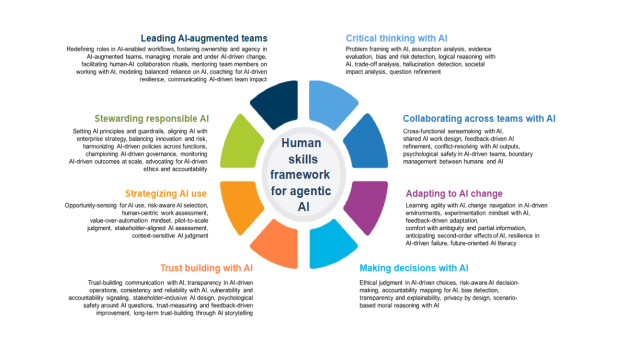
Take critical thinking. The framework breaks it down into problem framing, assumption spotting, hallucination detection, trade-off analysis and metacognition with AI, which is the habit of asking whether AI is quietly shaping your conclusions in ways you haven’t noticed. These are more than just soft skills, or human skills. They are operational disciplines.

The same logic applies to decision-making with AI. Leaders need to be able to map accountability for AI-driven choices, recognize when outputs introduce disparate impact, and make privacy-by-design decisions before agents touch sensitive data. The framework calls these out as distinct, learnable behaviors. They matter because humans must remain in the lead. But if they lack the analytical judgement to know when to accept AI outputs or push back on them, AI becomes just a mechanism for making bad decisions faster.

Human judgement is a guardrail

Most organizations think of AI guardrails as a technical problem, something the model team or the platform vendor handles. The IDC framework pushes back on that assumption.

Human judgment is a guardrail. When an agent recommends a configuration change and a senior engineer signs off without questioning the logic chain, that’s a failure of critical thinking. It has nothing to do with the model. When a team can’t explain an AI-assisted decision to a skeptical regulator, that’s a trust-building failure, not a communications problem.

The framework is built on the premise that humans need to be explicitly trained to catch the things AI will miss. And they must do it consistently, not just when they happen to be paying attention.

The hybrid role gap

Organizations are already creating hybrid roles that sit across IT, operations and the business. IDC is seeing the rise of workflow orchestrators, risk monitors, human-agent collaboration leads. These roles typically get staffed with strong technologists. The problem is that the skills those roles actually require (facilitation, change management, cross-functional sensemaking, storytelling) often aren’t part of a technologist’s development path.

The framework gives HR and L&D leaders a map for closing that gap intentionally. Because it’s modular, it can plug into existing competency models rather than requiring organizations to start from scratch.

Saying no is a skill, too. Employees need the discipline to decline AI-driven solutions that are too risky, too irrelevant and don’t fit the context. That is a trainable behavior that appears in the framework under the strategizing AI use cluster, alongside opportunity-sensing and pilot-to-scale judgment.

The inclusion is deliberate. Organizations stuck in perpetual proof-of-concept mode, or chasing automation for automation’s sake, need leaders who can push back on bad AI ideas as clearly as they can champion good ones. That requires analytical judgment.

What to do with it

The framework isn’t meant to be read once and filed. IDC’s guidance for technology buyers, appended to the research, emphasizes keeping it alive. As AI agents grow more capable and new use cases emerge, the skills and training examples need to update alongside them. A static competency model will age out fast.

The practical starting point: map a small set of critical behaviors to specific AI use cases. Avoid long competency lists. Equip managers to coach employees on AI use day to day in the flow of work. That’s a lot more effective than just pointing people toward courses. Build cross-functional squads that experiment with AI workflows and share what they learn.

The central bet the framework makes is that organizations succeeding with agentic AI won’t be the ones with the most sophisticated models. They’ll be the ones whose people know what to do when the model gets it wrong.

Gina Smith, PhD

Gina Smith, PhD - Research Director – IT Skills for Digital Business

As a Research Director at IDC, Gina Smith produces research in the IT education and skills sector. Her responsibilities include primary research, analysis, and the production of market insights worldwide. The New York Times bestselling author of Apple cofounder Steve Wozniak’s memoir, iWoz:…