



One of the most influential publications on real-world AI system design is Anthropic’s guide, Building Effective Agents. Its core message is simple:
Effective AI requires structure first, adaptability second.
Anthropic emphasizes that AI agents work best when:
These principles ensure accuracy, avoid hallucinations and keep investigations reproducible, all critical requirements for cybersecurity.
Intezer Forensic AI SOC is built on exactly this philosophy. Our platform uses a dual-mode design with Intezer AI Workflow and AI Agent, completely aligning with Anthropic’s best practices to deliver fast, scalable and highly accurate investigations across a broad range of alerts, all while keeping analysts in the loop.
Here is how Intezer implements Anthropic’s best practices for agents.
Anthropic advises that AI systems should begin with deterministic workflows instead of free-form reasoning. In cybersecurity, this is essential for accuracy, auditability, trust and scalability (when handling huge volumes of alerts).
Intezer’s AI Workflow mode is a structured triage process designed by security experts and executed with strict consistency. It applies AI only at key decision points, not as the driver of the entire investigation.
This approach provides:
Most alerts, especially well-defined ones, are fully resolved at this stage, giving SOCs broad alert coverage at low cost.
Anthropic states that agents should activate only when the structured workflow reaches uncertainty, and only after they inherit the full context. Intezer follows this exactly.
AI Agent mode activates only when the Workflow cannot reach a high-confidence verdict.
At that point, the agent:
This ensures the agent is guided, not free-floating, and its decisions remain grounded in evidence, not guesswork.
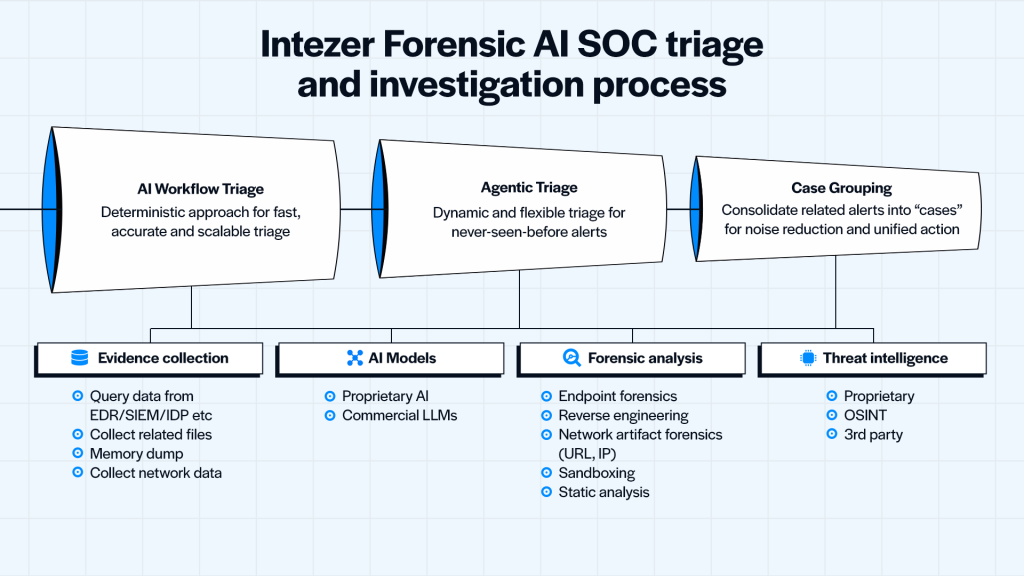
The result is deeper investigation where it matters, without unnecessary cost.
Intezer keeps human analysts at the center so they can review and override conclusions, and trace every decision made by Intezer. Of course, all evidence and reasoning is grounded in forensic data and is fully transparent and explainable for beginners and advanced analysts alike.
This aligns with Anthropic’s principle that humans remain final decision-makers, especially in high-stakes domains like cybersecurity.
Intezer’s adherence to Anthropic’s best practices produces measurable outcomes across the three most important SOC metrics: accuracy, coverage, and speed, while also reducing cost.
Intezer’s approach of combining deterministic forensics + adaptive AI = best-in-class verdict quality.
This hybrid approach dramatically reduces false positives and prevents premature conclusions.
Because AI Workflows handle the bulk of alerts inexpensively and AI Agents only run when needed, heavy and expensive reasoning calls are minimized
This frees SOCs from cherry-picking which alerts to ingest allowing them to triage and investigate them all.
This is crucial for:
You get broad alert coverage without inflating compute costs.
The result is a SOC where every alert is investigated quickly, consistently, and with forensic depth.
| Anthropic best practice | How Intezer implements it |
| Start with deterministic workflows | AI Workflow handles structured triage with predefined expert steps |
| Activate agents only when needed | AI Agent triggers only when confidence is insufficient |
| Give agents full context | Agent inherits the entire Workflow evidence set |
| Control tool usage | Agent selects tools based on evidence, not speculation |
| Maintain human-in-the-loop | Analysts can verify, guide, and override conclusions |
| Prioritize safety and reproducibility | Every action is logged, justified, and traceable |
Anthropic’s framework for building effective agents is now influencing industries far beyond general AI research. Intezer Forensic AI SOC might be one of the strongest real-world implementations of these practices in cybersecurity.
By combining:
Intezer is able to deliver fast, accurate, and scalable triage that transforms SOC operations.
此内容由惯性聚合(RSS阅读器)自动聚合整理,仅供阅读参考。 原文来自 — 版权归原作者所有。