












3 min read
Image of the Day for April 14, 2026
The violent storm aimed at the U.S. Northern Mariana Islands and Guam in mid-April 2026.
NASA Earth Observatory
Apr 14, 2026
Article
View more Images of the Day:
In mid-April 2026, a powerful typhoon bore down on the Mariana Islands in the North Pacific Ocean. The storm, Super Typhoon Sinlaku, was notable for reaching such exceptional strength so early in the year.
The VIIRS (Visible Infrared Imaging Radiometer Suite) on the Suomi NPP satellite captured this image at about 03:30 Universal Time (1:30 p.m. local time) on April 13, 2026, as Sinlaku approached the islands. At the time, the storm carried sustained winds of around 280 kilometers (175 miles) per hour. That places it as a violent typhoon—the highest intensity on the scale used by the Japan Meteorological Agency and equivalent to a category 5 storm on the Saffir-Simpson wind scale.
The storm continued along its northwest track toward the Marianas on the morning of April 14, as storm bands began to bring heavy rain to the islands of Saipan, Tinian, and Rota, according to an update from the National Weather Service. Forecasts called for typhoon conditions to affect Saipan and Tinian from April 14 into April 15 before subsiding to tropical storm conditions.
Though Super Typhoon Sinlaku occurred in the troposphere, the lowest layer of the atmosphere, it formed gravity waves that were visible much higher. The VIIRS (Visible Infrared Imaging Radiometer Suite) on the NOAA-20 satellite captured this nighttime image of the concentric waves made visible in the mesosphere by airglow.
Sinlaku is the second category 5 tropical cyclone of 2026, following Horacio, which churned over the South Indian Ocean in late February. Meteorologists note that Sinlaku is also one of only a handful of category 5 typhoons—a tropical cyclone that occurs in the Northwestern Pacific Ocean—known to have occurred so early in the year.
Meanwhile, several other storms spun over the planet’s oceans. On April 10, Tropical Cyclone Maila rotated in the opposite direction across the equator, and on April 12, Tropical Cyclone Vaianu crossed New Zealand’s North Island.
NASA Earth Observatory image by Michala Garrison, using VIIRS data from NASA EOSDIS LANCE, GIBS/Worldview, and the Suomi National Polar-orbiting Partnership. Story by Kathryn Hansen.
Downloads
April 13, 2026
- CIMSS Satellite Blog (2026, April 12) Super Typhoon Sinlaku rapidly intensifies to a Category 5 storm. Accessed April 13, 2026.
- Japan Meteorological Agency (2026, April 13) Tropical Cyclone Information. Accessed April 13, 2026.
- Joint Typhoon Warning Center (2026, April 13) Super Typhoon 04W (Sinlaku) Warning #20. Accessed April 13, 2026.
- National Weather Service (2026, April 14) Zone Forecast for Guam and the Northern Marianas. Accessed April 13, 2026.
- Yale Climate Connections (2026, April 12) Cat 5 Super Typhoon Sinlaku the 2nd-strongest typhoon so early in the year. Accessed April 13, 2026.
- Yale Climate Connections (2026, February 23) Tropical Cyclone Horacio: Earth’s first Category 5 tropical cyclone of 2026. Accessed April 13, 2026.
You may also be interested in:
Stay up-to-date with the latest content from NASA as we explore the universe and discover more about our home planet.
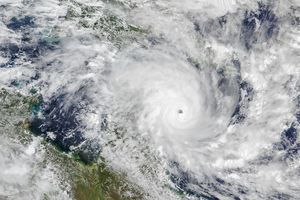
Tropical Cyclone Narelle Crosses Australia
3 min read
The powerful storm lashed the northern edge of the continent with damaging winds and drenching rain as it made landfall…
Article
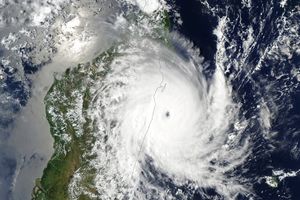
A Second Cyclone Slams Madagascar
3 min read
Widespread flooding affected tens of thousands of people after cyclones Fytia and Gezani drenched the island.
Article

Senyar Swamps Sumatra
3 min read
A rare tropical cyclone dropped torrential rains on the Indonesian island, fueling extensive and destructive floods.
Article
Keep Exploring