
惯性聚合 高效追踪和阅读你感兴趣的博客、新闻、科技资讯
阅读原文 在惯性聚合中打开

推荐订阅源

V
Vulnerabilities – Threatpost
V
V2EX
GbyAI
GbyAI
Recent Announcements
Microsoft Security Blog
阮一峰的网络日志
阮一峰的网络日志
Hugging Face - Blog
Hugging Face - Blog
T
Tailwind CSS Blog
Y
Y Combinator Blog
C
Check Point Blog
爱范儿
爱范儿
CTFtime.org: upcoming CTF events
美团技术团队
雷峰网
雷峰网
IT之家
IT之家
WordPress大学
WordPress大学
V
Visual Studio Blog
Microsoft Azure Blog
MyScale Blog
MyScale Blog
N
News and Events Feed by Topic
罗磊的独立博客
S
SegmentFault 最新的问题
S
Security Affairs
aimingoo的专栏
aimingoo的专栏
F
Fortinet All Blogs
K
KPMG report finds enterprise disconnect between AI and its ROI | CIO
Exploit-DB.com RSS Feed
H
Hacker News: Front Page
Google DeepMind News
B
Blog
O
OpenAI News
C
Cisco Blogs
Simon Willison's Weblog
The Last Watchdog
The Last Watchdog
Hacker News: Ask HN
Hacker News: Ask HN
博客园_首页
人人都是产品经理
人人都是产品经理
C
Cybersecurity and Infrastructure Security Agency CISA
Recent Commits to openclaw:main
Help Net Security
Help Net Security
月光博客
月光博客
J
Java Code Geeks
L
LangChain Blog
博客园 - 司徒正美
Stack Overflow Blog
Stack Overflow Blog
Security Archives - TechRepublic
Apple Machine Learning Research
T
The Exploit Database - CXSecurity.com
N
News and Events Feed by Topic
freeCodeCamp Programming Tutorials: Python, JavaScript, Git & More

NASA Science

Cosmic Origins at AAS 248, June 2026 - NASA Science Cosmic Structure SIG Seminar, 30 April 2026 - NASA Science CMB SAG Meeting, 24 April 2026 - NASA Science BBX SAG Meeting, 30 April 2026 - NASA Science Early Career Investigator Program – Earth Science (ROSES A.11) - NASA Science XR SIG Seminar, 1 May 2026 - NASA Science Night and (Earth) Day - NASA SWERV: High-Impact Historical Case Study - NASA Science AAS Meeting 248, June 2026 - NASA Science Earth Day 2026: Posters and Virtual Backgrounds - NASA Science Advancing Earth Observation at NASA since Release of Earthrise Photo - NASA Science X-59 Adds Freedom 250 Logo - NASA Belts of Green in the Washington Suburbs - NASA Science Artemis II Mission Milestones: An Image and Video Recap Curiosity Blog, Sols 4867-4872: Sand Fill In Antofagasta Crater and Finding Our Next Drill Target NASA Invites Media to Jordan Artemis Accords Signing Ceremony New NASA Views of Earth, From (S)PACE - NASA Science Crew Studies Biotech on Tuesday to Advance Health and Space Economy NASA Invests in Small Businesses Innovating for Space and Earth NASA at SXSW: Johnson Director Vanessa Wyche on Why Artemis Changes Everything Researchers: How Would You Extract Meaningful Insights from Just Four Astronauts? BBX SAG Meeting, 23 April 2026 - NASA Science Thailand’s Krabi Coast - NASA Science AI/ML STIG Lecture Series, 20 April 2026 - NASA Science SWERV: Training Overview and Agenda - NASA Science SWERV: REAL-TIME CAPABILITIES AND IONOSPHERIC DISRUPTIONS OF COMMUNICATIONS - NASA Science SWERV: Operationally Significant Phenomena and Impacts for Ground Operations - NASA Science SWERV: Space Weather Impacts on Satellites - NASA Science SWERV: Space Weather Chain of Events - NASA Science CSDA Quality Assessment Report Evaluates Satellogic NewSat Data - NASA Science NASA Shuts Off Instrument on Voyager 1 to Keep Spacecraft Operating - NASA Science Webinar 4/29: NASA CSDA Program Vendor Focus- MDA Space - NASA Science Testing Begins for Katalyst-NASA Swift Boost Mission - NASA Science Robert Maiberger - NASA William Vantine - NASA Holly Stevens - NASA Dennis McSweeney - NASA Mark T. Vande Hei - NASA Nicole Stott - NASA William Shepherd - NASA Josef Schmid - NASA NASA, OPM Announce New NASA Force Website, Open Job Applications  - NASA Frank Groen - NASA Ginger Kerrick - NASA Daniel Heimerdinger - NASA Michael Greenfield - NASA Kevin Ford - NASA Charles Daniel - NASA Capt. Frank L. Culbertson, Jr., USN (Ret.) - NASA Spring Rains Saturate Michigan - NASA Science NASA CubeSat Begins Mission to Study Radio Waves in Space - NASA Correction to F.5 FINESST, SMD’s Graduate Student Research Opportunity - NASA Science Restoring NASA's Core Competencies - NASA Small Steps, Giant Leaps: Episode 171: How NASA's Pandora Mission Unboxes Distant Worlds - NASA Physics of the Cosmos PAG Meetings - NASA Science NASA Science Veg-06: How plants and beneficial bacteria work together in microgravity Virtual Engineering & Spacecraft Flight Applications (VESFA) - NASA NASA Heliophysics Spacecraft Witness Comet’s Demise - NASA Science BBX SAG Meeting, 16 April 2026 - NASA Science NASA Invites Media to Latvia Artemis Accords Signing Ceremony - NASA Weak Lensing  - NASA Science At the Edge of Light - NASA NASA’s Mobile Launcher Rolls Ahead of Artemis III Preparation - NASA XR SIG Meeting, 27 April 2026 - NASA Science CRN SIG Meeting, 27 April 2026 - NASA Science GW SIG Seminar, 28 April 2026 - NASA Science Eyeing the Richat Structure - NASA Science I Am Artemis: Rebekah Tolatovicz - NASA NASA Selects Voyager for Seventh Private Mission to Space Station - NASA NASA Launches Six CubeSats to International Space Station Odyssey Celebrates 25 Years - NASA Science Crew Begins New Space Research and Installs New Science Gear - NASA NASA’s X-59 Completes First Wheels-Up Flight 2026 NSTA Hyperwall Schedule - NASA Science Update: Artemis II Crew Comes Home - NASA GW SIG Seminar, 14 April 2026 - NASA Science GR SIG Seminar, 17 April 2026 - NASA Science NASA's Webb Redefines Dividing Line Between Planets, Stars - NASA Science Vianni Ricano Cadenas Super Typhoon Sinlaku - NASA Science DGCE SIG Seminar, 23 April 2026 - NASA Science AI/ML STIG Lecture Series, 13 April 2026 - NASA Science NASA Night-light Imagery Tracks US Energy Transition, Global Volatility - NASA Science Hubble Completion Study 2012 - NASA Science Hubble Spies an Active Spiral - NASA Science Science with the Hubble and James Webb Space Telescopes VIII: Enriching the Universe: From Primordial Megaberg Ends Its Long Odyssey at Sea - NASA Science Artemis II Astronauts Back in Houston, Reunite with Families  - NASA Cygnus XL Cargo Craft Solar Arrays Deploy Powering Flight to Station - NASA Cygnus XL Cargo Craft Launches to Resupply Expedition 74 Crew - NASA La NASA da la bienvenida a la Tierra a los exploradores lunares de Artemis II, quienes batieron récords - NASA NASA Science, Cargo Launch Aboard Northrop Grumman CRS-24 - NASA Artemis II Splashes Down - NASA Artemis II Flight Day 10: Crew Completes Final Burn Before Splashdown  - NASA NASA Welcomes Record-Setting Artemis II Moonfarers Back to Earth  - NASA Human Perception and Performance Laboratory - NASA Artemis II Splashdown and Recovery - NASA Crew Preps for Cygnus XL Cargo Mission Targeted for Saturday Launch - NASA New Perspective of Home - NASA Artemis II Flight Day 10: Crew Sets for Final Burn, Splashdown - NASA
NASA’s Webb Pinpoints Millions of Stars Within Cigar Galaxy - NASA Science
Marty McCoy · 2026-06-23 · via NASA Science
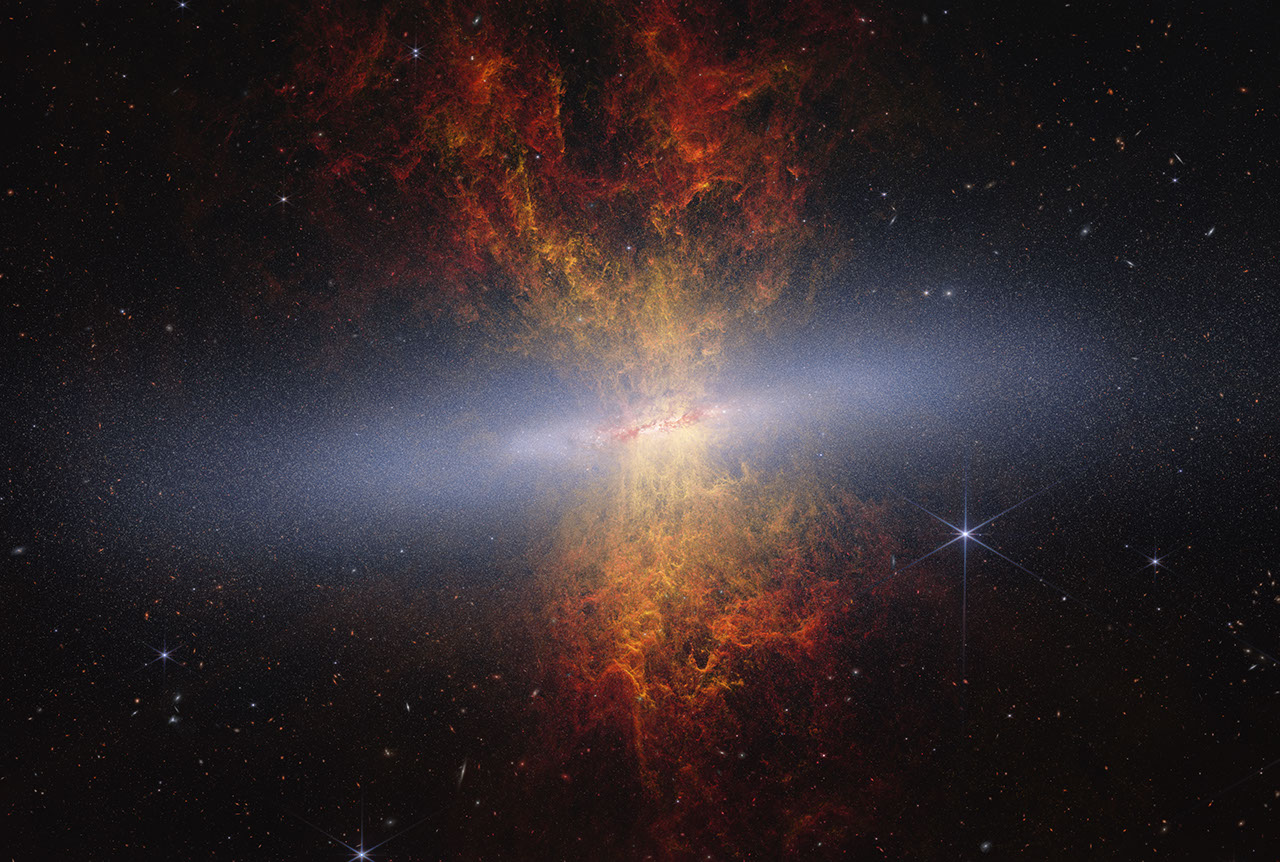
Composite image of edge-on spiral starburst galaxy Messier 82 as observed by NASA's James Webb and Hubble space telescopes. Hourglass-shaped plumes of gas are shooting outward from above and below a bright blue-white, disk-shaped center. The plumes are yellow near the galaxy’s bright center, denoting areas of ionized hydrogen gas as observed by Hubble, and gradually become redder as you move farther away. Messier 82 is set against the black background of space, which has many distant galaxies that appear as small white and orange spirals, ovals, and points of light. Toward the right of Messier 82 is a blue-white star with eight-pointed diffraction spikes that are characteristic of Webb.

Scientists used NASA’s James Webb Space Telescope to image edge-on starburst galaxy Messier 82 and trace its evolutionary history. This Webb and Hubble composite image includes 16.5 million stars (blue-white), dust grains (red-orange), and ionized hydrogen gas (yellow).

Credits: Image: NASA, ESA, CSA, Adam Smercina (STScI, Tufts), Thomas Williams (University of Manchester); Image Processing: Alyssa Pagan (STScI)

Located 12 million light-years away and undergoing rapid star formation, edge-on spiral galaxy Messier 82 (M82) is a scientifically unique sight to behold, and now NASA’s James Webb Space Telescope has revealed previously unseen details.

M82’s intense star formation, thought to be the result of a galaxy merger, will be a short-lived event in astronomical terms, estimated to last a few hundred million years in its entirety. This temporary phase of extreme star formation relative to the galaxy’s mass, as well as its location in the local universe, are among the factors that make M82, also known as the Cigar galaxy, a one-of-a-kind environment to study.

Composite image of edge-on spiral starburst galaxy Messier 82 as observed by NASA's James Webb and Hubble space telescopes. Hourglass-shaped plumes of gas are shooting outward from above and below a bright blue-white, disk-shaped center. The plumes are yellow near the galaxy’s bright center, denoting areas of ionized hydrogen gas as observed by Hubble, and gradually become redder as you move farther away. Messier 82 is set against the black background of space, which has many distant galaxies that appear as small white and orange spirals, ovals, and points of light. Toward the right of Messier 82 is a blue-white star with eight-pointed diffraction spikes that are characteristic of Webb.

Scientists used NASA’s James Webb Space Telescope to image edge-on starburst galaxy Messier 82 and trace its evolutionary history. This Webb and Hubble composite image includes 16.5 million stars (blue-white), dust grains (red-orange), and ionized hydrogen gas (yellow).

Image: NASA, ESA, CSA, Adam Smercina (STScI, Tufts), Thomas Williams (University of Manchester); Image Processing: Alyssa Pagan (STScI)

A team of astronomers recently completed an imaging survey with the Webb telescope. This program entailed a total of 65 hours of observation time with Webb’s NIRCam (Near-Infrared Camera) instrument and revealed never-seen-before details of the starburst galaxy, including its distended disk structure and millions of individual stars. Webb’s high-resolution imaging, specifically of the main plane of the galactic disk, has unlocked vital information for astronomers as they seek to uncover M82’s formation history. Additionally, the Webb data will help scientists understand the current processes occurring within the starburst galaxy.

“M82 is a mess, but it’s a beautiful mess. We don’t fully understand what’s going on, especially concerning its evolutionary history. What could have triggered such an elevated rate of star formation? How long has this galaxy been driving plumes of material away from its center?” said principal investigator Adam Smercina, a NASA Hubble Fellow at the Space Telescope Science Institute in Baltimore, and incoming Assistant Professor at Tufts University in Massachusetts. “M82 is an ideal galaxy evolution laboratory because it has properties that allow us to probe important physical processes, such as how stars form in such environments and how that activity drives outflows. M82 provides a simultaneous window onto many astrophysical questions, in a way that no other galaxy in the local universe can.”
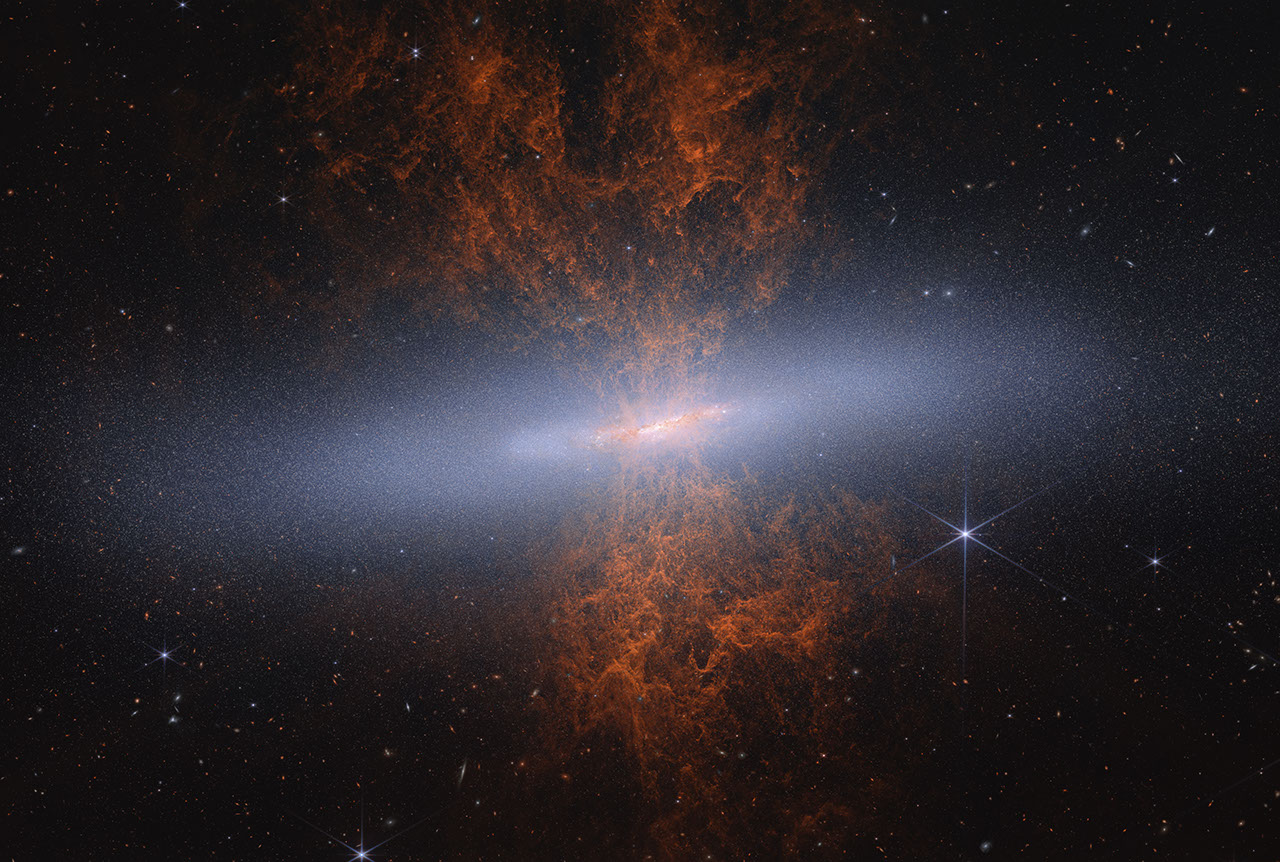
Edge-on spiral starburst galaxy Messier 82 as imaged by NASA's James Webb Space Telescope. Hourglass-shaped red-orange plumes of material are shooting outward from above and below a bright blue-white, disk-shaped center. Messier 82 is set against the black background of space, which has many distant galaxies that appear as small white and orange spirals, ovals, and points of light. Toward the right of Messier 82 is a blue-white star with eight-pointed diffraction spikes that are characteristic of Webb.

NASA’s James Webb Space Telescope observed edge-on starburst galaxy Messier 82, peering through dust to reveal 16.5 million stars and the galaxy’s distended disk structure. Scientists seek to learn the galaxy’s evolutionary history with the Webb data.

Image: NASA, ESA, CSA, Adam Smercina (STScI, Tufts), Thomas Williams (University of Manchester); Image Processing: Alyssa Pagan (STScI)

Prior to Webb, many observatories looked at the starburst galaxy, including NASA’s Hubble and retired Spitzer space telescopes. However, the sheer volume of dust within that galaxy limited the amount of information astronomers could acquire on M82 at high resolution. While Webb has previously looked at this galaxy, the duration of the new imaging survey, combined with the telescope’s infrared sensitivity, enabled it to pierce through the thick dust.
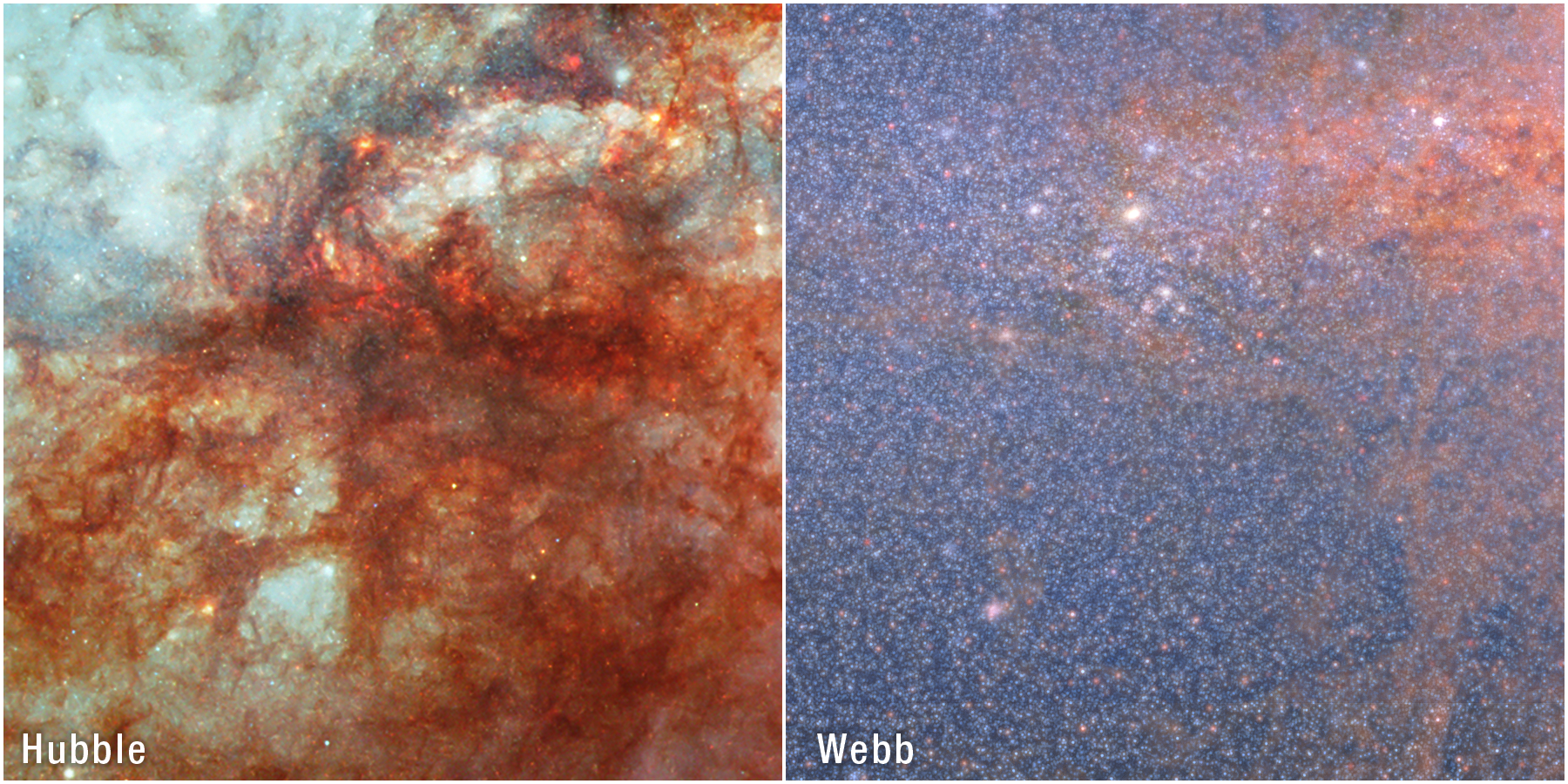
A side-by-side comparison of a portion of starburst galaxy Messier 82 (M82) as seen by NASA’s Hubble (left) and James Webb (right) space telescopes. The left image is labeled “Hubble” and the right image is labeled “Webb.” Hubble’s visible-light view at left shows bright, bluish light radiating from the center and a thick lane of dust, black in the center and red around the edges, diagonally stretching across the scene. Thinner strands and clumps of reddish dust cover the majority of the view. Webb’s infrared-light view at right shows a dense area of stars, depicted as luminous blue-white grains, against the black background of space. Toward the right side is clumpy red material, which is most visible toward the top right corner.

Side-by-side comparison of a portion of starburst galaxy Messier 82 (M82) as seen by NASA’s Hubble (left) and James Webb (right) space telescopes. Hubble detailed M82’s gas and dust structure, while Webb pierced through the dust and resolved millions of stars in infrared light.

Image: NASA, ESA, CSA, Adam Smercina (STScI, Tufts), Thomas Williams (University of Manchester); Image Processing: Alyssa Pagan (STScI)

The telescope’s near-infrared-light view is a snapshot of a scene that has been evolving over a couple hundred million years. Webb’s image contains approximately 16.5 million individual stars dispersed throughout the galaxy. The light from these stellar sources is depicted as luminous blue granules. This is only a small portion of the total amount of stars astronomers think reside in a galaxy like M82, with the majority too faint to be seen.

“The sheer number of stars that we were able to resolve with Webb is incredible,” said team member Benjamin Williams of the University of Washington. “It’s a whole different world from what we’ve been able to see with other telescopes. All of these stars collectively provide a detailed fossil record of the formation and evolution of M82.”

Moving inward, the increase in brightness and the asymmetrical shape of the galactic disk hints at the spiral galaxy’s unique underlying structure. The differing radii between the two sides suggests that M82 has a distorted shape, which can happen during intense galaxy mergers.

“At first glance, the disk of the galaxy may seem less spectacular because Webb sees through the dust,” said team member Eric Bell of the University of Michigan. “But M82 is a delightfully complex system. Webb’s observations will help us address some ongoing mysteries, such as how star formation has moved within M82 over the last few billion years.”

Because of the extreme star formation within the galaxy, which is 10 times faster than the Milky Way galaxy’s star formation rate, stellar birth will eventually be disrupted. M82’s stellar frenzy is causing bipolar plumes of material to be ejected above and below the disk. Though it looks like a tumultuous region, the hourglass-shaped outflows appear to have a layered structure. The yellow tendrils of material closest to the galaxy’s disk represent ionized gas, whereas the orange material farther away depicts small dust grains. These grains are called polycyclic aromatic hydrocarbons and are helpful in tracing material in the space between the galaxy’s stars, also known as the interstellar medium.

The information collected as part of this Webb study is just one dataset scientists will analyze as they seek to piece together this starburst galaxy’s formation history.

“Galaxies are such intricate ecosystems that if you truly want to understand them, you have to pull datasets from different missions together,” said team member Kristen McQuinn of the Space Telescope Science Institute. “One mission cannot fully answer all of the questions we have about M82. Combining the data collected by different telescopes, like Webb and Hubble, is powerful. When you marry the datasets, you expand what you can probe, and the questions that you can pose are even more complex.”

The James Webb Space Telescope is the world’s premier space science observatory. Webb is solving mysteries in our solar system, looking beyond to distant worlds around other stars, and probing the mysterious structures and origins of our universe and our place in it. Webb is an international program led by NASA with its partners, ESA (European Space Agency) and CSA (Canadian Space Agency).

To learn more about Webb, visit:

https://science.nasa.gov/webb

The following sections contain links to download this article's images and videos in all available resolutions followed by related information links, media contacts, and if available, research paper and Spanish translation links.

Related Images & Videos

M82 Cigar Galaxy (Webb + Hubble)

Scientists used NASA’s James Webb Space Telescope to image edge-on starburst galaxy Messier 82 and trace its evolutionary history. This Webb and Hubble composite image includes 16.5 million stars (blue-white), dust grains (red-orange), and ionized hydrogen gas (yellow).

M82 Cigar Galaxy (NIRCam Image)

NASA’s James Webb Space Telescope observed edge-on starburst galaxy Messier 82, peering through dust to reveal 16.5 million stars and the galaxy’s distended disk structure. Scientists seek to learn the galaxy’s evolutionary history with the Webb data.

M82 Cigar Galaxy (Hubble/Webb Side-by-Side)

Side-by-side comparison of a portion of starburst galaxy Messier 82 (M82) as seen by NASA’s Hubble (left) and James Webb (right) space telescopes. Hubble detailed M82’s gas and dust structure, while Webb pierced through the dust and resolved millions of stars in infrared light.

M82 Cigar Galaxy (Compass Image)

Annotated image of the starburst galaxy Messier 82 captured by Webb's NIRCam (Near-Infrared Camera) instrument, with compass arrows, a scale bar, and color key for reference.

M82 Cigar Galaxy (Webb + Hubble Fade)

NASA’s James Webb Space Telescope’s near-infrared observation of M82 is the most recent addition to overall data on this starburst galaxy. The Hubble Space Telescope is one observatory that has previously looked at M82, detailing the gas and dust structure seen in visible light.

Read more: Messier 82

Video: XRISM Clocks Hot Wind of Galaxy M82

Explore more: ViewSpace | The Infrared View of M81 and M82

Explore more: ViewSpace | Interacting Galaxies: The Antennae

More Webb: News | Images | Science | Home Page

Share

Details

Keep Exploring

Related Topics