





It has been a busy few weeks, and I wanted to provide some updates. To begin, I want to once again acknowledge the incredible contributions of the NASA workforce, along with our commercial and international partners, in sending the Artemis II crew safely on a historic mission around the Moon. You have captivated the world again, and now the show goes on as we prepare to return to the surface, build a base, and get ready for where we will inevitably go next.
While this is a long letter discussing organizational changes, the objectives remain unchanged.
- Artemis Program – Standardize the SLS architecture to the greatest extent possible, rebuild muscle memory, launch with frequency and return NASA astronauts to the surface of the Moon. The Artemis program will live on past any one launch vehicle, and at some point in the future, transition to commercial pathways with crewed missions as often as every six months to ensure we never give up the Moon again.
- Moon Base – Return to the Moon to stay, build an enduring presence through a phased iterative approach to learn until we have an outpost that delivers novel science, stimulates a lunar economy and becomes the proving ground for the technology necessary to undertake future crewed missions to Mars.
- Space Reactor Office – pioneer the next ‘giant leap’ technology, get America underway on nuclear power in space with SR-1 freedom, lay the foundation for a lunar surface power station, and scale-up to a generation of spacecraft capable of supporting a crewed mission to Mars and exploring the outer solar system.
- Ignite the orbital economy – launch frequent astronaut missions to the Space Station, prioritize high ‘commercial potential’ science, work to stimulate more private astronaut missions and support a transition to one or more commercial space stations.
- Build more X-planes, launch more missions of science and discovery – find efficiencies in commercial earth observation, space weather and other missions beyond their original design life, to free up more resources to pursue challenging flagship missions that only NASA is capable of undertaking.
To achieve the above, I believe it is imperative to concentrate resources towards the highest priority objectives in the National Space Policy and liberate the best and brightest from needless bureaucracy and obstacles that impede progress.
On that note, we have the President’s National Space Policy and NASA’s vision for achieving it as outlined during the Ignition event. We have the mandate, we have the resources through FY26 appropriations and Working Families Tax Cut Act, and we have the talent and a proven playbook. Now we need to organize and execute.
This letter touches on several topics and will be supported by a series of Directives to begin Implementation, but I want to be upfront and clear that there are no reductions in force (RIFs) being contemplated, no program cancellations, no facility closures. I am certainly interested in freeing up resources wherever possible, but my goal is to invest in centers, rebuild NASA core competencies, convert contractors where appropriate to civil service, maintain a healthy pipeline of interns and leverage OPM’s NASA Force to ensure we have the talent needed to execute on the mission.
Organization
I would like to begin by congratulating Matt Anderson on his confirmation as Deputy Administrator of NASA. There is much to accomplish and I welcome his leadership as we endeavor to achieve the most pressing objectives in President Trump’s national space policy in the years ahead.
To improve our operational efficiency, we must evolve the organization to be more ‘mission centric’, with specialized centers properly resourced to support current and future requirements. To do this, we will separate lines of authority between preparing and supporting the workforce and executing the mission. Center Directors will continue reporting to the Associate Administrator, focused on empowering the workforce and maintaining the facilities and critical capabilities at their Centers. Mission Directorates will now report to the Administrator with the primary focus on leveraging Center resources, industry, and international contributions to execute on the mission as urgently and efficiently as possible. We will also take this opportunity, where appropriate, to consolidate departments, flatten org structure and enhance HQ by rotating operational expertise into critical functions.
Mission Directorates
To best position NASA for success, we will restructure our Mission Directorates. The following changes will be implemented:
- Combine SOMD and ESDMD into a single Human Spaceflight Mission Directorate (HSMD). The goal is to unify the strengths of NASA’s Exploration and Space Operations communities into a streamlined organization, built to deliver on the next era of human spaceflight. Human space exploration is one mission at NASA – demanding, not without risk, and requiring the most optimal and resourced organization structure possible. At the time these orgs were separated, sending astronauts to the Moon was conceptual, while LEO was operational. Today, both are operational. Bringing these efforts together will clarify responsibilities, strengthen accountability, accelerate decision making, and better position NASA to execute our mission with the efficiency and integration required for the challenges ahead.
- Dr. Lori Glaze as Associate Administrator, with Joel Montalbano and Kelvin Manning as Deputies
- Within HSMD, the primary divisions will be:
- Low Earth Orbit, Dana Weigel as Program Manager (to include CCP, ISS, CLD)
- Moon Base, Carlos Garcia-Galan as Program Manager
- Artemis, Jeremy Parsons as Program Manager (renamed from Moon to Mars)
- We thank Lakiesha Hawkins for her excellent work stepping in as exploration deputy for the Artemis II mission. She will return to her role in the organization.
- The Aeronautics Research (ARMD) and Space Technology Mission Directorate (STMD) will combine into a single Research and Technology Mission Directorate (RTMD), unifying NASA’s aeronautics, space technology, and nuclear power and propulsion capabilities into a single, fastmoving organization focused on delivering the breakthrough technologies our missions and the Nation require.
- Dr. James Kenyon as Associate Administrator, with Wanda Peters as Deputy
- Within RTMD, the primary divisions will be:
- Aeronautics, Laurie Grindle as Director
- Advanced Research and Technology, Greg Stover as Director
- Space Reactor Office, Steve Sinacore as Acting Director
- Space Communications and Navigation (SCaN), Kevin Coggins as Director
- We thank Bob Pearce for his excellent service as the head of ARMD. After a short transition, Bob plans to retire after an amazing 36 year career at NASA.
- The Science Mission Directorate (SMD) leadership and primary science division structure will remain unchanged, with Dr. Nicky Fox as the Associate Administrator and Dr. Mark Clampin as Deputy. The Science Mission Directorate will remain NASA’s foundation for delivering world-changing discovery, focused on balancing the most exciting flagship scientific endeavors through expeditious mission design, efficient assembly and operations, and, where applicable, expanded use of commercial and private data and capabilities.
Mission Support Directorate
The Mission Support Directorate will be led by John Bailey with Eli Ouder as Acting Deputy. There will be a Directive issued to identify responsibilities that are unique to Centers and should shift back to them as well as streamline overlapping HQ functions that similarly support the broader enterprise. The aim is to put more ownership and responsibility for specialized capabilities on the Centers, while keeping enterprise-wide efforts managed centrally for the sake of shared services efficiency. This balance will clarify roles, strengthen accountability, and position us to deliver support where it is most effective. We thank Dave Mitchell for his outstanding leadership of MSD and note that Dave will be entrusted with a special assignment to the Administrator to help orchestrate relocation of HQ as described below.
Centers and Facilities
We will better resource Centers to increase specialization in support of the Mission Directorates and the outcomes we need to achieve. This does not mean all work at a center must align to the specialties identified here. Centers will continue to host select complementary capabilities that support multiple missions while leveraging cross-center resources, when that expertise already exists elsewhere.
Ames Research Center: Innovation Center of Excellence
o Director: Eugene Tu
Armstrong Flight Research Center: Flight Test and Aircraft Operations Center of Excellence
o Acting Director: Troy Asher
Glenn Research Center: Research and Technology Center of Excellence
o Director: Dawn Schaible
Goddard Space Flight Center: Earth and Space Science Center of Excellence
o Director: Jamie Dunn
o We thank Cynthia Simmons for her outstanding leadership of the center in acting capacity, and she will return to her role as Deputy.
Katherine Johnson IV&V Facility: Software Assurance Center of Excellence, reporting to the GSFC Director.
o Director: Wesley Deadrick
Johnson Space Center: Human Spaceflight Center of Excellence
o Director: Vanessa Wyche
Kennedy Space Center: Space Launch Center of Excellence
o Director: Brian Hughes
Langley Research Center: Aeronautics Research Center of Excellence
o Director: Dr. Trina Dyal
Marshall Space Flight Center: Space Structures, Propulsion, and Infrastructure Center of Excellence
o Acting Director: Rae Ann Meyer
Michoud Assembly Facility: Production and Manufacturing Center of Excellence, reporting to the MSFC Director
o Director: Hansel Gill
Stennis Space Center: Propulsion Testing and Enterprise Support Center of Excellence
o Director: Christine Powell
Wallops Flight Facility: Space Launch and Range Center of Excellence with Director reporting to the KSC Director
o Director: David Pierce
White Sands Test Facility: Specialized Testing Center of Excellence with Director reporting to the JSC Director
o Director: Jason Noble
Jet Propulsion Laboratory (FFRDC): Deep Space and Robotics Center of Excellence
o Director: Dave Gallagher
o Acting Director of NASA Office of JPL Management and Oversight (NOJMO): Antti Pulkkinen
Per the below directive, we will adjust the funding distribution, so Centers have the financial support needed to sustain the baseline critical capabilities independent of near-term mission assignment. In parallel, Centers will reduce the overhead burden applied to missions wherever applicable. This shift will allow Center Directors to focus on maintaining the infrastructure, workforce, and capabilities required for current and future missions.
HQ and Other Staffing Assignments
- A summary org chart is below that clarifies the reporting structure to the Administrator, Deputy Administrator, Associate Administrator, and the Chief of Staff.
- The Associate Administrator will also take on the title and responsibility of NASA Chief Engineer, reinforcing the technical foundation required to advise the Administrator and ensuring continuity of critical decisions between Administrations. The streamlining of programmatic authority directly from the Administrator to the MD AAs enables the Associate Administrator to maintain maximum objectivity in his recommendations to the Administrator and strengthens consistency with the conclusions of the Columbia Accident Investigation Board (CAIB) and other lessons from the Agency’s history. The Associate Administrator will work to empower each of the Technical Authorities (TAs), with a bias toward achieving the Agency’s goals with rigorous impatience. Likewise, the Mission Directorates and Centers will bring to bear the resources and decisive decisions that the TAs need to achieve their mandates as quickly as possible, commensurate with the Risk and Safety profile of each individual mission.
- We thank Joe Pellicciotti for his excellent service as Chief Engineer. After a short transition, Joe plans to retire. We are grateful for his amazing 25 years of service to NASA.
- Adam Steltzner, Jet Propulsion Laboratory, is assigned to serve as HQ Chief Engineer for Special Projects, to encompass Moon Base, SR-1 Freedom, and other priority initiatives.
- Casey Swails, Deputy Associate Administrator, alongside many of her direct reports, including the AA of the Mission Support Directorate, will report directly to the Deputy Administrator, allowing for uninterrupted execution and continuity of mission.
- The Office of International and Interagency Relations will be under the leadership of Associate Administrator Kathleen Karika. We thank Meredith McKay for her outstanding leadership of the office in acting capacity, and she will return to her role as Deputy AA for OIIR.
- The Office of Procurement will be under the leadership of Assistant Administrator for Procurement Bradley Niese. We thank Marvin Horne for his outstanding leadership of the office in acting capacity, and he will return to his role as Deputy Assistant Administrator for Procurement.
- As many of you know, NASA’s lease for the current Headquarters location will conclude in 2028. In preparation, we will begin planning for a more efficient footprint while remaining in the D.C. area, ideally freeing up resources to further invest at other Centers, like GSFC, that require renovated facilities. To ensure this effort is well coordinated and thoughtfully managed, I am asking Dave Mitchell to oversee this important effort.
- We will open additional temporary leadership and advisor positions at HQ to astronauts, engineers, scientists, and other operations personnel, including flight controllers, when they are between missions. These roles will be embedded at HQ alongside OIIR, OLIA and other Agency leadership to ensure engineering, scientific, and operational experience informs policy, partnerships, and execution. This will also give participants valuable HQ, legislative, international, and interagency experience to take back into their operational roles.
Workforce Initiative Updates:
For several months, we have been developing workforce initiatives, including NASA Force in partnership with OPM and contractor-to-civil servant position conversion pathways. NASA Force is designed to bring in talent from industry and academia for defined terms to close capabilities gaps and mentor the next generation of NASA talent. There will be pathways for term hires to convert to full-time roles, and we will also enable rotations from NASA personnel into industry.
At the same time, with more than 40,000 contractors, we are working with Center Directors and Mission Directorates to identify roles that go to the heart of NASA’s core competencies and those individuals that work exclusively for NASA, have done so for years, and are expected to continue long-term. These roles, particularly those tied to launch, operations, and mission-critical engineering capabilities, are strong candidates for conversion to the civil service.
There are, of course, cost savings from this effort, and from just the early pilots being implemented, there is over $100 million in annual savings. There are also operational benefits, as contractor structures often include layered management, third-party tools, contractual barriers, and other inefficiencies that can challenge progress.
This efficiency initiative is not focused on contractors working for small business or other highly specialized contractors who support multiple customers across industry, nor roles outside core mission functions such as facility maintenance, IT, cybersecurity, certain medical roles, and non-core research. This is not about forcing anyone to change roles. But for those who meet the criteria and plan to support NASA for the long term, there should be a clear path to join the civil service workforce.
I also want to touch on a few additional topics.
We are listening
We have received thousands of your submissions through the good idea box and the regulatory burn down and policy reform process. As you have hopefully observed, we are implementing quick wins where possible or through Directives already in circulation such as Recognize, Reward, Inspire, Restoring Core Competencies, Travel and other quick wins, and Acquisition Reform or the several new Directives issued alongside this letter. We are listening, whether through in person conversations at town halls or through the idea box, and I encourage everyone to continue communicating what works, so we can do more of it, and what is broken, so we can fix it. A fast feedback loop is essential, and I do value your inputs.
Concentrating Resources & Achieving the National Space Policy
Over the past month, I testified before Congress on the President’s Budget Request. My responsibility is to support that request and make the case for how we can do more with less. The reality is that we do not always have a strong track record assessing markets, selecting appropriate contracting methods, and delivering on cost and schedule. There are internal improvements we must make, but external pressures and competing priorities also contribute.
When you step back, it is worth considering how many additional missions we could have undertaken with the resources lost to program cancellations and cost overruns over the years. That is the problem we must fix, so the American taxpayer and space-loving community can receive the highest scientific return on every dollar we spend at NASA.
Of course, Congress will appropriate funding and I will always comply with the law and ensure we capture the most science and discovery for every dollar entrusted to the agency.
As part of our broader commitment to accountability, transparency, and maximizing the value we deliver to the American public, we intend to release an RFP for the management of NASA’s Federally Funded Research and Development Center (FFRDC) at the Jet Propulsion Laboratory. Several federal FFRDC’s, especially in the DOE, have had their management contracts periodically competed. This process will take several years, and I do not anticipate it having any impact on the projects underway or the location of the facilities. It does, however, provide an opportunity to evaluate management costs, overhead burdens, and ideally find ways to get after the science faster and more affordably.
I will say, I am deeply impressed and grateful for the work of Dave Gallagher as Lab Director, and that is reflected in projects like SkyFall, MoonFall and the JPL SME’s we are applying across NASA to solve some of our hardest engineering challenges.
In the near term, I will be reviewing industry feedback from the Ignition event as we prepare for additional Artemis missions, a Moon base, a commercial space station transition in LEO, and an interplanetary nuclear spacecraft, along with as many scientific missions as we can undertake as we endeavor to unlock the secrets of the universe.
As much as possible, I plan to be in the field with all of you, alongside our vendors and partners, to ensure we are driving the right outcomes, and delivering capabilities on time and on budget so we can launch more world-changing missions of science and discovery. I will host town halls and engage directly with as many of you as possible.
We are going back to the Moon, building the base, and doing the other things. This is no longer something to read in the history books, you are making history.
Honored to serve alongside all of you.
Jared
Directive 1: Workforce and Organization
To be completed within 60 days.
Direct the Associate Administrator to review, recommend, and implement where applicable:
- All organizations currently operating under Acting leadership and provide recommendations for permanent appointments or replacements.
- Direct all OIC’s to identify opportunities to consolidate departments and teams where appropriate to enhance mission execution. This is not a headcount reduction exercise. The objective is to flatten structures, improve information flow, increase decision velocity, and ensure clear ownership.
- With limited exceptions, and excluding those already assigned, we will seek to promote ownership by minimizing the designation of Deputies and Chiefs of Staff in organizations with fewer than 300 personnel.
- Assemble formal recommendations to better align, integrate, and empower the technical authorities, incorporating input from the Aerospace Safety Advisory Panel and lessons learned from prior programs, while preserving the independence and objectivity of each Technical Authority function. This includes a commensurate action to contemplate an Operations Technical Authority to represent the unique perspective that our operations teams across the Agency bring to our missions. The AA is not directed to implement this new TA but should provide a recommendation to the Administrator on various organizational models that enable the most disciplined judgement to rise freely either to the programmatic decision authorities or to the appropriate reclama paths as necessary.
Direct the Deputy Administrator to review, recommend and implement where applicable:
- Specific review of the Shared Services functions, between those in HQ and within the Mission Support Directorate with the aim of:
- Pushing responsibility of specialized functions back to Centers
- Reducing duplicative management between OIC’s and Mission Directorate responsibilities
- Identifying and recommending further efficiencies from enterprise-wide initiatives
- With support from applicable Senior Advisors, review grants, SBIR/STTR awards, and other expenditures across all Mission Directorates to ensure reviews and controls can be completed as expeditiously as possible, compliance with all executive orders, and alignment with the Agency Mission and National Space Policy objectives.
- Alongside OSTP, DOE, OIIR and with the OCIO, ensure NASA programs participate and make full use of AI capabilities inherent in Genesis
- Work alongside OSI, MSD to ensure WTFC funding are distributed to the highest priority infrastructure projects to meet the current and anticipated national space policy objectives.
Directive 2: Associate Administrator for Communications
To be completed within 60 days.
Direct the Associate Administrator for OCOMM with the concurrence of the Chief of Staff to review, recommend and implement where applicable:
- Conduct a comprehensive review of all external communications roles and functions across Centers, Mission Directorates, and programs, to realize the end state of an efficient and centralized enterprise communications function within OCOMM focused on quality over quantity.
- Develop a recommended structure that embeds communications personnel within key programs where needed, while maintaining a clear reporting line to the Associate Administrator for the Office of Communications at Headquarters.
- Identify programs that require dedicated communications support, prioritizing those aligned with National Space Policy objectives and high-visibility missions.
- Identify opportunities to consolidate communications efforts across related programs, including Artemis elements where appropriate (Artemis as a program vs. teams assigned to SLS, Orion, HLS).
- Ensure the workforce is sized across civil servants and contractors, including evaluation of contract support and potential realignment alongside workforce conversion effort, to meet agency requirements.
Directive 3: Associate Administrator for Science
The objective is to accelerate the delivery of science. Reduce time and resources spent on prolonged competitive processes and focus funding on the highest-priority missions across all Science Mission Directorate areas as quickly and affordably as possible.
To be completed within 120 days.
Direct the Associate Administrator for Science to evaluate:
- Missions operating beyond their original design life that are still producing valuable data, and identify opportunities to consolidate them into a single agency operated Science Operations Center.
- Recommended procurement strategy with commercial constellation providers to deliver Earth observation and space weather data at more affordable levels.
Direct the Associate Administrator for Science to review the end-to-end science formulation and selection process and provide a revised execution approach designed to deliver high-priority missions faster, at lower cost, and with greater predictability.
Evaluate the feasibility of undertaking a new high priority decadal flagship mission, such as Uranus Orbiter and Probe, that can be undertaken through efficiencies gained from this directive, other agency wide cost savings measures, or alongside philanthropic and public-private partnerships.
Directive 4: Finance & Infrastructure (OCFO)
The objective is to align NASA’s financial systems and infrastructure with mission execution. Streamline how core capabilities are funded, simplify how the Agency accounts for cost and labor, and prioritize investing in infrastructure to enable current and future missions.
To be completed within 90 days
- Direct OCFO to review and implement streamlined funding mechanisms for NASA’s core capabilities with the goal of moving to direct, transparent funding lines that better align Centers to the Mission Directorates they support.
- Direct OCFO and OCHCO to overhaul NASA’s labor charging structure with the goal of reducing administrative burden, improving data fidelity, and supporting workforce initiatives including in-sourcing.
- Direct OCFO to overhaul NASA’s WBS hierarchy and project costing guidelines with the goal of providing functional cost visibility and consistent reporting across the Agency.
- Direct OSI/FRED, building on the AMP and existing and updated Center Master Plans, to prioritize investment in the core infrastructure and capabilities that support current and future missions, with a data-driven approach to paybacks and monetization.
- Direct OCFO to ensure all financial and costing reforms adhere to the requirements and intent of the prior Acquisition Directive.
The objective is to align NASA’s financial systems and infrastructure with mission execution. Streamline how core capabilities are funded, simplify how the Agency accounts for cost and labor, and prioritize investing in infrastructure to enable current and future missions.
To be completed within 90 days.
- Direct OCFO to review and implement streamlined funding mechanisms for NASA’s core capabilities with the goal of moving to direct, transparent funding lines that better align Centers to the Mission Directorates they support.
- Direct OCFO and OCHCO to overhaul NASA’s labor charging structure with the goal of reducing administrative burden, improving data fidelity, and supporting workforce initiatives including in-sourcing.
- Direct OCFO to overhaul NASA’s WBS hierarchy and project costing guidelines with the goal of providing functional cost visibility and consistent reporting across the Agency.
- Direct OSI/FRED, building on the AMP and existing and updated Center Master Plans, to prioritize investment in the core infrastructure and capabilities that support current and future missions, with a data-driven approach to paybacks and monetization.
- Direct OCFO to ensure all financial and costing reforms adhere to the requirements and intent of the prior Acquisition Directive.
Directive 5: Associate Administrator for Legislative and Intergovernmental Affairs
To be completed within 30 days.
- Direct the Associate Administrator for the Office of Legislative and Intergovernmental Affairs (OLIA) to review and recommend a structure for OLIA that is inclusive of all communications and engagement with the U.S. Congress, to include appropriations.
- As part of the review, the Associate Administrator for OLIA will identify opportunities to consolidate teams where appropriate to enhance functionality. The objective is not to reduce headcount but to streamline communication with the Congress and ensure clear ownership.
- Direct the Associate Administrator for OLIA to identify programs that require dedicated legislative support, prioritizing those aligned with National Space Policy objectives and high-visibility missions.
Directive 6: Moon Base
The purpose of this directive is to consolidate all lunar programs outside of the Artemis program, into a unified Moon Base Program within HSMD, aligning capabilities and personnel to enable a sustained U.S. presence on the Moon by 2030.
The Moon Base Program will serve as NASA’s central authority for all lunar activities, responsible for integrating exploration architecture, surface mobility, science payloads, cargo landers, habitability systems, logistics, observation, communication, navigation and other technical demonstrations into a coherent end-to-end campaign. The program is charged with removing structural inefficiencies, aligning resources, and driving an operational cadence that supports permanent lunar operations.
To achieve this, HSMD will undertake the following restructuring and direction as soon as possible:
- Consolidate existing lunar programs and projects – including CLPS, large cargo landers, Argonaut/HLS cargo, human surface mobility, advanced exploration systems, lunar infrastructure development, habitation, and the current Gateway surface relevant scope – under a single Moon Base Program office.
- Establish unified program authority for planning, integration, contracting, and execution across all lunar missions, including SCaN and other science and technology elements, ensuring alignment with Agency priorities and the national space policy.
- Implement a single integrated project team model across engineering, safety, operations, procurement, international/interagency coordination, and communications to accelerate decision making and streamline mission execution.
- Increase mission cadence to the lunar surface by prioritizing high reliability access, payload integration, and logistics flow; remove or redirect efforts that do not directly support sustained surface operations.
- Develop an integrated lunar architecture and operations plan that identifies the critical path, long lead items, supply chain vulnerabilities, international, interagency, and commercial partnerships and integrate subject matter expertise to drive outcomes within the plan schedule and budget.
- Within 30 days, deliver a transition and integration plan consolidating personnel, contracts, and hardware across participating organizations. Within 60 days, deliver a Program Management Plan outlining program structure, roles, responsibilities, KPIs, and success metrics.
Carlos Garcia-Galan is designated as the Moon Base Program Manager, responsible for end-to-end execution and reporting to HSMD. The program office will be located at the Johnson Space Center.
Directive 7: Nuclear Power and Propulsion
The purpose of this directive is to centralize programmatic authority and accountability for all NASA space nuclear activities within RTMD, accelerate delivery of the SR-1 Freedom and LR-1 missions, and establish the technical foundation for nuclear-enabled crewed missions to Mars.
To achieve these objectives, RTMD will take the following actions as soon as possible:
- Consolidate all funding authority and decisions for space nuclear activities – across HSMD, RTMD, and SMD – under the Space Reactor Office. All funding decisions will be routed to the Space Reactor Office Director as delegated by the RTMD AA, with appropriate coordination with HSMD and SMD for planning and reporting.
- Direct the Space Reactor Office to deliver, within 60 days, an integrated program plan for SR-1 Freedom and LR-1 covering schedule, budget, contracting strategy, personnel, facility requirements, and international and interagency coordination, with both missions targeted launch-ready by 2030.
- In support of SR-1 Freedom, realign authority and funding decisions to the Program Manager to include the Power and Propulsion Element of Gateway (WFTCA-funded), Gateway funding allocated for the Launch Services Program, and future resources for mission and flight operations, software development, and integrated lab use.
- SMD is responsible for leading development, delivery, and integration of the Sky Fall science payload into SR-1 Freedom, including planning the funding necessary to develop the payload, and integrate it into the vehicles for delivery to Mars.
- Implement a rapid acquisition approach that streamlines processes and delegates procurement authority to the greatest extent possible.
- Sustain development of common enabling technologies, including radiation-hardened instrumentation and controls, high-temperature fuels, and advanced materials, to support SR-1, LR-1, NTP, and future missions.
- Consolidate management of radioisotope power sources within the Space Reactor Office to leverage existing nuclear launch safety and facility resources across the full space nuclear portfolio and work closely with Moon Base and SMD to encourage affordable, commercial procurement of RTG and RHU’s as necessary.
- Within 60 days, complete a study to guide investment in a next-generation integrated spacecraft program – maximizing use of NASA and vendor facilities – evaluating NTP, NEP, and chemical propulsion to enable unrefueled roundtrip crewed and cargo missions to Mars by 2036.
Steve Sinacore is designated as Acting Director of the Space Reactor Office and Program Manager for SR-1 Freedom and LR-1, responsible for end-to-end execution and reporting to the RTMD AA.
Directive 8: Low Earth Orbit
Direct HSMD to create a unified Low Earth Orbit (LEO) Program to ensure sustained U.S. human presence in LEO, accelerate development of a commercial LEO economy, and maintain NASA’s leadership in long duration human exploration.
To achieve these objectives, HSMD will take the following actions as soon as possible:
- Begin formulating a new Low Earth Orbit program to execute the overall human spaceflight mission in LEO. Emphasis should be placed on maximizing mission efficiency, streamlining the organizations, ensuring the most effective use of available budgets, and optimizing the workforce, with a focus on growth and development across the full suite of LEO missions while maintaining safety of flight.
- The program will combine the ISS, Commercial Crew, Commercial LEO Destination, and the EHP ISS EVA office, ensuring development and operational cultures remain distinct and appropriately risk-calibrated.
- The program will have the authority to streamline and align core competencies and complementary functions as needed to achieve the Agency’s LEO objectives, to include an achievable and affordable transition to one or more commercial LEO destinations (CLD).
- The program should work to prioritize flight opportunities and payloads with the greatest potential to stimulate commercial demand in microgravity, and work alongside industry to increase private astronaut or further monetization opportunities.
- Dana Weigel is designated as the LEO Program Manager, reporting to HSMD. The program office will be located at the Johnson Space Center.
Directive 9: Aviation Portfolio
The Aviation portfolio as organized and funded today, is dispersed across many Centers, result in inconsistent pilot and maintenance standards, and investment in areas that are not on the cutting edge of aeronautics and flight test research. This directive consolidates the aviation portfolio authority to streamline decision-making, reduce operating costs, ensure consistent training and maintenance standards across the fleet, and better focus research investments.
Within 60 days, the Associate Administrator of RTMD in coordination with the Armstrong Center Director shall:
- Establish an overarching hierarchy to include leadership and oversight of the agency-wide portfolio.
- Establish agency-wide standards for flight operations, safety, training, and maintenance
Within 60 days, the OCFO with support from the Senior Advisors shall:
- Develop a funding framework to ensure the aviation portfolio receives appropriate baseline resources to maintain needed operational capability and flight safety.
Within 60 days, the Armstrong Center Director will lead an evaluation effort with recommendations on how best to:
- Consolidate airborne research platforms where feasible, including designating a single high-altitude research platform and incorporating astronaut training into the program.
- Evaluate replacement options, including surplus DoW inventory, for aging T-38s for high performance training
- Consolidate business jet platforms where feasible
- Evaluate procurement of new light jet aircraft for astronaut training and operational team transportation.
- Provide recommendations for future use of NASA 737 reduced gravity-platform, including commercial collaboration opportunities with industry.
The AA of RTMD is directed to review all Aeronautic grants and other agency aeronautics investments to ensure alignment with:
- Advancing technology, to include additional X-planes, with a focus on radical airframe and engine propulsion design in support of future civil, commercial or national security requirements.
- Air Traffic Control (ATC) modernization
- Advanced materials, Aeronautics and other relevant mission priorities
- Avoiding investment in efforts that industry should independently be interested in funding for natural competitive purposes
Directive 10: National Space Policy Outcomes and Execution
To be completed within 30 days:
- Direct all Mission Directorates and major program offices, including Artemis, the Space Reactor Office, and the Moon Base Program, to produce written, agency-level plans that close on national space policy timelines or if unable, incorporate best recommendations on how to achieve the intended outcome. Plans must be informed by both internal SMEs and relevant vendor input.
- Each plan will identify named SMEs or Responsible Engineers who are embedded across the supply chain and positioned on the critical path.
- These individuals must have clear authority to drive outcomes, with a menu of escalation options to ensure technical and schedule achievability
- Plans should include a clear mapping of critical-path elements, with specific attention to long lead items and vendors with previous performance issues.
- As an escalation path, establish a targeted SBIR funding line focused specifically on high risk and high impact supply chain vulnerabilities.
- Priority areas include valves, hypergol propulsion components, specialized materials, and any subsystem where lack of domestic capability puts national space objectives at risk.
- Program Offices will identify candidate problem areas within 30 days, and the SBIR office will consolidate, scope, and publish solicitations aligned with those priorities.
- Integrate all program-level updates, decision points, and risk assessments associated with the above initiatives into the HQ Mission Room system.
- Updates will occur on a regular cadence to ensure senior leadership has real-time insight into progress.
- Mission Directorates and Program Offices will maintain disciplined reporting and ensure that embedded SMEs/REs contribute directly to Mission Room situational awareness.
Jared Isaacman
NASA Administrator
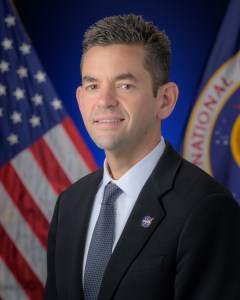
NASA Administrator Jared Isaacman
NASA Administrator Jared Isaacman