
惯性聚合 高效追踪和阅读你感兴趣的博客、新闻、科技资讯
阅读原文 在惯性聚合中打开

推荐订阅源

Security Archives - TechRepublic
Project Zero
Project Zero
K
Kaspersky official blog
G
Google Developers Blog
T
Threat Research - Cisco Blogs
T
The Blog of Author Tim Ferriss
Cyberwarzone
Cyberwarzone
Y
Y Combinator Blog
Recorded Future
Recorded Future
Blog — PlanetScale
Blog — PlanetScale
Threat Intelligence Blog | Flashpoint
Cisco Talos Blog
Cisco Talos Blog
Latest news
Latest news
Microsoft Security Blog
H
Help Net Security
S
Schneier on Security
P
Palo Alto Networks Blog
H
Hacker News: Front Page
N
News and Events Feed by Topic
N
Netflix TechBlog - Medium
博客园 - Franky
OSCHINA 社区最新新闻
OSCHINA 社区最新新闻
SecWiki News
SecWiki News
Cloudbric
Cloudbric
TaoSecurity Blog
TaoSecurity Blog
CTFtime.org: upcoming CTF events
The Hacker News
The Hacker News
C
Check Point Blog
L
LangChain Blog
腾讯CDC
小众软件
小众软件
T
Tenable Blog
Google DeepMind News
GbyAI
GbyAI
L
LINUX DO - 最新话题
A
About on SuperTechFans
Google Online Security Blog
C
Cisco Blogs
Recent Announcements
Hacker News: Ask HN
Hacker News: Ask HN
freeCodeCamp Programming Tutorials: Python, JavaScript, Git & More
Vercel News
Vercel News
雷峰网
雷峰网
美团技术团队
D
DataBreaches.Net
Martin Fowler
Martin Fowler
Help Net Security
Help Net Security
钛媒体:引领未来商业与生活新知
钛媒体:引领未来商业与生活新知
F
Full Disclosure
博客园_首页

NASA Science

Cosmic Origins at AAS 248, June 2026 - NASA Science Cosmic Structure SIG Seminar, 30 April 2026 - NASA Science CMB SAG Meeting, 24 April 2026 - NASA Science Integrated Modeling Virtual Institute (IMVI) - NASA Science BBX SAG Meeting, 30 April 2026 - NASA Science Early Career Investigator Program – Earth Science (ROSES A.11) - NASA Science XR SIG Seminar, 1 May 2026 - NASA Science Night and (Earth) Day - NASA SWERV: High-Impact Historical Case Study - NASA Science AAS Meeting 248, June 2026 - NASA Science Earth Day 2026: Posters and Virtual Backgrounds - NASA Science Advancing Earth Observation at NASA since Release of Earthrise Photo - NASA Science X-59 Adds Freedom 250 Logo - NASA Belts of Green in the Washington Suburbs - NASA Science Artemis II Mission Milestones: An Image and Video Recap Curiosity Blog, Sols 4867-4872: Sand Fill In Antofagasta Crater and Finding Our Next Drill Target NASA Invites Media to Jordan Artemis Accords Signing Ceremony New NASA Views of Earth, From (S)PACE - NASA Science Crew Studies Biotech on Tuesday to Advance Health and Space Economy NASA Invests in Small Businesses Innovating for Space and Earth NASA at SXSW: Johnson Director Vanessa Wyche on Why Artemis Changes Everything Researchers: How Would You Extract Meaningful Insights from Just Four Astronauts? BBX SAG Meeting, 23 April 2026 - NASA Science Thailand’s Krabi Coast - NASA Science AI/ML STIG Lecture Series, 20 April 2026 - NASA Science SWERV: Training Overview and Agenda - NASA Science SWERV: REAL-TIME CAPABILITIES AND IONOSPHERIC DISRUPTIONS OF COMMUNICATIONS - NASA Science SWERV: Operationally Significant Phenomena and Impacts for Ground Operations - NASA Science SWERV: Space Weather Impacts on Satellites - NASA Science SWERV: Space Weather Chain of Events - NASA Science CSDA Quality Assessment Report Evaluates Satellogic NewSat Data - NASA Science NASA Shuts Off Instrument on Voyager 1 to Keep Spacecraft Operating - NASA Science Webinar 4/29: NASA CSDA Program Vendor Focus- MDA Space - NASA Science Testing Begins for Katalyst-NASA Swift Boost Mission - NASA Science Robert Maiberger - NASA William Vantine - NASA Holly Stevens - NASA Dennis McSweeney - NASA Mark T. Vande Hei - NASA Nicole Stott - NASA William Shepherd - NASA Josef Schmid - NASA NASA, OPM Announce New NASA Force Website, Open Job Applications  - NASA Frank Groen - NASA Ginger Kerrick - NASA Daniel Heimerdinger - NASA Michael Greenfield - NASA Kevin Ford - NASA Charles Daniel - NASA Capt. Frank L. Culbertson, Jr., USN (Ret.) - NASA Spring Rains Saturate Michigan - NASA Science NASA CubeSat Begins Mission to Study Radio Waves in Space - NASA Correction to F.5 FINESST, SMD’s Graduate Student Research Opportunity - NASA Science Restoring NASA's Core Competencies - NASA Small Steps, Giant Leaps: Episode 171: How NASA's Pandora Mission Unboxes Distant Worlds - NASA Physics of the Cosmos PAG Meetings - NASA Science NASA Science Veg-06: How plants and beneficial bacteria work together in microgravity Virtual Engineering & Spacecraft Flight Applications (VESFA) - NASA NASA Heliophysics Spacecraft Witness Comet’s Demise - NASA Science BBX SAG Meeting, 16 April 2026 - NASA Science NASA Invites Media to Latvia Artemis Accords Signing Ceremony - NASA Weak Lensing  - NASA Science At the Edge of Light - NASA NASA’s Mobile Launcher Rolls Ahead of Artemis III Preparation - NASA XR SIG Meeting, 27 April 2026 - NASA Science CRN SIG Meeting, 27 April 2026 - NASA Science GW SIG Seminar, 28 April 2026 - NASA Science Eyeing the Richat Structure - NASA Science I Am Artemis: Rebekah Tolatovicz - NASA NASA Selects Voyager for Seventh Private Mission to Space Station - NASA NASA Launches Six CubeSats to International Space Station Odyssey Celebrates 25 Years - NASA Science Crew Begins New Space Research and Installs New Science Gear - NASA NASA’s X-59 Completes First Wheels-Up Flight 2026 NSTA Hyperwall Schedule - NASA Science Update: Artemis II Crew Comes Home - NASA GW SIG Seminar, 14 April 2026 - NASA Science GR SIG Seminar, 17 April 2026 - NASA Science Vianni Ricano Cadenas Super Typhoon Sinlaku - NASA Science DGCE SIG Seminar, 23 April 2026 - NASA Science AI/ML STIG Lecture Series, 13 April 2026 - NASA Science NASA Night-light Imagery Tracks US Energy Transition, Global Volatility - NASA Science Hubble Completion Study 2012 - NASA Science Hubble Spies an Active Spiral - NASA Science Science with the Hubble and James Webb Space Telescopes VIII: Enriching the Universe: From Primordial Megaberg Ends Its Long Odyssey at Sea - NASA Science Artemis II Astronauts Back in Houston, Reunite with Families  - NASA Cygnus XL Cargo Craft Solar Arrays Deploy Powering Flight to Station - NASA Cygnus XL Cargo Craft Launches to Resupply Expedition 74 Crew - NASA La NASA da la bienvenida a la Tierra a los exploradores lunares de Artemis II, quienes batieron récords - NASA NASA Science, Cargo Launch Aboard Northrop Grumman CRS-24 - NASA Artemis II Splashes Down - NASA Artemis II Flight Day 10: Crew Completes Final Burn Before Splashdown  - NASA NASA Welcomes Record-Setting Artemis II Moonfarers Back to Earth  - NASA Human Perception and Performance Laboratory - NASA Artemis II Splashdown and Recovery - NASA Crew Preps for Cygnus XL Cargo Mission Targeted for Saturday Launch - NASA New Perspective of Home - NASA Artemis II Flight Day 10: Crew Sets for Final Burn, Splashdown - NASA
NASA's Webb Redefines Dividing Line Between Planets, Stars - NASA Science
2026-04-14 · via NASA Science

Planets, like those in our solar system, form in a bottom-up process where small bits of rock and ice clump together and grow larger over time. But the heftier the planet, the harder it is to explain its formation that way.

Astronomers used NASA’s James Webb Space Telescope to examine 29 Cygni b, an object about 15 times as massive as Jupiter orbiting a nearby star. They found multiple lines of evidence that 29 Cygni b indeed formed from this bottom-up process, bringing new insights into how the heftiest planets come to be. A paper describing these findings published Tuesday in The Astrophysical Journal Letters.

The planet formation process is broadly understood to occur within gigantic disks of gas and dust around stars through a process called accretion. Dust gloms together into pebbles, which collide and grow larger and larger, forming protoplanets and eventually planets. The largest then collect gas to become giants like Jupiter. Since it takes more time for gas giants to form, and the disk of planet-forming material eventually evaporates and disappears, planetary systems end up with many more small planets than large planets.

In contrast, stars form when a vast cloud of gas fragments and each piece collapses under its own gravity, growing smaller and denser. A similar fragmentation process could theoretically occur within protoplanetary disks as well. That could explain why some very massive objects are found billions of miles from their host stars, in regions where the protoplanetary disk should have been too tenuous for accretion to occur.
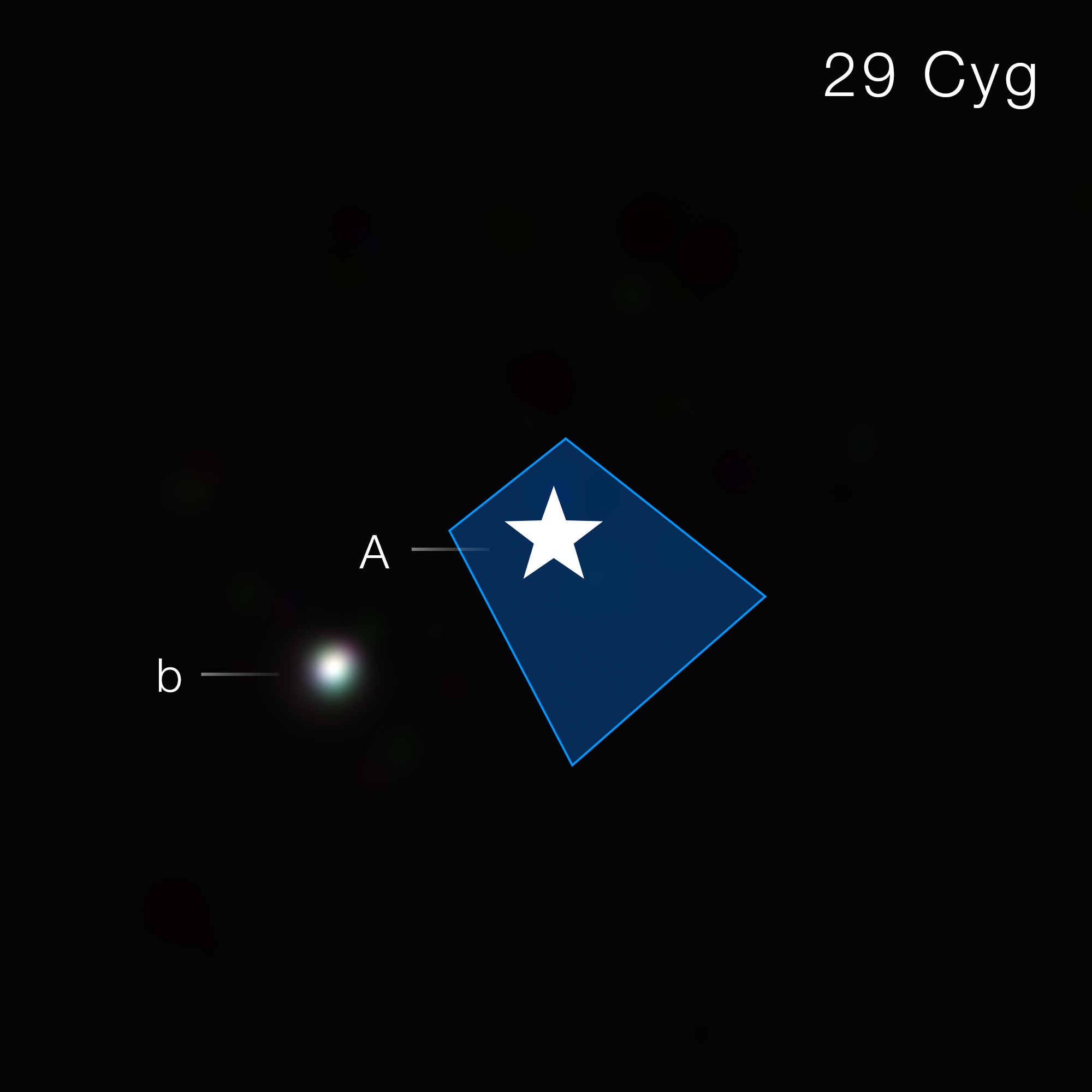
A black square labeled “29 Cyg” at upper right. In the middle, a white star symbol is surrounded by a small blue trapezoid that widens from upper left to lower right of the star. The star is labeled with a capital A. The trapezoid indicates where the star’s light has been blocked by a coronagraph. To the star’s left beyond the blue trapezoid at 8 o’clock is a fuzzy white blob labeled with a lower-case b.

Astronomers used NASA’s James Webb Space Telescope to directly image 29 Cygni b, which weighs 15 times Jupiter. They found evidence for heavy chemical elements like carbon and oxygen, which strongly suggests it formed like a planet by accretion within a protoplanetary disk.

Image: NASA, ESA, CSA, William Balmer (JHU, STScI), Laurent Pueyo (STScI); Image Processing: Alyssa Pagan (STScI)

29 Cygni b sits on the dividing line between what can be explained by these two different mechanisms. It weighs 15 times Jupiter and orbits its star at an average distance of 1.5 billion miles (2.4 billion kilometers), about the same as Uranus in our solar system. The research team targeted it because it could potentially result from either process.

“In computer models, it’s very easy for fragmentation in a disk to run away to much higher masses than 29 Cygni b. This is the lowest mass you could plausibly get. But at the same time, it’s about the highest mass you could get from accretion,” said lead author William Balmer of the Johns Hopkins University and the Space Telescope Science Institute, both in Baltimore.

Balmer’s observing program used Webb’s NIRCam (Near-Infrared Camera) in its coronagraphic mode to directly image 29 Cygni b. This planet was the first of four objects targeted by the program, all of which are known to weigh between 1 and 15 times as much as Jupiter. The team also required their targets to orbit within about 9 billion miles (15 billion kilometers) of their stars. 

The planets were all young and still hot from their formation, ranging in temperature from about 1,000 to 1,900 degrees Fahrenheit (530 to 1,000 degrees Celsius). This would ensure their atmospheric chemistry was similar to the planets of HR 8799, whose system Balmer studied previously

By choosing appropriate filters, the team was able to look for signs of light being absorbed by carbon dioxide (CO2) and carbon monoxide (CO), which allowed them to determine the amount of those heavier chemical elements, which astronomers collectively call metals.

They found strong evidence that 29 Cygni b is enriched in metals relative to its host star, which is similar to our Sun in its composition. Given the planet’s mass, the amount of heavy elements it contains is equivalent to about 150 Earths. This suggests that it accreted large amounts of metal-enriched solids from a protoplanetary disk.
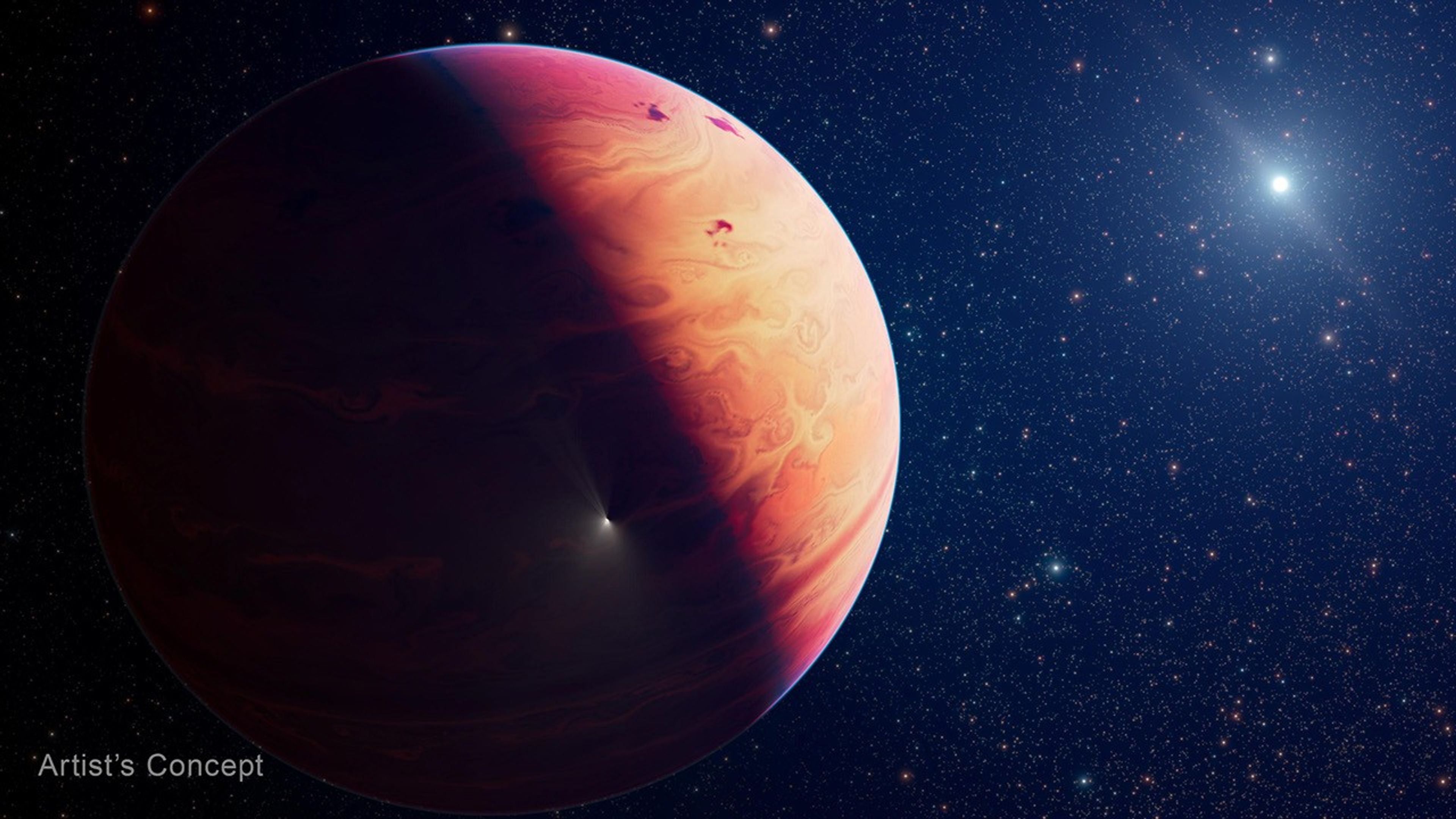
At left, an illustration shows a gas giant exoplanet whose right half is illuminated while the left half is in shadow. It is mostly orange shading to pinks and purples at the two poles and shows swirling bands of clouds. Three dark splotches on its upper right show locations where comet fragments impacted the cloudtops, and another incoming comet fragment is seen as a bright spot against the nightside. The planet is against a black background speckled with stars. In the upper right corner of the image shines a small white blob representing its host star. A faint edge-on disk of dust extending from 10 o’clock to 4 o’clock on the star is also white. The words “Artist’s Concept” are at lower left.

Exoplanet 29 Cygni b, seen in this artist’s concept, is a gas giant weighing about 15 times the mass of Jupiter. Astronomers studied 29 Cygni b with NASA’s James Webb Space Telescope. They determined that it likely formed from accretion rather than disk fragmentation.

Illustration: NASA, ESA, CSA, Joseph Olmsted (STScI)

The team also used a ground-based optical telescope array called CHARA (Center for High Angular Resolution Astronomy) to determine if the planet’s orbit is aligned with the spin of the star. They confirmed that alignment, which would be expected for an object that formed from a protoplanetary disk.

“We were able to update the planet’s orbit, and also observed the host star to determine its orientation with respect to that orbit,” said Ash Messier, co-author and a graduate student at Johns Hopkins University. “We showed that the inclination of the planet is well-aligned with the spin axis of the star, which is similar to what we see for the planets of our solar system.”

“Put together, this evidence strongly suggests that 29 Cygni b formed within a protoplanetary disk through rapid accretion of metal-rich material, rather than through gas fragmentation,” said Balmer. “In other words, it formed like a planet and not like a star.”

As the team gathers data on the other three targets within their program, they plan to look for evidence of compositional differences between the lower-mass and higher-mass planets. This should provide additional insights into their formation mechanisms.

The James Webb Space Telescope is the world’s premier space science observatory. Webb is solving mysteries in our solar system, looking beyond to distant worlds around other stars, and probing the mysterious structures and origins of our universe and our place in it. Webb is an international program led by NASA with its partners, ESA (European Space Agency) and CSA (Canadian Space Agency).

To learn more about Webb, visit:

https://science.nasa.gov/webb

The following sections contain links to download this article's images and videos in all available resolutions followed by related information links, media contacts, and if available, research paper and Spanish translation links.