
惯性聚合 高效追踪和阅读你感兴趣的博客、新闻、科技资讯
阅读原文 在惯性聚合中打开

推荐订阅源

P
Palo Alto Networks Blog
P
Proofpoint News Feed
GbyAI
GbyAI
Microsoft Azure Blog
B
Blog
Google DeepMind News
N
Netflix TechBlog - Medium
Recorded Future
Recorded Future
M
MIT News - Artificial intelligence
罗磊的独立博客
J
Java Code Geeks
月光博客
月光博客
F
Full Disclosure
博客园 - 聂微东
人人都是产品经理
人人都是产品经理
U
Unit 42
WordPress大学
WordPress大学
A
About on SuperTechFans
C
Cyber Attacks, Cyber Crime and Cyber Security
SecWiki News
SecWiki News
Security Latest
Security Latest
C
Check Point Blog
C
CERT Recently Published Vulnerability Notes
小众软件
小众软件
I
InfoQ
钛媒体:引领未来商业与生活新知
钛媒体:引领未来商业与生活新知
B
Blog RSS Feed
V
Visual Studio Blog
博客园_首页
NISL@THU
NISL@THU
I
Intezer
Spread Privacy
Spread Privacy
AWS News Blog
AWS News Blog
The Register - Security
D
Darknet – Hacking Tools, Hacker News & Cyber Security
Latest news
Latest news
Project Zero
Project Zero
博客园 - 叶小钗
C
Cybersecurity and Infrastructure Security Agency CISA
Threat Intelligence Blog | Flashpoint
P
Privacy International News Feed
博客园 - 【当耐特】
cs.CL updates on arXiv.org
T
Threat Research - Cisco Blogs
Simon Willison's Weblog
T
Tor Project blog
V
Vulnerabilities – Threatpost
博客园 - 司徒正美
freeCodeCamp Programming Tutorials: Python, JavaScript, Git & More
雷峰网
雷峰网

NASA Science

Cosmic Origins at AAS 248, June 2026 - NASA Science Cosmic Structure SIG Seminar, 30 April 2026 - NASA Science CMB SAG Meeting, 24 April 2026 - NASA Science BBX SAG Meeting, 30 April 2026 - NASA Science Early Career Investigator Program – Earth Science (ROSES A.11) - NASA Science XR SIG Seminar, 1 May 2026 - NASA Science Night and (Earth) Day - NASA SWERV: High-Impact Historical Case Study - NASA Science AAS Meeting 248, June 2026 - NASA Science Earth Day 2026: Posters and Virtual Backgrounds - NASA Science Advancing Earth Observation at NASA since Release of Earthrise Photo - NASA Science X-59 Adds Freedom 250 Logo - NASA Belts of Green in the Washington Suburbs - NASA Science Artemis II Mission Milestones: An Image and Video Recap Curiosity Blog, Sols 4867-4872: Sand Fill In Antofagasta Crater and Finding Our Next Drill Target NASA Invites Media to Jordan Artemis Accords Signing Ceremony New NASA Views of Earth, From (S)PACE - NASA Science Crew Studies Biotech on Tuesday to Advance Health and Space Economy NASA Invests in Small Businesses Innovating for Space and Earth NASA at SXSW: Johnson Director Vanessa Wyche on Why Artemis Changes Everything Researchers: How Would You Extract Meaningful Insights from Just Four Astronauts? BBX SAG Meeting, 23 April 2026 - NASA Science Thailand’s Krabi Coast - NASA Science AI/ML STIG Lecture Series, 20 April 2026 - NASA Science SWERV: Training Overview and Agenda - NASA Science SWERV: REAL-TIME CAPABILITIES AND IONOSPHERIC DISRUPTIONS OF COMMUNICATIONS - NASA Science SWERV: Operationally Significant Phenomena and Impacts for Ground Operations - NASA Science SWERV: Space Weather Impacts on Satellites - NASA Science SWERV: Space Weather Chain of Events - NASA Science CSDA Quality Assessment Report Evaluates Satellogic NewSat Data - NASA Science NASA Shuts Off Instrument on Voyager 1 to Keep Spacecraft Operating - NASA Science Webinar 4/29: NASA CSDA Program Vendor Focus- MDA Space - NASA Science Testing Begins for Katalyst-NASA Swift Boost Mission - NASA Science Robert Maiberger - NASA William Vantine - NASA Holly Stevens - NASA Dennis McSweeney - NASA Mark T. Vande Hei - NASA Nicole Stott - NASA William Shepherd - NASA Josef Schmid - NASA NASA, OPM Announce New NASA Force Website, Open Job Applications  - NASA Frank Groen - NASA Ginger Kerrick - NASA Daniel Heimerdinger - NASA Michael Greenfield - NASA Kevin Ford - NASA Charles Daniel - NASA Capt. Frank L. Culbertson, Jr., USN (Ret.) - NASA Spring Rains Saturate Michigan - NASA Science NASA CubeSat Begins Mission to Study Radio Waves in Space - NASA Correction to F.5 FINESST, SMD’s Graduate Student Research Opportunity - NASA Science Restoring NASA's Core Competencies - NASA Small Steps, Giant Leaps: Episode 171: How NASA's Pandora Mission Unboxes Distant Worlds - NASA Physics of the Cosmos PAG Meetings - NASA Science NASA Science Veg-06: How plants and beneficial bacteria work together in microgravity Virtual Engineering & Spacecraft Flight Applications (VESFA) - NASA NASA Heliophysics Spacecraft Witness Comet’s Demise - NASA Science BBX SAG Meeting, 16 April 2026 - NASA Science NASA Invites Media to Latvia Artemis Accords Signing Ceremony - NASA Weak Lensing  - NASA Science At the Edge of Light - NASA NASA’s Mobile Launcher Rolls Ahead of Artemis III Preparation - NASA XR SIG Meeting, 27 April 2026 - NASA Science CRN SIG Meeting, 27 April 2026 - NASA Science GW SIG Seminar, 28 April 2026 - NASA Science Eyeing the Richat Structure - NASA Science I Am Artemis: Rebekah Tolatovicz - NASA NASA Selects Voyager for Seventh Private Mission to Space Station - NASA NASA Launches Six CubeSats to International Space Station Odyssey Celebrates 25 Years - NASA Science Crew Begins New Space Research and Installs New Science Gear - NASA NASA’s X-59 Completes First Wheels-Up Flight 2026 NSTA Hyperwall Schedule - NASA Science Update: Artemis II Crew Comes Home - NASA GW SIG Seminar, 14 April 2026 - NASA Science GR SIG Seminar, 17 April 2026 - NASA Science NASA's Webb Redefines Dividing Line Between Planets, Stars - NASA Science Vianni Ricano Cadenas Super Typhoon Sinlaku - NASA Science DGCE SIG Seminar, 23 April 2026 - NASA Science AI/ML STIG Lecture Series, 13 April 2026 - NASA Science NASA Night-light Imagery Tracks US Energy Transition, Global Volatility - NASA Science Hubble Completion Study 2012 - NASA Science Hubble Spies an Active Spiral - NASA Science Science with the Hubble and James Webb Space Telescopes VIII: Enriching the Universe: From Primordial Megaberg Ends Its Long Odyssey at Sea - NASA Science Artemis II Astronauts Back in Houston, Reunite with Families  - NASA Cygnus XL Cargo Craft Solar Arrays Deploy Powering Flight to Station - NASA Cygnus XL Cargo Craft Launches to Resupply Expedition 74 Crew - NASA La NASA da la bienvenida a la Tierra a los exploradores lunares de Artemis II, quienes batieron récords - NASA NASA Science, Cargo Launch Aboard Northrop Grumman CRS-24 - NASA Artemis II Splashes Down - NASA Artemis II Flight Day 10: Crew Completes Final Burn Before Splashdown  - NASA NASA Welcomes Record-Setting Artemis II Moonfarers Back to Earth  - NASA Human Perception and Performance Laboratory - NASA Artemis II Splashdown and Recovery - NASA Crew Preps for Cygnus XL Cargo Mission Targeted for Saturday Launch - NASA New Perspective of Home - NASA Artemis II Flight Day 10: Crew Sets for Final Burn, Splashdown - NASA
Hubble Survey Sets Up Roman’s Future Look Near Milky Way’s Center - NASA Science
Andrea Giano · 2026-05-11 · via NASA Science

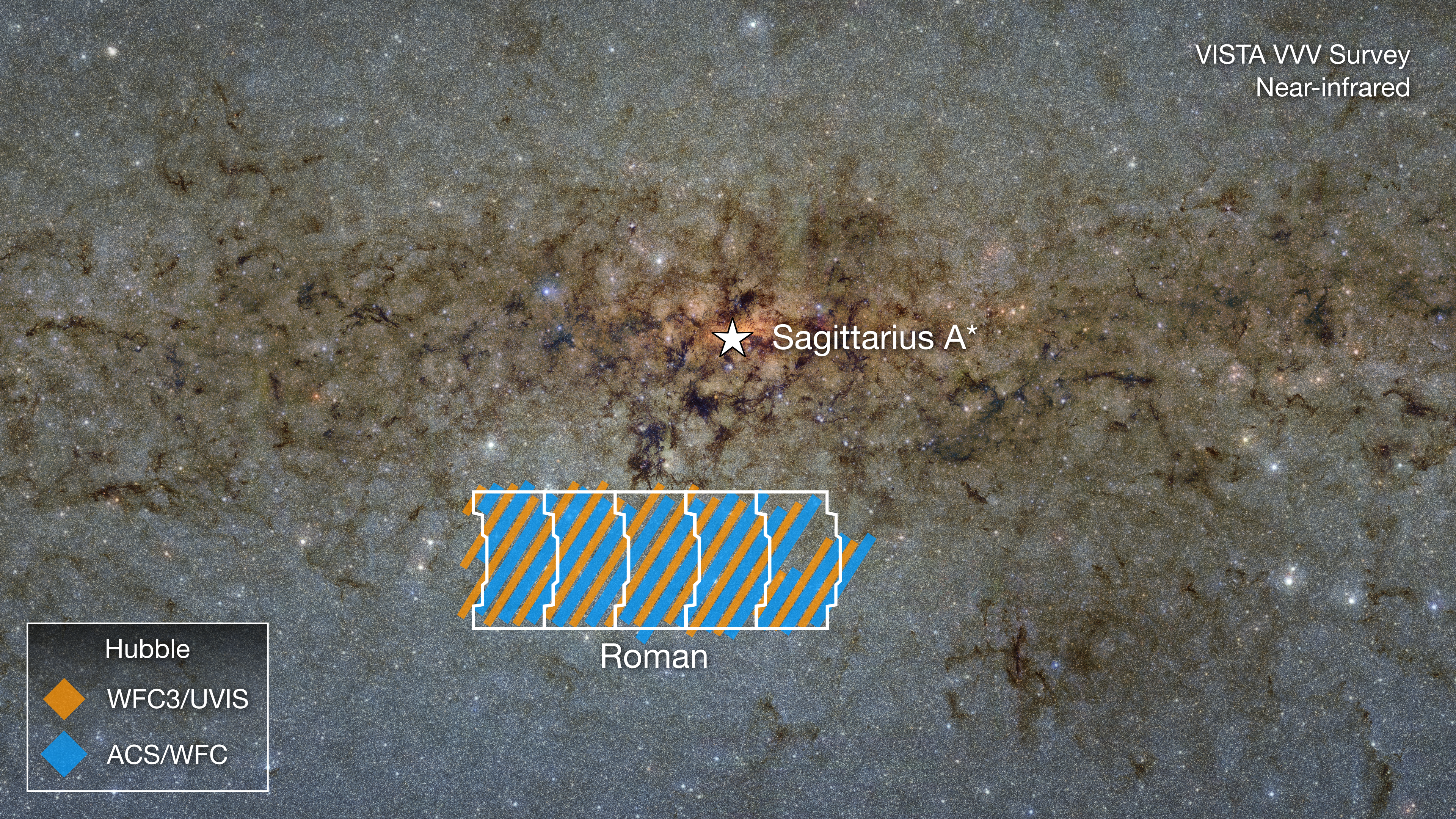
An observation (labeled “VISTA V V V Survey, Near-infrared) of the Milky Way’s center pointing toward its supermassive black hole, which is labeled Sagittarius A* (pronounced “A star”). At 7 o’clock from center is a small region, outlined with 5 fields of view from the Nancy Grace Roman Space Telescope that are stacked together in a horizontal rectangle. This region is about a third of the image in length and a fifth of the image in width. Within that same region are diagonal lines that alternate between orange and blue. A legend at the bottom left shows two Hubble instruments. One of them, marked with an orange diamond, is labeled “W F C 3 / U V I S.” The other, marked with a blue diamond, is labeled “A C S / W F C.” The background is a field of stars, gas, and dust that appear grey, except the center third that runs from the left to the right of the frame, which is composed of brown filaments of dust and gas. The tiny region surrounding Sagittarius A star appears orange.

This VISTA VVV Survey image shows the galactic bulge near Sagittarius A*, the supermassive black hole at the Milky Way’s center. A region planned for observation by NASA’s Nancy Grace Roman Space Telescope is outlined. This area has been observed by NASA’s Hubble Space Telescope.

Image: NASA, Alyssa Pagan (STScI); Acknowledgment: VISTA, Dante Minniti (UNAB), Ignacio Toledo (ALMA), Martin Kornmesser (ESO)

The Milky Way’s galactic bulge, the bulbous region that surrounds the galactic center, contains a dense collection of stars, planets, and other free-floating objects. This region has been studied for decades with numerous ground-based and space-based telescopes, including NASA’s Hubble and James Webb space telescopes. Soon, NASA’s Nancy Grace Roman Space Telescope will be the first to make studying the galactic bulge a part of its core science objectives, building on the data collected from all observatories before it. Roman’s field of view will cover more area at a far faster cadence than previous space telescopes, allowing it to survey millions of stars and find thousands of new exoplanets.

To support Roman in characterizing numerous stars and planets, astronomers sought to use Hubble to observe many of the same areas of the galactic bulge that Roman will observe in its core Galactic Bulge Time-Domain Survey. By comparing Hubble data taken months or years earlier to new Roman data, astronomers will be better able to interpret Roman’s forthcoming observations. The Roman telescope team is targeting as soon as early September 2026 for launch.

“A top priority of our Hubble survey is to cover as much sky area as possible,” said Sean Terry, project lead and assistant research scientist from the University of Maryland, College Park and NASA’s Goddard Space Flight Center in Greenbelt.

A paper about the team’s work published May 11, 2026 in the Astrophysical Journal.

Many planetary systems within the Milky Way evolve much like our solar system did, beginning with the collapse of a cosmic gas cloud, the growth of a star, and the formation of surrounding planets. However, in some systems, different events can result in a planet being ejected from the system where it formed. Hundreds of these “rogue planets” will be detected by Roman’s Galactic Bulge Time-Domain Survey, in addition to previously unseen, isolated neutron stars, and even black holes with masses similar to our Sun.

This survey consists of six 72-day observing seasons during which Roman will take a snapshot every 12 minutes of a large portion of the bulge (approximately 1.7 square degrees of the region, or the area of 8.5 full moons). While it will detect a variety of targets, the survey is optimized to look for a specific type of event known as microlensing.

Microlensing events, a type of gravitational lensing event, occur when the light from a more distant object is warped by the mass of a closer object along the line of sight. These events occur on a much smaller scale than larger lensing events (on the order of individual stars instead of galaxies or galaxy clusters) and allow us to search for exoplanets between us and the densely packed stars within the galactic bulge.

“The great thing about microlensing is that we’ll be able to do a complete census of objects as small as Mars that are moving between us and these fields in the bulge, no matter what it is,” said co-author Jay Anderson of the Space Telescope Science Institute in Baltimore.

When a telescope observes a lensing object, such as a bright star, aligning with a star in the galactic bulge, it can be difficult for astronomers to decipher which of the two the starlight comes from. Therefore, timing is a key consideration. If astronomers can identify light sources separately before a microlensing event occurs, it becomes far easier to disentangle them.

To collect this pre-Roman data, astronomers used the Hubble Space Telescope to conduct a large-scale survey, which began in the spring of 2025, covering much of the same area that Roman will observe in the Galactic Bulge Time-Domain Survey. The size of this program is even larger than two previous surveys (each around 0.5 square degrees) that led to Hubble’s largest mosaic, that of our neighboring Andromeda galaxy, which took over 10 years to assemble.

“The main goal of these observations is to be able to identify objects that participate in lensing events during the Roman survey, catching them before they undergo the lensing event,” said Anderson. “When, in a couple of years, an event happens during Roman's long stare at the field, we can go back and say, ‘This was a red star, this was a blue star, and the event happened when the red star went in front of the blue star.’”

The data from Hubble also will help shape the analysis of the lensing objects themselves. The microlensing event itself measures only a ratio of the masses of a host star and its planet. With data from stars before or after their microlensing events, however, scientists would be able to measure the stars’ individual masses, echoing the way Hubble previously determined the mass of a star and its planet in the Milky Way. This method turns a more opaque measurement of the relationship between a star and its planet into one far more certain. 

“Instead of estimating a mass ratio of a planet that's orbiting a star, we can say that we're confident it's a Saturn-mass planet orbiting a star that's 0.8 solar masses, for example,” Terry said. “So with the help of precursor imaging from Hubble you can hope to get direct measurements of the masses as opposed to indirect mass ratios.”

While exoplanet discovery is a large part of Roman’s Galactic Bulge Time-Domain Survey, observing such a large area with Hubble also can help identify areas of extinction, dense pockets of dust and gas that absorb or scatter light, allowing us to create maps detailing where we can see stars and where we can’t.

Hubble’s survey also has provided the crucial beginning of a brand-new catalog of stars, which will help astronomers characterize the host stars of exoplanets discovered by Roman. The research team predicts Roman will add to Hubble’s star catalog by an order of magnitude.

“This Hubble survey will build a catalog of 20 to 30 million point sources,” said Terry. “But, by the end of the Galactic Bulge Time-Domain Survey, Roman may measure about 200 to 300 million, and it will produce, essentially, some of the deepest images ever taken of any part of the sky.”

The data from the most recent Hubble survey is available in the Mikulski Archive for Space Telescopes.

The Hubble Space Telescope has been operating for over three decades and continues to make ground-breaking discoveries that shape our fundamental understanding of the universe. Hubble is a project of international cooperation between NASA and ESA (European Space Agency). NASA Goddard manages the telescope and mission operations. Lockheed Martin Space, based in Denver, also supports mission operations at Goddard. The Space Telescope Science Institute in Baltimore, which is operated by the Association of Universities for Research in Astronomy, conducts Hubble science operations for NASA. 

The Nancy Grace Roman Space Telescope is managed at NASA Goddard with participation by NASA's Jet Propulsion Laboratory in Southern California; Caltech/IPAC in Pasadena, California; the Space Telescope Science Institute; and a science team comprising scientists from various research institutions. The primary industrial partners are BAE Systems, Inc. in Boulder, Colorado; L3Harris Technologies in Melbourne, Florida; and Teledyne Scientific & Imaging in Thousand Oaks, California.