



惯性聚合 高效追踪和阅读你感兴趣的博客、新闻、科技资讯
阅读原文 在惯性聚合中打开

推荐订阅源

cs.AI updates on arXiv.org
Schneier on Security
cs.CV updates on arXiv.org
Attack and Defense Labs
H
Hacker News: Front Page
Google DeepMind News
雷峰网
雷峰网
C
CXSECURITY Database RSS Feed - CXSecurity.com
Cisco Talos Blog
Cisco Talos Blog
T
Tenable Blog
G
Google Developers Blog
A
About on SuperTechFans
The Cloudflare Blog
S
Securelist
OSCHINA 社区最新新闻
OSCHINA 社区最新新闻
C
Cisco Blogs
H
Hackread – Cybersecurity News, Data Breaches, AI and More
aimingoo的专栏
aimingoo的专栏
云风的 BLOG
云风的 BLOG
Forbes - Security
Forbes - Security
腾讯CDC
Application and Cybersecurity Blog
V
Vulnerabilities – Threatpost
IT之家
IT之家
博客园_首页
P
Proofpoint News Feed
P
Privacy & Cybersecurity Law Blog
C
Cyber Attacks, Cyber Crime and Cyber Security
Project Zero
Project Zero
月光博客
月光博客
NISL@THU
NISL@THU
爱范儿
爱范儿
S
Secure Thoughts
K
Kaspersky official blog
Security Latest
Security Latest
T
Tailwind CSS Blog
博客园 - Franky
D
Darknet – Hacking Tools, Hacker News & Cyber Security
TaoSecurity Blog
TaoSecurity Blog
The GitHub Blog
The GitHub Blog
Microsoft Azure Blog
B
Blog RSS Feed
S
SegmentFault 最新的问题
H
Help Net Security
T
Tor Project blog
L
LINUX DO - 热门话题
S
Security @ Cisco Blogs
N
News and Events Feed by Topic
O
OpenAI News
S
Schneier on Security

NASA Science

Cosmic Origins at AAS 248, June 2026 - NASA Science Cosmic Structure SIG Seminar, 30 April 2026 - NASA Science CMB SAG Meeting, 24 April 2026 - NASA Science BBX SAG Meeting, 30 April 2026 - NASA Science Early Career Investigator Program – Earth Science (ROSES A.11) - NASA Science XR SIG Seminar, 1 May 2026 - NASA Science Night and (Earth) Day - NASA SWERV: High-Impact Historical Case Study - NASA Science AAS Meeting 248, June 2026 - NASA Science Earth Day 2026: Posters and Virtual Backgrounds - NASA Science Advancing Earth Observation at NASA since Release of Earthrise Photo - NASA Science X-59 Adds Freedom 250 Logo - NASA Belts of Green in the Washington Suburbs - NASA Science Artemis II Mission Milestones: An Image and Video Recap Curiosity Blog, Sols 4867-4872: Sand Fill In Antofagasta Crater and Finding Our Next Drill Target NASA Invites Media to Jordan Artemis Accords Signing Ceremony New NASA Views of Earth, From (S)PACE - NASA Science Crew Studies Biotech on Tuesday to Advance Health and Space Economy NASA Invests in Small Businesses Innovating for Space and Earth NASA at SXSW: Johnson Director Vanessa Wyche on Why Artemis Changes Everything Researchers: How Would You Extract Meaningful Insights from Just Four Astronauts? BBX SAG Meeting, 23 April 2026 - NASA Science Thailand’s Krabi Coast - NASA Science AI/ML STIG Lecture Series, 20 April 2026 - NASA Science SWERV: Training Overview and Agenda - NASA Science SWERV: REAL-TIME CAPABILITIES AND IONOSPHERIC DISRUPTIONS OF COMMUNICATIONS - NASA Science SWERV: Operationally Significant Phenomena and Impacts for Ground Operations - NASA Science SWERV: Space Weather Impacts on Satellites - NASA Science SWERV: Space Weather Chain of Events - NASA Science CSDA Quality Assessment Report Evaluates Satellogic NewSat Data - NASA Science NASA Shuts Off Instrument on Voyager 1 to Keep Spacecraft Operating - NASA Science Webinar 4/29: NASA CSDA Program Vendor Focus- MDA Space - NASA Science Testing Begins for Katalyst-NASA Swift Boost Mission - NASA Science Robert Maiberger - NASA William Vantine - NASA Holly Stevens - NASA Dennis McSweeney - NASA Mark T. Vande Hei - NASA Nicole Stott - NASA William Shepherd - NASA Josef Schmid - NASA NASA, OPM Announce New NASA Force Website, Open Job Applications  - NASA Frank Groen - NASA Ginger Kerrick - NASA Daniel Heimerdinger - NASA Michael Greenfield - NASA Kevin Ford - NASA Charles Daniel - NASA Capt. Frank L. Culbertson, Jr., USN (Ret.) - NASA Spring Rains Saturate Michigan - NASA Science NASA CubeSat Begins Mission to Study Radio Waves in Space - NASA Correction to F.5 FINESST, SMD’s Graduate Student Research Opportunity - NASA Science Restoring NASA's Core Competencies - NASA Small Steps, Giant Leaps: Episode 171: How NASA's Pandora Mission Unboxes Distant Worlds - NASA Physics of the Cosmos PAG Meetings - NASA Science NASA Science Veg-06: How plants and beneficial bacteria work together in microgravity Virtual Engineering & Spacecraft Flight Applications (VESFA) - NASA NASA Heliophysics Spacecraft Witness Comet’s Demise - NASA Science BBX SAG Meeting, 16 April 2026 - NASA Science NASA Invites Media to Latvia Artemis Accords Signing Ceremony - NASA Weak Lensing  - NASA Science At the Edge of Light - NASA NASA’s Mobile Launcher Rolls Ahead of Artemis III Preparation - NASA XR SIG Meeting, 27 April 2026 - NASA Science CRN SIG Meeting, 27 April 2026 - NASA Science GW SIG Seminar, 28 April 2026 - NASA Science Eyeing the Richat Structure - NASA Science I Am Artemis: Rebekah Tolatovicz - NASA NASA Selects Voyager for Seventh Private Mission to Space Station - NASA NASA Launches Six CubeSats to International Space Station Odyssey Celebrates 25 Years - NASA Science Crew Begins New Space Research and Installs New Science Gear - NASA NASA’s X-59 Completes First Wheels-Up Flight 2026 NSTA Hyperwall Schedule - NASA Science Update: Artemis II Crew Comes Home - NASA GW SIG Seminar, 14 April 2026 - NASA Science GR SIG Seminar, 17 April 2026 - NASA Science NASA's Webb Redefines Dividing Line Between Planets, Stars - NASA Science Vianni Ricano Cadenas Super Typhoon Sinlaku - NASA Science DGCE SIG Seminar, 23 April 2026 - NASA Science AI/ML STIG Lecture Series, 13 April 2026 - NASA Science NASA Night-light Imagery Tracks US Energy Transition, Global Volatility - NASA Science Hubble Completion Study 2012 - NASA Science Hubble Spies an Active Spiral - NASA Science Science with the Hubble and James Webb Space Telescopes VIII: Enriching the Universe: From Primordial Megaberg Ends Its Long Odyssey at Sea - NASA Science Artemis II Astronauts Back in Houston, Reunite with Families  - NASA Cygnus XL Cargo Craft Solar Arrays Deploy Powering Flight to Station - NASA Cygnus XL Cargo Craft Launches to Resupply Expedition 74 Crew - NASA La NASA da la bienvenida a la Tierra a los exploradores lunares de Artemis II, quienes batieron récords - NASA NASA Science, Cargo Launch Aboard Northrop Grumman CRS-24 - NASA Artemis II Splashes Down - NASA Artemis II Flight Day 10: Crew Completes Final Burn Before Splashdown  - NASA NASA Welcomes Record-Setting Artemis II Moonfarers Back to Earth  - NASA Human Perception and Performance Laboratory - NASA Artemis II Splashdown and Recovery - NASA Crew Preps for Cygnus XL Cargo Mission Targeted for Saturday Launch - NASA New Perspective of Home - NASA Artemis II Flight Day 10: Crew Sets for Final Burn, Splashdown - NASA
NASA's Webb Catches Exoplanet Getting Roasted - NASA Science
Stephen Sabia · 2026-06-17 · via NASA Science

One well-done gas giant, coming right up! That’s the latest from researchers analyzing NASA’s James Webb Space Telescope’s observations of HD 80606 b, an exoplanet four times the mass of Jupiter with an extremely elliptical orbit that sweeps close by its Sun-like star. The research team is presenting their study and preliminary findings Tuesday at the 248th meeting of the American Astronomical Society in Pasadena, California.

“Hot Jupiters are already considered some of the most extreme exoplanets we know of, but even among that population, HD 80606 b is one of the most extreme,” said Tiffany Kataria, the study’s principal investigator at NASA's Jet Propulsion Laboratory in Southern California. “We typically think of hot Jupiters as hot gas giants sitting right next to their stars, but this planet’s highly eccentric orbit creates a completely different beast.”

As the planet plunges close to its star, Webb shows its temperature skyrockets by 1,100 degrees Fahrenheit. Previous studies have shown that radical temperature swings can cause an exoplanet's chemistry and clouds to change in real time. According to the research team, the dynamic conditions of HD 80606 b make the planet an ideal target to observe these changes with Webb’s powerful instruments.
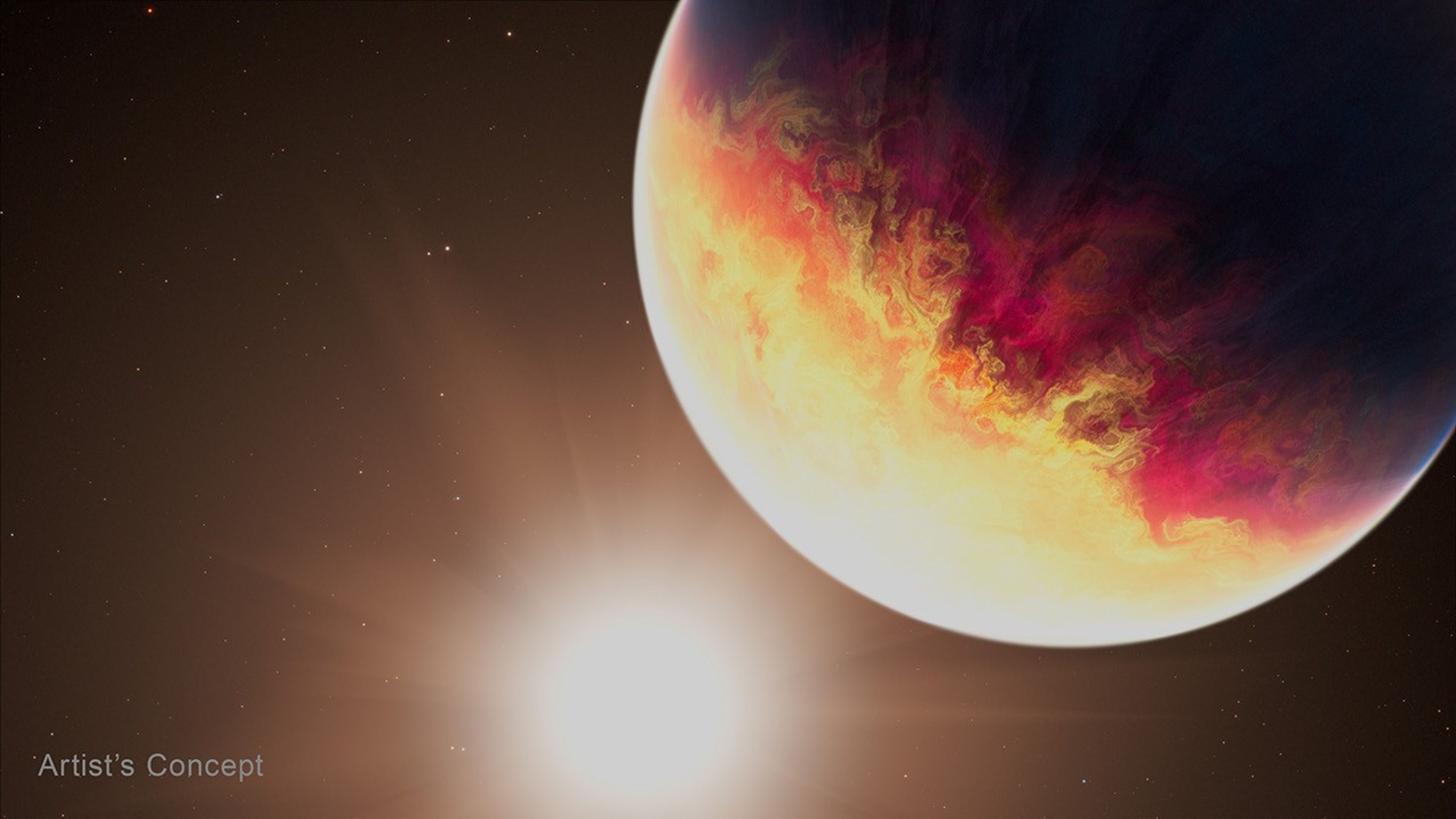
Illustration of a planet and a star, labeled artist’s concept at the bottom left. The planet fills more than a quarter of the image to the upper right, with the bright star to its lower left. The planet is white hot on the star side, fading to yellow that mixes with swirls of bright red across its middle, and eventually fading to black on the side most distant from the star. Distant stars dot the background of space, which is black near the edges of the frame.

This artist’s concept shows exoplanet HD 80606 b being “roasted” as its orbit approaches periastron, the point at which it is closest to its host star, which is similar to our Sun.

Artwork: NASA, ESA, CSA, Joseph Olmsted (STScI)

“Observing a planet like HD 80606 b is actually very efficient because its unusual orbit, with the corresponding swings in temperature and chemical composition, allow us to gather data under varying conditions in just hours and apply those findings to other hot Jupiters or more conventional exoplanets,” said Laura C. Mayorga, co-investigator on the study and an exoplanet astronomer at the Johns Hopkins Applied Physics Laboratory in Laurel, Maryland.

Measurements of temperature and chemical composition were done with spectroscopy, a technique scientists use to break light into its component colors to reveal information about the composition, temperature, motion, and physical properties of objects in space. The team used Webb’s MIRI (Mid-Infrared Instrument) for an extended observation of HD 80606 b before, during, and after its periastron, or closest pass by its star. During periastron, the planet also passed behind the star from Webb’s perspective in what’s known as a secondary eclipse. The observation was years in the planning, as scheduling the time to catch the planet at this point was complex given its extremely elliptical 111-day orbit, and Webb’s own restrictions on where it can look during specific times of the year, based on Earth’s position in orbit around the Sun.

Researchers say they have only begun to peel back the layers of an incredibly rich dataset, but they can clearly see a dramatic shift in the exoplanet’s temperature. “Webb has shown that the planet’s increase in temperature was even more extreme than we anticipated based on Spitzer data,” said Kataria.

In fact, the planet had already been dubbed the “roasted exoplanet” and even got its own poster in NASA’s popular series. NASA’s now-retired Spitzer Space Telescope laid the groundwork of infrared observations of HD 80606 b, showing that more detailed spectroscopic data from Webb would be especially compelling.

“Spitzer did amazing work on this exoplanet, and now Webb is building on that legacy by enabling us to drill down to distinguish specific chemical signatures like methane and carbon dioxide, which is just amazing progress,” said Ryan Challener, co-author and research associate at the Cornell Center for Astrophysics and Planetary Science. “There’s so much to learn from this one dataset here — we really are just getting started deciphering what Webb has to tell us.”

The James Webb Space Telescope is the world’s premier space science observatory. Webb is solving mysteries in our solar system, looking beyond to distant worlds around other stars, and probing the mysterious structures and origins of our universe and our place in it. Webb is an international program led by NASA with its partners, ESA (European Space Agency) and CSA (Canadian Space Agency).

For more information on Webb, visit:

science.nasa.gov/webb

The following sections contain links to download this article's images and videos in all available resolutions followed by related information links, media contacts, and if available, research paper and Spanish translation links.