


惯性聚合 高效追踪和阅读你感兴趣的博客、新闻、科技资讯
阅读原文 在惯性聚合中打开

推荐订阅源

Recent Announcements
freeCodeCamp Programming Tutorials: Python, JavaScript, Git & More
Last Week in AI
Last Week in AI
Scott Helme
Scott Helme
cs.AI updates on arXiv.org
L
LINUX DO - 最新话题
S
Security @ Cisco Blogs
Webroot Blog
Webroot Blog
S
Security Affairs
H
Hacker News: Front Page
TaoSecurity Blog
TaoSecurity Blog
W
WeLiveSecurity
G
GRAHAM CLULEY
T
Tenable Blog
Schneier on Security
S
Securelist
Cyberwarzone
Cyberwarzone
P
Privacy International News Feed
Exploit-DB.com RSS Feed
S
Schneier on Security
Hacker News - Newest:
Hacker News - Newest: "LLM"
Recent Commits to openclaw:main
O
OpenAI News
N
News and Events Feed by Topic
AWS News Blog
AWS News Blog
C
Cisco Blogs
T
Threat Research - Cisco Blogs
S
Secure Thoughts
大猫的无限游戏
大猫的无限游戏
C
Check Point Blog
The GitHub Blog
The GitHub Blog
G
Google Developers Blog
奇客Solidot–传递最新科技情报
奇客Solidot–传递最新科技情报
美团技术团队
Martin Fowler
Martin Fowler
Microsoft Security Blog
L
LangChain Blog
Apple Machine Learning Research
爱范儿
爱范儿
D
DataBreaches.Net
博客园_首页
MyScale Blog
MyScale Blog
博客园 - 叶小钗
博客园 - 三生石上(FineUI控件)
P
Proofpoint News Feed
J
Java Code Geeks
SecWiki News
SecWiki News
P
Palo Alto Networks Blog
Know Your Adversary
Know Your Adversary
cs.CL updates on arXiv.org

NASA Science

Cosmic Origins at AAS 248, June 2026 - NASA Science Cosmic Structure SIG Seminar, 30 April 2026 - NASA Science CMB SAG Meeting, 24 April 2026 - NASA Science BBX SAG Meeting, 30 April 2026 - NASA Science Early Career Investigator Program – Earth Science (ROSES A.11) - NASA Science XR SIG Seminar, 1 May 2026 - NASA Science Night and (Earth) Day - NASA SWERV: High-Impact Historical Case Study - NASA Science AAS Meeting 248, June 2026 - NASA Science Earth Day 2026: Posters and Virtual Backgrounds - NASA Science Advancing Earth Observation at NASA since Release of Earthrise Photo - NASA Science X-59 Adds Freedom 250 Logo - NASA Belts of Green in the Washington Suburbs - NASA Science Artemis II Mission Milestones: An Image and Video Recap Curiosity Blog, Sols 4867-4872: Sand Fill In Antofagasta Crater and Finding Our Next Drill Target NASA Invites Media to Jordan Artemis Accords Signing Ceremony New NASA Views of Earth, From (S)PACE - NASA Science Crew Studies Biotech on Tuesday to Advance Health and Space Economy NASA Invests in Small Businesses Innovating for Space and Earth NASA at SXSW: Johnson Director Vanessa Wyche on Why Artemis Changes Everything Researchers: How Would You Extract Meaningful Insights from Just Four Astronauts? BBX SAG Meeting, 23 April 2026 - NASA Science Thailand’s Krabi Coast - NASA Science AI/ML STIG Lecture Series, 20 April 2026 - NASA Science SWERV: Training Overview and Agenda - NASA Science SWERV: REAL-TIME CAPABILITIES AND IONOSPHERIC DISRUPTIONS OF COMMUNICATIONS - NASA Science SWERV: Operationally Significant Phenomena and Impacts for Ground Operations - NASA Science SWERV: Space Weather Impacts on Satellites - NASA Science SWERV: Space Weather Chain of Events - NASA Science CSDA Quality Assessment Report Evaluates Satellogic NewSat Data - NASA Science NASA Shuts Off Instrument on Voyager 1 to Keep Spacecraft Operating - NASA Science Webinar 4/29: NASA CSDA Program Vendor Focus- MDA Space - NASA Science Testing Begins for Katalyst-NASA Swift Boost Mission - NASA Science Robert Maiberger - NASA William Vantine - NASA Holly Stevens - NASA Dennis McSweeney - NASA Mark T. Vande Hei - NASA Nicole Stott - NASA William Shepherd - NASA Josef Schmid - NASA NASA, OPM Announce New NASA Force Website, Open Job Applications  - NASA Frank Groen - NASA Ginger Kerrick - NASA Daniel Heimerdinger - NASA Michael Greenfield - NASA Kevin Ford - NASA Charles Daniel - NASA Capt. Frank L. Culbertson, Jr., USN (Ret.) - NASA Spring Rains Saturate Michigan - NASA Science NASA CubeSat Begins Mission to Study Radio Waves in Space - NASA Correction to F.5 FINESST, SMD’s Graduate Student Research Opportunity - NASA Science Restoring NASA's Core Competencies - NASA Small Steps, Giant Leaps: Episode 171: How NASA's Pandora Mission Unboxes Distant Worlds - NASA Physics of the Cosmos PAG Meetings - NASA Science NASA Science Veg-06: How plants and beneficial bacteria work together in microgravity Virtual Engineering & Spacecraft Flight Applications (VESFA) - NASA NASA Heliophysics Spacecraft Witness Comet’s Demise - NASA Science BBX SAG Meeting, 16 April 2026 - NASA Science NASA Invites Media to Latvia Artemis Accords Signing Ceremony - NASA Weak Lensing  - NASA Science At the Edge of Light - NASA NASA’s Mobile Launcher Rolls Ahead of Artemis III Preparation - NASA XR SIG Meeting, 27 April 2026 - NASA Science CRN SIG Meeting, 27 April 2026 - NASA Science GW SIG Seminar, 28 April 2026 - NASA Science Eyeing the Richat Structure - NASA Science I Am Artemis: Rebekah Tolatovicz - NASA NASA Selects Voyager for Seventh Private Mission to Space Station - NASA NASA Launches Six CubeSats to International Space Station Odyssey Celebrates 25 Years - NASA Science Crew Begins New Space Research and Installs New Science Gear - NASA NASA’s X-59 Completes First Wheels-Up Flight 2026 NSTA Hyperwall Schedule - NASA Science Update: Artemis II Crew Comes Home - NASA GW SIG Seminar, 14 April 2026 - NASA Science GR SIG Seminar, 17 April 2026 - NASA Science NASA's Webb Redefines Dividing Line Between Planets, Stars - NASA Science Vianni Ricano Cadenas Super Typhoon Sinlaku - NASA Science DGCE SIG Seminar, 23 April 2026 - NASA Science AI/ML STIG Lecture Series, 13 April 2026 - NASA Science NASA Night-light Imagery Tracks US Energy Transition, Global Volatility - NASA Science Hubble Completion Study 2012 - NASA Science Hubble Spies an Active Spiral - NASA Science Science with the Hubble and James Webb Space Telescopes VIII: Enriching the Universe: From Primordial Megaberg Ends Its Long Odyssey at Sea - NASA Science Artemis II Astronauts Back in Houston, Reunite with Families  - NASA Cygnus XL Cargo Craft Solar Arrays Deploy Powering Flight to Station - NASA Cygnus XL Cargo Craft Launches to Resupply Expedition 74 Crew - NASA La NASA da la bienvenida a la Tierra a los exploradores lunares de Artemis II, quienes batieron récords - NASA NASA Science, Cargo Launch Aboard Northrop Grumman CRS-24 - NASA Artemis II Splashes Down - NASA Artemis II Flight Day 10: Crew Completes Final Burn Before Splashdown  - NASA NASA Welcomes Record-Setting Artemis II Moonfarers Back to Earth  - NASA Human Perception and Performance Laboratory - NASA Artemis II Splashdown and Recovery - NASA Crew Preps for Cygnus XL Cargo Mission Targeted for Saturday Launch - NASA New Perspective of Home - NASA Artemis II Flight Day 10: Crew Sets for Final Burn, Splashdown - NASA
Hubble Details Early Galaxy Transforming Neighborhood - NASA Science
Andrea Gianopoulos · 2026-06-23 · via NASA Science

Astronomers using NASA’s Hubble Space Telescope have found something they never expected — ultraviolet light from a galaxy that existed just 1.4 billion years after the big bang. That galaxy contains tightly clustered young stars that produce ionizing light capable of transforming the opaque, neutral gas within and immediately around the galaxy, clearing our view. This suggests that similar galaxies in the early universe were responsible for clearing the neutral fog of hydrogen gas that once filled the cosmos.

A paper describing this discovery was published June 23 in the Astrophysical Journal.

The galaxy, cataloged MXDFz4.4, existed at the end of the Era of Reionization, a transformative period in our universe. During roughly the first billion years of the cosmos, the gas between stars and galaxies was opaque to energetic ultraviolet light. As time wore on, gas everywhere became transparent or ionized. The changeover was not like an on/off switch, but likely took hundreds of millions of years. Researchers are still collecting evidence to fully understand how this happened, which is why MXDFz4.4 sets a critical precedent.

“Observing a galaxy like this was thought to be impossible,” said lead author Ilias Goovaerts, a postdoctoral fellow at the Space Telescope Science Institute (STScI) in Baltimore. “Researchers expected the ‘fog’ or neutral hydrogen that filled the early universe would be too thick and obscure our view of its ionizing light. Hubble not only spotted that light, but it also helped reveal incredible details about the galaxy’s characteristics.”
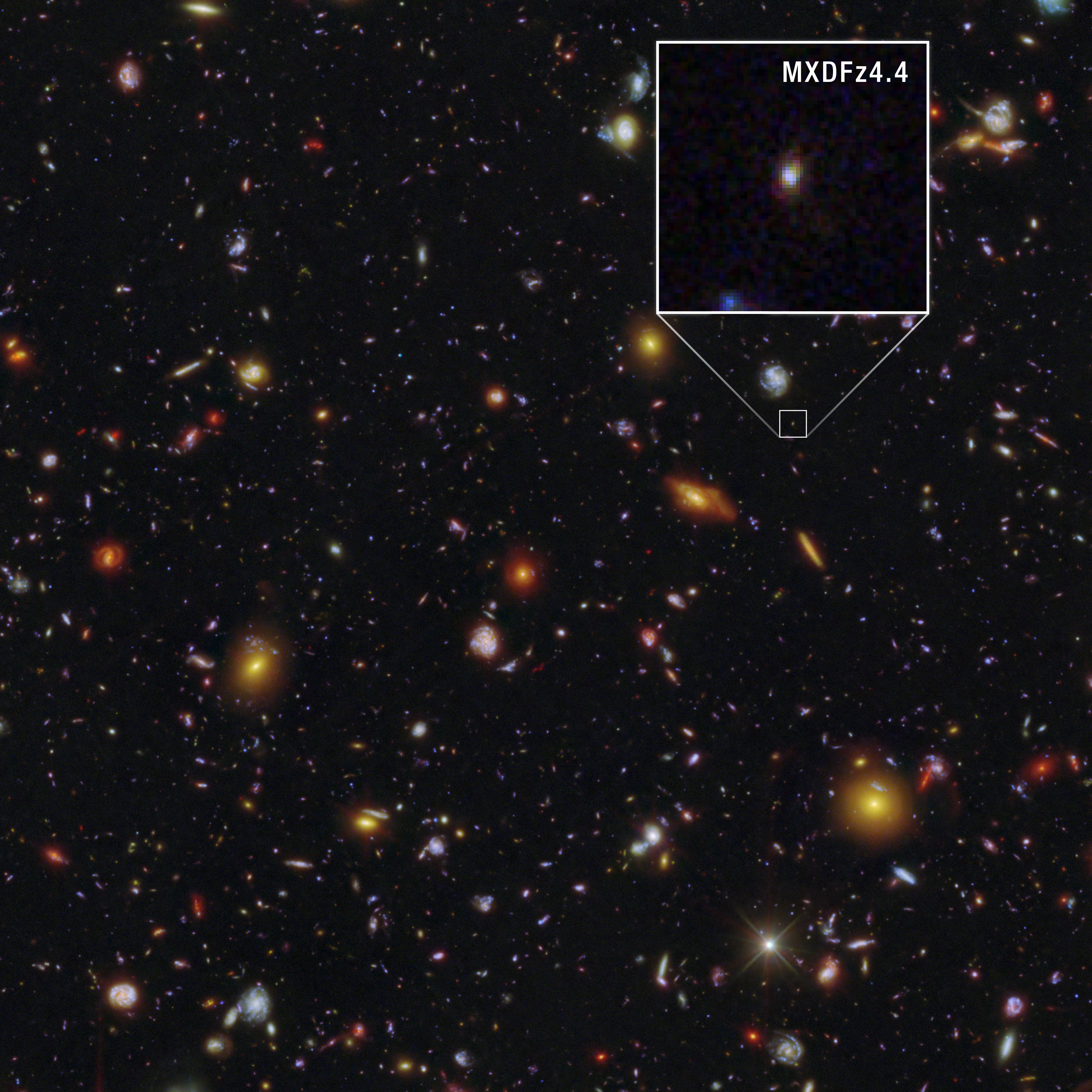
Thousands of galaxies appear across the black background of space. The galaxies range in size, from big blobs and larger face-on spirals to short lines and tiny dots. The galaxies appear in a variety of colors, including orange, white, pink, and blue. One prominent foreground star appears toward the lower right with several diffraction spikes. A white square highlights one tiny pinpoint of blue light in the top third, which is blown up in a box above it and labeled MXDFz4.4. The galaxy has a light blue core with some yellow and red blotches around its edges.

Detailed visible-light images from Hubble reveal that several bursts of younger stars cleared the space in and around galaxy MXDFz4.4. Astronomers have long sought evidence to explain this transition — and Hubble has provided the first example in this time period.

Image: NASA, ESA, CSA, STScI, Ilias Goovaerts (STScI), Marc Rafelski (STScI, JHU), Anton Koekemoer (STScI); Image Processing: Alyssa Pagan (STScI)

Young, massive stars emit ultraviolet light capable of ionizing hydrogen atoms. As this light traveled for over 12 billion years to reach Hubble, space expanded, and the light stretched or redshifted into visible light. Hubble’s wavelength coverage, combined with the sensitivity and resolution of its space-based vantage point, makes it the only telescope capable of capturing this ultraviolet light from the early universe.

“Astronomers have found many galaxies that existed at this point in the history of the universe, but we haven’t detected ionizing photons from any of them, making MXDFz4.4 one of a kind,” said Marc Rafelski, a co-author and Hubble deputy mission head at STScI.

Hubble’s long exposures, pulled from several existing surveys, revealed that the galaxy’s young, massive stars are the source of the ultraviolet light, which cleared the surrounding space. These stars formed in bursts within the last few million years of MXDFz4.4’s existence and are crammed together.

Amplifying this crowding effect, MXDFz4.4 is about 100 times smaller by area than our Milky Way galaxy, but is forming stars 10 times faster.

“A lot of young, hot, massive stars in a small space do a better job of blasting through opaque gas,” Goovaerts said. The researchers estimate that 50 to 100% of the young stars’ energetic ionizing light is escaping the surrounding gas.

Massive stars’ lifetimes also play a role, since they live for only a few million years. Many explode as supernovae, releasing gigantic amounts of energy and blowing colossal holes that allow even more light to escape.
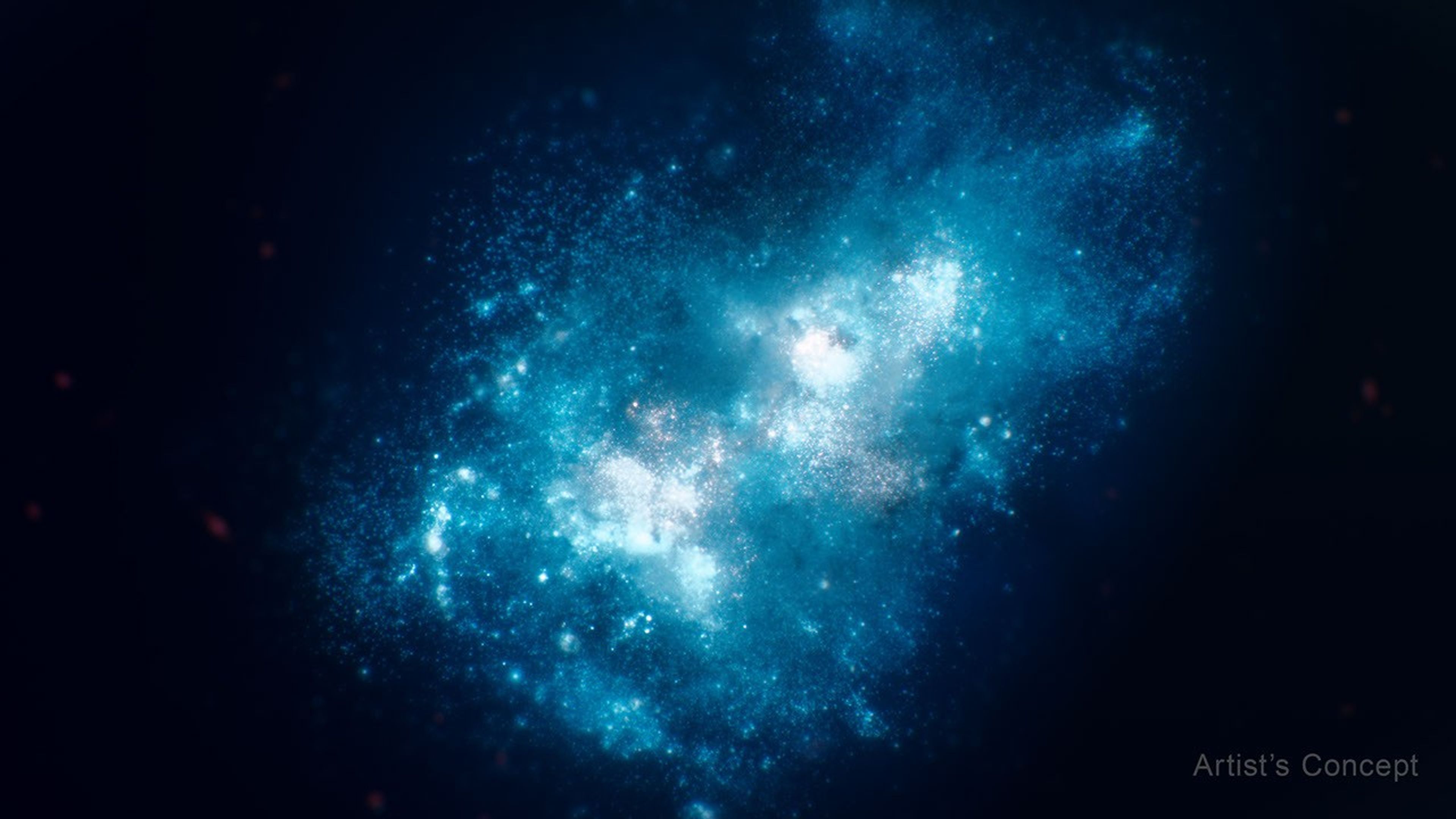
Illustration shows a closeup of a galaxy forming in the early universe. It appears chaotic and takes up most of the frame, from bottom left to top right. At the center are several bright white and blue blobs, which are areas of concentrated star formation. The blue becomes slightly darker in areas around this, taking up more than half of the galaxy’s overall size. There are smaller regions of bright blue star formation throughout this section. The galaxy’s edges, also irregularly shaped, are a medium blue, and smaller areas of star formation are apparent. The black background of space surrounds the galaxy.

This illustration portrays galaxy MXDFz4.4 when it existed 1.4 billion years after the big bang. At this time, the universe was still a mix of opaque and transparent gas as the Era of Reionization was gradually ending.

Illustration: NASA, ESA, Leah Hustak (STScI)

Hubble could not do this alone. These conclusions are supported by survey data taken by NASA’s James Webb Space Telescope in near-infrared light and the MUSE eXtremely Deep Field or MXDF, the galaxy’s namesake, captured by the European Southern Observatory’s Very Large Telescope (VLT) in visible light.

The team used Webb’s data to determine the galaxy’s mass, analyze its older stars, and measure the galaxy’s star formation history. The galaxy’s older stars are less massive and cooler, and therefore not responsible for changing the gas around them.

Comparing Hubble and Webb data also showed that recent star formation happened in bursts. “Without Webb to clarify what we saw in Hubble’s images, we couldn’t make these conclusions,” Rafelski said.

Data from the VLT pinpointed when MXDFz4.4 existed: 1.4 billion years after the big bang. Before this discovery, researchers had only identified a galaxy emitting ionized light from a time when the universe was 1.6 billion years old. Only a few additional examples have been identified, and those existed when the universe was about 2 billion years old. MXDFz4.4 brings researchers closer to drawing firm conclusions about how the Era of Reionization unfolded.

Credit: NASA's Goddard Space Flight Center; Lead Producer: Paul Morris

Studying the Era of Reionization is a decades-old endeavor. Researchers use statistics about star populations in nearby galaxies, which we can observe in great detail, to make well-informed assumptions about what might be happening in galaxies in the early universe, in part because their star populations are too distant to resolve in any detail.

In 2023, researchers using Webb showed that galaxies’ stars emitted enough light to heat and ionize the gas around them 900 million years after the big bang. This was a breakthrough, but astronomers need galaxies like MXDFz4.4 to fully explain how the process happened, since it shows how the high-energy light from young stars managed to escape the gas and dust within the galaxy itself. 

It’s possible other galaxies like MXDFz4.4 are waiting to be discovered.

“Hubble’s observations of MXDFz4.4 let us test our hypotheses much closer to the Era of Reionization than ever before,” Rafelski said. “Finding more galaxies, especially at slightly later cosmic times where larger samples are within reach, would let us refine these measurements and figure out what cleared our view as that era was ending.”

The Hubble Space Telescope has been operating for over three decades and continues to make ground-breaking discoveries that shape our fundamental understanding of the universe. Hubble is a project of international cooperation between NASA and ESA (European Space Agency). NASA’s Goddard Space Flight Center in Greenbelt, Maryland, manages the telescope and mission operations. Lockheed Martin Space, based in Denver, also supports mission operations at Goddard. The Space Telescope Science Institute in Baltimore, which is operated by the Association of Universities for Research in Astronomy, conducts Hubble science operations for NASA.