

惯性聚合 高效追踪和阅读你感兴趣的博客、新闻、科技资讯
阅读原文 在惯性聚合中打开

推荐订阅源

F
Fortinet All Blogs
爱范儿
爱范儿
V
Visual Studio Blog
Engineering at Meta
Engineering at Meta
B
Blog
云风的 BLOG
云风的 BLOG
G
Google Developers Blog
MongoDB | Blog
MongoDB | Blog
博客园 - Franky
U
Unit 42
Cyber Security Advisories - MS-ISAC
WordPress大学
WordPress大学
D
DataBreaches.Net
B
Blog RSS Feed
小众软件
小众软件
人人都是产品经理
人人都是产品经理
I
InfoQ
P
Proofpoint News Feed
博客园 - 聂微东
让小产品的独立变现更简单 - ezindie.com
J
Java Code Geeks
The GitHub Blog
The GitHub Blog
OSCHINA 社区最新新闻
OSCHINA 社区最新新闻
奇客Solidot–传递最新科技情报
奇客Solidot–传递最新科技情报

NASA Science

Cosmic Origins at AAS 248, June 2026 - NASA Science Cosmic Structure SIG Seminar, 30 April 2026 - NASA Science CMB SAG Meeting, 24 April 2026 - NASA Science BBX SAG Meeting, 30 April 2026 - NASA Science Early Career Investigator Program – Earth Science (ROSES A.11) - NASA Science XR SIG Seminar, 1 May 2026 - NASA Science Night and (Earth) Day - NASA SWERV: High-Impact Historical Case Study - NASA Science AAS Meeting 248, June 2026 - NASA Science Earth Day 2026: Posters and Virtual Backgrounds - NASA Science Advancing Earth Observation at NASA since Release of Earthrise Photo - NASA Science X-59 Adds Freedom 250 Logo - NASA Belts of Green in the Washington Suburbs - NASA Science Artemis II Mission Milestones: An Image and Video Recap Curiosity Blog, Sols 4867-4872: Sand Fill In Antofagasta Crater and Finding Our Next Drill Target NASA Invites Media to Jordan Artemis Accords Signing Ceremony New NASA Views of Earth, From (S)PACE - NASA Science Crew Studies Biotech on Tuesday to Advance Health and Space Economy NASA Invests in Small Businesses Innovating for Space and Earth NASA at SXSW: Johnson Director Vanessa Wyche on Why Artemis Changes Everything Researchers: How Would You Extract Meaningful Insights from Just Four Astronauts? BBX SAG Meeting, 23 April 2026 - NASA Science Thailand’s Krabi Coast - NASA Science AI/ML STIG Lecture Series, 20 April 2026 - NASA Science SWERV: Training Overview and Agenda - NASA Science SWERV: REAL-TIME CAPABILITIES AND IONOSPHERIC DISRUPTIONS OF COMMUNICATIONS - NASA Science SWERV: Operationally Significant Phenomena and Impacts for Ground Operations - NASA Science SWERV: Space Weather Impacts on Satellites - NASA Science SWERV: Space Weather Chain of Events - NASA Science CSDA Quality Assessment Report Evaluates Satellogic NewSat Data - NASA Science
Curiosity Captures a 360-Degree View at ‘Nevado Sajama’ -...
Rafael Alani · 2026-04-29 · via NASA Science

2 Min Read

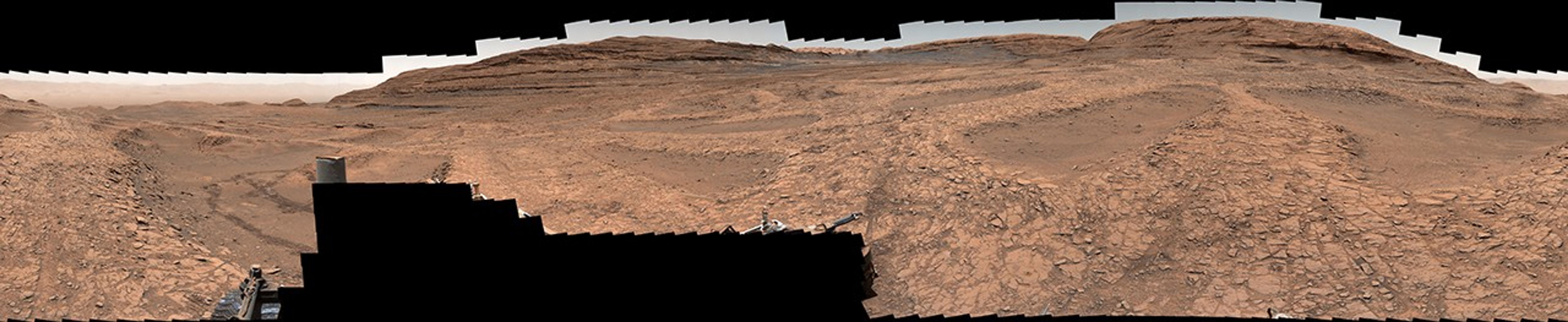
A series of shallow, sand-filled pits with low ridges spread across a tawny Martian landscape. Rover tracks stretch toward the horizon at left, and steep ridgetops loom in the background.

PIA26696

Credits: NASA/JPL-Caltech/MSSS

NASA’s Curiosity Mars rover captured this 360-degree view of a region filled with low ridges called boxwork formations between Nov. 9 and Dec. 7, 2025 (the 4,714th to 4,741st Martian days, or sols, of the mission). At 1.5 billion pixels, this is one of the largest panoramas Curiosity has ever taken (the rover’s largest panorama of all time is 1.8 billion pixels). This newer panorama is made up of 1,031 individual images captured by Curiosity’s Mastcam using its right camera, which has a 100-millimeter focal length lens. The images were later sent to Earth and stitched together into the full panorama.

The images were taken at a ridgetop site nicknamed “Nevado Sajama,” where Curiosity collected a rock sample using a drill on the end of its robotic arm. Since May 2025, Curiosity has been exploring a region full of geologic formations called boxwork, which crisscross the surface for miles and look like giant spiderwebs when viewed from space. The new panorama shows them as they really are: low ridges standing roughly 3 to 6 feet (1 to 2 meters) tall and about 30 feet (9 meters) across with sandy hollows in between.

Figure A is a high-resolution version of this panorama (1.8 gigabytes).

Figure B is a lower-resolution version of the panorama (276 megabytes) captured by Mastcam’s left camera, which has a 34-millimeter focal length lens. This version includes the rover’s deck, which is often left out of such imagery in order to reduce the amount of data relayed back to Earth.

Curiosity was built by NASA’s Jet Propulsion Laboratory, which is managed by Caltech in Pasadena, California. JPL leads the mission on behalf of NASA’s Science Mission Directorate in Washington as part of NASA’s Mars Exploration Program portfolio. Malin Space Science Systems in San Diego built and operates Mastcam.

To learn more about Curiosity, visit:

science.nasa.gov/mission/msl-curiosity

Keep Exploring

Discover More Topics From Photojournal