





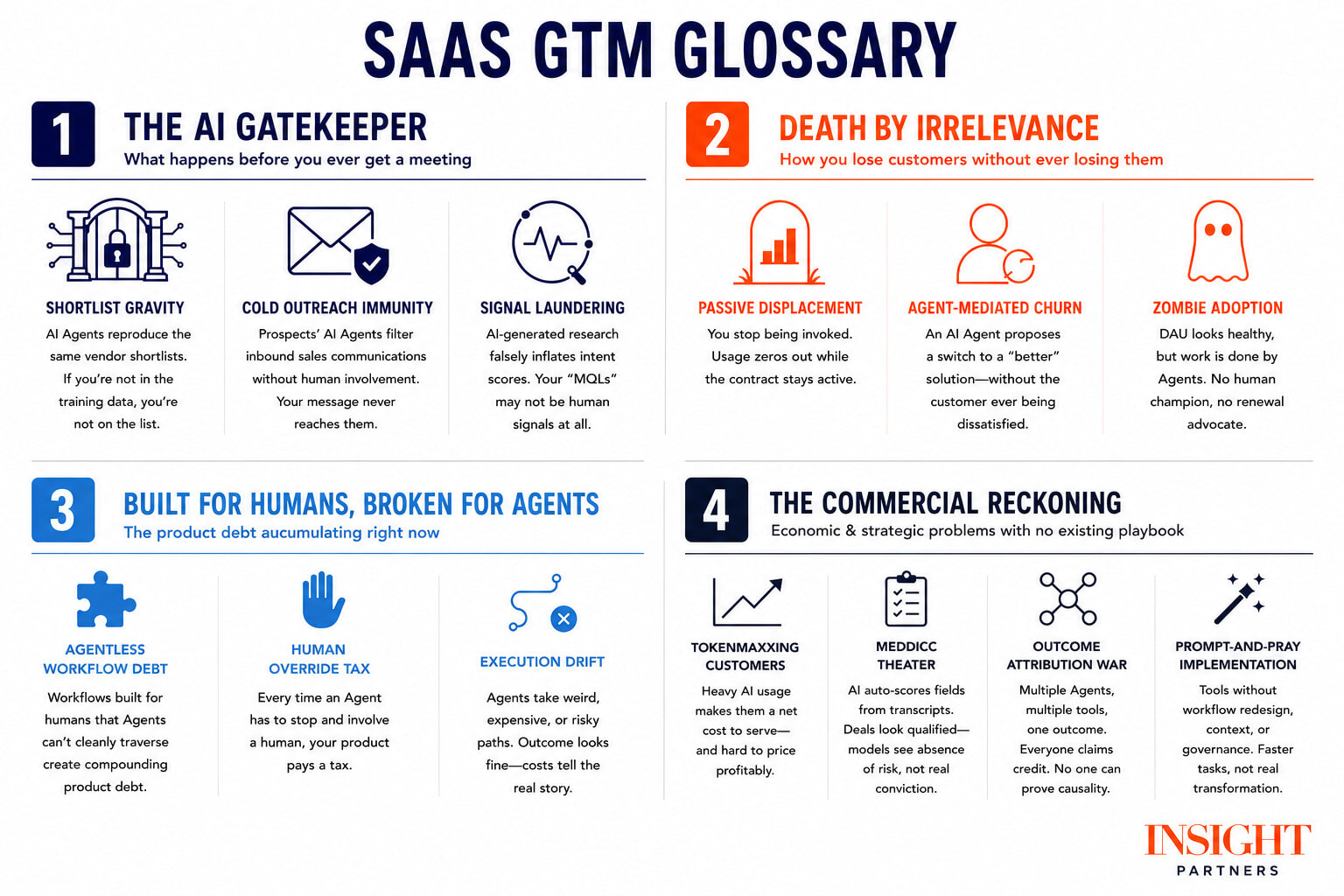
In the SaaS landscape, many long-held best practices and truths are being questioned with the evolving capacities of AI. Go-to-market is no exception. It’s being rewired, and new opportunities, problems, and metrics have surfaced, but most of the vocabulary hasn’t caught up.
These are the concepts that keep surfacing in founder conversations, product reviews, and board meetings across our portfolio — the ones people are reaching for but don’t have a clean name for yet. We’ve broken the list into four thematic categories.
The thinking here draws on conversations with Insight Onsite experts Senior Vice President Neal Behrend, Vice President Jack Rohrer, Executive Vice President Ajay Gandhi, Senior Vice President Samma Hafeez, Vice President Jared Brickman, and Executive Vice President Charlene Chen.
Your pipeline doesn’t start when a prospect visits your website anymore. It starts, and often ends, in an AI evaluation you never knew was happening.
Long before any human takes a meeting, the buyer’s Agent has already read your site, your G2, your security docs, and done a full product teardown — and quietly disqualified you or placed you on a list you never knew existed. If you survive that audit, you still face a second structural problem: AI purchasing Agents tend to reproduce the same vendor shortlists because they’re trained on the same corpora. This includes analyst reports, G2 rankings, review sites, and press coverage. The rich get richer, the unknown stays unknown, and no amount of outbound fixes a training data gap.
“The vendors winning AI-era procurement are winning on presence. If you’re not in the training data, you’re not on the list. No cold email fixes that.”
— Neal Behrend
Prospects’ AI Agents are now handling inbound sales communications, filtering them against stated priorities and discarding them without the human ever seeing them. Your sequence didn’t fail; it was intercepted. Better subject lines, smarter timing, and custom signals to drive personalization won’t move the needle when the audience is an Agent, not a person. The lever shifts from outbound content to presence: the review sites, analyst reports, and training data that Agents actually consult.
“We keep optimizing sequences for humans who never see them. The buyer didn’t ignore your email; their Agent did. You can’t personalize your way onto a shortlist that was built before you ever sent anything.”
— Jack Rohrer
AI-generated research behavior gets processed through your intent scoring as human buying signals. Your marketing-qualified lead (MQL) scored a 94, but no person was ever actually curious about your product. The programs you’re doubling down on, the accounts your business development representatives (BDRs) are calling, the pipeline your CRO is forecasting. It’s all downstream of a signal that was never real.
“Your intent data is lying to you. It’s not intentional. It just doesn’t know it. And neither do you.”
— Ajay Gandhi
Traditional churn announces itself. This kind doesn’t. The contract renews, the daily active user (DAU) holds, and the relationship quietly hollows out.
You don’t get canceled. Instead, you stop being invoked. The contract stays active, the renewal auto-processes, but usage quietly zeros out as Agents route tasks to tools that are more API-friendly or better represented in their training data. It’s death by irrelevance rather than cancellation, and it won’t show up in your churn rate until it’s too late.
“Usage is the truth. Everything else — the contract, the login, the renewal — is a lagging indicator. In this era, being contracted by the human and used by the Agent are two completely different things, and I’m not sure which matters more.”
— Neal Behrend
A customer’s AI Agent may proactively identify a better-fit solution and propose switching, without the customer ever being dissatisfied. Your NPS score, your account executive relationship, your quarterly business review (QBR) cadence, none of it mattered because none of it was visible to the actual decision-maker. The human didn’t churn; the Agent made the call.
“Retention used to mean keeping the human happy. Now it means keeping the Agent from looking around. Those require completely different playbooks.”
— Samma Hafeez
Your DAU looks healthy, but your champion isn’t. The work is being done by the customer’s AI Agents, not the humans who signed the contract, meaning that the product is active, but the relationship is on life support. When renewal comes, there’s no champion fighting for you because no human has meaningfully touched your product in the past 6 months.
“You can’t manage retention that you can’t measure. And if your DAU doesn’t distinguish humans from Agents, you’re not measuring anything real.”
— Ajay Gandhi
Your product was designed for humans. Agents are the new primary user. The gap between those two facts is where your next product crisis lives.
Every workflow you built for human users that an AI Agent can’t cleanly traverse is accumulating as a new form of technical debt — onboarding flows that require human clicks, dashboards that surface data visually but don’t expose it via API, support processes that require phone calls or form submissions. As Agents become the primary interface for SaaS interaction, the cost of not fixing these will compound like tech debt: quietly, invisibly, and then all at once. The companies that treat Agent-legibility as a product priority today will have a moat that’s very hard to replicate in two years.
“Every time you built a UI instead of an API, you were making a bet that humans would always be the primary interface. That bet is coming due.”
— Neal Behrend
The penalty a product pays every time an Agent has to stop and ask a human to click, approve, interpret, or resolve ambiguity. Too many overrides make the product Agent-avoidant, even if human users still love it. Agents will simply route around products that interrupt their workflows and toward ones that don’t. Some overrides are necessary for governance, but the unnecessary ones can serve as a vote against you in the Agent’s next routing decision.
“Every approval gate you built for compliance is a tax your Agents pay on every workflow. Some of those gates are worth it. Most of them were designed for a world where humans were the bottleneck.”
— Jared Brickman
An Agent completes the requested job but takes a weird, expensive, non-compliant, or low-margin path to get there. The customer sees “task complete,” yet the vendor sees token burn, API overuse, audit risk, and support tickets. This is the operational cousin of hallucination, and it’s harder to detect because the outcome looks fine until you look at what it costs to produce it.
“You can have a perfectly accurate support org that’s bleeding margin. The culprit isn’t wrong answers — it’s how many steps it took to get to the right one.”
— Jared Brickman
The old problems have playbooks. Churn can be modeled, pipeline can be forecasted, and analyst narratives can be crafted. These four sit outside the old frameworks.
Customers who use AI features and LLM output so heavily that they’re a net cost to serve. You can’t fire them — they’re proving out your best use cases daily and generating the case studies your sales team needs — but managing their usage and pricing is now critical to long-term margins. The challenge is that the unit economics your pricing model was built on didn’t anticipate them.
“You priced your AI features assuming average usage. Your best customers don’t have average usage. Those are two very different businesses hiding inside the same contract.”
— Neal Behrend
There are now a dozen tools, native platform features, and DIY options that will auto-score deal qualification off of call transcripts. Most of them grade for language, not reality. The model passes a deal because nothing disqualifying was said, not because something real was confirmed. Reps figure that out in about a week. The opportunity grading dashboard turns green, qualified pipeline coverage looks better than ever, and managers run deal inspection on the opportunities that surface as problems, while the real risk hides behind green scores. The CRO finds out the hard way at the end of the quarter. The AI made the theater more convincing overall.
“Compliance scoring tells you whether the champion said the right words. It will not tell you if that champion is actually going to go to bat for you at the end of the quarter. When you score qualification artifacts instead of qualification reality, you just teach reps to produce better artifacts.”
— Jack Rohrer
When multiple Agents and tools contribute to the same result, everyone claims the outcome, and no one can cleanly prove causality. In a workflow spanning CRM, ERP, billing, support, and data infrastructure, the question becomes: Who gets paid for the resolved ticket, the prevented churn, the booked meeting? The commercial and contractual infrastructure for answering that question doesn’t exist yet, and the companies that figure it out first will have a significant pricing and retention advantage.
“When five Agents touch the same outcome, every vendor claims credit. The company that can actually prove causality in multi-Agent workflows will reprice SaaS from the ground up.”
— Jared Brickman
The act of using AI by entering prompts and hoping valuable output follows, without the training, context, workflows, or systems needed to make results reliable and repeatable. At the individual level, prompt-and-pray looks like trial-and-error prompting: asking, rephrasing, regenerating, and hoping the next response is better than the last.
At the organizational level, it means handing people AI tools and expecting transformation without investing in the workflows, systems, and knowledge sharing needed to make AI effective at scale. The result is that AI stays trapped at the individual level: people get faster, but the company doesn’t get better.
“Giving everyone AI and calling it a strategy is like handing out instruments and calling it an orchestra.”
— Charlene Chen
None of these terms existed five years ago because none of these problems did. That’s the point. The GTM playbook most SaaS companies are running was written for a world where humans did the buying, the using, and the leaving. That world is receding faster than most teams are moving. The vocabulary you use shapes the problems you can solve, and the companies that name this terrain clearly will navigate it better than the ones still borrowing language from the last era.
This post contains forward-looking statements and predictions regarding the future of AI. These statements are based on our current expectations and assumptions, and actual results may differ materially from those expressed or implied in these statements. The information provided in this post is for informational purposes only and does not constitute financial, investment, or professional advice. This post should not be considered as a recommendation to buy, sell, or hold any particular investment or security. Investments in AI and related technologies involve inherent risks, and past performance is not indicative of future results.
此内容由惯性聚合(RSS阅读器)自动聚合整理,仅供阅读参考。 原文来自 — 版权归原作者所有。