


There's a paradox at the heart of high-performance infrastructure: the better it works, the less anyone notices.
When your edge platform is doing its job, requests are fast, origins are protected, and threats are stopped before they reach your application. The result is silence. No incidents, outages, or fire drills. Just everything working exactly as it should.
That's the goal but it’s showing it is a problem.
If you're an engineer managing Fastly, you know this tension well. The platform is delivering enormous value on every single request. But when it comes time to justify the investment in a budget review, a renewal conversation, or a board presentation, "nothing went wrong" isn't exactly a compelling narrative.
We call this the "silent performance" problem. And we've been thinking a lot about how to solve it.
Fastly's reporting has historically spoken the language of engineers with cache hit ratios, error rates, origin response times, and request volumes. If you're an engineer, that data is essential. You can troubleshoot, optimize, and tune your services with precision.
But if you're a CTO walking into a board meeting, or a VP of Engineering sitting down with procurement, or a DevOps manager trying to explain to finance why this line item matters, those metrics don't land. Not because they aren't important, but because they require translation. And that translation has been falling on the people who can least afford to spend time on it: your engineering team.
For every budget conversation someone has to pull the data, consolidate across products, build the slides, and reframe everything in language that a non-technical audience can actually use. That's engineering time spent on reporting instead of building, optimizing, or innovating.
Meanwhile, gaps start compounding. Leadership can't see what the platform is doing, so they treat it as a cost center. That's a visibility gap. Procurement can't connect the spend to the infrastructure savings it's generating. That's an efficiency gap. And the platform is quietly protecting revenue and absorbing threats that no one outside engineering even knows about. That's a protection gap. These add up to make strategic investment that look like an expense.
Every request that Fastly handles generates value. High technical performance is a business value. The first step in solving the silent performance problem is making that return on investment visible.
That's why we've redesigned the Account Summary page under Observability. At the top of the page, you'll now find six at-a-glance metrics with trend indicators. These aren't raw request counts or technical ratios. They're a curated view of the ROI being generated at the edge, framed in terms that matter to every stakeholder in the room.
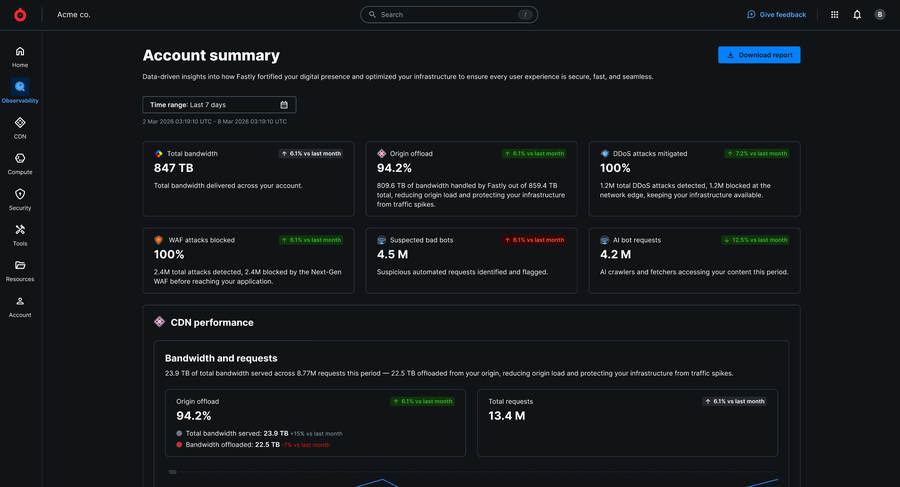
Two metrics in particular anchor this view:
Origin Offload tells you what percentage of requests are being served from the edge without ever touching your origin. If your Origin Offload is at 84.7%, that means 84.7% of bandwidth never hits your origin servers. That's not just a caching statistic, it's a signal of infrastructure cost savings on every request, scalability assurance that keeps your origin stable under peak load, and money you're not spending on compute, egress, or emergency scaling.
Mitigation Rate % tells you what percentage of malicious or unwanted traffic is being stopped at the edge before it reaches your application. That's not a NGWAF metric for your security team to parse, it's a measure of business continuity, revenue protection and the answer to "what would have happened if this wasn't in place?" DDoS mitigation, bot management, and NGWAF protection all follow the same pattern. Raw block counts and detection events become quantified downtime avoidance, fraud prevention, and compliance assurance.
The technical reality hasn’t changed. Fastly was always doing this work. What’s changed is that the data now tells the story in the language your cross-functional stakeholders such as CFO, procurement team, and board speak.
For engineering leaders, this is the difference between walking into a budget conversation armed with uncontextualized metrics and walking in with a clear narrative: "Here's how much infrastructure cost we avoided. Here's how much revenue we protected. Here's the business continuity we maintained." Instead of a cost center, you can show how a strategic investment paid off in measurable returns.
Because Fastly sits in front of your origin and sees all traffic first, we can surface trends and shifts that aren't visible from origin-side monitoring, and often aren't visible until they've already become a cost problem. For instance, AI crawler traffic can add up. Large language model crawlers and AI bots are consuming increasing amounts of bandwidth across the web, and most organizations don't have clear visibility into how much, how often, or which services are being hit. By the time the traffic shows up as an unexpected spike in your bandwidth bill, the cost has already been incurred.
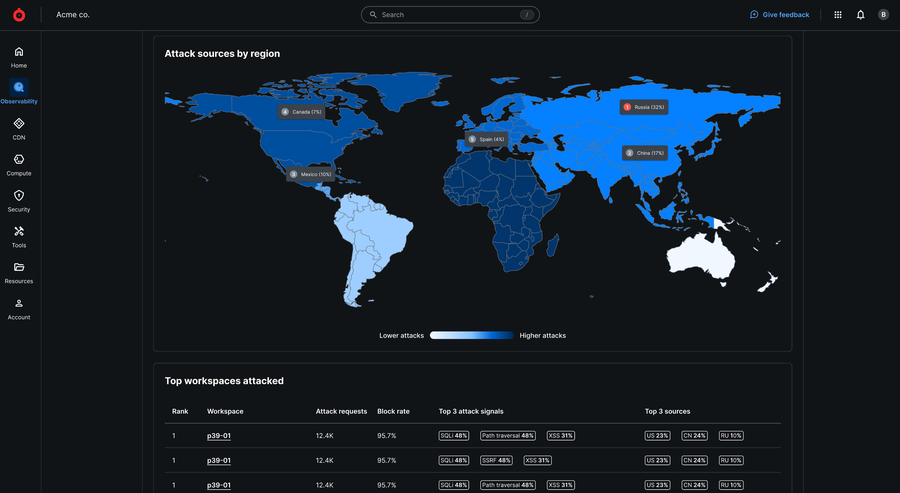
The redesigned Account Summary surfaces these trends proactively so you can see how traffic composition is shifting, identify where resources are being consumed, and make informed decisions about how to respond. Make those decisions from a position of visibility, instead of reacting after the fact. Your edge platform is already seeing this traffic. Now you can see it too, and act on it before it becomes a problem to explain in a budget review.
We mentioned the valuable time that engineering teams spend pulling, consolidating, and translating data for executive consumption. Even if you have the best metrics in the world, they don't help if the process of getting them in front of the right people is manual or time-consuming.
We've built sharing directly into the reporting experience. PDF downloads give you presentation-ready exports so that engineering, security, finance, and leadership are all looking at the same data, framed in the same business outcomes. When everyone shares a common view, alignment happens faster and decisions get made with data instead of assumptions.
The mission hasn't changed. We're still building a faster, safer, more reliable web. What's changed is that the value of that mission is now visible to every stakeholder who needs to see it.
For Platform Engineers and DevOps teams, this means the reporting burden is lifted. The work you're doing at the edge, the performance optimization, the security posture management, the reliability engineering, now speaks for itself in a format that travels across the organization without you having to translate it manually.
For engineering leaders and VPs, this means you have the data to walk into any budget conversation, any renewal discussion, any board presentation with confidence. Not with raw metrics that require a glossary, but with a clear narrative of cost savings, revenue protection, and business resilience that connects your infrastructure investment directly to business outcomes.
For executives, whether CTO, CIO, or CISO, this means instant validation. A single view that confirms your digital infrastructure is resilient, protected, and delivering return on investment. No digging into dashboards. No waiting for someone to build you a report. The answer to "is this working?" is right there.
Impeccable performance is still the goal. Your edge platform should work so well that nobody has to think about it. But now, when someone asks what it's doing for the business, the answer is visible, defensible, and ready to share.
Curious what your Origin Offload and Mitigation Rate look like? Check the new Account Summary and download a report you can share with your team today.
此内容由惯性聚合(RSS阅读器)自动聚合整理,仅供阅读参考。 原文来自 — 版权归原作者所有。