


惯性聚合 高效追踪和阅读你感兴趣的博客、新闻、科技资讯
阅读原文 在惯性聚合中打开

推荐订阅源

F
Full Disclosure
Recorded Future
Recorded Future
T
Tenable Blog
S
Securelist
C
CERT Recently Published Vulnerability Notes
T
Threatpost
S
Schneier on Security
A
Arctic Wolf
The Hacker News
The Hacker News
C
CXSECURITY Database RSS Feed - CXSecurity.com
Know Your Adversary
Know Your Adversary
P
Privacy International News Feed
Threat Intelligence Blog | Flashpoint
The Register - Security
Cisco Talos Blog
Cisco Talos Blog
AWS News Blog
AWS News Blog
K
Kaspersky official blog
T
True Tiger Recordings
T
Threat Research - Cisco Blogs
V
Vulnerabilities – Threatpost
P
Palo Alto Networks Blog
T
The Exploit Database - CXSecurity.com
小众软件
小众软件
B
Blog
Cyber Security Advisories - MS-ISAC
Microsoft Azure Blog
Cyberwarzone
Cyberwarzone
C
Cybersecurity and Infrastructure Security Agency CISA
T
Tor Project blog
Spread Privacy
Spread Privacy
Malwarebytes
Malwarebytes
P
Proofpoint News Feed
F
Fox-IT International blog
F
Fortinet All Blogs
P
Privacy & Cybersecurity Law Blog
G
GRAHAM CLULEY
量子位
Latest news
Latest news
OSCHINA 社区最新新闻
OSCHINA 社区最新新闻
博客园 - 叶小钗
Project Zero
Project Zero
T
Tailwind CSS Blog
N
Netflix TechBlog - Medium
Martin Fowler
Martin Fowler
IntelliJ IDEA : IntelliJ IDEA – the Leading IDE for Professional Development in Java and Kotlin | The JetBrains Blog
I
Intezer
博客园_首页
腾讯CDC
H
Hackread – Cybersecurity News, Data Breaches, AI and More
D
Darknet – Hacking Tools, Hacker News & Cyber Security

Megaport Blog

Early Warning Signs Your Network Needs a Refresh Introducing Megaport DDoS Protection A Guide to 400G Connectivity A Guide to NAT Gateway A Guide to Cloud Storage How the Data Center Is Evolving in 2026 What to Expect When Attending Your First Network Operator Group (NOG) Nine Ways to Connect to Cloud Using Private Connectivity Migrate Your On-premises to the Cloud: A Step-by-Step Guide How to Lower Your Egress Fees in 2026 How to Achieve Data Sovereignty in Europe Redefining the Edge with Cisco and Megaport How to Reduce Latency in Your Multicloud Environment Introducing Megaport High-Speed Cross-Cloud Encryption Are Businesses Leaving the Cloud? Using Meraki and Megaport Virtual Edge for Multicloud Networking Equinix Metal® is Going Away: Here’s What You Can Do Introducing Megaport On-ramp as a Service Megaport’s Full Solution Portfolio Is Coming to India New Bare-metal GPU Instance Now Available with NVIDIA RTX Pro 6000 A Look Back at 2025: Megaport's Biggest Updates Megaport Expands Into India With Extreme IX Your 2026 Predictions From AWS re:Invent 2025 Top NaaS Trends for 2026 What is IPsec? When to Move From Public Internet to Private Connectivity Megaport and Latitude.sh: Bringing Compute and Connectivity Together Improve Your Microsoft ExpressRoute Resilience with Megaport Comparing Ways to Connect to AWS What is API-First Networking? The Hidden Cost of Running Cloud-Hosted SD-WAN for IaaS Overcoming NaaS Integration Challenges Introducing SCION with Anapaya and Megaport How to Use Network as a Service to Future-Proof Your Network Introducing 400G Ports All the As-a-services, Compared Introducing Megaport IPsec Tunnels High Score: Megaport Hits 1,000 Locations A Guide to Colocation Data Centers Maximizing Peering Through Flow Analysis Build Resilient Networks for AI Production Workloads Introducing Packet Filtering on Megaport Cloud Router Building Resilient Government IT: Strategies for Secure, Compliant, and Scalable Connectivity Future-Proofing Government IT Telstra Programmable Network Is Being Discontinued. Here’s How to Migrate The Future of WAN Design Depends on Network as a Service (NaaS) Cisco Webex Edge Connect Launches on Megaport Voice and Video Exchange How to Prepare for APRA CPS 230 Comparing the SD-WAN Licensing Needs of Major Vendors A Guide to Improving Network Performance How Latitude.sh, Wasabi, and Megaport Unlock Cost-Effective Multicloud Four Ways to Connect Your Clouds SD-WAN and MPLS: Weighing the Similarities, Differences, and Benefits A Guide to Network as a Service (NaaS) How to Arrange Bilateral Peering Sessions Comparing Major SD-WAN Vendors Software Defined Networking in Healthcare Deploying A Global Network in Minutes With Megaport AWS Direct Connect Gateway (DGW) Data Transfer Outbound Rules Bilateral and Multilateral Peering: What’s the Difference? Multi-Region SD-WAN: Why Megaport SDCI is the Right Choice Microsoft Azure is Going Secure by Default. Are You Ready? How Megaport and Vultr Are Solving the Enterprise AI Challenge Introducing Megaport NAT Gateway A Guide to AWS Security Tools How to Deploy Amazon Bedrock Using AWS Direct Connect and Megaport Azure Private Link, Explained Introducing 100G MCRs Simplifying Hybrid and Multicloud Network Connectivity How to Fix Poor AWS Latency A Look Back at 2024: Megaport’s Biggest Updates Your 2025 Predictions From AWS re:Invent 2024 Six Ways to Get a More Resilient Network in 2025 Multicloud Security: Challenges and Solutions The Real Cost of High Network Latency Why Brazil is Your Key to Unlocking Business Growth in Latin America Why You Need Integrated Network Security Six Key Differences Between Major Cloud Providers How to Automate Your Megaport Infrastructure With APIs Why Italy is Europe’s Next Cloud Expansion Hotspot How to Lower Your Cloud Costs Peering: How Local Is Local? Introducing Megaport AI Exchange How to Connect Equinix and Digital Realty Megaport Enables Microsoft Azure ExpressRoute Metro for More Resilient Network Connectivity Executives, Here’s What Your Network Team Wants You to Know Easy Ways to Interconnect Your Network The Role of the Data Center in Your Network 100G VXC Expansion: Now Available From 597 Data Centers Worldwide Top 10 How-To Guides To Improve Your Network Comparing Encryption in Transit Options Comparing Generative AI Offerings From Major Cloud Providers A Sustainable Business Strategy Starts With Your Network Solutions to Common API Issues With Megaport Transforming Financial Connectivity: Introducing Megaport Financial Services Exchange (FSX) Megaport Enhancing Connectivity in Adelaide Megaport’s Latest Portal Features and Functionalities Automate Your Network Deployments With The New Megaport Terraform Provider A Recap of the Megaport World Tour 2024 Top 5 Cloud and Networking Announcements From Cisco Live 2024
Two Scenarios for Hybrid Multicloud Deployment With IBM Cloud and Microsoft Azure
2024-09-26 · via Megaport Blog

Learn how you can modernize your applications at scale for a powerful hybrid multicloud solution.

Every network team wants a hybrid multicloud network that is efficient, resilient, secure, and scalable. Megaport has been a part of this journey for years, and many enterprises today leverage Megaport Cloud Router (MCR) for their cross-cloud workloads to achieve their dream networks.

This managed router can be spun up in minutes, enabling users to provision direct connections to their cloud service providers and other data centers. As our exploration of use cases—like how to connect AWS and Microsoft Azure—shows, MCR is often a superior connectivity method to its alternatives.

Recently, we’ve been working with IBM Cloud and Azure as a preferred partner for their multicloud solutions. Now, we’re excited to deliver an exciting new use case: Using MCR to bridge the enterprise-scale IaaS offering, IBM® Power® Virtual Server (IBM PowerVS), and your cloud-native workloads in hyperscaler Azure, for a powerful hybrid multicloud solution.

The below guide demonstrates how you can interconnect your mission-critical IBM Power workloads with your cloud-native Azure workloads and gain the ability to deploy on best-suited infrastructure, get more value out of each application, and experience seamless operation across multiple infrastructure providers and environments.

This guide was originally featured on the IBM and Microsoft Azure blogs. Special thanks to the authors that brought it together:

  • Pradip Roychowdhury
  • Charbak Roy
  • Ashwin Srinivas
  • Subrata Ghosh
  • Ricardo Galvan
  • Poom Nupong
  • Bhaskar Bandam

As enterprises further embrace a hybrid cloud strategy, it’s critically important that applications have the flexibility to be deployed anywhere across this landscape to reap the full benefits. This flexibility allows enterprises to use the continuous innovation that’s happening across public cloud providers along with the security, data privacy and reliability of enterprise’s own data center.

IBM® Power® Virtual Server (IBM PowerVS) is a leading, enterprise scale, Infrastructure as Service (IaaS) offering from IBM that is used by hundreds of enterprises to run mission critical IBM Power workloads together with IBM Cloud. Many enterprises would like to combine the enterprise scale of IBM PowerVS and cloud native workloads running in a hyperscale cloud such as Microsoft Azure.

This article will cover two potential patterns of application modernization and hybrid multi-cloud deployment. This hybrid multi-cloud connectivity model can offer clients the option to optimize (or eliminate) on-premises data center spend while at the same time extend application value by enabling the flexibility to locate workloads (or parts of workloads) on the best infrastructure based upon the specific needs of the application. For example, consider a distributed order management system application where data is exchanged between a front-end mobile or web tier running on cloud native infrastructure in Microsoft Azure with the core back-end system running on IBM i on Power servers in IBM PowerVS.

With IBM PowerVS, clients will benefit from the ability to run core mission critical workloads off premises without the need to re-platform coupled with the security, resiliency, and enterprise scale provided by IBM Power Virtual Server. In addition, clients gain access to 200+ IBM Cloud services available on the IBM Cloud catalog including AI, ML, analytics, and container platforms. With Microsoft Azure, clients have access to a rich set of cloud native x86 infrastructure from a leading hyperscale cloud provider. A vital component in connecting such multi-cloud environments are services from a network exchange provider such as Megaport. With Megaport, clients can access fast, flexible, on-demand secure network connections with wide global coverage.

See the following links to learn more about:

The following two patterns describe an architectural view of integrating these workloads running on two different cloud platforms to realize end to end business use case.

Patterns:

  1. API Based Integration
  2. Event Driven Integration Pattern.

1. Pattern: API Based Integration

Use Case

Front-end applications running on Microsoft Azure (monolithic or cloud-native) connecting to System of Record (SoR) applications running on IBM PowerVS via API-integration.

Benefits

1. Decoupling and Modernization: By separating the front-end applications from the SoR applications such as core banking system, insurance policy administration system, you can modernize and refactor the front-end without affecting the underlying SoR, reducing the risk of disrupting critical business operations.

2. Scalability and Flexibility: Microsoft Azure provides a scalable and flexible infrastructure for the front-end applications, allowing you to quickly respond to changing business demands and user traffic.

3. Improved User Experience: By hosting the front-end applications in Microsoft Azure, you can leverage Microsoft Azure’s global presence and edge computing capabilities to reduce latency and improve the overall user experience.

4. Data Consistency and Integrity: The SoR applications on IBM PowerVS remain the single source of truth for critical business data, ensuring data consistency and integrity.

5. Security and Compliance: IBM PowerVS provides a secure and compliant environment for the SoR and superior IaaS when compared to other clouds with Power Servers. Microsoft Azure customers needing to connect Microsoft Azure resources to IBM Power resources can leverage multi-cloud connectivity to connect directly to IBM PowerVS.

Variations

1. Multi-cloud Front-end: In addition to Microsoft Azure, the front-end applications can be deployed across multiple cloud providers (e.g. IBM Cloud, AWS, Google Cloud, Oracle Cloud) as part of the multi-cloud architecture to take advantage of each cloud’s strengths and avoid vendor lock-in.

2. Containerized SoR: Containerize the SoR applications on IBM PowerVS using Docker and Red Hat OpenShift, allowing for greater portability and easier management of the SoR environment.

3. API Gateway on IBM Cloud: Move the API gateway to IBM Cloud, closer to the SoR applications running on IBM PowerVS, to reduce latency and improve security by minimizing the exposure of the SoR to the public internet.

4. Event-driven Architecture: Implement an event-driven architecture, where the front-end applications publish events to a message broker (e.g. Microsoft Azure Service Bus, IBM MQ) and the SoR.
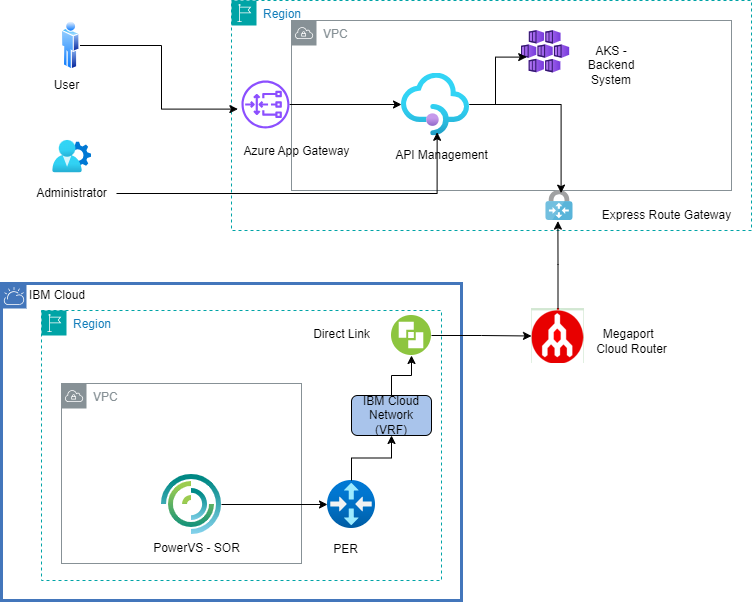
Fig 1: API Based integration from Microsoft Azure API management to get SoRs from IBM PowerVS

Fig 1: API Based integration from Microsoft Azure API management to get SoRs from IBM PowerVS

Architecture Description

1. Front-end Applications: Monolithic or cloud-native applications running on Microsoft Azure, providing user interfaces and business logic.

2. API Gateway: An API gateway (e.g. Microsoft Azure API Management) in Microsoft Azure, responsible for managing API requests, authentication, and rate limiting.

3. API Integration: RESTful APIs or other integration mechanisms (e.g., messaging queues) connecting the front-end applications to the SoR applications on IBM PowerVS.

4. SoR Applications: AIX-based applications running on IBM PowerVS, serving as the single source of truth for critical business data.

5. Multi-cloud Network Connectivity: Secure, dedicated connectivity between Microsoft Azure and IBM PowerVS, provided by Megaport, ensuring high-performance and low-latency data exchange.

2. Pattern: Event Driven Integration Pattern

Use Case

Microservice applications on Microsoft Azure pulling data from IBM PowerVS asynchronously via event-driven architecture using Microsoft Azure Event Bus at Microsoft Azure and Kafka at IBM cloud.

Benefits of Event-Driven Architecture:

  1. Decoupled Systems Integration:

    • By leveraging event-driven architecture, the integration between Microsoft Azure microservices and AIX-based applications on IBM PowerVS becomes decoupled. This decoupling allows for independent evolution and scaling of each component without impacting the other, thereby minimizing the risk of disruption to critical business operations.
  2. Scalability and Elasticity:

    • Microsoft Azure’s event-driven services like Microsoft Azure Event Grid and Microsoft Azure Event Hubs provide scalable and elastic infrastructure for handling event streams. This capability enables seamless scaling of microservices in response to varying workloads and business demands, ensuring optimal performance and resource utilization.
  3. Real-Time Data Processing and Responsiveness:

    • Event-driven architecture facilitates real-time data processing by enabling immediate consumption of events as they occur. This responsiveness enhances the overall system agility, allowing Microsoft Azure microservices to react swiftly to changes in data from AIX-based applications on IBM PowerVS.
  4. Fault Tolerance and Resilience:

    • By distributing events through durable event brokers such as Microsoft Azure Event Hubs and Kafka on IBM Cloud, the architecture enhances fault tolerance and resilience. It ensures that even if components fail temporarily, events are reliably delivered and processed once the system recovers, maintaining system availability and reliability.
  5. Enhanced Integration Capabilities:

    • Event-driven patterns promote seamless integration across diverse systems and platforms. Microsoft Azure’s ecosystem supports a wide range of connectors and adapters for integrating with various data sources and services, facilitating smoother interactions between Microsoft Azure microservices and AIX-based applications on IBM PowerVS.
  6. Operational Efficiency and Cost Optimization:

    • Event-driven architecture optimizes resource consumption by processing events asynchronously and on-demand. This operational efficiency reduces idle resource times and minimizes infrastructure costs, making the solution cost-effective and scalable as per business needs.

  7. Future-Proof and Extensible Design:

    • The modular and loosely coupled nature of event-driven architecture future-proofs the system by accommodating future changes and enhancements with minimal disruption. It supports evolving business requirements and technological advancements, ensuring long-term viability and adaptability of the integrated solution.

Variations on Event-Driven Architecture:

1. Multi-cloud Front-end

Description

Deploy front-end applications across multiple cloud providers such as IBM Cloud, Microsoft Azure, AWS, Google Cloud, and Oracle Cloud as part of the multi-cloud architecture. Each cloud provider can host different components of the application stack, leveraging their respective strengths.

Benefits

  • Vendor Flexibility: Avoid vendor lock-in by utilizing multiple cloud providers, choosing services that best fit specific application needs.
  • Geographical Reach: Distribute front-end components closer to users in different regions, improving latency and user experience.
  • High Availability: Ensure redundancy and failover across multiple cloud environments, enhancing application resilience.

2. Containerized System of Record (SoR)

Description

Containerize SoR applications on IBM PowerVS using Docker and Red Hat OpenShift, allowing for greater portability and easier management of the SoR environment.

Benefits

  • Portability: Easily move and deploy SoR applications across different environments, including on-premises and various cloud platforms.
  • Scalability: Red Hat OpenShift orchestrates containerized applications, automatically scaling based on workload demands.
  • Management Efficiency: Simplify deployment, management, and updates of SoR applications through containerization, enhancing operational efficiency.

3. API Gateway on IBM Cloud

Description

Host the API gateway (e.g. using Microsoft Azure API Management or similar) on IBM Cloud, closer to the SoR applications running on IBM PowerVS.

Benefits
  • Latency Reduction: Minimize latency by keeping API requests and responses within the same cloud environment as the SoR applications.
  • Security Enhancement: Enhance security by reducing exposure of critical APIs to the public internet, leveraging IBM Cloud’s security features and network controls.
  • Compliance: Ensure compliance with data sovereignty regulations by keeping sensitive data and APIs within designated cloud regions.

Key Points of Integration

  • Event-Driven Approach: Microservices on Microsoft Azure subscribe to events from Microsoft Azure Event Grid/Event Hubs, while Kafka on IBM Cloud facilitates event publication from AIX-based applications.
  • API Gateway Consideration: If necessary, an API gateway (like Microsoft Azure API Management) can still be utilized for exposing APIs to external clients or other services.
  • Network Connectivity: Ensuring secure and performant connectivity between Microsoft Azure and IBM Cloud is crucial for seamless data flow.

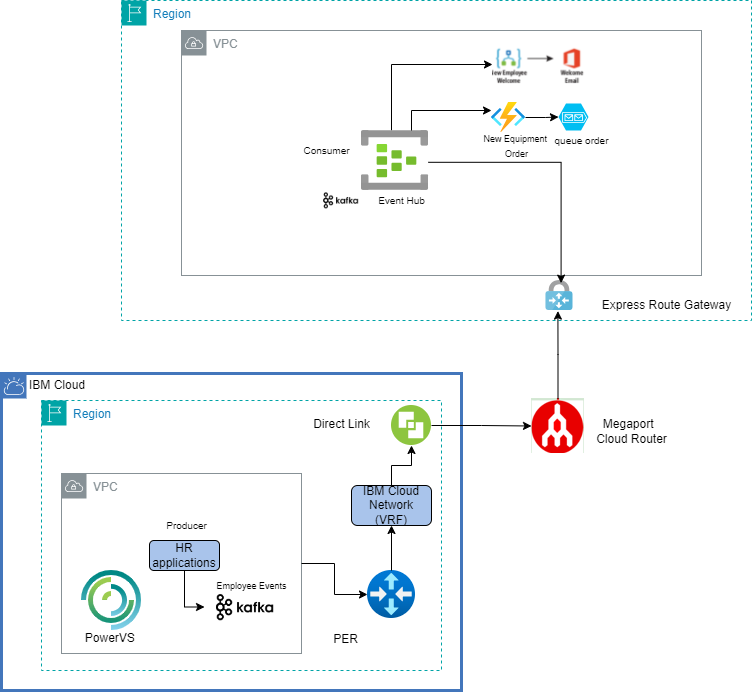
Fig 2: Kafka based integration with Event Bus with Kafka extension running on Microsoft Azure

Fig 2: Kafka based integration with Event Bus with Kafka extension running on Microsoft Azure

Architecture Description

1. Microservices on Microsoft Azure:

  • Cloud-native microservices deployed on Microsoft Azure, handling specific functionalities or services.

2. Event Bus:

  • Microsoft Azure Event Grid or Microsoft Azure Event Hubs used as an event bus within Microsoft Azure.
  • Kafka deployed on IBM Cloud used as an event bus on the IBM Cloud side.

3. Event-Driven Integration:

  • Microservices on Microsoft Azure subscribe to relevant topics or events on Microsoft Azure Event Grid/Event Hubs.
  • Kafka topics on IBM Cloud are used for publishing events from the AIX-based applications on IBM PowerVS.

4. SoR Applications:

  • AIX-based applications running on IBM PowerVS continue to serve as the SoR for critical business data.

5. Multi-cloud Network Connectivity:

  • Secure, dedicated connectivity between Microsoft Azure and IBM Cloud (where Kafka is hosted), ensuring high-performance and low-latency data exchange.
  • Megaport or similar services can be used to establish this connectivity.

Conclusion

IBM Power systems house an enterprise’s mission-critical data. IBM PowerVS delivers scalability, performance, and flexibility for Power workloads in the cloud with both scale-up and scale-out servers, SAN attached storage, native connectivity to the cloud network backbone, SAP and Oracle certified support, consistent enterprise architecture as on-prem and consistent ISV support.

For further flexibility and innovation, enterprises can connect IBM PowerVS and Microsoft Azure to extend application value with access to run modern cloud native applications on an enterprise scale Red Hat OpenShift platform and x86 virtual machines in Microsoft Azure, with application data exchange back and forth to and from AIX, IBM i or Linux virtual machines in IBM PowerVS.

This combination provides low-latency secured communication to enterprise data hosted in IBM PowerVS. This method provides superior performance due to fewer network hops, and allows for highly secured communication between new cloud-native applications and enterprise data stores as network traffic never has to leave the dedicated network path.