







By Chris Cabel, Senior Director, Global Cloud Solutions
Discover the advantages, use cases, and trends behind why this popular networking method is a must for businesses connecting to the cloud.
NaaS is a cloud model where customers use third-party services to run their network as opposed to deploying and maintaining their own physical network infrastructure. This model shifts businesses from hardware-based to software-defined networking.
Born from the desire for businesses to configure their own wide area networks (WANs) that were more stable and performant than traditional setups, NaaS offers a subscription-based alternative to renting telco links and deploying your own infrastructure. Private connections between your Points of Presence (PoPs), cloud providers, and managed services can simply be used and scaled as needed.
This allows for easy business growth with global connectivity and interconnection across data centers, clouds, and regions, while removing the need to manage on-premises infrastructure.
NaaS typically replaces or modernizes setups like Multiprotocol Label Switching (MPLS) and virtual private networks (VPNs), and removes the need for on-premises hardware like load balancers and firewall appliances. This allows businesses flexibility in where and how they connect while reducing costs.
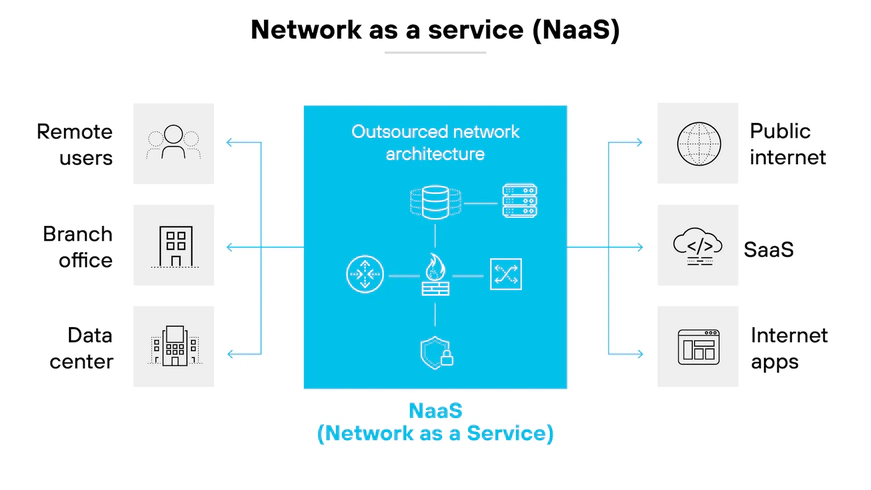
Before NaaS, businesses usually relied on private networks with rented links, onsite hardware, and internet VPNs to manage their WAN. But as cloud services became the norm, data traveling via corporate infrastructure and the public internet became increasingly inefficient, creating constant latency issues, jitter, traffic bottlenecks, and security concerns.
As networking technology has advanced, networking functions that used to be hardware-based (like firewalls and load balancers) can now be deployed and managed virtually. This enables employees to securely connect to cloud services directly through a virtual, externally-managed network as opposed to going through corporate VPNs and onsite WAN infrastructure.
By outsourcing their WAN to a NaaS provider, businesses are able to take full advantage of the applications and services cloud providers have to offer with improved performance, easier management, and more flexibility.
While NaaS is far from a new concept, it continues to grow in popularity for a number of reasons:
By shifting your network infrastructure from hardware to software, you can eliminate the need to purchase routers, switches, firewalls, and circuits for (almost) no capex. And with the ability to connect to data centers, clouds, and partners without investing in colocation space or physical interconnects, you’ll continue to save capex over time.
A usage-based model also allows you to pay only for the connections you use, so you can budget more effectively and adjust your connectivity on demand to reduce opex.
Software-defined networking comes with built-in redundancy and failover to minimize downtime. Traffic reroutes instantly if a connection fails, and diverse network paths across multiple data centers and regions protect high availability. Private NaaS connections are also protected from the instability of the public internet, eliminating bottlenecks.
Because of these advantages, many NaaS providers can offer high availability SLAs that give your team peace of mind and improve user experience for your customers.
Elastic NaaS connectivity enables businesses to adapt to changing network demands without hardware constraints. Instantly increase or decrease capacity as needed to avoid overprovisioning, and virtually add or remove network connections in minutes.
You can also integrate and scale your cloud network by interconnecting multiple cloud providers and data centers, as well as automate network adjustments for dynamic workloads. And you can do all of this on a pay-as-you-go model with no long-term commitments.
Replace hardware-centric processes with centralized, software-driven control to manage all your global connections through a single pane of glass. Offload hardware management, updates, and troubleshooting to the provider, and improve the efficiency of your team with customizable APIs.
Integrated encryption, firewall policies, and compliance controls also work together to reduce the complexity associated with managing your network.
Software-defined routing enables you to bypass the public internet with private, high-speed links to clouds, data centers, and service providers, ensuring your data takes the most efficient possible path.
Adjust capacity in real time to prevent congestion and maintain peak performance. Dedicated links reduce packet loss and jitter, while the ability to adjust capacity in real time prevents congestion and enables you to rightsize your bandwidth.
Plus, distributed global backbones and access to multiple service providers allow for seamless interconnectivity with fewer hops. The result of all these benefits: more uptime, smoother operations, and faster time to market.
The long lead and deployment times you’re used to with a traditional telco don’t exist with a NaaS provider. Software-defined orchestration replaces manual provisioning with automated, software-defined connectivity to set up your virtual connections in minutes via a self-service portal or API. Get direct, on-demand access to cloud providers, managed service providers, and colocation facilities. You can also quickly spin up or modify connections as business needs change.
Reduce your attack surface and avoid exposure to internet-based threats with dedicated links, built-in security features, and end-to-end encryption on a private network underlay. Software-defined routing also supports Zero Trust Network Access (ZTNA) by restricting access based on identity and least-privilege principles.
Take your security a step further and use APIs to apply consistent encryption, segmentation, and compliance controls across all your connections.
Connect seamlessly across cloud environments with a vendor-neutral underlay built for multicloud and hybrid cloud support. Incorporate SD-WAN, SASE, MPLS, and bare metal setups to interconnect all your network endpoints and improve performance.
Feature | Traditional networking | NaaS |
Costs | High capex and non-optimized opex | Reduced capex and optimized opex |
Reliability | Prone to downtime and bottlenecks | Built-in redundancy and failover |
Scalability | Scale bandwidth and add connections manually | Add bandwidth and connections virtually |
Management | Manual configuration and maintenance | Central portal, APIS, and/or automation |
Speed | Fixed bandwidth, instability of public internet | Scalable bandwidth, predictable latency |
Security | Public internet risks, BYO security features | End-to-end encryption, integrated security features |
Flexibility | Long lead times for deployment and growth | Deploy and scale in minutes with multicloud and hybrid cloud support |
If you’re considering a move from a traditional WAN network to NaaS, be mindful of the following challenges:
Plenty of as-a-service models deliver IT resources on demand, but that serve slightly different purposes. Here are some common offerings you may hear about, and how they differ from one another.
Service | Purpose | Key benefit | Example provider |
NaaS | Cloud-based networking | On-demand connectivity | Megaport |
PaaS | Development and deployment platform | Simplifies app development | Google App Engine |
SaaS | Software applications | No installation, accessible anywhere | Salesforce |
IaaS | Virtualized infrastructure | Scalable compute, storage, and networking | AWS EC2 |
DaaS | Cloud-hosted desktops | Secure remote desktop access | Azure Virtual Desktop |
With a completely virtual setup, it’s easy to get started with NaaS – just choose your provider and follow their instructions to spin up your connections.
Look for a provider with:
Searching for the perfect NaaS provider? Check out Megaport. We offer a huge range of networking solutions on our elastic network fabric, we’re available in 1,100 + global locations, and you can spin up most of our services in under 60 seconds.
Discover how other businesses have used Megaport’s NaaS to transform their business.
Want to get straight to the point? Chat to one of our experts for a free personalized demo.
此内容由惯性聚合(RSS阅读器)自动聚合整理,仅供阅读参考。 原文来自 — 版权归原作者所有。