







By Misha Cetrone, Vice President
With the latest suite of integrations between Megaport and Oracle Cloud, boosting performance and reducing costs across your cloud suite is easier than ever.
In Flexera’s 2022 State of the Cloud Report, 89% of respondents reported having a multicloud strategy. And, according to a 2022 HashiCorp survey, 90% of businesses that have adopted a multicloud strategy say it’s working for them. With its slew of benefits, multicloud has made itself an intrinsic part of the business world, and for good reason – but it comes with new challenges of its own.
With workloads now sitting across multiple clouds, regions, and on-prem or colocated environments, IT infrastructure is more distributed than ever. In a distributed environment, application performance is only as good as the underlying connectivity. Many businesses start their multicloud journey using IPSec tunnels to connect to and between clouds.
However, very quickly, they run into performance, management, and security issues inherent to the internet. To solve this, organizations need a private, enterprise-grade network across their entire multicloud environment – and with the right approach, it doesn’t have to be difficult.
In this blog, we’ll introduce new integrations between Oracle and Megaport that make it possible and easy for the 22,000 Oracle Cloud infrastructure customers globally to take this next step in business performance with direct, private cloud-to-cloud interconnection. We’ll also outline some use case examples and core benefits for customers.
Having multiple cloud providers alone isn’t enough to future-proof your business — that’s where cloud-to-cloud, direct private peering comes into the picture. When you interconnect cloud tenancies directly, rather than just connect to them, you can achieve improved performance, optimized costs, and bolstered security. We cover this in more detail in a previous blog post – Three Reasons You Should Interconnect Your Clouds.
Cloud-to-cloud networking involves connecting two or more separate cloud environments or cloud service providers (CSPs) to route traffic between or “communicate” with each other directly, in a peer-to-peer architecture. This can be done through a virtual cloud router, wherein an enterprise uses a Network as a Service (NaaS) provider like Megaport to spin up a virtual device that routes traffic between cloud environments.
While the need for cloud-to-cloud connectivity is usually determined by your unique application and workload requirements, interconnecting your clouds comes with several benefits (which we explain below). But sometimes, you just need it – for example, if you’re using one cloud provider’s database, another’s AI and ML capabilities, and another’s analytics platform. High performance and private and direct peering between clouds unlocks the flexibility to run the right workload, on the right cloud, in the right place – and it is optimized by private networking solutions such as Oracle’s FastConnect.
Oracle Cloud Infrastructure (OCI) FastConnect enables customers to connect their private infrastructure to their OCI virtual cloud networks (VCNs) through private, high-speed connections. With multiple high-bandwidth options and connectivity models on offer via FastConnect partners such as Megaport, customers can benefit from more reliable, consistent networking performance in comparison to internet-based solutions like IPSec VPNs.
Why is FastConnect important here? Well, cloud-to-cloud architectures often rely on low-latency and high-throughput communication to meet application requirements or user experience expectations. This is where an OCI FastConnect solution comes into play. When compared with Internet/VPN solutions, FastConnect typically provides a more reliable, predictable, and higher-performance connection (tip: It is better because it isn’t the public internet).
Megaport’s virtual cloud routing solution, Megaport Cloud Router (MCR), enables customers to instantly provision and control virtual routers through Megaport’s web-based portal. Enterprises and service providers can unlock powerful use cases with cloud-to-cloud networking and deploy Virtual Points of Presence (VPoPs) without the need to purchase or maintain physical routing equipment or space and power, thereby reducing the total cost of ownership. With MCR, customers can rapidly deploy services and control traffic at the IP level.
Oracle has long been one of Megaport’s key connectivity partners, and our joint capabilities continue to grow.
In 2021, Megaport and Oracle announced an OCI FastConnect partner-integrated workflow in the Oracle Cloud Console. This integration means that customers can fully provision their FastConnect partner virtual circuits with Megaport from a single pane of glass within the OCI Console, without having to switch between two web portals. It’s available in all OCI regions where Megaport is located as a FastConnect partner.
Now, in addition to the Megaport VXC solution, the integration now includes support for MCR. Mutual customers can select an existing MCR, or create a new one for their FastConnect virtual circuit, all from the OCI console. This industry “first-of-its-kind” integration makes connecting from OCI to resources in other public cloud platforms easier than ever.
Why have Oracle and Megaport developed these capabilities? We are striving to make high-performance cloud-to-cloud networking as easy as possible for our mutual customers.
The benefits include:
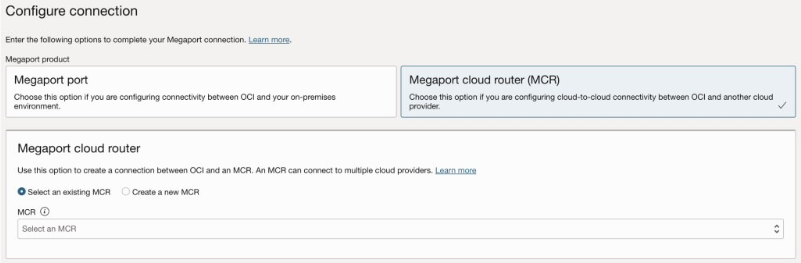
Customers can deploy MCR directly from the OCI console.
Let’s take a look at a couple of interesting use case examples.
One of many ways to employ this integration is to build a redundant and resilient database architecture using the Oracle Data Guard solution.
Maintaining business continuity and ensuring IT resiliency is a top priority for IT leaders today. Enterprises from every sector and industry are increasingly implementing multicloud solutions to enable best-in-class services while enhancing risk management and avoiding vendor lock-in.
Oracle Data Guard provides a comprehensive set of services that create, maintain, manage, and monitor one or more standby databases to enable production Oracle databases to survive disasters and data corruptions. The solution enables automatic failover for unplanned outages and database rolling upgrades that minimize downtime and risk when performing planned maintenance.
Customers of OCI can use Megaport to privately interconnect to any major cloud provider and choose MCR to set up cross-cloud connectivity between a primary Oracle Database in one cloud and a standby Oracle Database in OCI.
The below reference architecture diagram depicts a Data Guard configuration across OCI and a second cloud, in this case, Amazon Web Services (AWS).
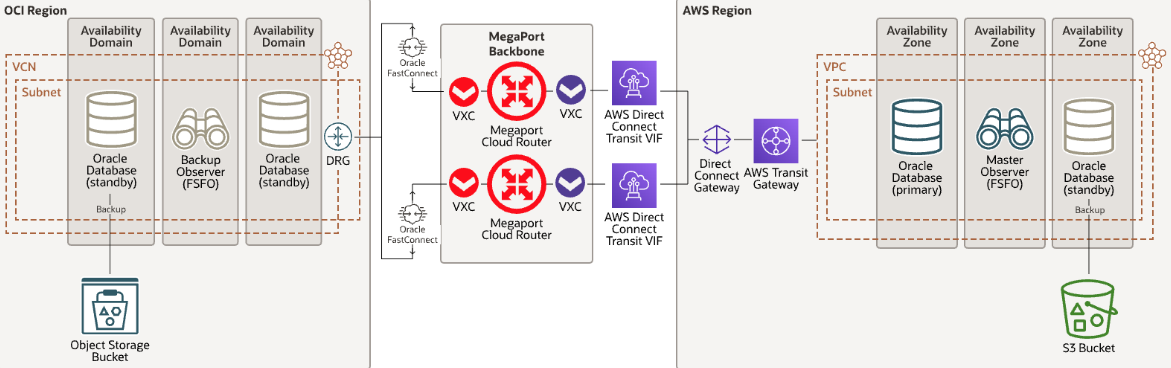
This architecture shows a Data Guard configuration across OCI and AWS using MCR.
This architecture leverages the OCI FastConnect solution with the “companion” private networking technology from AWS called Direct Connect. The end-to-end private connection between clouds ensures that performance will be optimized for latency and throughput.
Another use case with MCR and OCI is to connect two different OCI sovereign cloud tenancies.
Oracle Cloud is comprised of a number of different “realms” – a logical collection of OCI regions that don’t allow customer data to leave these realm boundaries. These realms are segmented and isolated from each other by design, to comply with specific regulatory or data sovereignty requirements.
Within the Commercial OCI realm, for example, a customer tenancy can operate workloads in any one of the global OCI commercial regions. But data cannot natively traverse outside of the commercial realm to a different OCI realm.
| Commercial Public Cloud | EU Sovereign Cloud | Government Cloud | |
|---|---|---|---|
| Global operations | EU operations | Serving US and UK agencies | |
| Data center location | 41 cloud regions in 22 countries | 2 cloud regions in the EU | 7 cloud regions in the US and UK |
| Operations and support | Oracle Global | Oracle EU | Realm-specific |
| Cloud isolation (realm) | Global realm | EU realm | Government realms |
| Multi-tenancy | Yes | Yes | Yes |
However, there are instances where an OCI customer may want to move data between realms. In this case, the MCR integration can help. In this scenario, an enterprise customer can choose to interconnect between OCI Commercial and Government realms.
An MCR and FastConnect solution makes this possible and can be easily deployed from the OCI console. This Commercial-Government architecture is optimized by FastConnect peering at each OCI instance and is connected with the MCR.
Want to run Database on Oracle Cloud and utilize analytics from Azure? Or AI and ML services from Google Cloud? The Megaport Cloud Router (MCR) and new integration with OCI makes it possible and easy to harness the unique capabilities from each platform and connect resources with low latency, high throughput, and optimized performance.
These new features and enhancements mean more customers globally can benefit from reliable, secure, and private multicloud networking. Whether it’s connecting a commercial cloud to a government cloud or quickly and easily spinning up new MCR connections through a single pane of glass, cloud interconnection has never been easier.
Did we mention that this private cloud-to-cloud architecture can be deployed in an afternoon?
此内容由惯性聚合(RSS阅读器)自动聚合整理,仅供阅读参考。 原文来自 — 版权归原作者所有。