
惯性聚合 高效追踪和阅读你感兴趣的博客、新闻、科技资讯
阅读原文 在惯性聚合中打开

推荐订阅源

酷 壳 – CoolShell
酷 壳 – CoolShell
H
Hacker News: Front Page
P
Palo Alto Networks Blog
T
ThreatConnect
Apple Machine Learning Research
博客园_首页
T
True Tiger Recordings
P
Privacy & Cybersecurity Law Blog
B
Blog
IT之家
IT之家
Last Week in AI
Last Week in AI
F
Full Disclosure
Hacker News: Ask HN
Hacker News: Ask HN
C
Comments on: Blog
Microsoft Azure Blog
C
Cybersecurity and Infrastructure Security Agency CISA
Microsoft Security Blog
博客园 - 【当耐特】
N
News and Events Feed by Topic
NISL@THU
NISL@THU
腾讯CDC
雷峰网
雷峰网
Security Latest
Security Latest
李成银的技术随笔
M
Microsoft Research Blog - Microsoft Research
L
LangChain Blog
L
Lohrmann on Cybersecurity
cs.CL updates on arXiv.org
C
Check Point Blog
Y
Y Combinator Blog
Recent Announcements
博客园 - Franky
N
News | PayPal Newsroom
V
V2EX
A
About on SuperTechFans
The Register - Security
月光博客
月光博客
奇客Solidot–传递最新科技情报
奇客Solidot–传递最新科技情报
Google Online Security Blog
MyScale Blog
MyScale Blog
Cisco Talos Blog
Cisco Talos Blog
Vercel News
Vercel News
WordPress大学
WordPress大学
C
Cyber Attacks, Cyber Crime and Cyber Security
The Hacker News
The Hacker News
IntelliJ IDEA : IntelliJ IDEA – the Leading IDE for Professional Development in Java and Kotlin | The JetBrains Blog
爱范儿
爱范儿
A
Arctic Wolf
L
LINUX DO - 最新话题
freeCodeCamp Programming Tutorials: Python, JavaScript, Git & More

Megaport Blog

Early Warning Signs Your Network Needs a Refresh Introducing Megaport DDoS Protection A Guide to 400G Connectivity A Guide to NAT Gateway A Guide to Cloud Storage How the Data Center Is Evolving in 2026 What to Expect When Attending Your First Network Operator Group (NOG) Nine Ways to Connect to Cloud Using Private Connectivity Migrate Your On-premises to the Cloud: A Step-by-Step Guide How to Lower Your Egress Fees in 2026 How to Achieve Data Sovereignty in Europe Redefining the Edge with Cisco and Megaport How to Reduce Latency in Your Multicloud Environment Introducing Megaport High-Speed Cross-Cloud Encryption Are Businesses Leaving the Cloud? Using Meraki and Megaport Virtual Edge for Multicloud Networking Equinix Metal® is Going Away: Here’s What You Can Do Introducing Megaport On-ramp as a Service Megaport’s Full Solution Portfolio Is Coming to India New Bare-metal GPU Instance Now Available with NVIDIA RTX Pro 6000 A Look Back at 2025: Megaport's Biggest Updates Megaport Expands Into India With Extreme IX Your 2026 Predictions From AWS re:Invent 2025 Top NaaS Trends for 2026 What is IPsec? When to Move From Public Internet to Private Connectivity Megaport and Latitude.sh: Bringing Compute and Connectivity Together Improve Your Microsoft ExpressRoute Resilience with Megaport Comparing Ways to Connect to AWS What is API-First Networking? The Hidden Cost of Running Cloud-Hosted SD-WAN for IaaS Overcoming NaaS Integration Challenges Introducing SCION with Anapaya and Megaport How to Use Network as a Service to Future-Proof Your Network Introducing 400G Ports All the As-a-services, Compared Introducing Megaport IPsec Tunnels High Score: Megaport Hits 1,000 Locations A Guide to Colocation Data Centers Maximizing Peering Through Flow Analysis Build Resilient Networks for AI Production Workloads Introducing Packet Filtering on Megaport Cloud Router Building Resilient Government IT: Strategies for Secure, Compliant, and Scalable Connectivity Future-Proofing Government IT Telstra Programmable Network Is Being Discontinued. Here’s How to Migrate The Future of WAN Design Depends on Network as a Service (NaaS) Cisco Webex Edge Connect Launches on Megaport Voice and Video Exchange How to Prepare for APRA CPS 230 Comparing the SD-WAN Licensing Needs of Major Vendors A Guide to Improving Network Performance How Latitude.sh, Wasabi, and Megaport Unlock Cost-Effective Multicloud Four Ways to Connect Your Clouds SD-WAN and MPLS: Weighing the Similarities, Differences, and Benefits A Guide to Network as a Service (NaaS) How to Arrange Bilateral Peering Sessions Comparing Major SD-WAN Vendors Software Defined Networking in Healthcare Deploying A Global Network in Minutes With Megaport AWS Direct Connect Gateway (DGW) Data Transfer Outbound Rules Bilateral and Multilateral Peering: What’s the Difference? Multi-Region SD-WAN: Why Megaport SDCI is the Right Choice Microsoft Azure is Going Secure by Default. Are You Ready? How Megaport and Vultr Are Solving the Enterprise AI Challenge Introducing Megaport NAT Gateway A Guide to AWS Security Tools How to Deploy Amazon Bedrock Using AWS Direct Connect and Megaport Azure Private Link, Explained Introducing 100G MCRs Simplifying Hybrid and Multicloud Network Connectivity How to Fix Poor AWS Latency A Look Back at 2024: Megaport’s Biggest Updates Your 2025 Predictions From AWS re:Invent 2024 Six Ways to Get a More Resilient Network in 2025 Multicloud Security: Challenges and Solutions The Real Cost of High Network Latency Why Brazil is Your Key to Unlocking Business Growth in Latin America Why You Need Integrated Network Security Six Key Differences Between Major Cloud Providers How to Automate Your Megaport Infrastructure With APIs Why Italy is Europe’s Next Cloud Expansion Hotspot How to Lower Your Cloud Costs Peering: How Local Is Local? Introducing Megaport AI Exchange Two Scenarios for Hybrid Multicloud Deployment With IBM Cloud and Microsoft Azure How to Connect Equinix and Digital Realty Megaport Enables Microsoft Azure ExpressRoute Metro for More Resilient Network Connectivity Executives, Here’s What Your Network Team Wants You to Know Easy Ways to Interconnect Your Network The Role of the Data Center in Your Network 100G VXC Expansion: Now Available From 597 Data Centers Worldwide Top 10 How-To Guides To Improve Your Network Comparing Encryption in Transit Options Comparing Generative AI Offerings From Major Cloud Providers A Sustainable Business Strategy Starts With Your Network Solutions to Common API Issues With Megaport Transforming Financial Connectivity: Introducing Megaport Financial Services Exchange (FSX) Megaport Enhancing Connectivity in Adelaide Megaport’s Latest Portal Features and Functionalities Automate Your Network Deployments With The New Megaport Terraform Provider A Recap of the Megaport World Tour 2024
Connecting Oracle Cloud to Any Cloud with MCR
2019-08-19 · via Megaport Blog

How to use virtual routing for connecting your workloads between Oracle Cloud and other cloud environments.

It’s easy to see why enterprise companies include Oracle Cloud as a core element in their cloud strategy. There are many factors attracting massive amounts of customers to this cloud giant. The first of which springs to mind is their high-performance database solutions that are highly valuable for organisations of any size. But, there’s much more on offer from Oracle Cloud that complements a rounded and integrated approach making it easy for businesses to get started in the cloud. 

Common enterprise use cases for Oracle Cloud

When users are looking for cloud providers, they’re typically seeking the ‘full package’ including the latest technologies, prebuilt tooling, automation, and easy integration into existing systems. Oracle’s application suite, platform, and infrastructure enables business differentiation with more than a thousand software as a service (SaaS) applications and Oracle’s infrastructure as a service (IaaS) capabilities. Companies can run any workload in the cloud – in fact, Oracle Cloud Platform offers the same capabilities in the cloud as on-premises for the greatest choice and most flexible access.

For this reason, it’s common to see these capabilities used in some of the following scenarios:

  • Running hybrid cloud environments
  • Migration from on-prem to cloud
  • Running simultaneous workloads on Oracle Cloud and with other CSPs
  • Migrating services from one cloud to another

Connectivity as an enabler of communication between the clouds

These scenarios all depend on connectivity to function completely. It’s the glue that holds them all together. Moving data between on-premises and cloud environments requires your A-end and B-end to talk to one another efficiently. Making the right choice when it comes to connectivity ensures successful deployments and migrations. With direct, flexible connectivity to and between your cloud environments, and your on-premises hardware or colocation facility, enables a dedicated line for data movement as well the choice to change and flex based on your business demands.

Let’s explore how Megaport’s Network as a Service (NaaS) solution can enable direct, flexible connectivity to enable the scenarios above. Each of these use cases requires connectivity between on-premises and Oracle Cloud, between Oracle Cloud and another CSP, or between cloud platforms within the Oracle sphere. We’ll explore all three of these options.

Connecting from on-premises to Oracle Cloud

As an increasing number of Oracle customers have begun the journey to Oracle Cloud, the process has become simpler. Oracle offers migration tools that simplify how organisations migrate on-premises workloads to the cloud. For many users, it’s not necessarily about migration and more about fast continual archiving, fast archive retrieval, and disaster recovery.

However, no matter the use case, the move to the cloud brings concerns about security, latency, and reliability. Connecting from any Megaport enabled data centre to Oracle Cloud is a straightforward process which solves any security and privacy concerns by ensuring traffic traverses our private Software Defined Network.

This works seamlessly for the first two scenarios highlighted above - Running hybrid cloud environments and Migration from on-prem to cloud. More information about how to enable hybrid cloud from your locations to Oracle Cloud is available here.

Connecting from Oracle Cloud to other cloud providers

One of the complexities with moving to the cloud is finding the best way to connect your cloud environment to other CSP platforms. With many large enterprises now embracing multicloud, we’re seeing many Oracle Cloud users obtaining the benefits of best-in-class services from a variety of CSPs and creating and tailored cloud strategy for their business.

The headache arises when you want to use the services from two or more CSPs and want to avoid connecting over the public internet or tromboning your traffic through an on-premises facility.

The simple solution is to spin up a Megaport Cloud Router (MCR) which resides on the Megaport Network. MCR is a virtual router that enables dedicated connectivity between cloud environments without the need to manage physical hardware. You can provision an MCR quickly and easily in your Megaport account, and within a few minutes, you’ll gain the capabilities of directly connecting multiple clouds without routing your traffic back to a data centre or using the public internet. You can see how this works below:
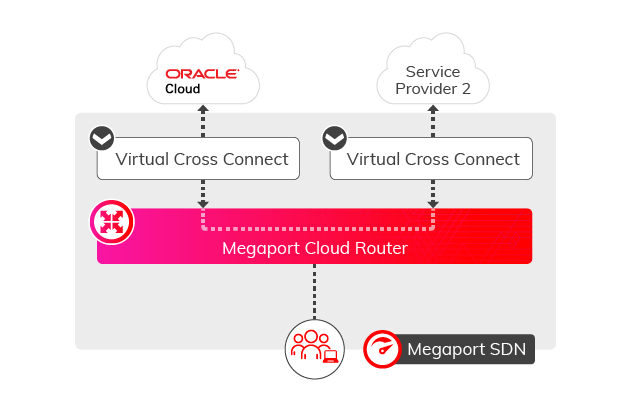
Workloads can be distributed between different cloud environments so you can choose your desired architecture based on CSP service capabilities and cost – and there’s no need to worry about latency. Service offerings are constantly evolving, MCR drives business agility by enabling your architecture to quickly alter as CSP services change.

Quick Case Study:

A Megaport customer in the UK required connectivity from Oracle Cloud Database to their workloads in AWS. Following an introduction to MCR, they proceeded to spin up a 5 Gbps instance in London and established BGP sessions to both clouds. This provided an introduction to live services in less than 90 minutes. They were able to save on time, costs, and complexity when creating a multicloud and cloud to cloud strategy.

Migrating from OCI Classic to Oracle Cloud

Many users of OCI Classic have identified a business need and are seeking a secure, flexible way to migrate databases and workloads from Oracle Cloud Infrastructure Classic (OCI-C) to Oracle Cloud Infrastructure (OCI).

The most common option is to use an encrypted connection across the public internet. For example, to migrate a single-instance Oracle Database from an OCI-C server to an OCI server that uses bare metal, you must open ports to establish an SSH session over the public internet.

MCR makes it possible to connect to any of the ten OCI-C FastConnect on-ramp locations in Ashburn, Chicago, London, Amsterdam, and Sydney. Likewise, it’s also possible to connect the MCR to any of the ten OCI FastConnect on-ramp locations in Phoenix, Ashburn, London, and Frankfurt. Combining these environments may be completed in minutes via your Megaport account to facilitate secure migration of Database and services at the data rate required to suit your needs.

As each organisation identifies a cloud strategy, Megaport has developed a common set of connectivity scenarios when accessing Oracle Cloud services. Scenarios include single, dual, High-Availability (HA), and Disaster Recovery (DR) based practices.

For more details on creating a cloud strategy incorporating Oracle, feel free to download our Oracle Cloud infopaper from our dedicated webpage.

Article reviewed by Vittorio Garbuglio, Cloud Architect, Oracle.