






How to connect your offices, private data centres, and public cloud partners – easily.
Businesses thrive on communication – with customers, with partners, and with suppliers. Very few organisations operate in isolation, so it makes sense that communicating with the external arms of your workplace should be as easy and secure as possible. Some prefer to keep external communications limited to standard business applications, such as email and document sharing tools, along with other SaaS-based solutions, which may work perfectly well for certain verticals.
Most, however, need to directly interconnect with partners outside of their organisation to function as a business and for many, the default option is to connect via a VPN across the public internet. The main way of supporting this is to manage multiple IPSec or SSL VPNs by each partner. In some industry verticals such as finance, it’s common to house third-party equipment from a partner which introduces issues around supporting and monitoring foreign equipment that doesn’t belong to the organisation.
While many companies trust their private traffic traversing the public internet and can cope with high and varying latency on a mostly uncontrolled network, others don’t want to take the risk – or want greater control and choice over their connectivity. Companies that fall into security-conscious verticals, like healthcare and finance, simply won’t tolerate their mission-critical, and often sensitive, traffic traversing the public internet.
Building private connections to an external party can be a difficult process which requires interconnecting private networks and data centres. In an ideal situation, both parties would be able to reach a common local data centre and order a cross-connect between each other’s infrastructure. Often, however, this isn’t possible because of the geographic distance between company facilities. In this case, a network provider is required to bridge the gap. Then, if redundancy is required, a second connection is also needed between the two parties. Multiply this task by the number of partners you want to connect to, and you end up with significant network operation and management challenges.
A valuable solution for making your connectivity ecosystem between partners simple to manage, and secure for mission-critical workloads, is using service keys to enable networking services. With the ability to share service keys with each party across your ecosystem, you can connect to and between them with greater flexibility, cost efficiency, and security than the public internet can offer. Plus, it’s a straightforward process with Megaport.
Within your Megaport account, you can generate service keys associated with your physical Ports. One party is the creator of the key and the other party is the consumer of the key. You can choose a single-use or multi-use key that is then shared out-of-band (via email, for example) with the other party. The consumer of this key can use it in their Megaport account to create a Virtual Cross Connect (VXC) from a Port or Megaport Cloud Router (MCR) to the creator’s Port. This enables direct connectivity between service provider and enterprise user.
Please note: the party that consumes the key must take on the Megaport VXC charges.
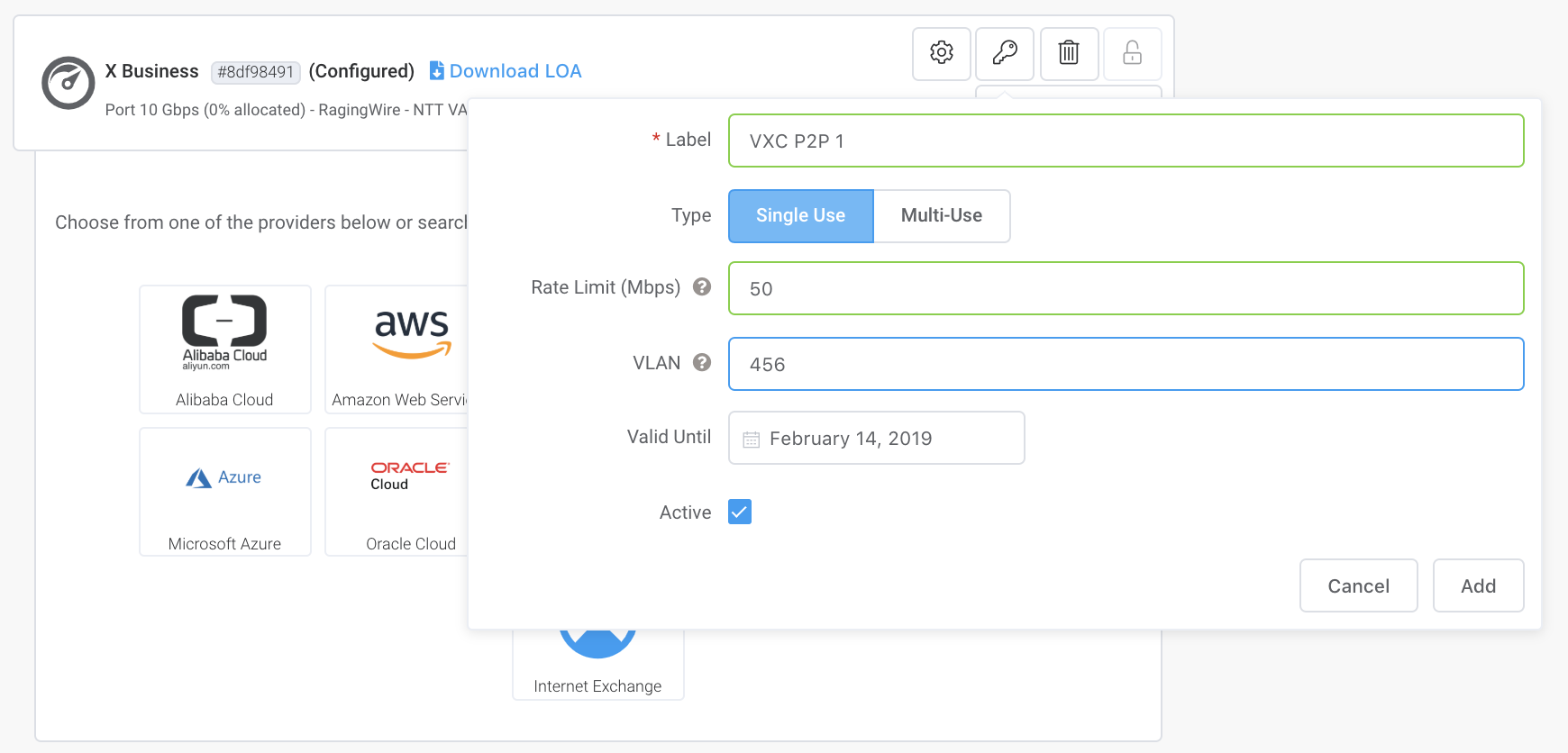
The service key enables you to create VXCs and isn’t crucial after the connection is created. The key creator has control over limiting the bandwidth of the connection and can also specify the VLAN ID for a single-use key. It’s also possible to put a time limit on the key or disable it at any time before use. Of course, either party can remove the VXC at any time from their account.
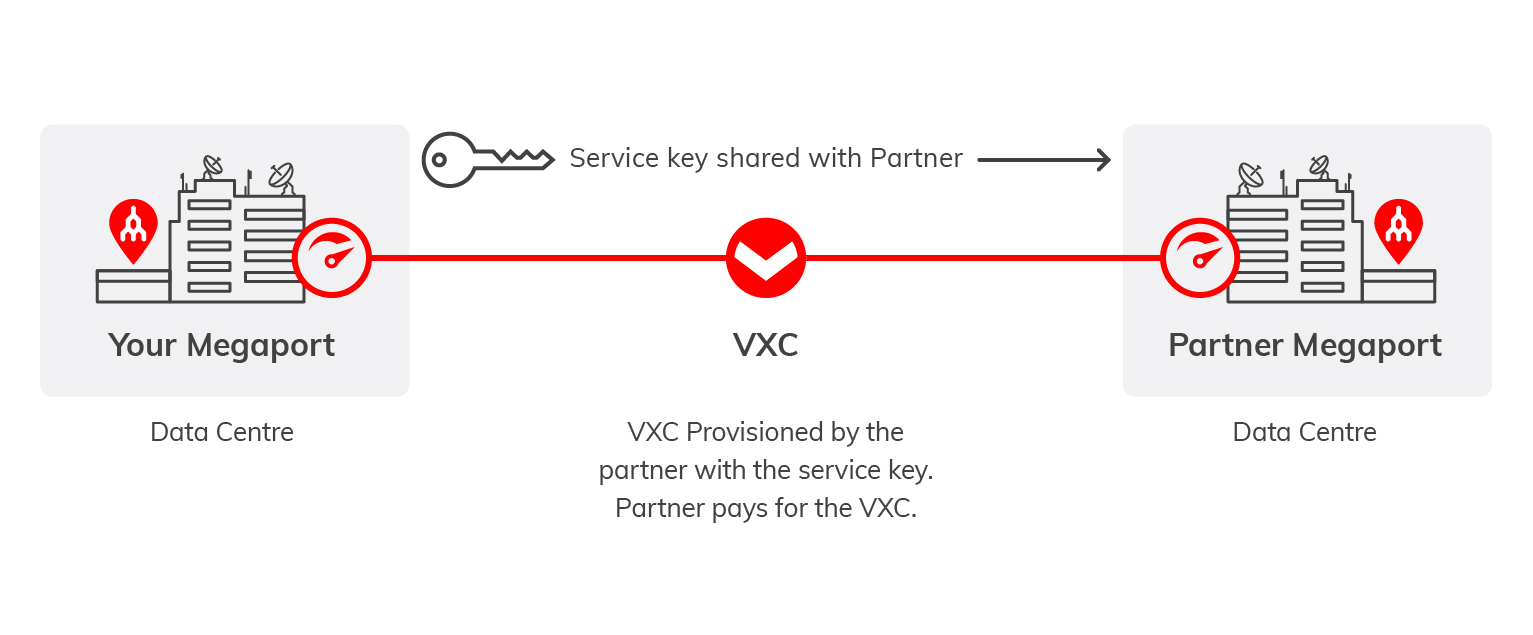
Once connected Port-to-Port, you’ll have low-latency, private, Layer 2 connectivity with your partner. Working with your partner, you can then decide on route prefixes and protocols such as BGP.
Please note: most parties use a firewall to maintain control at the network border.
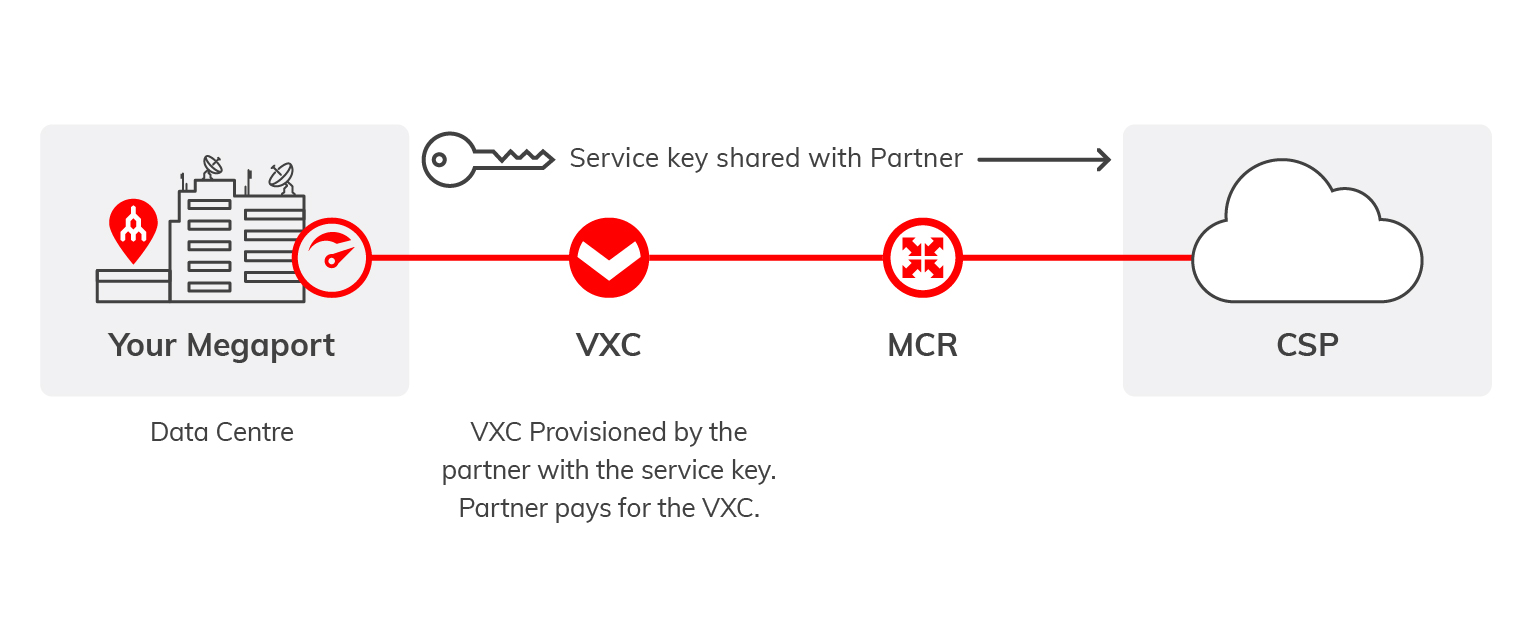
You may require connectivity to your partner services located in the cloud. In this case, it’s possible to use the partner’s MCR in conjunction with your Port service keys. Connecting with Megaport gives you the added benefit of having significantly lower traffic egress costs from leading cloud providers compared with connecting over the public internet.
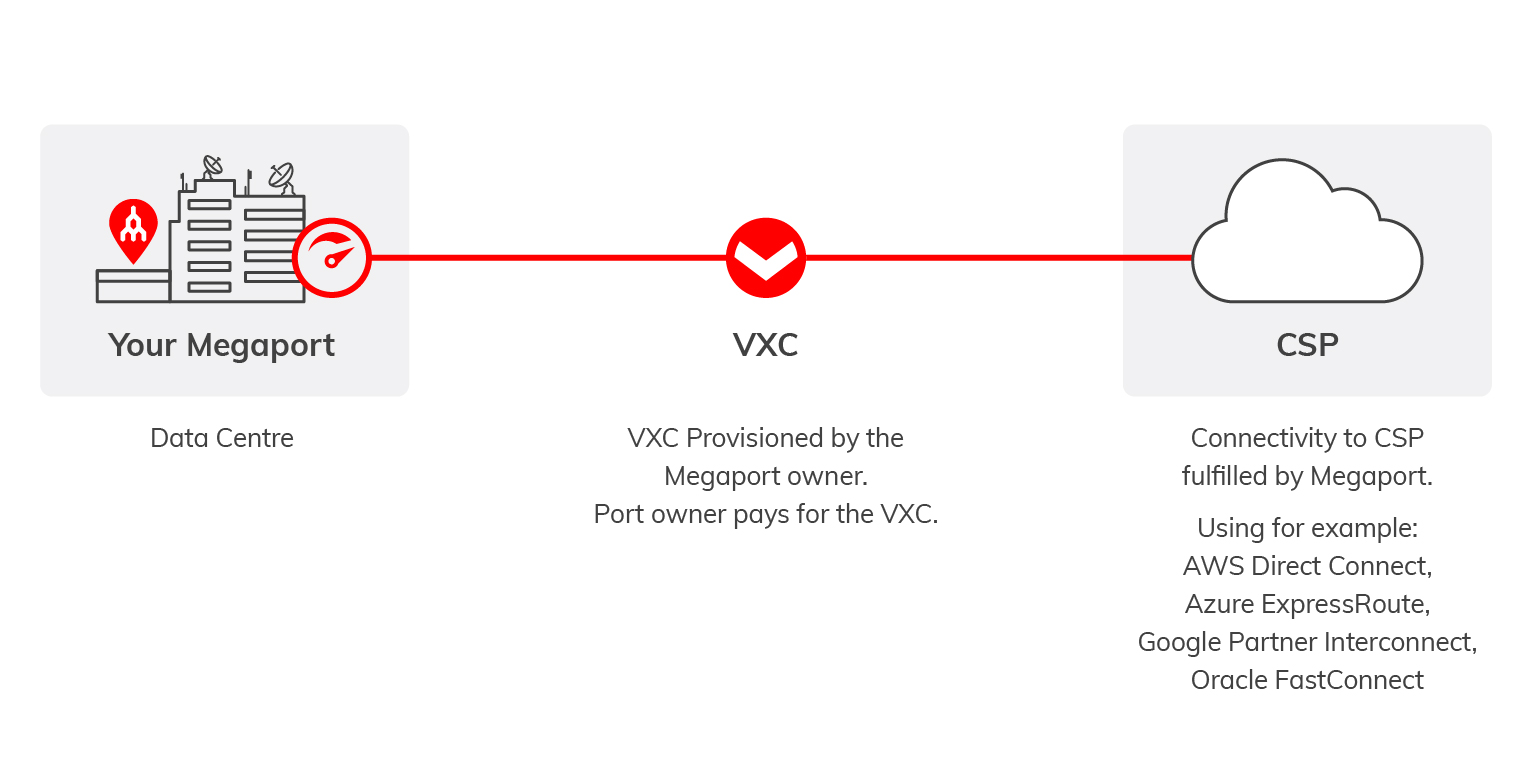
There are many companies who only operate within cloud environments. With Megaport, you can actually connect directly from your physical Port to a partner’s cloud account without the use of service keys. Your partner in the cloud would need to share some details about the cloud connection to allow you to provision a VXC from your Megaport account. For AWS, that means the AWS account ID, and for most of the other cloud providers, they would share the interface or attachment service key.
Using Megaport to connect securely and privately with third parties is relevant to all industry verticals with growing popularity within finance and media and communications sectors. These include Voxbone a global provider of voice and messaging services for major brands such as Uber, Zoom, and Telefonica. Voxbone uses Megaport to provide speedy service connections to their partners’ data centres and cloud infrastructure.
“Megaport brings Voxbone’s customers a simple, effective way to interface with our network from more locations, including all major public cloud environments,” says Voxbone VP Product, Matt Brown.“Megaport further strengthens our value proposition as a global enterprise-grade communications provider through easier connectivity and on-demand bandwidth flexibility – effectively bringing our network closer to our customers, no matter their location.”
Another way to connect to customers and partners – albeit publicly – is by promoting your business on the Megaport Marketplace – a global ecosystem that connects service providers with enterprise customers. On the Marketplace, you can showcase your brand, reach global enterprises, scale to new markets, and provide solutions for businesses worldwide. Enterprises can efficiently multi-source their IT services by connecting to various providers. Making your presence public is key.
Subsequent to creating a Marketplace profile and making your Port(s) publicly visible, you’re ready to start receiving connection requests from customers. Customers can rapidly self-provision VXCs to any provider hosted on the Marketplace. When a customer initiates the connection request, you’ll be notified of the request by email and can choose to accept or deny the request.
If you want to discuss how Megaport can optimise communication with your partners and how you can leverage private connectivity to grow your partner ecosystem, feel free to reach out and get in touch with our team.
此内容由惯性聚合(RSS阅读器)自动聚合整理,仅供阅读参考。 原文来自 — 版权归原作者所有。