




惯性聚合 高效追踪和阅读你感兴趣的博客、新闻、科技资讯
阅读原文 在惯性聚合中打开

推荐订阅源

酷 壳 – CoolShell
酷 壳 – CoolShell
H
Hacker News: Front Page
P
Palo Alto Networks Blog
T
ThreatConnect
Apple Machine Learning Research
博客园_首页
T
True Tiger Recordings
P
Privacy & Cybersecurity Law Blog
B
Blog
IT之家
IT之家
Last Week in AI
Last Week in AI
F
Full Disclosure
Hacker News: Ask HN
Hacker News: Ask HN
C
Comments on: Blog
Microsoft Azure Blog
C
Cybersecurity and Infrastructure Security Agency CISA
Microsoft Security Blog
博客园 - 【当耐特】
N
News and Events Feed by Topic
NISL@THU
NISL@THU
腾讯CDC
雷峰网
雷峰网
Security Latest
Security Latest
李成银的技术随笔
M
Microsoft Research Blog - Microsoft Research
L
LangChain Blog
L
Lohrmann on Cybersecurity
cs.CL updates on arXiv.org
C
Check Point Blog
Y
Y Combinator Blog
Recent Announcements
博客园 - Franky
N
News | PayPal Newsroom
V
V2EX
A
About on SuperTechFans
The Register - Security
月光博客
月光博客
奇客Solidot–传递最新科技情报
奇客Solidot–传递最新科技情报
Google Online Security Blog
MyScale Blog
MyScale Blog
Cisco Talos Blog
Cisco Talos Blog
Vercel News
Vercel News
WordPress大学
WordPress大学
C
Cyber Attacks, Cyber Crime and Cyber Security
The Hacker News
The Hacker News
IntelliJ IDEA : IntelliJ IDEA – the Leading IDE for Professional Development in Java and Kotlin | The JetBrains Blog
爱范儿
爱范儿
A
Arctic Wolf
L
LINUX DO - 最新话题
freeCodeCamp Programming Tutorials: Python, JavaScript, Git & More

Megaport Blog

Early Warning Signs Your Network Needs a Refresh Introducing Megaport DDoS Protection A Guide to 400G Connectivity A Guide to NAT Gateway A Guide to Cloud Storage How the Data Center Is Evolving in 2026 What to Expect When Attending Your First Network Operator Group (NOG) Nine Ways to Connect to Cloud Using Private Connectivity Migrate Your On-premises to the Cloud: A Step-by-Step Guide How to Lower Your Egress Fees in 2026 How to Achieve Data Sovereignty in Europe Redefining the Edge with Cisco and Megaport How to Reduce Latency in Your Multicloud Environment Introducing Megaport High-Speed Cross-Cloud Encryption Are Businesses Leaving the Cloud? Using Meraki and Megaport Virtual Edge for Multicloud Networking Equinix Metal® is Going Away: Here’s What You Can Do Introducing Megaport On-ramp as a Service Megaport’s Full Solution Portfolio Is Coming to India New Bare-metal GPU Instance Now Available with NVIDIA RTX Pro 6000 A Look Back at 2025: Megaport's Biggest Updates Megaport Expands Into India With Extreme IX Your 2026 Predictions From AWS re:Invent 2025 Top NaaS Trends for 2026 What is IPsec? When to Move From Public Internet to Private Connectivity Megaport and Latitude.sh: Bringing Compute and Connectivity Together Improve Your Microsoft ExpressRoute Resilience with Megaport Comparing Ways to Connect to AWS What is API-First Networking? The Hidden Cost of Running Cloud-Hosted SD-WAN for IaaS Overcoming NaaS Integration Challenges Introducing SCION with Anapaya and Megaport How to Use Network as a Service to Future-Proof Your Network Introducing 400G Ports All the As-a-services, Compared Introducing Megaport IPsec Tunnels High Score: Megaport Hits 1,000 Locations A Guide to Colocation Data Centers Maximizing Peering Through Flow Analysis Build Resilient Networks for AI Production Workloads Introducing Packet Filtering on Megaport Cloud Router Building Resilient Government IT: Strategies for Secure, Compliant, and Scalable Connectivity Future-Proofing Government IT Telstra Programmable Network Is Being Discontinued. Here’s How to Migrate The Future of WAN Design Depends on Network as a Service (NaaS) Cisco Webex Edge Connect Launches on Megaport Voice and Video Exchange How to Prepare for APRA CPS 230 Comparing the SD-WAN Licensing Needs of Major Vendors A Guide to Improving Network Performance How Latitude.sh, Wasabi, and Megaport Unlock Cost-Effective Multicloud Four Ways to Connect Your Clouds SD-WAN and MPLS: Weighing the Similarities, Differences, and Benefits A Guide to Network as a Service (NaaS) How to Arrange Bilateral Peering Sessions Comparing Major SD-WAN Vendors Software Defined Networking in Healthcare Deploying A Global Network in Minutes With Megaport AWS Direct Connect Gateway (DGW) Data Transfer Outbound Rules Bilateral and Multilateral Peering: What’s the Difference? Multi-Region SD-WAN: Why Megaport SDCI is the Right Choice Microsoft Azure is Going Secure by Default. Are You Ready? How Megaport and Vultr Are Solving the Enterprise AI Challenge Introducing Megaport NAT Gateway A Guide to AWS Security Tools How to Deploy Amazon Bedrock Using AWS Direct Connect and Megaport Azure Private Link, Explained Introducing 100G MCRs Simplifying Hybrid and Multicloud Network Connectivity How to Fix Poor AWS Latency A Look Back at 2024: Megaport’s Biggest Updates Your 2025 Predictions From AWS re:Invent 2024 Six Ways to Get a More Resilient Network in 2025 Multicloud Security: Challenges and Solutions The Real Cost of High Network Latency Why Brazil is Your Key to Unlocking Business Growth in Latin America Why You Need Integrated Network Security Six Key Differences Between Major Cloud Providers How to Automate Your Megaport Infrastructure With APIs Why Italy is Europe’s Next Cloud Expansion Hotspot How to Lower Your Cloud Costs Peering: How Local Is Local? Introducing Megaport AI Exchange Two Scenarios for Hybrid Multicloud Deployment With IBM Cloud and Microsoft Azure How to Connect Equinix and Digital Realty Megaport Enables Microsoft Azure ExpressRoute Metro for More Resilient Network Connectivity Executives, Here’s What Your Network Team Wants You to Know Easy Ways to Interconnect Your Network The Role of the Data Center in Your Network 100G VXC Expansion: Now Available From 597 Data Centers Worldwide Top 10 How-To Guides To Improve Your Network Comparing Encryption in Transit Options Comparing Generative AI Offerings From Major Cloud Providers A Sustainable Business Strategy Starts With Your Network Solutions to Common API Issues With Megaport Transforming Financial Connectivity: Introducing Megaport Financial Services Exchange (FSX) Megaport Enhancing Connectivity in Adelaide Megaport’s Latest Portal Features and Functionalities Automate Your Network Deployments With The New Megaport Terraform Provider A Recap of the Megaport World Tour 2024
How to Keep Your Network Safe in 2022
2022-01-26 · via Megaport Blog

Stay ahead of the hackers and keep your data secure with our simple networking tips.

Cybersecurity has never been more important. With many businesses now fully embracing flexible and remote work models, a lot of data is traversing the globe at any given time – in fact, the latest research shows that we’re globally sharing 2.5 quintillion bytes of data every single day. (To put that number into perspective, a quintillion has 18 zeros.)

With so much critical business info at risk at any given moment, it’s no wonder that cybercriminals invest as much as they do into finding new and creative ways to penetrate your data. And these cybercriminals are successful more often than you may realize – cybercrime cost our global economies more than US$6 trillion in 2021.

But in 2022, with a bit of preparation and the latest cybersecurity technology, you can safeguard your network architecture.

1. Avoid public connections

We’ve covered the security concerns of public internet connectivity on our blog for years, and for good reason – using a public connection is like placing your data in an unlocked safe before sending it to its destination. In 2022, protecting your data with private connectivity remains one of the most important steps you can take to improve your network security.

Dive deeper into your cloud security with our blog “Is Your Cloud Data Secure? Three Questions You Can Ask Yourself.”

While no connectivity method is without its risks, private connectivity protects your data from exposure to the public internet by reducing the Autonomous System (AS) paths it needs to take – in other words, shortening the road it travels. With the right provider, like Megaport, you can also encrypt your network traffic end-to-end.

And if you choose an ISO/IEC 27001 certified provider—the international standard for information security management of the International Organization for Standardization (ISO) and the International Electrotechnical Commission (IEC)—you’ll have peace of mind knowing your provider complies with stringent standards that protect your enterprise globally.

Megaport has earned the ISO/IEC 27001 certification, effectively locking your data safe with comprehensive security features.

2. Integrate your cloud stack

According to GartnerⓇ, “By 2025, 35% of companies that use multiple public cloud providers will use a single network stack, an increase of more than 10x from 2021.”1

Aside from giving you a hybrid cloud or multicloud architecture that’s more cost effective and easier to manage, integrating your cloud stack through a single private network provider also gives you a holistic overview of your cloud applications. This means you can identify potential risks as quickly as possible, and enclose your stack within the security and protection benefits offered by your provider. Plus, you can further protect from data breaches by easily applying consistent security measures across your entire network.

Megaport Cloud Router (MCR) is one way to more closely integrate your networking across multiple clouds. This virtual routing service gives your business instant private Layer 3 connectivity, allowing you to integrate and connect to the cloud and managed services you need without any hardware. By using Virtual Cross Connects, you can route data to and between providers and platforms without hair-pinning traffic to a data center or your on-premises environment. The result can be a simplified, streamlined, and integrated hybrid cloud and multicloud network stack.

Get the Megaport Cloud Router (MCR) infopaper here.

3. Supercharge your SD-WAN with edge connectivity

When it comes to network security, time is critical – and the more operationally agile your enterprise is, the more quickly you can identify and respond to security threats.

SD-WAN offers more than a network for your enterprise; it offers an ecosystem. Reputable providers like Cisco, Fortinet, Versa, Aruba, and VMware offer excellent SD-WAN solutions that integrate and optimize your increasingly distributed WAN consisting of multicloud, cloud-native network security, branches, and applications.

Learn more about the benefits of SD-WAN in this blog post comparing SD-WAN and MPLS.

You can go a step further and extend the benefits of your SD-WAN from the data center to the edge by integrating a Network Function Virtualization (NFV) hosting service that allows you to extend your SD-WAN fabric closer to the end user. This will privatize your connection all the way to and from your branch and reduce your data’s internet hops, therefore reducing instances of your data being exposed to threats.

Megaport Virtual Edge (MVE), Megaport’s on-demand NFV service, supercharges your SD-WAN by routing mission-critical traffic via Megaport’s SDN and reducing internet hops. And when you use MVE with one of our integration partners, you’ll get a lot of other benefits, too:

  • Unmatched global reach with 700+ Megaport enabled data centers, 100+ unique operators, 240+ Cloud interconnects, and 20+ MVE enabled metros
  • Faster resource deployment to save time
  • Increased connectivity and maximum edge diversity
  • Access to a dedicated global team of software-defined networking experts
  • Flexible range of connectivity options with unrestricted choices
  • Simplified deployment, requirements, and costs
  • Immediate provisioning access for fast modernization.

Get the Megaport Virtual Edge (MVE) infopaper here.

4. Don’t just protect your network – protect your applications

When cyberattacks occur, they not only put your sensitive data at risk, they can also leave you unable to access the applications vital to running your business.

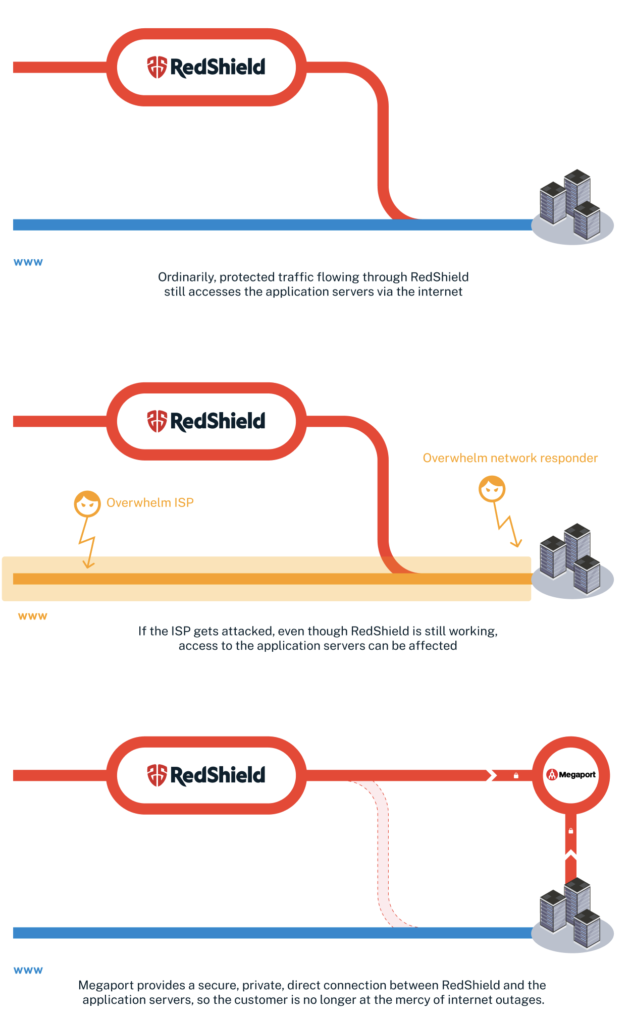
The best way to mitigate this risk is to operate dedicated connections and reduce reliance on Internet Service Providers (ISPs) as much as possible, like web application security provider RedShield did.

RedShield’s customers, in industries ranging from government to healthcare, rely on them to help keep their web applications safe in today’s cybersecurity landscape. RedShield’s proprietary “shielding” tools protect customers from security vulnerabilities, but these tools rely on highly available connectivity to provide constant protection.

RedShield was using ISPs for their connectivity, but they had a problem – if an ISP link RedShield used was targeted by a Distributed Denial of Service (DDoS) attack, congesting the link, the team was effectively blocked from the customer’s server, meaning they were also blocked from being able to manage risks and ensure dynamic web app content was working properly. They knew they needed to make a change.

By leveraging a dedicated link to application servers via Megaport, they were able to transform cybersecurity for both themselves and their customers. Once set up, they began offering the choice of either MegaIX or Virtual Cross Connects (VXCs) to bypass the internet via Megaport.

Through either method, RedShield can now leverage their dedicated connections to directly, securely, and consistently access and protect their customers’ servers.
Read RedShield’s case study to learn more.

By protecting your data with a private global network and extending this private connectivity across your cloud stack and to the edge, you can elevate your network security and protect your enterprise data almost anywhere it goes.

Ready to get started? You can deploy a global, high availability network in minutes with Megaport’s industry-leading Network as a Service (NaaS) platform – just point, click, and connect.

Try Megaport now.

1Gartner®, Predicts 2022: Connecting the Digital Enterprise, By Andrew Lerner, John Watts, Joe Skorupa, Published 2 December 2021.

GARTNER is a registered trademark and service mark of Gartner, Inc. and/or its affiliates in the U.S. and internationally and is used herein with permission. All rights reserved.