

惯性聚合 高效追踪和阅读你感兴趣的博客、新闻、科技资讯
阅读原文 在惯性聚合中打开

推荐订阅源

F
Fox-IT International blog
Security Latest
Security Latest
S
Security @ Cisco Blogs
L
LINUX DO - 热门话题
T
Threatpost
W
WeLiveSecurity
cs.CL updates on arXiv.org
腾讯CDC
雷峰网
雷峰网
Cyberwarzone
Cyberwarzone
V
V2EX - 技术
freeCodeCamp Programming Tutorials: Python, JavaScript, Git & More
P
Proofpoint News Feed
T
Tailwind CSS Blog
Cisco Talos Blog
Cisco Talos Blog
人人都是产品经理
人人都是产品经理
罗磊的独立博客
P
Privacy International News Feed
The Register - Security
T
Threat Research - Cisco Blogs
IT之家
IT之家
T
True Tiger Recordings
SecWiki News
SecWiki News
V
Vulnerabilities – Threatpost
博客园_首页
OSCHINA 社区最新新闻
OSCHINA 社区最新新闻
博客园 - 司徒正美
月光博客
月光博客
P
Privacy & Cybersecurity Law Blog
N
News | PayPal Newsroom
Google DeepMind News
The Cloudflare Blog
美团技术团队
Simon Willison's Weblog
博客园 - Franky
V
Visual Studio Blog
E
Exploit-DB.com RSS Feed
酷 壳 – CoolShell
酷 壳 – CoolShell
F
Future of Privacy Forum
J
Java Code Geeks
Microsoft Azure Blog
奇客Solidot–传递最新科技情报
奇客Solidot–传递最新科技情报
Recent Commits to openclaw:main
C
Cisco Blogs
AWS News Blog
AWS News Blog
cs.AI updates on arXiv.org
Scott Helme
Scott Helme
D
Darknet – Hacking Tools, Hacker News & Cyber Security
I
InfoQ
U
Unit 42

Megaport Blog

Early Warning Signs Your Network Needs a Refresh Introducing Megaport DDoS Protection A Guide to 400G Connectivity A Guide to NAT Gateway A Guide to Cloud Storage How the Data Center Is Evolving in 2026 What to Expect When Attending Your First Network Operator Group (NOG) Nine Ways to Connect to Cloud Using Private Connectivity Migrate Your On-premises to the Cloud: A Step-by-Step Guide How to Lower Your Egress Fees in 2026 How to Achieve Data Sovereignty in Europe Redefining the Edge with Cisco and Megaport How to Reduce Latency in Your Multicloud Environment Introducing Megaport High-Speed Cross-Cloud Encryption Are Businesses Leaving the Cloud? Using Meraki and Megaport Virtual Edge for Multicloud Networking Equinix Metal® is Going Away: Here’s What You Can Do Introducing Megaport On-ramp as a Service Megaport’s Full Solution Portfolio Is Coming to India New Bare-metal GPU Instance Now Available with NVIDIA RTX Pro 6000 A Look Back at 2025: Megaport's Biggest Updates Megaport Expands Into India With Extreme IX Your 2026 Predictions From AWS re:Invent 2025 Top NaaS Trends for 2026 What is IPsec? When to Move From Public Internet to Private Connectivity Megaport and Latitude.sh: Bringing Compute and Connectivity Together Improve Your Microsoft ExpressRoute Resilience with Megaport Comparing Ways to Connect to AWS What is API-First Networking? The Hidden Cost of Running Cloud-Hosted SD-WAN for IaaS Overcoming NaaS Integration Challenges Introducing SCION with Anapaya and Megaport How to Use Network as a Service to Future-Proof Your Network Introducing 400G Ports All the As-a-services, Compared Introducing Megaport IPsec Tunnels High Score: Megaport Hits 1,000 Locations A Guide to Colocation Data Centers Maximizing Peering Through Flow Analysis Build Resilient Networks for AI Production Workloads Introducing Packet Filtering on Megaport Cloud Router Building Resilient Government IT: Strategies for Secure, Compliant, and Scalable Connectivity Future-Proofing Government IT Telstra Programmable Network Is Being Discontinued. Here’s How to Migrate The Future of WAN Design Depends on Network as a Service (NaaS) Cisco Webex Edge Connect Launches on Megaport Voice and Video Exchange How to Prepare for APRA CPS 230 Comparing the SD-WAN Licensing Needs of Major Vendors A Guide to Improving Network Performance How Latitude.sh, Wasabi, and Megaport Unlock Cost-Effective Multicloud Four Ways to Connect Your Clouds SD-WAN and MPLS: Weighing the Similarities, Differences, and Benefits A Guide to Network as a Service (NaaS) How to Arrange Bilateral Peering Sessions Comparing Major SD-WAN Vendors Software Defined Networking in Healthcare Deploying A Global Network in Minutes With Megaport AWS Direct Connect Gateway (DGW) Data Transfer Outbound Rules Bilateral and Multilateral Peering: What’s the Difference? Multi-Region SD-WAN: Why Megaport SDCI is the Right Choice Microsoft Azure is Going Secure by Default. Are You Ready? How Megaport and Vultr Are Solving the Enterprise AI Challenge Introducing Megaport NAT Gateway A Guide to AWS Security Tools How to Deploy Amazon Bedrock Using AWS Direct Connect and Megaport Azure Private Link, Explained Introducing 100G MCRs Simplifying Hybrid and Multicloud Network Connectivity How to Fix Poor AWS Latency A Look Back at 2024: Megaport’s Biggest Updates Your 2025 Predictions From AWS re:Invent 2024 Six Ways to Get a More Resilient Network in 2025 Multicloud Security: Challenges and Solutions The Real Cost of High Network Latency Why Brazil is Your Key to Unlocking Business Growth in Latin America Why You Need Integrated Network Security Six Key Differences Between Major Cloud Providers How to Automate Your Megaport Infrastructure With APIs Why Italy is Europe’s Next Cloud Expansion Hotspot How to Lower Your Cloud Costs Peering: How Local Is Local? Introducing Megaport AI Exchange Two Scenarios for Hybrid Multicloud Deployment With IBM Cloud and Microsoft Azure How to Connect Equinix and Digital Realty Megaport Enables Microsoft Azure ExpressRoute Metro for More Resilient Network Connectivity Executives, Here’s What Your Network Team Wants You to Know Easy Ways to Interconnect Your Network The Role of the Data Center in Your Network 100G VXC Expansion: Now Available From 597 Data Centers Worldwide Top 10 How-To Guides To Improve Your Network Comparing Encryption in Transit Options Comparing Generative AI Offerings From Major Cloud Providers A Sustainable Business Strategy Starts With Your Network Solutions to Common API Issues With Megaport Transforming Financial Connectivity: Introducing Megaport Financial Services Exchange (FSX) Megaport Enhancing Connectivity in Adelaide Megaport’s Latest Portal Features and Functionalities Automate Your Network Deployments With The New Megaport Terraform Provider A Recap of the Megaport World Tour 2024
A Guide to AWS Direct Connect Locations
2021-07-12 · via Megaport Blog

What are they, where are they, and how do you connect to them to get more out of AWS for your business? We answer all of your questions about AWS Direct Connect locations.

In 2021, AWS is the largest and most popular Cloud Service Provider (CSP) in the world, providing a myriad of benefits to companies in every industry. And, as any AWS user will know, one of the most popular ways to reach this CSP is via AWS Direct Connect.

AWS Direct Connect offers an alternative to using the internet to connect to AWS, instead providing a private network connection between your enterprise facilities and any AWS service you need to access. Using Direct Connect to reach AWS can result in reduced costs, increased bandwidth, and a more reliable and secure network experience than what an internet-based connection can provide.

About AWS Direct Connect locations

When your enterprise uses AWS Direct Connect, you will need to connect via an AWS Direct Connect location, which acts as the secure midpoint between you and your AWS services. An AWS Direct Connect location, often referred to as an on-ramp, is a data center or colocation environment. For high availability, AWS recommends that you use more than one location.
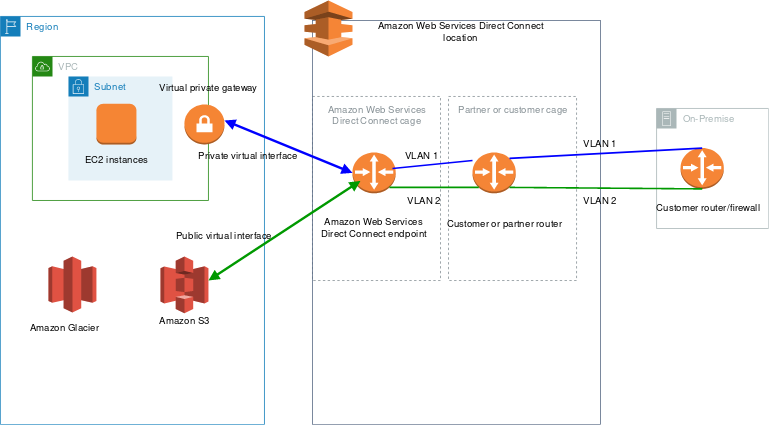
This diagram shows how AWS Direct Connect interfaces with your network. The AWS Direct Connect location your business connects from is the midpoint between you and the AWS services your business needs.

This diagram shows how AWS Direct Connect interfaces with your network. The AWS Direct Connect location your business connects from is the midpoint between you and the AWS services your business needs. (Source: AWS)

To learn more about AWS Direct Connect, visit the AWS FAQ page.

There are more than 100 AWS Direct Connect locations in total, and each location falls under an encompassing region. With a basic setup, connecting to a specific location also gives your business access to all AWS resources in that location’s region; for example, if you connect to AWS via their NEXTDC C1, Canberra, Australia Direct Connect location, you will have access to all AWS workloads within this location’s region, Asia Pacific (Sydney). And if you set up Direct Connect with a Direct Connect Gateway (DGW) or Transit Gateway (TGW), you’ll gain access to all AWS global regions excluding China.

What’s the difference between AWS VGW, DGW, and TGW? Read our blog post for a detailed comparison of these gateways.

How to access AWS Direct Connect locations

There are three ways you can access AWS Direct Connect and its locations.

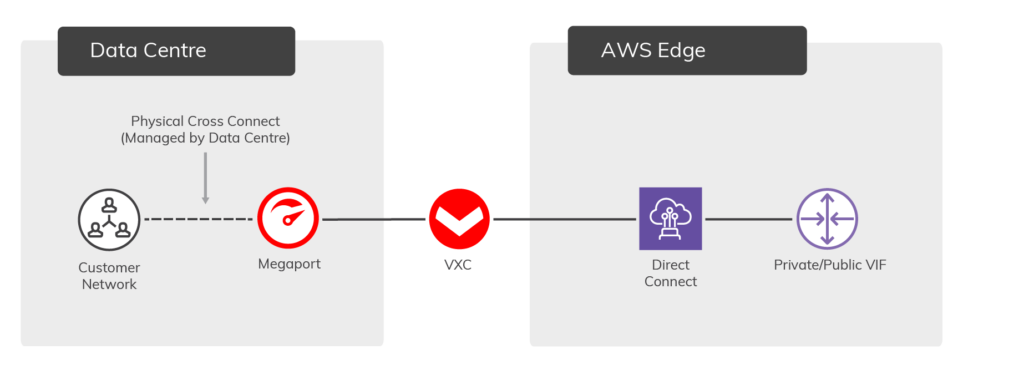
1. Hosted virtual interface (VIF)
Hosted VIF is an on-demand logical connection which a partner can provide. You can choose between a public or private VIF, with scalability and flexibility to change speeds to suit your usage patterns on demand – available in 1 Mbps increments up to 5 Gbps. Megaport includes the AWS port as part of its hosted VIF service, meaning there are no hourly AWS port charges.
2. Hosted connection
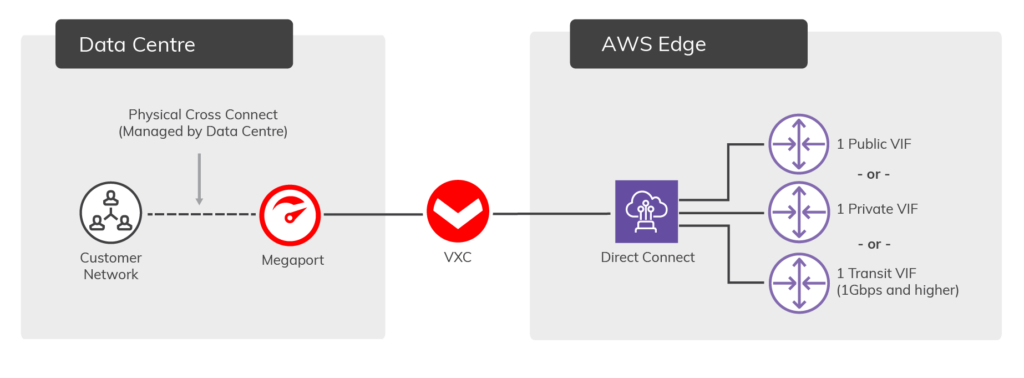
Like hosted VIF, a hosted connection is an on-demand logical connection provided by a partner like Megaport. But unlike hosted VIF, with a hosted connection you can set speeds of up to 10 Gbps, matching your AWS environment 1:1, and access AWS Transit Gateway on Virtual Cross Connects (VXCs) of 1 Gbps and higher. Hosted connection also supports Diversity Zones – groups of devices (like Ports and VXCs) which are physically separated and connected to different AWS devices for maximized redundancy during scheduled downtime.
3. Dedicated connection
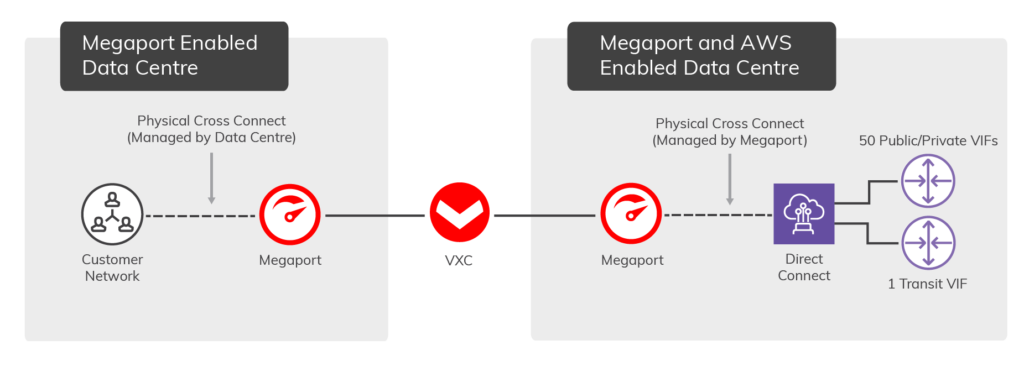
If you’re not in an AWS edge location, you can bring AWS to you with a dedicated connection, where AWS will provision you a 1 Gbps, 10 Gbps, or 100 Gbps port. But there’s a catch: you need to have a physical fiber cross-connect in the same data center as the AWS Direct Connect network. And the more locations you want to have access to, the more cross-connects you need to provision to more data centers. The great news here is that you can actually use an AWS partner like Megaport for this type of connection as well. Megaport already has physical infrastructure access to 43 Direct Connect locations across enabled data centers worldwide; by simply provisioning a dedicated connection leveraging Megaport’s physical fiber cross-connects in your nearest AWS Direct Connect data center, you tap into all 43 of these locations via Megaport’s SDN without the need to set up any infrastructure.
Which connection method is right for you?

Connecting to AWS Direct Connect locations can feel overwhelming at first, but when you break down the differences between the three ways to access them, it can help you decide which is right for your business. Hosted VIF is a good option for those who won’t need to scale above 5 Gbps, to avoid port charges; hosted connection is best for situations where more than 5 Gbps will be required, or where Transit Gateway or redundancy support would be beneficial; and if you need to bring AWS to you, you’ll probably want to leverage a dedicated connection. Whatever option you choose, the best way to provision this connection is to contact your chosen AWS partner, so they can set it up with you.

The Megaport advantage

As an official AWS Direct Connect Delivery Partner, Megaport has passed additional validation from the AWS Service Delivery Program for enabling customers to access Direct Connect. Megaport also has established interconnect monitoring as well as authorization to provision capacities greater than 500 Mbps. In fact, with Megaport, you can scale up and scale down on demand, so no matter how much bandwidth you need, you’re always covered; plus, you only ever pay for the bandwidth you use. Megaport also has one of the highest numbers of accessible locations of any AWS Direct Connect Partner, at 25 for hosted connection, 38 for hosted VIF, and 43 for dedicated connection.*

Another benefit of connecting to AWS Direct Connect via Megaport, whatever method you use, is that your connection medium is a Virtual Cross Connect (VXC). A VXC is a private, high-bandwidth, scalable connection to AWS, alleviating your enterprise of the need for expensive colocation. VXCs are instead billed per minute, so you can adjust bandwidth on demand based on your utilization; and with no lock-in contracts, you can create, customize, and delete VXCs at any time via the Megaport Portal.

Want to get connected to AWS Direct Connect locations via Megaport? Get more info and pricing here.

Stay updated


Keep up to date on Megaport by following us on social media at:

Twitter: @megaportnetwork
LinkedIn: @megaport
Facebook: @megaportnetworks

*Location numbers are correct as of July 2021. For an up-to-date list of locations, please visit the AWS Direct Connect Partners page.