








By Misha Cetrone, Vice President
From security to scalability, we guide you through the benefits of building a multicloud strategy with Google Cloud Platform (GCP) and optimizing your connectivity with Megaport to make the most of your clouds.
Google Cloud is the chosen Cloud Service Provider (CSP) by global enterprises that belong to many diverse industries from award-winning creative studios to groundbreaking travel tech companies.
With a focus on efficient data deployments into multiple cloud environments and easy application management, the cloud giant has not only made waves in the data migration and storage world but also on the multicloud front – all in the name of supporting modern business solutions.
Google Cloud’s intuitive cloud platform, GCP, which incorporates Google’s public cloud infrastructure, serverless computing environments, APIs for Machine Learning, and of course, Google Workspace, has become synonymous with forward-thinking, open-source cloud computing.
GCP’s multicloud capabilities focus on enabling transformation for the enterprise. Offering flexible cloud services and tools – founded on smart infrastructure – GCP allows you to easily move and build applications in mixed and matched cloud environments.
Whether you’re looking to distribute workloads across a combination of Google Cloud and AWS, Microsoft Azure, Oracle Cloud, and/or any other public or private CSPs, or virtualized infrastructures, GCP’s solutions help optimize the process so you can reap the benefits of each cloud’s best features and services.
Google Anthos is the key to managing enterprise multicloud on GCP. Anthos extends Google Cloud services to your different cloud infrastructures by enabling your team to deploy and run containerized applications across them, as well as giving them a consistent bird’s eye view over your organization’s cloud environments to manage them accordingly.
One of the great things about Google Anthos is that its core building block is Google Kubernetes Engine (GKE), the open-source containerization service that offers ultimate control to manage distributed infrastructure and services with Google Cloud.
So, what could your multicloud setup with GCP look like?
In a nutshell: an optimized stack of your chosen cloud services and environments connected with the ability to build, migrate, and run applications across them, while managing the Google Cloud aspect from one control panel.
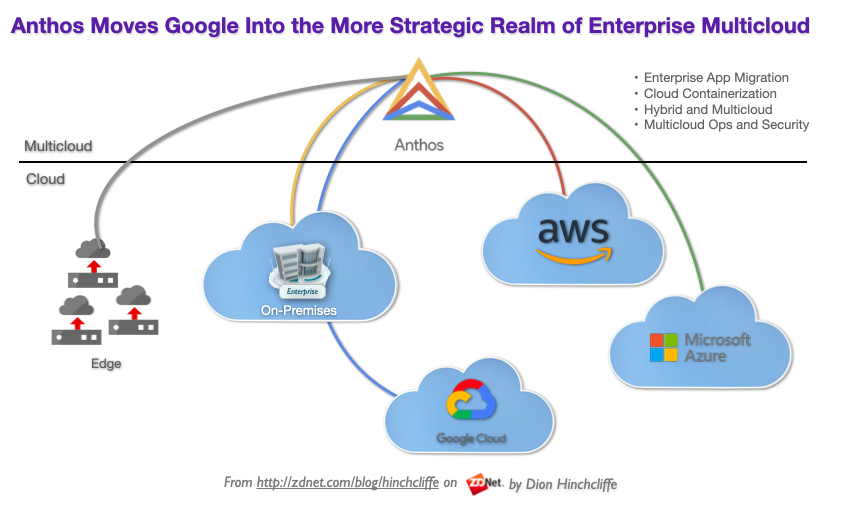
Google Anthos gives you an overview of your different cloud infrastructures for simplified management. Source: ZDNet
Today’s enterprise is migrating, processing, and analyzing more data than ever before while developing, scaling, and deploying new applications to go to market fast.
It’s no surprise, then, that their expectations of cloud services, CSPs, and multicloud environments focus heavily on flexibility, agility, and security to empower them to keep pace with a global business landscape that’s constantly evolving and becoming ever more reliant on digital infrastructure.
What could be considered one of the most valuable aspects of establishing a multicloud architecture with GCP is the company’s cloud agnosticism and practical business solutions that align with this ethos.
GCP’s focus is less on vendor-specific solutions and more about unlocking the benefits of all clouds through dynamic capabilities centered around delivering value for the enterprise’s holistic multicloud strategy so they, in turn, can deliver on great customer experiences.
Setting up a multicloud strategy with GCP can provide your team with some unique benefits:
In order to completely leverage the benefits of multicloud, businesses require a high-performance network that brings their disparate environments together, delivers data securely, and aligns with the flexible nature of their organization.
When you’re moving and processing data workloads between multiple clouds, strong consideration should be given to how and where these environments are connected to one another as well as to your on-premises environment or headquarters.
After all, connectivity is the critical enabler of your entire multicloud strategy, architecture, and operational approach.
Here’s how easy it can be to set up a multicloud strategy with GCP and Megaport connectivity:
Megaport’s global Network is purpose-built for streamlining connections between the virtualized environments that have become fundamental for doing business in the cloud. The Network not only aligns with the cloud-agnostic nature of GCP but also brings with it a myriad of features to help you optimize your GCP multicloud architecture, such as:
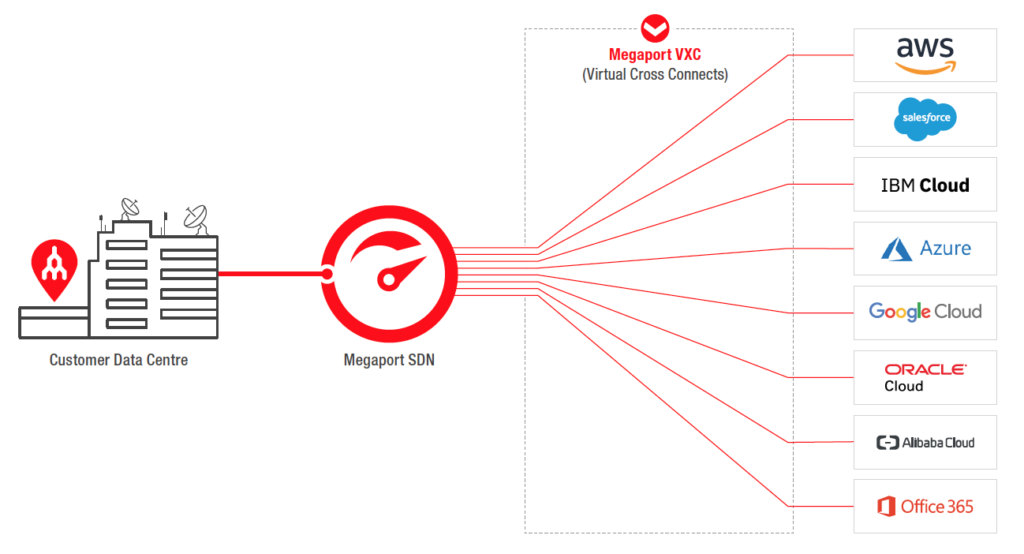
With the Megaport Software Defined Network (SDN) as your central point, your multicloud setup can be streamlined.
Modern business operations demand the agility, flexibility, and security that a GCP multicloud setup can offer. Making the most of your multicloud simply comes down to choosing the right cloud services to fulfil your operational requirements and ensuring interoperability with the right network connectivity.
Keep up to date on Megaport by following us on social media at:
Twitter: @megaportnetwork
LinkedIn: @megaport
Facebook: @megaportnetworks
此内容由惯性聚合(RSS阅读器)自动聚合整理,仅供阅读参考。 原文来自 — 版权归原作者所有。