







By Alexis Bertholf, Global Technical Evangelist
From simplifying AI integration and automation to network virtualization and cybersecurity, re:Invent 2024 left us with plenty to think about going into 2025.
AWS re:Invent 2024 was a whirlwind. TechRadar reported an estimated 60,000 in-person attendees, and with over 2,000 learning sessions there was no shortage of opportunities to collaborate.
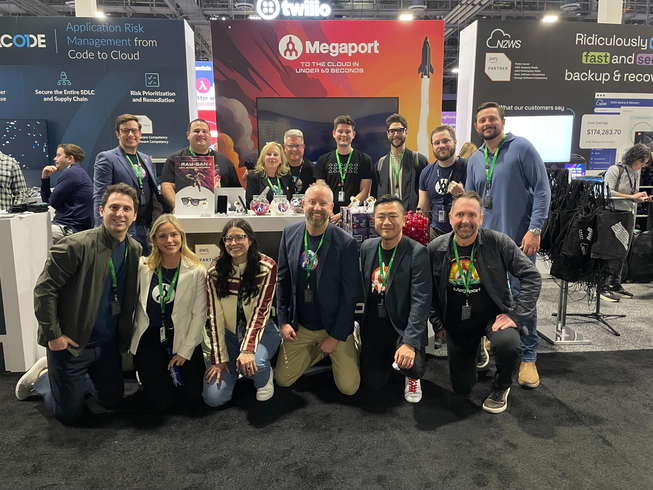
Our Megaport booth was buzzing, and we loved connecting with you. We shared the details of our latest innovations, demonstrated how to streamline multicloud and hybrid cloud architectures, and simply heard about the challenges you’re solving in your organizations.
It was clear that the focus this year wasn’t just on exciting technology, but on how to make that technology work harder for you. In this recap, we’ll share the standout trends, updates, and 2025 predictions we took away from re:Invent 2024.
As with last year’s re:Invent, AI dominated most conversations. But unlike 2023 when the concept was more novel (and more skepticized), the conversation is now centered around how to simplify its integration and management, making sure it works for us and not the other way round.
Data exists in silos, and access to this data is essential to maximizing AI workloads. So how do we drive tangible business outcomes and simplify how we leverage these tools?
Appearing as our answer, Amazon announced updates to multiple AI offerings that simplify these platforms and streamline user operations, including the following:
To simplify your 2025 AI journey, review where your team is currently spending the most time on manual network and IT management. Will you save the most time by implementing AI-powered customer support on your website? Will you gain the most benefit from adopting a fully-managed, automated service for building and testing new applications?
After prioritizing in line with your goals, review what’s available from your cloud providers and implement accordingly.
All AI is some form of automation, but not all automation is categorically AI – think APIs and Terraform providers.
During his keynote, Amazon.com VP and CTO Werner Vogels mentioned the concept of managing complexity with automation, saying “Automation makes complexity manageable.” It will have the added benefit of making your AI integrations less time-intensive and far easier to scale.
Everything will be data-driven in 2025, so now is the time to let the developers on your team experiment with what works. Don’t limit automation to your cloud providers only – apply it to your entire network with network provider-led APIs and Terraform providers.
Your investment will pay off handsomely with efficient, simple operations that extend right to your customer – and your profits.
One more for AI and automation (it really was everywhere).
In all of our whiteboard sessions and booth conversations, there was some level of discussion around the best methods of migrating to and from on-premises data centers and other data hyperscalers, as well as directly between clouds.
For businesses transitioning to cloud-native, AWS announced that AWS Database Migration Service now automates time-intensive schema conversion tasks using generative AI.
This provides a significantly more efficient, cost-effective, and streamlined pathway to cloud adoption, automating up to 90% of the work involved in migrating databases to PostgreSQL. As a result, users can reduce migration time, lower costs, and minimize downtime, enabling faster and more efficient cloud adoption.
Developments like this will lead the way for organizations to more quickly and effectively virtualize their network, so don’t overlook tools like these in 2025 – they will be worth the investment.
Based on our conversations at re:Invent, the kind of migrations different businesses are undertaking seem divided. Many are in the later stages of their move to a cloud-native structure, others are running a permanent hybrid cloud setup, and some are even on a cloud repatriation journey.
Whichever camp you sit in, the best migration-related announcement we heard was that you can now use your on-premises infrastructure in Amazon EKS clusters with Amazon EKS hybrid nodes.
This integration allows customers to unify Kubernetes management across both their cloud and on-premises environments for consistent operations, all backed by the availability and scale of Amazon EKS.
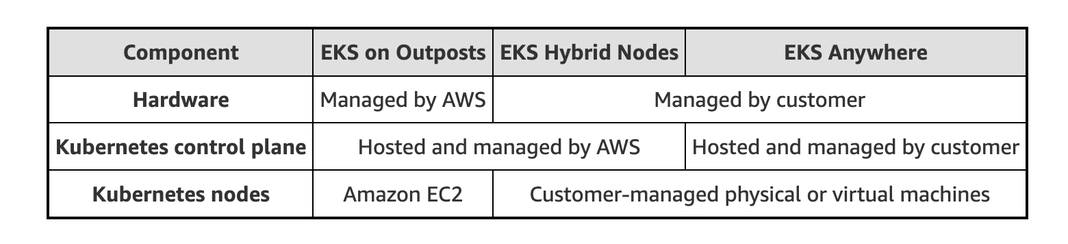
Source: AWS
In 2025, don’t skip the tools when it comes to your migration. They’re too advanced to ignore, and the tiny performance and management improvements they provide will equate to a massive cost and time difference for businesses willing to invest the effort upfront.
As well as using platforms your cloud providers offer, make sure you’re using a scalable network underlay (like Megaport’s) that can handle your migrations easily.
As businesses expand their multicloud and hybrid clouds, adding providers and automation, the global cost of cybercrime is continuing to increase.
Network security has never been a “set and forget” practice, but in 2025 it needs to keep pace faster than ever. AWS has been hard at work keeping its customers on the front foot, announcing a variety of new security, identity, and compliance features:
As well as exploring these new functionalities from AWS, 2025 is the time to integrate your network security. This will enable you to maintain effective and consistent protection from end to end, as well as scale your architecture easily as it evolves.
On the constant mission to integrate the enterprise network, virtual private clouds (VPCs) can feel like an anomaly. They need to be isolated from your other resources – until they don’t. And if your architecture isn’t optimized, migrating or duplicating environments to and from your VPCs can be a dreaded task.
That’s why we were particularly excited by the announcement that you can now securely share your AWS resources across VPC and account boundaries with PrivateLink, VPC Lattice, EventBridge, and Step Functions. With the integration of these services, users can now access Amazon EC2 instances, container services, and custom HTTPS services across different VPCs and accounts.
As a result, you can simplify the process of connecting multiple AWS accounts and create hybrid event-driven architectures to leverage on-premises applications. In other words, your isolated environments can serve their intended purpose without creating extra hurdles when you’re ready to re-integrate.
We think 2025 will see network integration go a step further as separate environments like these continue to move closer to each other.
AWS announced more at re:Invent 2024 than we could possibly fit into this blog post, but this blog is a great comprehensive recap if you want to take a deeper dive.
Since re:Invent 2023, the hype around AI, automation, and network virtualization has begun to settle; now, we’re having the important conversations about exactly how on earth we turn these buzzwords into real-world business outcomes.
The conversations may not be as fluffy, but this is where we start to see the benefits of all these new technologies as they come to life. And in my opinion, that’s far more exciting.
此内容由惯性聚合(RSS阅读器)自动聚合整理,仅供阅读参考。 原文来自 — 版权归原作者所有。