



惯性聚合 高效追踪和阅读你感兴趣的博客、新闻、科技资讯
阅读原文 在惯性聚合中打开

推荐订阅源

F
Fox-IT International blog
Security Latest
Security Latest
S
Security @ Cisco Blogs
L
LINUX DO - 热门话题
T
Threatpost
W
WeLiveSecurity
cs.CL updates on arXiv.org
腾讯CDC
雷峰网
雷峰网
Cyberwarzone
Cyberwarzone
V
V2EX - 技术
freeCodeCamp Programming Tutorials: Python, JavaScript, Git & More
P
Proofpoint News Feed
T
Tailwind CSS Blog
Cisco Talos Blog
Cisco Talos Blog
人人都是产品经理
人人都是产品经理
罗磊的独立博客
P
Privacy International News Feed
The Register - Security
T
Threat Research - Cisco Blogs
IT之家
IT之家
T
True Tiger Recordings
SecWiki News
SecWiki News
V
Vulnerabilities – Threatpost
博客园_首页
OSCHINA 社区最新新闻
OSCHINA 社区最新新闻
博客园 - 司徒正美
月光博客
月光博客
P
Privacy & Cybersecurity Law Blog
N
News | PayPal Newsroom
Google DeepMind News
The Cloudflare Blog
美团技术团队
Simon Willison's Weblog
博客园 - Franky
V
Visual Studio Blog
E
Exploit-DB.com RSS Feed
酷 壳 – CoolShell
酷 壳 – CoolShell
F
Future of Privacy Forum
J
Java Code Geeks
Microsoft Azure Blog
奇客Solidot–传递最新科技情报
奇客Solidot–传递最新科技情报
Recent Commits to openclaw:main
C
Cisco Blogs
AWS News Blog
AWS News Blog
cs.AI updates on arXiv.org
Scott Helme
Scott Helme
D
Darknet – Hacking Tools, Hacker News & Cyber Security
I
InfoQ
U
Unit 42

Megaport Blog

Early Warning Signs Your Network Needs a Refresh Introducing Megaport DDoS Protection A Guide to 400G Connectivity A Guide to NAT Gateway A Guide to Cloud Storage How the Data Center Is Evolving in 2026 What to Expect When Attending Your First Network Operator Group (NOG) Nine Ways to Connect to Cloud Using Private Connectivity Migrate Your On-premises to the Cloud: A Step-by-Step Guide How to Lower Your Egress Fees in 2026 How to Achieve Data Sovereignty in Europe Redefining the Edge with Cisco and Megaport How to Reduce Latency in Your Multicloud Environment Introducing Megaport High-Speed Cross-Cloud Encryption Are Businesses Leaving the Cloud? Using Meraki and Megaport Virtual Edge for Multicloud Networking Equinix Metal® is Going Away: Here’s What You Can Do Introducing Megaport On-ramp as a Service Megaport’s Full Solution Portfolio Is Coming to India New Bare-metal GPU Instance Now Available with NVIDIA RTX Pro 6000 A Look Back at 2025: Megaport's Biggest Updates Megaport Expands Into India With Extreme IX Your 2026 Predictions From AWS re:Invent 2025 Top NaaS Trends for 2026 What is IPsec? When to Move From Public Internet to Private Connectivity Megaport and Latitude.sh: Bringing Compute and Connectivity Together Improve Your Microsoft ExpressRoute Resilience with Megaport Comparing Ways to Connect to AWS What is API-First Networking? The Hidden Cost of Running Cloud-Hosted SD-WAN for IaaS Overcoming NaaS Integration Challenges Introducing SCION with Anapaya and Megaport How to Use Network as a Service to Future-Proof Your Network Introducing 400G Ports All the As-a-services, Compared Introducing Megaport IPsec Tunnels High Score: Megaport Hits 1,000 Locations A Guide to Colocation Data Centers Maximizing Peering Through Flow Analysis Build Resilient Networks for AI Production Workloads Introducing Packet Filtering on Megaport Cloud Router Building Resilient Government IT: Strategies for Secure, Compliant, and Scalable Connectivity Future-Proofing Government IT Telstra Programmable Network Is Being Discontinued. Here’s How to Migrate The Future of WAN Design Depends on Network as a Service (NaaS) Cisco Webex Edge Connect Launches on Megaport Voice and Video Exchange How to Prepare for APRA CPS 230 Comparing the SD-WAN Licensing Needs of Major Vendors A Guide to Improving Network Performance How Latitude.sh, Wasabi, and Megaport Unlock Cost-Effective Multicloud Four Ways to Connect Your Clouds A Guide to Network as a Service (NaaS) How to Arrange Bilateral Peering Sessions Comparing Major SD-WAN Vendors Software Defined Networking in Healthcare Deploying A Global Network in Minutes With Megaport AWS Direct Connect Gateway (DGW) Data Transfer Outbound Rules Bilateral and Multilateral Peering: What’s the Difference? Multi-Region SD-WAN: Why Megaport SDCI is the Right Choice Microsoft Azure is Going Secure by Default. Are You Ready? How Megaport and Vultr Are Solving the Enterprise AI Challenge Introducing Megaport NAT Gateway A Guide to AWS Security Tools How to Deploy Amazon Bedrock Using AWS Direct Connect and Megaport Azure Private Link, Explained Introducing 100G MCRs Simplifying Hybrid and Multicloud Network Connectivity How to Fix Poor AWS Latency A Look Back at 2024: Megaport’s Biggest Updates Your 2025 Predictions From AWS re:Invent 2024 Six Ways to Get a More Resilient Network in 2025 Multicloud Security: Challenges and Solutions The Real Cost of High Network Latency Why Brazil is Your Key to Unlocking Business Growth in Latin America Why You Need Integrated Network Security Six Key Differences Between Major Cloud Providers How to Automate Your Megaport Infrastructure With APIs Why Italy is Europe’s Next Cloud Expansion Hotspot How to Lower Your Cloud Costs Peering: How Local Is Local? Introducing Megaport AI Exchange Two Scenarios for Hybrid Multicloud Deployment With IBM Cloud and Microsoft Azure How to Connect Equinix and Digital Realty Megaport Enables Microsoft Azure ExpressRoute Metro for More Resilient Network Connectivity Executives, Here’s What Your Network Team Wants You to Know Easy Ways to Interconnect Your Network The Role of the Data Center in Your Network 100G VXC Expansion: Now Available From 597 Data Centers Worldwide Top 10 How-To Guides To Improve Your Network Comparing Encryption in Transit Options Comparing Generative AI Offerings From Major Cloud Providers A Sustainable Business Strategy Starts With Your Network Solutions to Common API Issues With Megaport Transforming Financial Connectivity: Introducing Megaport Financial Services Exchange (FSX) Megaport Enhancing Connectivity in Adelaide Megaport’s Latest Portal Features and Functionalities Automate Your Network Deployments With The New Megaport Terraform Provider A Recap of the Megaport World Tour 2024 Top 5 Cloud and Networking Announcements From Cisco Live 2024
SD-WAN and MPLS: Weighing the Similarities, Differences, and Benefits
2025-04-07 · via Megaport Blog

By Mark Austen, Solutions Architect

Compare these two leading networking technologies so you can decide which is best for your organization.

In 2025, Software-Defined Wide Area Networking (SD-WAN) is considered an essential part of many organizations’ network fabric. But what about Multiprotocol Label Switching (MPLS)? Has this trusty routing technique been made redundant by the increasing uptake of SD-WAN? What are the differences and similarities between SD-WAN and MPLS? And are there valid reasons to use both?

In this article we’ll explore both technologies so you can decide which is best for your organization. Let’s start by examining the foundations of SD-WAN and MPLS, and how they work.

What is SD-WAN?

Software-Defined Wide Area Networking (SD-WAN) is as it sounds: a software-defined approach toward wide area networking. This approach is ideal for organizations seeking more diversity and control over their enterprise WAN, offering Local Area Network (LAN)-like features at a broader scale.

SD-WAN uses a traditional hardware-based networking model and adds a software-defined virtual network overlay on top. This overlay is managed and provisioned centrally by a controller, so users don’t need to manually configure and manage every device. The underlay, or data plane, is then left with the responsibility to process and transit packets between devices.

The overlay can run over a range of standard network transport services, including the public internet, 4G, 5G, and MPLS. Application-aware routing will assess the performance of underlying network transport to control where and when an application uses a specific service, making sure real-time and sensitive applications run as reliably as possible.
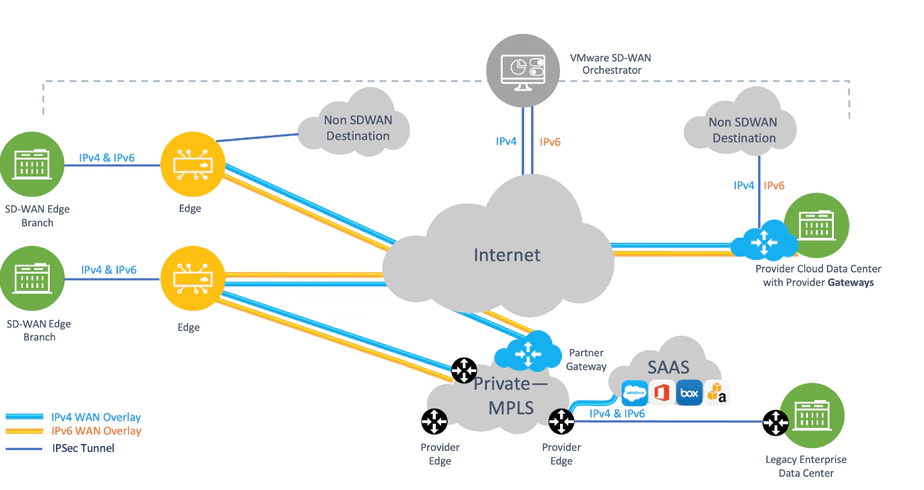
Diagram showing how SD-WAN works. Source: VMware

What is MPLS?

Multiprotocol Label Switching is just that—a label-switched-path network model—in which data packets take a pre-defined, private route straight to their destination. This routing takes place over Layer 2 Ethernet or Layer 3 Virtual Private Networks (VPNs).

MPLS circuits are segregated from the internet and from other MPLS circuits on the carrier’s network, and can instead be viewed as dedicated services bound by their own Service Level Agreements (SLAs) for packet loss, jitter, and latency.
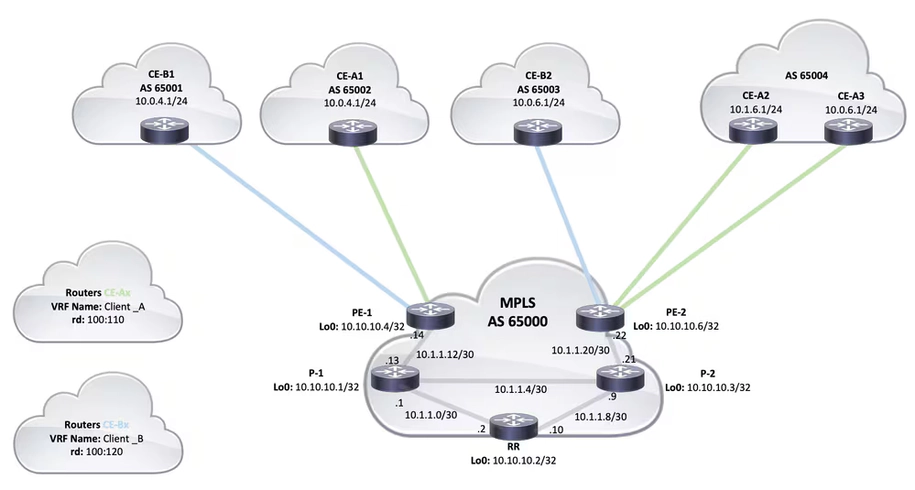
An example of a MPLS topology. Source: Cisco

Discover more ways to interconnect your network and supercharge your business operations.

Benefits of SD-WAN

SD-WAN is the newer, and arguably more popular, player in town. Cisco, Fortinet, Aruba, Viptela, Versa, Palo Alto, and Broadcom are the major networking giants that offer SD-WAN solutions to simplify remote and complex enterprise networks. SD-WAN provides its users with a range of benefits.

Centralized management system

Most SD-WAN solutions provide a centralized management system by default, with built-in automation, security, and application-level visibility. This removes the need to integrate SD-WAN devices into another vendor’s network management system, saving significant time and cost.

Flexible private overlay

SD-WAN can build a private overlay over any network transport type, whether it be public internet, private MPLS, or a combination of both. By bundling different types of network transport within this flexible model, users can achieve higher bandwidth at a lower overall cost with improved security.

Zero Touch Provisioning (ZTP)

Zero Touch Provisioning, or ZTP, refers to the ability to provision a device or network without the need for local configuration. Some SD-WAN devices support ZTP, meaning they can be shipped to site directly from the factory without the need to apply configurations.

When connected to the internet, a ZTP device will securely connect back to a centralized controller, receive verification against its serial number, download its configuration, and join the overlay network – it’s that simple.

Compare SD-WAN vendors to pick the perfect provider for your use case.

Benefits of MPLS

MPLS is the legacy technology in this comparison, and while its higher price tag and lower flexibility places it at a comparative disadvantage against SD-WAN, it shouldn’t be dismissed; MPLS has its own set of benefits.

Consistent connectivity

MPLS connections can be used as a dedicated private service with SLAs for throughput, latency, and jitter. End-to-end connectivity across an MPLS network is assured by the network operator to perform within the bounds of this SLA, ensuring reliability and consistency.

Proactive network management

MPLS network capacity is proactively managed and end-to-end latency closely monitored by the provider, to ensure paths are clear of congestion and faults are addressed as soon as they occur. This attentive approach to network management minimizes downtime and keeps your teams productive.

Easy deployment

WAN designs with static and predictable requirements can be easily deployed with MPLS. An MPLS-enabled site with a simple redundant design of two MPLS links is easy to both implement and support.

The similarities between SD-WAN and MPLS

While SD-WAN and MPLS have some key differences, they also share some important similarities.

SD-WAN and MPLS both:

  • deliver high-performance, reliable, and private WAN connectivity
  • provide a type of private overlay – SD-WAN with the use of Internet Protocol Security (IPSec) VPNs, MPLS with labels
  • use private IPv4 (Internet Protocol version 4) addressing to communicate between devices connected to the WAN within their private overlays
  • support classification of network traffic into different priority and importance levels.

The verdict

SD-WAN and MPLS are often treated as separate network models, but as our comparison shows, they aren’t directly competing configurations; you don’t have to face an ultimatum between which model is right for you.

If you need to streamline connectivity between multiple endpoints and cloud providers, SD-WAN is a proven, cost-effective solution. If consistency and simplicity is what you’re after, MPLS alone may be your preferred option.

But if you have more complex networking requirements, you can actually use MPLS together with SD-WAN to build a hybrid WAN design.
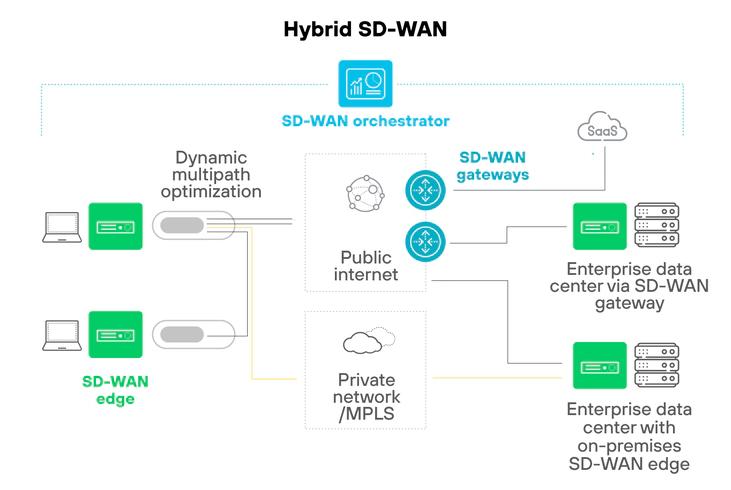
Hybrid SD-WAN diagram. Source: Palo Alto Networks

The application-aware routing of SD-WAN ensures critical traffic like Voice over Internet Protocol (VoIP) is directed over your reliable MPLS transport, while non-critical traffic is directed over internet transport. Using MPLS and SD-WAN together is a great way to lay a flexible foundation as your cloud connectivity needs continue to grow and evolve.

Deploy SD-WAN gateways, virtual routers, and virtual firewalls in minutes with Megaport Virtual Edge.