
惯性聚合 高效追踪和阅读你感兴趣的博客、新闻、科技资讯
阅读原文 在惯性聚合中打开

推荐订阅源

F
Full Disclosure
Recorded Future
Recorded Future
T
Tenable Blog
S
Securelist
C
CERT Recently Published Vulnerability Notes
T
Threatpost
S
Schneier on Security
A
Arctic Wolf
The Hacker News
The Hacker News
C
CXSECURITY Database RSS Feed - CXSecurity.com
Know Your Adversary
Know Your Adversary
P
Privacy International News Feed
Threat Intelligence Blog | Flashpoint
The Register - Security
Cisco Talos Blog
Cisco Talos Blog
AWS News Blog
AWS News Blog
K
Kaspersky official blog
T
True Tiger Recordings
T
Threat Research - Cisco Blogs
V
Vulnerabilities – Threatpost
P
Palo Alto Networks Blog
T
The Exploit Database - CXSecurity.com
小众软件
小众软件
B
Blog
Cyber Security Advisories - MS-ISAC
Microsoft Azure Blog
Cyberwarzone
Cyberwarzone
C
Cybersecurity and Infrastructure Security Agency CISA
T
Tor Project blog
Spread Privacy
Spread Privacy
Malwarebytes
Malwarebytes
P
Proofpoint News Feed
F
Fox-IT International blog
F
Fortinet All Blogs
P
Privacy & Cybersecurity Law Blog
G
GRAHAM CLULEY
量子位
Latest news
Latest news
OSCHINA 社区最新新闻
OSCHINA 社区最新新闻
博客园 - 叶小钗
Project Zero
Project Zero
T
Tailwind CSS Blog
N
Netflix TechBlog - Medium
Martin Fowler
Martin Fowler
IntelliJ IDEA : IntelliJ IDEA – the Leading IDE for Professional Development in Java and Kotlin | The JetBrains Blog
I
Intezer
博客园_首页
腾讯CDC
H
Hackread – Cybersecurity News, Data Breaches, AI and More
D
Darknet – Hacking Tools, Hacker News & Cyber Security

Megaport Blog

Early Warning Signs Your Network Needs a Refresh Introducing Megaport DDoS Protection A Guide to 400G Connectivity A Guide to NAT Gateway A Guide to Cloud Storage How the Data Center Is Evolving in 2026 What to Expect When Attending Your First Network Operator Group (NOG) Nine Ways to Connect to Cloud Using Private Connectivity Migrate Your On-premises to the Cloud: A Step-by-Step Guide How to Lower Your Egress Fees in 2026 How to Achieve Data Sovereignty in Europe Redefining the Edge with Cisco and Megaport How to Reduce Latency in Your Multicloud Environment Introducing Megaport High-Speed Cross-Cloud Encryption Are Businesses Leaving the Cloud? Using Meraki and Megaport Virtual Edge for Multicloud Networking Equinix Metal® is Going Away: Here’s What You Can Do Introducing Megaport On-ramp as a Service Megaport’s Full Solution Portfolio Is Coming to India New Bare-metal GPU Instance Now Available with NVIDIA RTX Pro 6000 A Look Back at 2025: Megaport's Biggest Updates Megaport Expands Into India With Extreme IX Your 2026 Predictions From AWS re:Invent 2025 Top NaaS Trends for 2026 What is IPsec? When to Move From Public Internet to Private Connectivity Megaport and Latitude.sh: Bringing Compute and Connectivity Together Improve Your Microsoft ExpressRoute Resilience with Megaport Comparing Ways to Connect to AWS What is API-First Networking? The Hidden Cost of Running Cloud-Hosted SD-WAN for IaaS Overcoming NaaS Integration Challenges Introducing SCION with Anapaya and Megaport How to Use Network as a Service to Future-Proof Your Network Introducing 400G Ports All the As-a-services, Compared Introducing Megaport IPsec Tunnels High Score: Megaport Hits 1,000 Locations A Guide to Colocation Data Centers Maximizing Peering Through Flow Analysis Build Resilient Networks for AI Production Workloads Introducing Packet Filtering on Megaport Cloud Router Building Resilient Government IT: Strategies for Secure, Compliant, and Scalable Connectivity Future-Proofing Government IT Telstra Programmable Network Is Being Discontinued. Here’s How to Migrate The Future of WAN Design Depends on Network as a Service (NaaS) Cisco Webex Edge Connect Launches on Megaport Voice and Video Exchange How to Prepare for APRA CPS 230 Comparing the SD-WAN Licensing Needs of Major Vendors A Guide to Improving Network Performance How Latitude.sh, Wasabi, and Megaport Unlock Cost-Effective Multicloud Four Ways to Connect Your Clouds SD-WAN and MPLS: Weighing the Similarities, Differences, and Benefits A Guide to Network as a Service (NaaS) How to Arrange Bilateral Peering Sessions Comparing Major SD-WAN Vendors Software Defined Networking in Healthcare Deploying A Global Network in Minutes With Megaport AWS Direct Connect Gateway (DGW) Data Transfer Outbound Rules Bilateral and Multilateral Peering: What’s the Difference? Multi-Region SD-WAN: Why Megaport SDCI is the Right Choice Microsoft Azure is Going Secure by Default. Are You Ready? How Megaport and Vultr Are Solving the Enterprise AI Challenge Introducing Megaport NAT Gateway A Guide to AWS Security Tools How to Deploy Amazon Bedrock Using AWS Direct Connect and Megaport Azure Private Link, Explained Introducing 100G MCRs Simplifying Hybrid and Multicloud Network Connectivity How to Fix Poor AWS Latency A Look Back at 2024: Megaport’s Biggest Updates Your 2025 Predictions From AWS re:Invent 2024 Six Ways to Get a More Resilient Network in 2025 Multicloud Security: Challenges and Solutions The Real Cost of High Network Latency Why Brazil is Your Key to Unlocking Business Growth in Latin America Why You Need Integrated Network Security Six Key Differences Between Major Cloud Providers How to Automate Your Megaport Infrastructure With APIs Why Italy is Europe’s Next Cloud Expansion Hotspot How to Lower Your Cloud Costs Peering: How Local Is Local? Introducing Megaport AI Exchange Two Scenarios for Hybrid Multicloud Deployment With IBM Cloud and Microsoft Azure How to Connect Equinix and Digital Realty Megaport Enables Microsoft Azure ExpressRoute Metro for More Resilient Network Connectivity Executives, Here’s What Your Network Team Wants You to Know Easy Ways to Interconnect Your Network The Role of the Data Center in Your Network 100G VXC Expansion: Now Available From 597 Data Centers Worldwide Top 10 How-To Guides To Improve Your Network Comparing Encryption in Transit Options Comparing Generative AI Offerings From Major Cloud Providers A Sustainable Business Strategy Starts With Your Network Solutions to Common API Issues With Megaport Transforming Financial Connectivity: Introducing Megaport Financial Services Exchange (FSX) Megaport Enhancing Connectivity in Adelaide Megaport’s Latest Portal Features and Functionalities Automate Your Network Deployments With The New Megaport Terraform Provider A Recap of the Megaport World Tour 2024
From Excavators to Earthquakes: Achieving Redundant Networks
2021-05-24 · via Megaport Blog

By Darren Wilson, Chief Operating Officer

We look at the challenges connectivity providers face with achieving fully redundant networks, and share our tips on how to check your provider's redundancy.

In March, the world turned its attention to France as a fire destroyed several data centers, disrupting millions of websites and businesses in the process. It’s easy to forget that the internet, and the cloud, rely on physical infrastructure, but this event was an abrupt reminder.

When digital infrastructure goes down, it can spell disaster for companies around the world. Whether it’s data centers, subsea cables, or fiber, the infrastructure connecting our networks spans every landscape, ranging from arid deserts to ocean floors, and cable-related redundancy incidents happen constantly.

In this article we’ll dive into these incidents, ranging from the regular to the rare, and give you some questions to ask your Network as a Service (NaaS) provider to find out how they architect their network to minimize the customer impact of these incidents.

Don’t just check your provider’s redundancy—learn more about how you can improve your network redundancy in the cloud in our blog post.

A closer look at Megaport’s network redundancy

We manage over 2,000 circuits globally and detect, on average, approximately seven reduced redundancy infrastructure events each month. The vast majority of these outages are restored within 24 hours.

The most common cause of latency changes is when traffic reroutes to a geographically diverse path. But when networks are designed and implemented correctly, customer traffic will reroute seamlessly around unplanned infrastructure downtime, so any latency changes almost go unnoticed.

To learn more about ensuring redundancy in your multicloud architecture, read our Design Scenarios for Multicloud blog post.

Following larger incidents, restoration activities can take days. In these situations, our operations teams will regularly verify the network status and provide real-time updates to our customers until the issue is resolved. Plus, we’re always available if customers want to check in or get specialized support.

What types of incidents can impact network redundancy?

Once connection cables are laid into the ground underneath roads or across the bottom of the ocean they need to be maintained, and every 15 to 30 years, they need to be replaced. The vast majority of redundancy incidents are due to human error during this maintenance. With urban sprawl, growing cities, expanding road networks, and other construction, cables are accidentally cut all the time. Because cable repair is usually straightforward, these issues are often solved within hours.

“Stranger things do happen…In the Australian outback, wombats have been known to burrow into the ground and disturb cable ducts.”

Some incidents take longer to fix, and can impact much larger areas. Earthquakes, for example, commonly shear cables in the ocean as tectonic plates shift. And because cables on land often follow roads, events like landslides can take out kilometers of cable. These outages can take weeks to repair.

Trying to achieve network redundancy with an Active/Active AWS Direct Connect Connection? Read our blog post here.

Now and then, stranger things do happen. In the Australian outback, animals like wombats have been known to burrow into the ground and disturb cable ducts. And yes, those stories of curious sharks biting undersea cables are true—but they rarely cause outages, especially with the way today’s cables are designed.
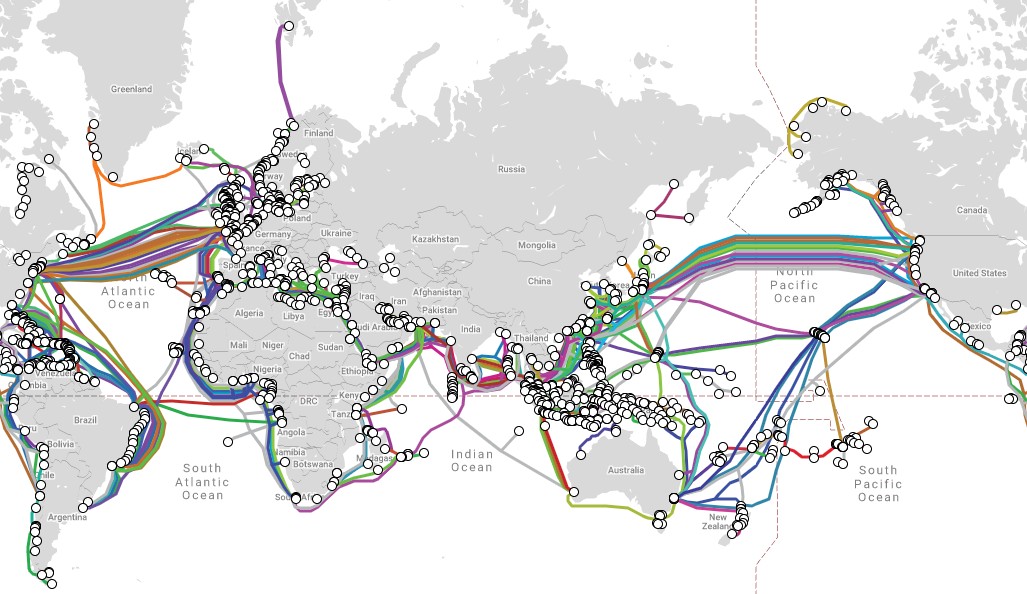
Submarine cable world map static image from submarinecablemap.com as of May 2021

According to Telegeography’s Submarine Cable Map, as of 2021 there are approximately 426 cables globally, spanning a total of more than 1.3 million kilometers.

Check your NaaS provider’s network redundancy

Because of the global infrastructure we rely on for our connectivity, there’s really no possibility of zero redundancy incidents. But for some industries, downtime is critical. Broadcast media is a great example; if your connection goes down during a sports game or live interview, your revenue comes to a halt because your sponsors and advertisers lose connection, too. If you’re in one of these industries (or even if you’re not), here are some network redundancy questions you can ask your NaaS provider.

Read our blog post on improving network redundancy with ExpressRoute Global Reach here.

What’s your backup plan?

A well-adopted industry practice, not just in tech but in most industries, is to always have a backup. This is the most obvious question you can ask your provider—do they have more than one way to get you online or to the cloud if one of their paths goes down? The more backups they have, the safer you are. The way Megaport secures such high availability is to have many well-connected PoPs worldwide, and backup routes for most situations that could affect our customers’ connectivity. But availability alone isn’t enough.

How much does this high availability cost?

If your availability requirements aren’t being met by your NaaS or telecommunications provider, it can often be hard to get out of the lengthy and expensive contracts you’re locked into, so checking how much this availability costs ensures you’re not overpaying for a redundant network.

Megaport’s edge over other industry players is that we have availability as well as scalability, with our pay-as-you-go billing model. With Megaport, you can turn up speedy connections in seconds with our “point, click, connect” setup, and you pay only for the bandwidth you consume; you can turn it off whenever you like with no penalties.

But even with a lot of PoPs, high availability, and the added benefit of scalability, unexpected outages can still happen, so it’s worth checking one last thing with your NaaS provider.

How do you communicate redundancy issues with your customers?

An effective provider will show transparency: communicating what they know as they learn it, to guide customers through even the most unpredictable situations. This allows you to effectively plan around the outage and feel assured that your provider is working with you to do this. That’s an ethos Megaport is always aiming for: transparency and visibility.

In a world reliant on being constantly connected, minimizing redundancy incidents is fundamentally important to enterprise success. Understanding the types of incidents impacting network redundancy—and knowing what questions to ask your NaaS provider—is a great way to ensure your company stays connected.

Want to take a deeper dive into the technical side of achieving network redundancy? Read our earlier blog post here.