By David Sloan, Solutions Architect
Connecting these two leading data center providers can supercharge your network efficiency. Here are three ways to do it.
It doesn’t matter what size your business is – the ability to seamlessly transfer and manage data across multiple locations is crucial for uninterrupted productivity.
A common use case network managers want to implement is connecting their Equinix and Digital Realty data centers. This blog will cover the reasons you may want to consider connecting these providers, and how to do it.
Why connect Equinix and Digital Realty?
If you operate critical applications or store significant amounts of data across both Digital Realty and Equinix data centers, hairpinning your workloads between both data centers and using traditional or public connectivity methods both present a number of challenges:
- High latency: The increased hops from indirect data center connections add latency, slowing your transfers down and making projects clunky to manage.
- Security risks: Every time your data is in transit, it’s at risk of compromise from cyber breaches and malicious attacks – especially when it travels over a public network layer.
- Unreliable: Increased hops also means increased points of failure on your network, multiplying your risk of downtime.
- High costs: Existing solutions, often based on traditional leased lines, are costly and lack the flexibility to scale in line with your budget.
Establishing direct connectivity between your data centers instead reduces network latency and jitter, safeguards data security, protects uptime, and improves cost management. But in our opinion, not all connectivity methods are equal.
How to connect Equinix and Digital Realty
1. Set up VPN tunnels
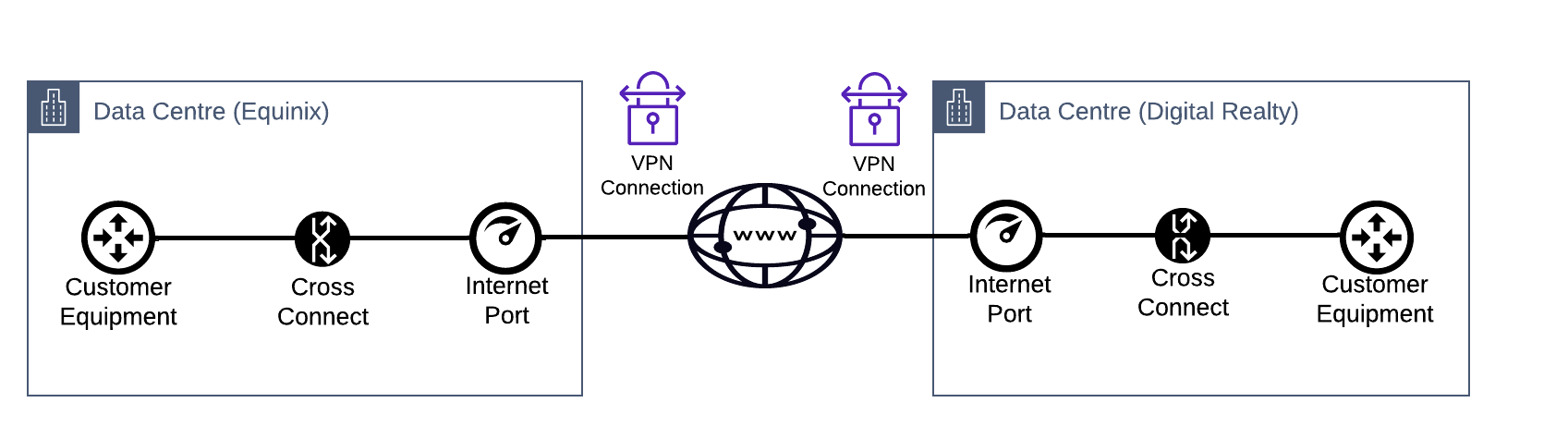
Setting up a VPN tunnel over a public internet connection between Equinix and Digital Realty is a tried and true traditional method of connecting your cloud environments between different data centers, but there are many disadvantages to connecting this way:
- You may have to build and manage numerous VPN tunnels to support different applications, and you’ll spend a lot of time managing ECMP (Equal-Cost Multi-Path routing) or load balancing.
- Routing is unpredictable via the public internet.
- There’s always potential for compromised security due to exposure to the public internet.
While VPN tunnels are an affordable and easy solution for businesses migrating small, low-risk workloads between data center providers, it’s not recommended for bandwidth-heavy workloads or sensitive information that can’t be compromised.
2. Build private lines
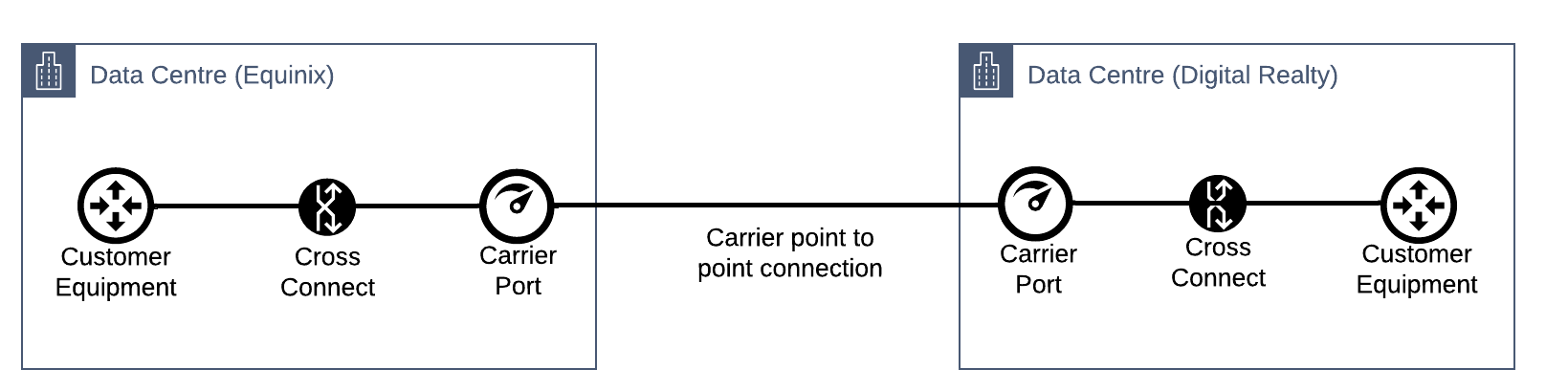
The second way you can connect Equinix and Digital Realty is to build private lines between the two data centers by buying dedicated circuits from your telco provider. These circuits will give you a private connection that isn’t routed over the unpredictable, vulnerable public internet.
You’ll get lower latency, heightened security, and stronger privacy than if you use VPN tunnels, but there are also some disadvantages to this approach:
- Private lines are more costly as they subject you to long-term contracts. Your telco will likely lock you into 18-24 month contracts for your dedicated circuits, with 45-90 day installation windows, so bandwidth capacity increases can take months while unused bandwidth will burn a hole in your pocket.
- Private line services are often static, not dynamic, so if the line is cut then the service is rendered useless. To mitigate this, redundant circuits can be procured at an additional cost.
- Building private lines is generally the most costly way to connect between Equinix and Digital Realty.
3. Data center interconnection with a NaaS provider
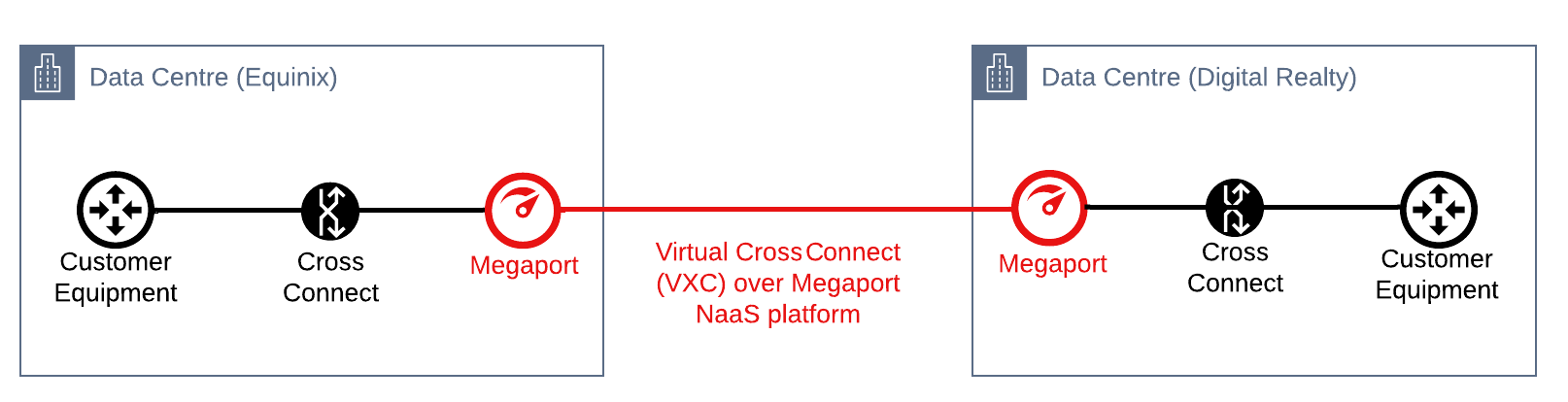
Your third option is to use a third-party Network as a Service (NaaS) provider to interconnect Equinix and Digital Realty. A NaaS provider will use two ports—one at each data center endpoint—and a virtual connection across the provider’s network to create a Layer 2 connection between any two data centers in its global ecosystem.
Using a NaaS provider comes with benefits like:
- fast provisioning, scaling, and management of your Equinix-Digital Realty connections
- high-speed, constant connectivity unencumbered by the bottlenecks of the public internet
- ease of use, with the NaaS provider managing all network infrastructure and for an OpEx-only network
- private connectivity with reduced risk of jitter and downtime, as well as the ability to easily fortify your data security.
Provided you choose a good NaaS provider, there are virtually no downsides to this method. To maximize your benefits, look for a NaaS provider with:
- bandwidth options that will cater to the higher end of your business needs, ensuring low latency even in peak demand periods
- global partnerships with both Equinix and Digital Realty, resulting in the availability of your required A-end and B-end locations
- on-demand provisioning and scaling along with pay-as-you-go pricing
- strong availability SLAs to protect uptime and resilience
- commitment to security compliance with relevant ISO/IEC certifications.
Connect Equinix and Digital Realty with Megaport Data Center Interconnect
Connecting Equinix and Digital Realty is as simple as point, click, and provision with Megaport Data Center Interconnect (DCI).
When you provision DCI with Megaport, you get:
- High-speed connectivity: Enjoy rapid data transfer capabilities on an ultra-low-latency network backbone and access large volumes of data almost instantly.
- Scalable bandwidth: Scale your connectivity based on committed demand and augment bandwidth temporarily based on project requirements, all via the Megaport Portal. You can even scale up to 100 Gbps in select locations.
- Global reach: 161 connected Equinix data centers and 94 connected Digital Realty data centers are just the start of Megaport’s extensive global network. Take your operations global with 930+ enabled locations and 410+ service providers worldwide.
- Easy to use: Use our intuitive Portal to effortlessly configure and control your connections or customize your network management with our APIs.
- Reliable: Our highly redundant data channels minimize downtime, ensuring continuous data flow so you can keep your projects running.
- Built for security: Our private underlay is the perfect foundation for you to build secure data channels, ensuring the integrity and confidentiality of your information in transit.
- Cost-effective: Megaport presents a cost-effective alternative to lock-in contracts with pay-as-you-go provisioning, transparent billing, and highly competitive rates and bundles, so you can optimize your IT budget without compromising on performance.
- Flexible: DCI offers Megaport connectivity at each terminating location, giving you full access to our ecosystem of services including AWS, Azure, Google, Oracle, and over 100 other service partners.
Ready to connect Equinix and Digital Realty with DCI? Learn more about how to provision DCI here, then get provisioning in the Megaport Portal.
Have more questions before trying DCI? Our team is here to help. Reach out to us for a tailored demo.











