


惯性聚合 高效追踪和阅读你感兴趣的博客、新闻、科技资讯
阅读原文 在惯性聚合中打开

推荐订阅源

酷 壳 – CoolShell
酷 壳 – CoolShell
H
Hacker News: Front Page
P
Palo Alto Networks Blog
T
ThreatConnect
Apple Machine Learning Research
博客园_首页
T
True Tiger Recordings
P
Privacy & Cybersecurity Law Blog
B
Blog
IT之家
IT之家
Last Week in AI
Last Week in AI
F
Full Disclosure
Hacker News: Ask HN
Hacker News: Ask HN
C
Comments on: Blog
Microsoft Azure Blog
C
Cybersecurity and Infrastructure Security Agency CISA
Microsoft Security Blog
博客园 - 【当耐特】
N
News and Events Feed by Topic
NISL@THU
NISL@THU
腾讯CDC
雷峰网
雷峰网
Security Latest
Security Latest
李成银的技术随笔
M
Microsoft Research Blog - Microsoft Research
L
LangChain Blog
L
Lohrmann on Cybersecurity
cs.CL updates on arXiv.org
C
Check Point Blog
Y
Y Combinator Blog
Recent Announcements
博客园 - Franky
N
News | PayPal Newsroom
V
V2EX
A
About on SuperTechFans
The Register - Security
月光博客
月光博客
奇客Solidot–传递最新科技情报
奇客Solidot–传递最新科技情报
Google Online Security Blog
MyScale Blog
MyScale Blog
Cisco Talos Blog
Cisco Talos Blog
Vercel News
Vercel News
WordPress大学
WordPress大学
C
Cyber Attacks, Cyber Crime and Cyber Security
The Hacker News
The Hacker News
IntelliJ IDEA : IntelliJ IDEA – the Leading IDE for Professional Development in Java and Kotlin | The JetBrains Blog
爱范儿
爱范儿
A
Arctic Wolf
L
LINUX DO - 最新话题
freeCodeCamp Programming Tutorials: Python, JavaScript, Git & More

Megaport Blog

Early Warning Signs Your Network Needs a Refresh Introducing Megaport DDoS Protection A Guide to 400G Connectivity A Guide to NAT Gateway A Guide to Cloud Storage How the Data Center Is Evolving in 2026 What to Expect When Attending Your First Network Operator Group (NOG) Nine Ways to Connect to Cloud Using Private Connectivity Migrate Your On-premises to the Cloud: A Step-by-Step Guide How to Lower Your Egress Fees in 2026 How to Achieve Data Sovereignty in Europe Redefining the Edge with Cisco and Megaport How to Reduce Latency in Your Multicloud Environment Introducing Megaport High-Speed Cross-Cloud Encryption Are Businesses Leaving the Cloud? Using Meraki and Megaport Virtual Edge for Multicloud Networking Equinix Metal® is Going Away: Here’s What You Can Do Introducing Megaport On-ramp as a Service Megaport’s Full Solution Portfolio Is Coming to India New Bare-metal GPU Instance Now Available with NVIDIA RTX Pro 6000 A Look Back at 2025: Megaport's Biggest Updates Megaport Expands Into India With Extreme IX Your 2026 Predictions From AWS re:Invent 2025 Top NaaS Trends for 2026 What is IPsec? When to Move From Public Internet to Private Connectivity Megaport and Latitude.sh: Bringing Compute and Connectivity Together Improve Your Microsoft ExpressRoute Resilience with Megaport Comparing Ways to Connect to AWS What is API-First Networking? The Hidden Cost of Running Cloud-Hosted SD-WAN for IaaS Overcoming NaaS Integration Challenges Introducing SCION with Anapaya and Megaport How to Use Network as a Service to Future-Proof Your Network Introducing 400G Ports All the As-a-services, Compared Introducing Megaport IPsec Tunnels High Score: Megaport Hits 1,000 Locations A Guide to Colocation Data Centers Maximizing Peering Through Flow Analysis Build Resilient Networks for AI Production Workloads Introducing Packet Filtering on Megaport Cloud Router Building Resilient Government IT: Strategies for Secure, Compliant, and Scalable Connectivity Future-Proofing Government IT Telstra Programmable Network Is Being Discontinued. Here’s How to Migrate The Future of WAN Design Depends on Network as a Service (NaaS) Cisco Webex Edge Connect Launches on Megaport Voice and Video Exchange How to Prepare for APRA CPS 230 Comparing the SD-WAN Licensing Needs of Major Vendors A Guide to Improving Network Performance How Latitude.sh, Wasabi, and Megaport Unlock Cost-Effective Multicloud Four Ways to Connect Your Clouds SD-WAN and MPLS: Weighing the Similarities, Differences, and Benefits A Guide to Network as a Service (NaaS) How to Arrange Bilateral Peering Sessions Comparing Major SD-WAN Vendors Software Defined Networking in Healthcare Deploying A Global Network in Minutes With Megaport AWS Direct Connect Gateway (DGW) Data Transfer Outbound Rules Bilateral and Multilateral Peering: What’s the Difference? Multi-Region SD-WAN: Why Megaport SDCI is the Right Choice Microsoft Azure is Going Secure by Default. Are You Ready? How Megaport and Vultr Are Solving the Enterprise AI Challenge Introducing Megaport NAT Gateway A Guide to AWS Security Tools How to Deploy Amazon Bedrock Using AWS Direct Connect and Megaport Azure Private Link, Explained Introducing 100G MCRs Simplifying Hybrid and Multicloud Network Connectivity How to Fix Poor AWS Latency A Look Back at 2024: Megaport’s Biggest Updates Your 2025 Predictions From AWS re:Invent 2024 Six Ways to Get a More Resilient Network in 2025 Multicloud Security: Challenges and Solutions The Real Cost of High Network Latency Why Brazil is Your Key to Unlocking Business Growth in Latin America Why You Need Integrated Network Security Six Key Differences Between Major Cloud Providers How to Automate Your Megaport Infrastructure With APIs Why Italy is Europe’s Next Cloud Expansion Hotspot How to Lower Your Cloud Costs Peering: How Local Is Local? Introducing Megaport AI Exchange Two Scenarios for Hybrid Multicloud Deployment With IBM Cloud and Microsoft Azure How to Connect Equinix and Digital Realty Megaport Enables Microsoft Azure ExpressRoute Metro for More Resilient Network Connectivity Executives, Here’s What Your Network Team Wants You to Know Easy Ways to Interconnect Your Network The Role of the Data Center in Your Network 100G VXC Expansion: Now Available From 597 Data Centers Worldwide Top 10 How-To Guides To Improve Your Network Comparing Encryption in Transit Options Comparing Generative AI Offerings From Major Cloud Providers A Sustainable Business Strategy Starts With Your Network Solutions to Common API Issues With Megaport Transforming Financial Connectivity: Introducing Megaport Financial Services Exchange (FSX) Megaport Enhancing Connectivity in Adelaide Megaport’s Latest Portal Features and Functionalities Automate Your Network Deployments With The New Megaport Terraform Provider A Recap of the Megaport World Tour 2024
When to Use ExpressRoute Local for Microsoft Azure Private Peering
2021-03-15 · via Megaport Blog

By Paul McGuinness, Head of Solutions Europe

A checklist for knowing how to make ExpressRoute Local on Microsoft Azure right for you.

In this article, we will explore the different options for connecting to Microsoft Azure private peering and Microsoft peering. Then we will examine the best connectivity options regarding cost, look at examples, and offer you a checklist for when to consider ExpressRoute Local. With this information, you can decide if reaching out to an ExpressRoute Local location via Megaport is worthwhile for your organization’s private connectivity.

Find out how to easily connect to Microsoft Azure ExpressRoute from wherever you are.

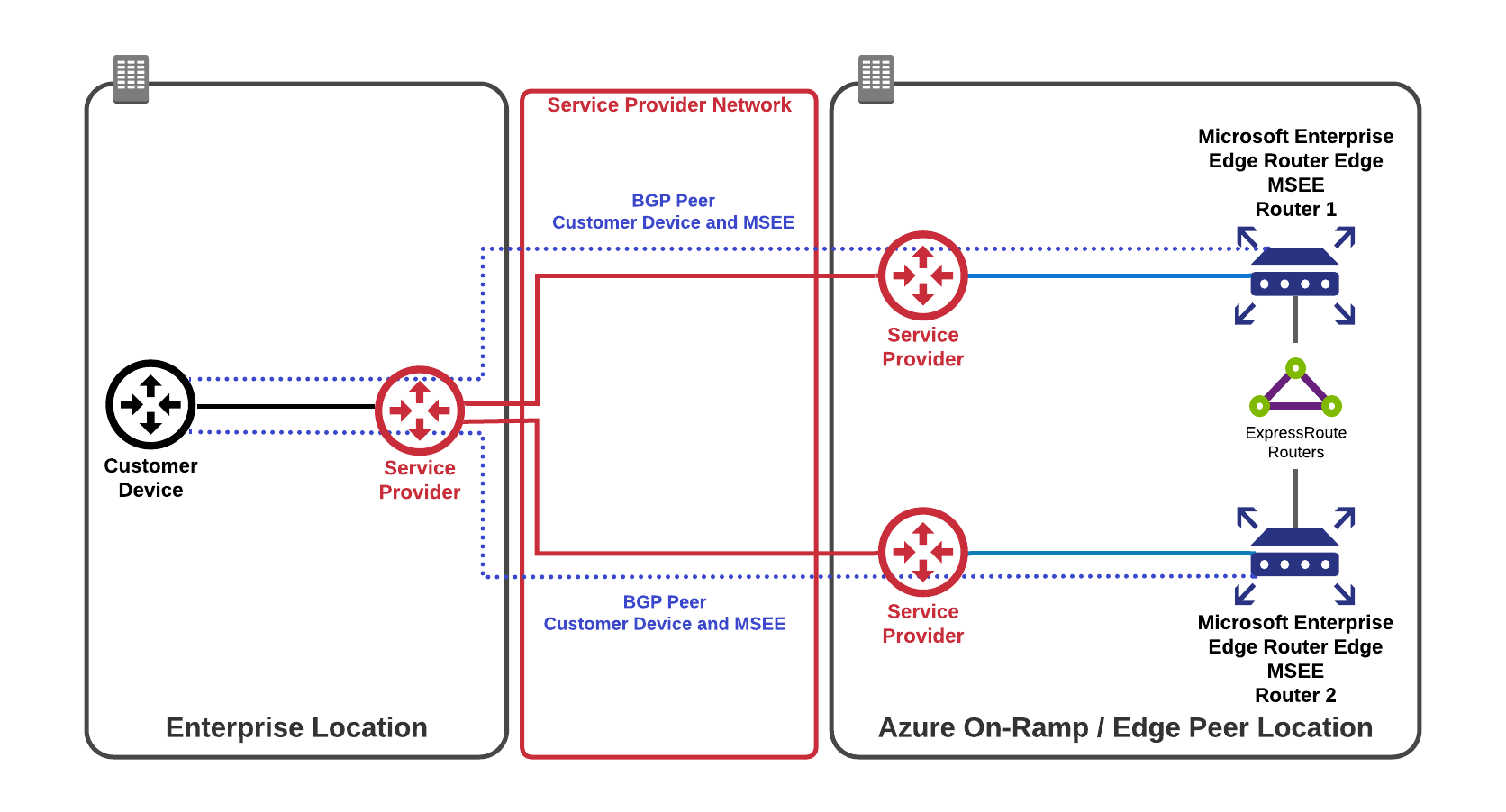
An ExpressRoute circuit connects your on-premises infrastructure to Microsoft cloud services through a connectivity provider like Megaport. Azure compute services, such as virtual machines (IaaS) and cloud services (PaaS) that are deployed within a virtual network, can be connected through the private peering domain. The private peering domain can be a secure and reliable extension of your core network into Microsoft Azure.

Connectivity to Microsoft online services (Microsoft 365 and Azure PaaS services) occurs through Microsoft peering.

ExpressRoute locations versus Azure regions

ExpressRoute locations (sometimes referred to as peering locations or meet-me locations) are colocation facilities where Microsoft Enterprise edge (MSEE) devices are located. ExpressRoute locations are the entry point to Microsoft’s network. They are globally distributed, providing customers the opportunity to connect to Microsoft’s network around the world. These locations are where ExpressRoute partners connect to Microsoft’s network.

There are a few key points which can often cause confusion:

  • The ExpressRoute location doesn’t need to match the Azure region. For example, a customer can create an ExpressRoute circuit with a Frankfurt Peering location and a resource location of West Europe.
  • You can have access to Azure services across all regions within a geopolitical region if you’re connected, with a standard SKU, to at least one ExpressRoute location within that geopolitical region.

Egress fees matter (the internet vs ExpressRoute)

Transferring data from your on-premises environments to Azure (“inbound” or “ingress”) is free for both public internet connections and for private options such as Azure ExpressRoute. In contrast, the data transfer fees for pulling data out of Azure (“outbound” or “egress”) vary depending on whether you utilize the public internet or use the cloud service provider’s preferred private connectivity option. Major public cloud providers including AWS, Azure, and Google Cloud often financially incentivize customers to adopt private interconnection by reducing the “outbound” charges associated with the public internet.

The cost of egress data sent over the public internet is based on volume. As an example, in Europe and North America, the Microsoft Azure internet egress fee starts at €0.074/GB of data transferred. These egress fees are in addition to fees paid to your Internet Service Provider.

The cost of egress data sent over private connectivity is also volume-based. The fee for an Azure ExpressRoute circuit in Europe and North America is €0.021/GB of data transferred. These outbound data transfer fees are in addition to the hourly port fees for Azure ExpressRoute.

You can benefit from reducing your data transfer charges by bringing Megaport, a trusted Microsoft Azure ExpressRoute Partner, into the equation.

If you’re sending even a small amount of data out of the cloud, private connectivity can quickly pay for itself. As an example, if you’re egressing 100 Mbps, then private connectivity could save you 37% for Azure. This includes the costs of the Megaport services.
Savings via ExpressRoute vs the public internet

Table 1: Savings via ExpressRoute vs the public internet

Use ExpressRoute Local where you can

ExpressRoute Local is a Microsoft Azure ExpressRoute circuit type; that is, a local circuit at an ExpressRoute peering location that gives you access to only one or two Azure regions in or near the same metro. This is in contrast to a Standard or Premium ExpressRoute circuit, which gives you access to many more regions or even all regions globally.

While you need to pay egress data transfer for your Metered Plan circuits, you don’t pay egress data transfer on top of your ExpressRoute Local circuit, plus the Local circuit is more reasonably priced than the Unlimited Plan for Standard or Premium ExpressRoute circuits. If you have large amounts of data to transfer over a private connection to an ExpressRoute peering location near your desired Azure regions, you can save a lot of money using ExpressRoute Local. We’ve discussed the use case of how to avoid cloud bill shock by using ExpressRoute Local in a previous post.

Organizations can use Megaport’s Software Defined Network (SDN) to get to an Express Route Local location and benefit from zero egress fees when pulling data out of Microsoft Azure. Even if you need to create a longhaul Megaport Virtual Cross Connect (VXC) this will still turn out cheaper, in many cases, than paying egress fees.

Example: ExpressRoute Local vs Metered and Unlimited costs

Here’s an example where your data is egressing from Microsoft West Europe region but your data center is located in London. Typically you would connect to Megaport in a London data center and then provision an ExpressRoute in London to reach the West Europe region with a standard circuit.

The cost-saving alternative is to connect to Megaport in a London data center and then provision connectivity to an ExpressRoute in Amsterdam, to reach the West Europe region with an Express Route Local circuit. Note that the minimum speed for ExpressRoute local is 1 Gbps. The costs would look like this:

ExpressRoute Plan w/ MegaportMetered @ 500 MbpsUnlimited @ 500 MbpsLocal @ 500 Mbps
Express Route Port€245€2319€1012
ExpressRoute Egress fees€3541€0€0
Megaport Port€500€500€500
2 x Metro 500 Mbps VXC (London)€200€200
2 x 500 Mbps VXC (London – Amsterdam)€426
Total in €/m€4,486/m€3,019/m€1,938/m

Table 2: Egressing 500 Mbps which totals 164 TB per month


ExpressRoute Plan w/ MegaportMetered @ 1GbpsUnlimited @ 1GbpsLocal @ 1Gbps
Express Route Port€368€4807€1012
ExpressRoute Egress fees€7081€0€0
Megaport Port€500€500€500
2 x Metro 1 Gbps VXC (London)€200€200
2 x 1 Gbps VXC (London – Amsterdam)€626
Total in €/m€8,149/m€5,507€2,138/m

Table 3: Egressing 1 Gbps which totals 328 TB per month


ExpressRoute Plan w/ MegaportMetered @ 2GbpsUnlimited @ 2GbpsLocal @ 2Gbps
Express Route Port€735€9614€1855
ExpressRoute Egress fees€14919€0€0
Megaport Port€500€500€500
2 x Metro 500 Mbps VXC (London)€400€400
2 x 500 Mbps VXC (London – Amsterdam)€1026
Total in €/m€16,554/m€10,514€3,381/m

Table 4: Egressing 2 Gbps which totals 657 TB per month

Incidentally, to do a flat 1 Gbps egress data rate over the internet would cost €17,348/m!

Click here to better understand private connectivity costs for AWS, Microsoft Azure, and Google Cloud.

Checklist for when to use ExpressRoute Local

ExpressRoute Local may be an economical choice for you if some or all of the following are true:

  • You have large amounts of data that you need to transfer out of Azure.
  • Your resource requirements do not exceed those of Standard circuits. ExpressRoute Local also has the same limits on resources as Standard. See here for details.
    • The number of VNet links required is less than 10.
    • The maximum number of routes advertised to Azure private peering is less than 4,000
  • You don’t require access to Microsoft 365 via the ExpressRoute service. An ExpressRoute Premium circuit is required to use Office 365 with ExpressRoute.
  • You don’t need access to services outside the Azure region that are local to your ExpressRoute location.
  • You don’t need ExpressRoute Global Reach. ExpressRoute Global Reach is not available on ExpressRoute Local.

Conclusion

If you’re a large data user and your requirements are in line with the items listed above, it will be wise from a cost and performance perspective to use ExpressRoute local for flat data rates above 200 Mbps or for more than a total 66 TB/m.

Megaport has the private network capacity to get you to the doorstep of the ExpressRoute Local location in your region. Get in touch with us and we can model your ExpressRoute connectivity requirements to make sure you’re adopting the correct deployment strategy for today and for future growth.

Also read

Avoid Cloud Bill Shock with Azure ExpressRoute Local and Megaport

Understanding Private Connectivity Costs for AWS, Microsoft Azure, and Google Cloud