


惯性聚合 高效追踪和阅读你感兴趣的博客、新闻、科技资讯
阅读原文 在惯性聚合中打开

推荐订阅源

酷 壳 – CoolShell
酷 壳 – CoolShell
H
Hacker News: Front Page
P
Palo Alto Networks Blog
T
ThreatConnect
Apple Machine Learning Research
博客园_首页
T
True Tiger Recordings
P
Privacy & Cybersecurity Law Blog
B
Blog
IT之家
IT之家
Last Week in AI
Last Week in AI
F
Full Disclosure
Hacker News: Ask HN
Hacker News: Ask HN
C
Comments on: Blog
Microsoft Azure Blog
C
Cybersecurity and Infrastructure Security Agency CISA
Microsoft Security Blog
博客园 - 【当耐特】
N
News and Events Feed by Topic
NISL@THU
NISL@THU
腾讯CDC
雷峰网
雷峰网
Security Latest
Security Latest
李成银的技术随笔
M
Microsoft Research Blog - Microsoft Research
L
LangChain Blog
L
Lohrmann on Cybersecurity
cs.CL updates on arXiv.org
C
Check Point Blog
Y
Y Combinator Blog
Recent Announcements
博客园 - Franky
N
News | PayPal Newsroom
V
V2EX
A
About on SuperTechFans
The Register - Security
月光博客
月光博客
奇客Solidot–传递最新科技情报
奇客Solidot–传递最新科技情报
Google Online Security Blog
MyScale Blog
MyScale Blog
Cisco Talos Blog
Cisco Talos Blog
Vercel News
Vercel News
WordPress大学
WordPress大学
C
Cyber Attacks, Cyber Crime and Cyber Security
The Hacker News
The Hacker News
IntelliJ IDEA : IntelliJ IDEA – the Leading IDE for Professional Development in Java and Kotlin | The JetBrains Blog
爱范儿
爱范儿
A
Arctic Wolf
L
LINUX DO - 最新话题
freeCodeCamp Programming Tutorials: Python, JavaScript, Git & More

Megaport Blog

Early Warning Signs Your Network Needs a Refresh Introducing Megaport DDoS Protection A Guide to 400G Connectivity A Guide to NAT Gateway A Guide to Cloud Storage How the Data Center Is Evolving in 2026 What to Expect When Attending Your First Network Operator Group (NOG) Nine Ways to Connect to Cloud Using Private Connectivity Migrate Your On-premises to the Cloud: A Step-by-Step Guide How to Lower Your Egress Fees in 2026 How to Achieve Data Sovereignty in Europe Redefining the Edge with Cisco and Megaport How to Reduce Latency in Your Multicloud Environment Introducing Megaport High-Speed Cross-Cloud Encryption Are Businesses Leaving the Cloud? Using Meraki and Megaport Virtual Edge for Multicloud Networking Equinix Metal® is Going Away: Here’s What You Can Do Introducing Megaport On-ramp as a Service Megaport’s Full Solution Portfolio Is Coming to India New Bare-metal GPU Instance Now Available with NVIDIA RTX Pro 6000 A Look Back at 2025: Megaport's Biggest Updates Megaport Expands Into India With Extreme IX Your 2026 Predictions From AWS re:Invent 2025 Top NaaS Trends for 2026 What is IPsec? When to Move From Public Internet to Private Connectivity Megaport and Latitude.sh: Bringing Compute and Connectivity Together Improve Your Microsoft ExpressRoute Resilience with Megaport Comparing Ways to Connect to AWS What is API-First Networking? The Hidden Cost of Running Cloud-Hosted SD-WAN for IaaS Overcoming NaaS Integration Challenges Introducing SCION with Anapaya and Megaport How to Use Network as a Service to Future-Proof Your Network Introducing 400G Ports All the As-a-services, Compared Introducing Megaport IPsec Tunnels High Score: Megaport Hits 1,000 Locations A Guide to Colocation Data Centers Maximizing Peering Through Flow Analysis Build Resilient Networks for AI Production Workloads Introducing Packet Filtering on Megaport Cloud Router Building Resilient Government IT: Strategies for Secure, Compliant, and Scalable Connectivity Future-Proofing Government IT Telstra Programmable Network Is Being Discontinued. Here’s How to Migrate The Future of WAN Design Depends on Network as a Service (NaaS) Cisco Webex Edge Connect Launches on Megaport Voice and Video Exchange How to Prepare for APRA CPS 230 Comparing the SD-WAN Licensing Needs of Major Vendors A Guide to Improving Network Performance How Latitude.sh, Wasabi, and Megaport Unlock Cost-Effective Multicloud Four Ways to Connect Your Clouds SD-WAN and MPLS: Weighing the Similarities, Differences, and Benefits A Guide to Network as a Service (NaaS) How to Arrange Bilateral Peering Sessions Comparing Major SD-WAN Vendors Software Defined Networking in Healthcare Deploying A Global Network in Minutes With Megaport AWS Direct Connect Gateway (DGW) Data Transfer Outbound Rules Bilateral and Multilateral Peering: What’s the Difference? Multi-Region SD-WAN: Why Megaport SDCI is the Right Choice Microsoft Azure is Going Secure by Default. Are You Ready? How Megaport and Vultr Are Solving the Enterprise AI Challenge Introducing Megaport NAT Gateway A Guide to AWS Security Tools How to Deploy Amazon Bedrock Using AWS Direct Connect and Megaport Azure Private Link, Explained Introducing 100G MCRs Simplifying Hybrid and Multicloud Network Connectivity How to Fix Poor AWS Latency A Look Back at 2024: Megaport’s Biggest Updates Your 2025 Predictions From AWS re:Invent 2024 Six Ways to Get a More Resilient Network in 2025 Multicloud Security: Challenges and Solutions The Real Cost of High Network Latency Why Brazil is Your Key to Unlocking Business Growth in Latin America Why You Need Integrated Network Security Six Key Differences Between Major Cloud Providers How to Automate Your Megaport Infrastructure With APIs Why Italy is Europe’s Next Cloud Expansion Hotspot How to Lower Your Cloud Costs Peering: How Local Is Local? Introducing Megaport AI Exchange Two Scenarios for Hybrid Multicloud Deployment With IBM Cloud and Microsoft Azure How to Connect Equinix and Digital Realty Megaport Enables Microsoft Azure ExpressRoute Metro for More Resilient Network Connectivity Executives, Here’s What Your Network Team Wants You to Know Easy Ways to Interconnect Your Network 100G VXC Expansion: Now Available From 597 Data Centers Worldwide Top 10 How-To Guides To Improve Your Network Comparing Encryption in Transit Options Comparing Generative AI Offerings From Major Cloud Providers A Sustainable Business Strategy Starts With Your Network Solutions to Common API Issues With Megaport Transforming Financial Connectivity: Introducing Megaport Financial Services Exchange (FSX) Megaport Enhancing Connectivity in Adelaide Megaport’s Latest Portal Features and Functionalities Automate Your Network Deployments With The New Megaport Terraform Provider A Recap of the Megaport World Tour 2024 Top 5 Cloud and Networking Announcements From Cisco Live 2024
The Role of the Data Center in Your Network
2024-08-26 · via Megaport Blog

By Brian Bowman, Senior Solutions Architect

From traditional to virtual, we explore the different ways this facility can support your enterprise network.

Ten years ago, the term “data center” had a more simple definition than it does today.

No longer thought of as a simple collection of storage racks, data centers are now home to our most critical assets, as well as a crucial hub in the flow of information (which only continues to grow). And from traditional to virtual, there are many types of data centers available today.

If it’s been a while, it’s worth reviewing which types of data centers you’re using to ensure you’re optimizing costs, performance, and general network efficiency. This blog will explain the types of data centers available, how they function, and where they fit into your network infrastructure.

Table of Contents

Types of data centers

Unlike server farms, which tend to have simpler infrastructure and are used for a singular function, such as mining cryptocurrency, data centers host everything needed for “mission-critical” Software as a Service (SaaS) products, such as:

  • Cloud storage applications, including data backup and recovery
  • E-commerce applications, which support high-volume transactions
  • Website hosting
  • Email and other productivity applications
  • Online gaming
  • AI, “big data”, and machine learning applications.

Online gaming setup

Types of data centers include:

  • Enterprise-owned data centers: Either onsite or offsite in a shared space.
  • Telecom data centers: Run by telecom companies, these require high-speed connections.
  • Colocation centers: The data center hosts the infrastructure and the enterprise owns the hardware (including servers, storage, and firewalls), so enterprises pay only for what they need and can save on power and cooling costs.
  • Hyperscale data centers: These massive facilities have exceptional computing power, can scale up or down based on the load required, and facilitate edge computing. They support robust applications and host more than 5,000 servers within.
  • Edge data center: Smaller than a standard center, these are designed to be as close to the end user as possible. Instead of having one large data center, your enterprise can opt for multiple smaller ones located closer to where data is being generated and used, to better enable new applications.
  • Micro data center: Essentially an edge data center pushed to the extreme, these handle the data processed in a specific region.

The shift to virtual

In 2019, Gartner predicted, “By 2025, 80% of enterprises will shut down their traditional data centers.” Since then, a lot has happened to speed up this prediction.

The pandemic accelerated a large shift to cloud and as-a-service offerings, which provide scalable, on-demand applications to enterprises that had to adapt to a distributed and remote workforce with quicker network speeds and higher performance than ever before. Nearly five years later, cloud architecture is firmly enmeshed into most companies’ day-to-day operations, virtualizing the data center beyond its basic “brick and mortar” form.

The growth of AI has also led to the automated transit and storage of huge amounts of data. A traditional data center architecture is rarely the fastest or most efficient way to efficiently manage this data. In addition to all this, increasing sustainability demands are pushing businesses to virtualize where they can. With such compelling causes to go virtual, hybrid data center infrastructures have become the norm.

Traditional versus virtual

“Virtual” or cloud data centers are a slight misnomer. The cloud is “not a physical entity, but [contains] a group or network of remote servers which are arched together to operate as a single entity for an assigned task.” In other words, virtual data centers still rely on brick and mortar like traditional data centers do. The difference is that while cloud data centers have typical hardware, each physical server contains many virtual servers to maximize available virtual space per piece of hardware.

In every data center, whether traditional or virtual, each component needs to interact seamlessly. Servers have firewall protection and mechanisms to ensure applications deliver where and when they are needed.

They all feature:

  • Storage infrastructure for the secure storage of software files and applications
  • Network infrastructure which connects either physical or virtual servers to data centers’ end users
  • Computing servers to manage and run applications that process data and provide data network connectivity, firewall software, and other functions.

Traditional data centers offer the value of internal control, from how they are built to who is allowed access. If your business doesn’t have complex or changing data requirements, they can also contribute to lower latency on applications due to their proximity to users’ devices. You may also prefer a traditional data facility if, for instance, your industry’s regulations make it easier to keep compliant in-house.

But traditional data centers have some drawbacks in comparison to their virtual counterparts:

  • Higher construction and infrastructure costs
  • Less energy efficiency, leading to higher cooling costs (we share our tips for maintaining a greener network here)
  • Requirement for a static IP address, which can be hacked more easily than a dynamic one
  • Risk of hardware vendor contract lock-in, making it harder to stay agile as business needs change over time
  • Risk of downtime (compared to the built-in redundancy of cloud storage), which could lead to lost productivity and customer dissatisfaction.

On the other hand, virtual servers enable Infrastructure as a Service (IaaS), a cloud computing service package. IaaS combines networks, servers, virtualization, and storage products for clients. The scalability and customization of IaaS allows customers to choose storage, bandwidth, security, and application packages depending on their size, budget, and industry.

Depending on the compute processing needs of your business, either a traditional or virtual data center design may make more sense. But hybrid setups aren’t uncommon and, when designed well, offer the best of both worlds.
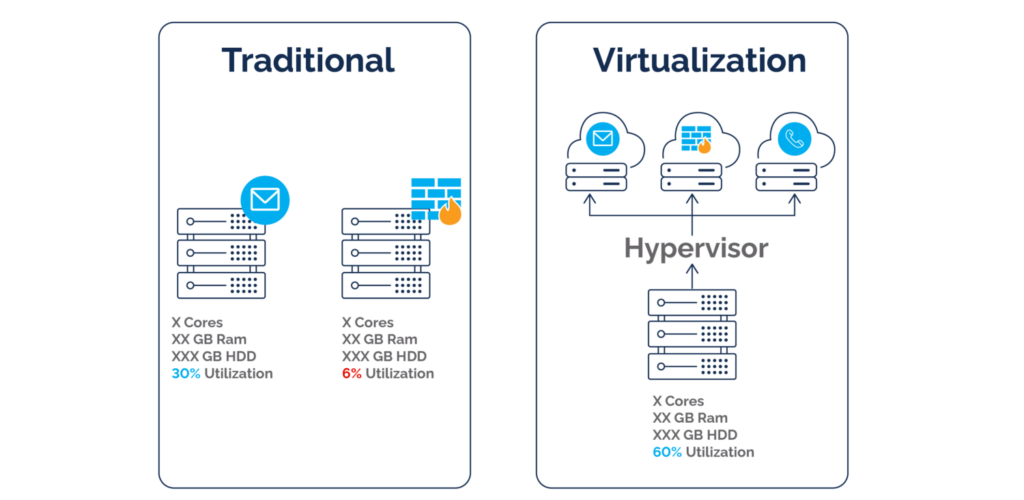
Traditional data center vs virtualization – Park Place Technologies

Source: Park Place Technologies

Is your network experiencing downtime? Your internet connection could be to blame – learn more in our blog.

Data center security

Data centers need to be physically secure: That is, in a safe location with limited entry points and in nondescript buildings. Managers should establish protocols for who can enter and ensure there is constant surveillance.

Whether traditional or virtual, facilities should invest in zero-trust software systems to lessen the chance of hacker entry at the weakest points. These measures entail firewalls, encryption, and other methods.

Should you adopt a zero-trust network architecture? Learn more here.
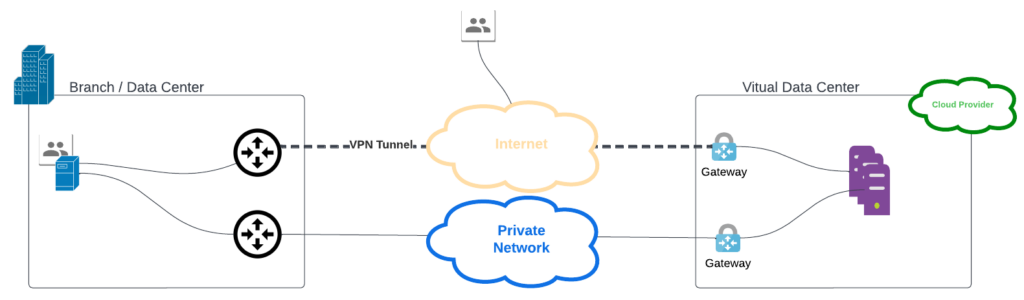
Where the virtual data center sits in your enterprise architecture

Using Amazon VPC through a VPN tunnel (without NAT)

When choosing a data center, keep these factors in mind:

  • Do the service providers maintain and manage the cloud? Is this at a deferred cost?
  • Is data security outsourced to the cloud, which could lead to internal negligence?
  • Is the cloud storage solution scalable? Is there a process in place to ensure no internal oversight in which costs could balloon?
  • Is cloud onboarding quick and simple?
  • Does the provider offer pay-as-you-go and autoscaling, which can mean cheaper costs than storing traditionally?
  • Is there the option for multi-device access to applications and other cloud services, which is ideal for remote workers?

To choose how to plug into a virtual data center, enterprises need to weigh costs versus bandwidth needs and other factors, among these three options:

  • Site-to-site VPN IPSEC connection: An internet-based connection, with VPN encryption offering security. This is often the cheapest method.
  • Remote VPN SSL connection: allowing remote employees access to the data center.
  • Private connection: This method bypasses the public internet and its bandwidth and latency issues.

Interconnecting your data centers

With today’s advances in cloud storage and a renewed focus on green networks, enterprises can mix and match to find the best solutions, changing course as their storage and computing needs shift.

Interconnecting your network comes with a suite of benefits, and this includes your data centers. The best way to reliably interconnect these data centers is to leverage a Network as a Service (NaaS) provider with its own data interconnection solutions, giving you a flexible network underlay to manage these connections at scale.

Megaport Data Center Interconnect

With Megaport Data Center Interconnect, it’s easy to integrate hundreds of endpoints with simple, fast, and direct campus connections between your key metro locations.

  • Rapid: Provision dedicated, private, and reliable connections between hundreds of Megaport-enabled data centers within metro areas, nationally, or internationally.
  • Scalable: Manage your network costs with pay-as-you-go provisioning and spin connections up or down on our 100G+ scalable backbone.
  • Resilient: Connect across a fully redundant network architecture for disaster recovery, better latency, and less downtime.
  • Global: Get immediate access to over 850 enabled data centers and over 100 unique data center operators worldwide.
  • Engineered for security: Use Megaport’s private connectivity to bypass the public internet and apply consistent security measures across your entire data stream.
  • Megaport Cloud Router: Use our managed routing platform for easy public or private connectivity at Layer 3, to integrate your clouds without hardware.
  • Virtual Cross Connect (VXC): Provision private Layer 2 Ethernet circuits to any service provider in the Megaport ecosystem.

Get started

Data center designs are an often-forgotten but powerful way to optimize your overall network. To avoid locking yourself into a purely traditional or purely virtual environment, use a NaaS data interconnection solution to mix and match your data center infrastructure across different regions and functions, ensuring you’re getting the best value for money when it comes to network performance, efficiency, and ease of management.

Bring the Megaport team to your next network review and we’ll show you how to provision data center interconnections that supercharge your network in just a few clicks.