

惯性聚合 高效追踪和阅读你感兴趣的博客、新闻、科技资讯
阅读原文 在惯性聚合中打开

推荐订阅源

The Last Watchdog
The Last Watchdog
C
Cyber Attacks, Cyber Crime and Cyber Security
L
LINUX DO - 热门话题
G
GRAHAM CLULEY
S
Schneier on Security
钛媒体:引领未来商业与生活新知
钛媒体:引领未来商业与生活新知
S
SegmentFault 最新的问题
IT之家
IT之家
阮一峰的网络日志
阮一峰的网络日志
Recorded Future
Recorded Future
I
Intezer
云风的 BLOG
云风的 BLOG
博客园 - Franky
月光博客
月光博客
大猫的无限游戏
大猫的无限游戏
T
Tenable Blog
The Hacker News
The Hacker News
T
The Blog of Author Tim Ferriss
Attack and Defense Labs
D
DataBreaches.Net
freeCodeCamp Programming Tutorials: Python, JavaScript, Git & More
N
News and Events Feed by Topic
有赞技术团队
有赞技术团队
Exploit-DB.com RSS Feed
N
News and Events Feed by Topic
Threat Intelligence Blog | Flashpoint
S
Secure Thoughts
The Register - Security
B
Blog
Security Archives - TechRepublic
The Cloudflare Blog
Webroot Blog
Webroot Blog
W
WeLiveSecurity
H
Heimdal Security Blog
博客园 - 三生石上(FineUI控件)
V
Vulnerabilities – Threatpost
G
Google Developers Blog
O
OpenAI News
V
V2EX
罗磊的独立博客
博客园_首页
N
News | PayPal Newsroom
cs.CL updates on arXiv.org
CTFtime.org: upcoming CTF events
TaoSecurity Blog
TaoSecurity Blog
Cloudbric
Cloudbric
H
Hacker News: Front Page
博客园 - 叶小钗
T
Tor Project blog
AI
AI

Megaport Blog

A Guide to NAT Gateway A Guide to Cloud Storage How the Data Center Is Evolving in 2026 What to Expect When Attending Your First Network Operator Group (NOG) Nine Ways to Connect to Cloud Using Private Connectivity Migrate Your On-premises to the Cloud: A Step-by-Step Guide How to Lower Your Egress Fees in 2026 How to Achieve Data Sovereignty in Europe Cisco and Megaport: Redefining the Edge of Modern Networking How to Reduce Latency in Your Multicloud Environment Introducing Megaport High-Speed Cross-Cloud Encryption Are Businesses Leaving the Cloud? Using Meraki and Megaport Virtual Edge for Multicloud Networking Equinix Metal® is Going Away: Here’s What You Can Do Introducing Megaport On-ramp as a Service Megaport’s Full Solution Portfolio Is Coming to India New Bare-metal GPU Instance Now Available with NVIDIA RTX Pro 6000 A Look Back at 2025: Megaport's Biggest Updates Megaport Expands Into India With Strategic Acquisition of Extreme IX Your 2026 Predictions From AWS re:Invent 2025 What’s Next for NaaS? Top Trends for 2026 What is IPsec? When to Move From Public Internet to Private Connectivity Megaport and Latitude.sh: Bringing Compute and Connectivity Together How to Improve Your Microsoft ExpressRoute Resilience with Megaport Connectivity Comparing Ways to Connect to AWS What is API-First Networking? The Hidden Cost of Running Cloud-Hosted SD-WAN for IaaS How to Overcome NaaS Integration Challenges Introducing SCION with Anapaya and Megaport How You Can Use Network as a Service (NaaS) to Future-Proof Your Network Introducing 400G Ports All the As-a-services, Compared Introducing Megaport IPsec Tunnels High Score: Megaport Hits 1,000 Locations A Guide to Colocation Data Centers Maximizing Peering Through Flow Analysis How to Build Resilient Networks for AI Production Workloads Introducing Packet Filtering on Megaport Cloud Router Building Resilient Government IT: Strategies for Secure, Compliant, and Scalable Connectivity Future-Proofing Government IT: Balancing Innovation, Security, and Sovereignty in a Changing World Telstra Programmable Network Is Being Discontinued. Here’s How to Migrate The Future of WAN Design Depends on Network as a Service (NaaS) Cisco Webex Edge Connect Launches on Megaport Voice and Video Exchange How to Prepare for APRA CPS 230 Regulations Comparing the SD-WAN Licensing Needs of Major Vendors A Guide to Improving Network Performance How Latitude.sh, Wasabi, and Megaport Unlock Cost-Effective Multicloud Four Ways to Connect Your Clouds SD-WAN and MPLS: Weighing the Similarities, Differences, and Benefits What is Network as a Service (NaaS)? How to Arrange Bilateral Peering Sessions Comparing Major SD-WAN Vendors Software Defined Networking in the Healthcare Industry Deploying A Global Network in Minutes With Megaport AWS Direct Connect Gateway (DGW) Data Transfer Outbound Rules Bilateral and Multilateral Peering: What’s the Difference? Multi-Region SD-WAN: Why Megaport SDCI is the Right Choice Microsoft Azure is Going Secure by Default. Are You Ready? Building Production-Ready AI Infrastructure: How Megaport and Vultr Are Solving the Enterprise Challenge Introducing Megaport NAT Gateway A Guide to AWS Security Tools How to Deploy Amazon Bedrock Using AWS Direct Connect and Megaport Azure Private Link, Explained Introducing 100G MCRs Your Questions Answered on Simplifying Hybrid and Multicloud Network Connectivity How to Fix Poor AWS Latency A Look Back at 2024: Megaport’s Biggest Updates Your 2025 Predictions From AWS re:Invent 2024 Six Ways to Get a More Resilient Network in 2025 Multicloud Security: Challenges and Solutions The Real Cost of High Network Latency Why Brazil is Your Key to Unlocking Business Growth in Latin America Why You Need Integrated Network Security Six Key Differences Between Major Cloud Providers How to Automate Your Megaport Infrastructure With APIs Why Italy is Europe’s Next Cloud Expansion Hotspot How to Lower Your Cloud Costs Peering: How Local Is Local? Introducing Megaport AI Exchange Two Scenarios for Hybrid Multicloud Deployment With IBM Cloud and Microsoft Azure How to Connect Equinix and Digital Realty Megaport Enables Microsoft Azure ExpressRoute Metro for More Resilient Network Connectivity Executives, Here’s What Your Network Team Wants You to Know Easy Ways to Interconnect Your Network The Role of the Data Center in Your Network 100G VXC Expansion: Now Available From 597 Data Centers Worldwide Top 10 How-To Guides To Improve Your Network Comparing Encryption in Transit Options A Sustainable Business Strategy Starts With Your Network Solutions to Common API Issues With Megaport Transforming Financial Connectivity: Introducing Megaport Financial Services Exchange (FSX) Megaport Enhancing Connectivity in Adelaide Megaport’s Latest Portal Features and Functionalities Automate Your Network Deployments With The New Megaport Terraform Provider A Recap of the Megaport World Tour 2024 Top 5 Cloud and Networking Announcements From Cisco Live 2024 Megaport Enhancing Connectivity in Canberra AWS PrivateLink, Explained How Megaport and Wasabi Are Simplifying Cloud Storage
Why Cloud-to-Cloud Connectivity is Key in Canada
Megaport · 2020-12-18 · via Megaport Blog

Eliminate unnecessary latency and modernise your network with direct cloud-to-cloud connectivity.

Let’s say your company is located in Calgary and uses Oracle and AWS clouds to run its Oracle databases, with data being sent between the two providers. Common examples of this are companies running Oracle databases within an AWS virtual machines.

All of the major cloud providers in Canada – AWS, Microsoft Azure, Google Cloud –  have their physical infrastructure located in Toronto, Montreal, or Quebec City. In Canada, there are no cloud regions west of Toronto and currently there are no plans for any of the big hyperscalers to build out new regions in central and western Canada. Your traffic would go from the Oracle region in Toronto or Montreal back to your on-premises network in Calgary and hairpin back out to the AWS infrastructure in Montreal. This routing scenario is illustrated in the diagram below.
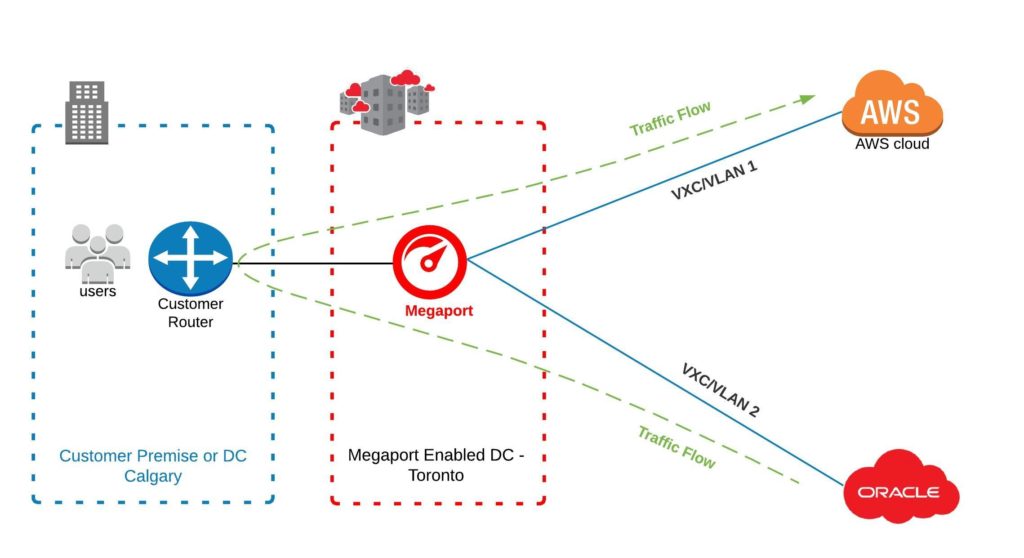
The Result? Big-Time Latency


Depending on the applications you’re running, having your data bouncing back and forth between Toronto or Montreal and Calgary will result in high latency and significant performance issues for the end user. If you go to the Megaport website and look at our Network Latency data, taken from monitoring equipment inside Megaport-enabled data centres around the world, you’ll see that average monthly latency between data centres in Calgary to data centres in Toronto averages between 40 and 43 milliseconds. Latency averages between Calgary data centres and ones in Montreal are even higher, between 48 and 50 milliseconds.

Data Sovereignty in Canada

These high levels of latency are especially relevant to Canadian businesses either operating in, or dealing with, industry sectors that must account for data sovereignty. Data stored in Canada falls within the jurisdiction of Canada’s historically strong privacy laws. Once data is allowed to cross Canada’s southern border into the United States, it’s no longer protected by Canadian law.  

Industry sectors that are particularly sensitive to data sovereignty include government and defense, oil, gas, and hydroelectricity, as well as public utilities and local municipalities. For organisations that must account for data sovereignty regulations, sending their packets to data centres on the West Coast of the United States to lower latency and improve application performance simply isn’t an option.

The Solution? Cloud-to-Cloud Routing


If cloud-to-cloud connectivity was used as part of your network architecture, your data in Toronto or Montreal could be directly connected to the Oracle and AWS clouds. Traffic would take the shortest route between the two clouds, removing the extra latency from the data going back and forth to Calgary.

Cloud-to-cloud connectivity is made possible with Megaport Cloud Router (MCR), a virtual routing service that can be spun up in Toronto or Montreal, immediately giving your business private connectivity at Layer 3 in bandwidth options of 1 Gbps, 2.5 Gbps, 5 Gbps and 10 Gbps – all without any new hardware. MCR is available in a number of different data centres in Toronto or Montreal, allowing you to also easily build redundancy into your network design.

This cloud-to-cloud solution is illustrated in the diagram below.
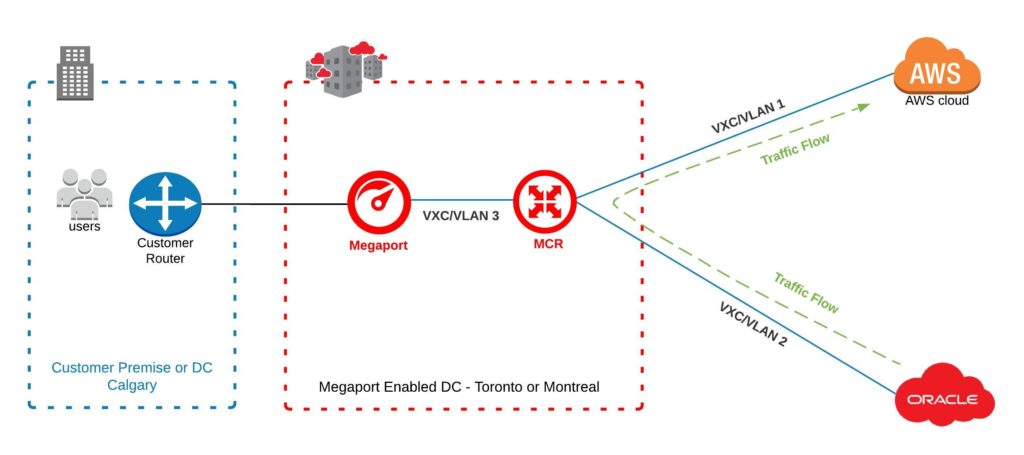
You can also have traffic go directly from the cloud provider to your on-premises network without any unnecessary latency. And things are even simpler if your data doesn’t even need to go to any on-premises infrastructure – you could implement a solution such as the one shown in the diagram below.
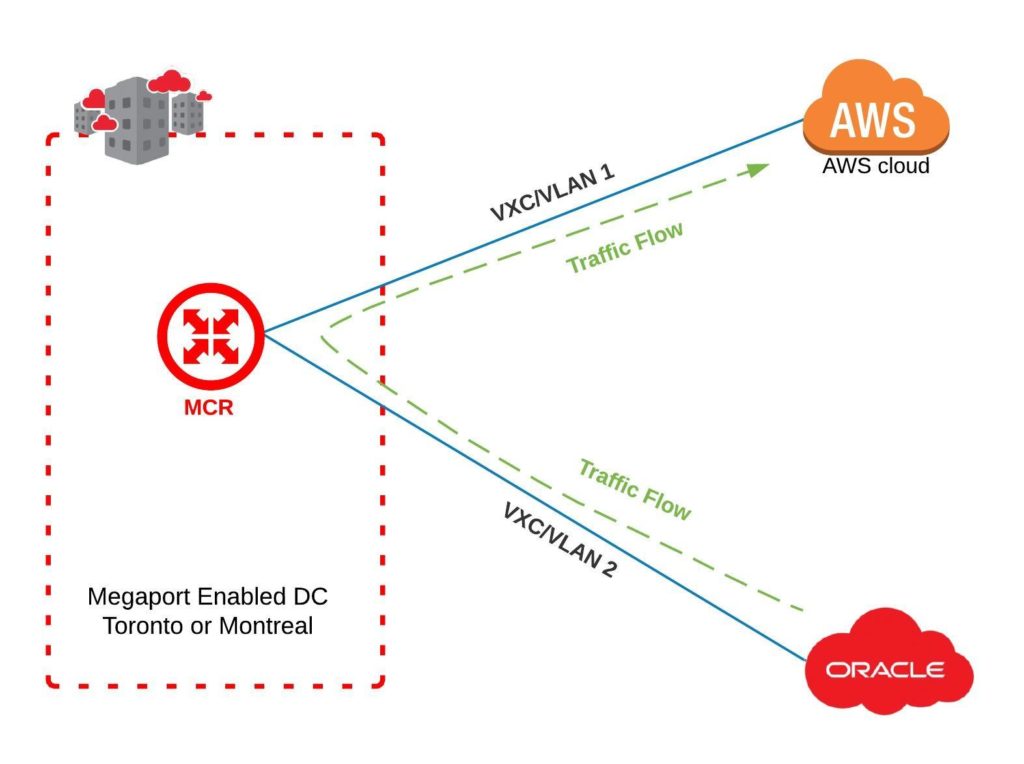
Of course, MCR works with all of the major cloud providers as well as any of the companies that are part of the Megaport Marketplace (such as iLand, IronCloud, and Wasabi). Because MCR doesn’t require the deployment of any new physical connections, it can be spun up and ready to use in just minutes at any Megaport-enabled location around the world. 

You wouldn’t even need a physical point of presence in Toronto or Montreal. 

Learn More


Click here for the complete list of MCR locations. To learn more about Megaport Cloud Router, visit the MCR services page on Megaport.com.