


惯性聚合 高效追踪和阅读你感兴趣的博客、新闻、科技资讯
阅读原文 在惯性聚合中打开

推荐订阅源

S
Schneier on Security
博客园 - 聂微东
美团技术团队
奇客Solidot–传递最新科技情报
奇客Solidot–传递最新科技情报
T
Tor Project blog
N
Netflix TechBlog - Medium
G
Google Developers Blog
L
LINUX DO - 最新话题
Recent Announcements
爱范儿
爱范儿
P
Privacy & Cybersecurity Law Blog
F
Fortinet All Blogs
The GitHub Blog
The GitHub Blog
Spread Privacy
Spread Privacy
TaoSecurity Blog
TaoSecurity Blog
T
Tailwind CSS Blog
OSCHINA 社区最新新闻
OSCHINA 社区最新新闻
S
SegmentFault 最新的问题
AWS News Blog
AWS News Blog
P
Proofpoint News Feed
D
DataBreaches.Net
CTFtime.org: upcoming CTF events
Hacker News: Ask HN
Hacker News: Ask HN
V
V2EX
www.infosecurity-magazine.com
cs.CL updates on arXiv.org
K
Kaspersky official blog
博客园 - 司徒正美
U
Unit 42
K
KPMG report finds enterprise disconnect between AI and its ROI | CIO
Blog — PlanetScale
Blog — PlanetScale
云风的 BLOG
云风的 BLOG
Schneier on Security
H
Hackread – Cybersecurity News, Data Breaches, AI and More
T
Threatpost
Vercel News
Vercel News
Engineering at Meta
Engineering at Meta
Attack and Defense Labs
L
Lohrmann on Cybersecurity
Recent Commits to openclaw:main
Hugging Face - Blog
Hugging Face - Blog
PCI Perspectives
PCI Perspectives
S
Secure Thoughts
The Cloudflare Blog
L
LangChain Blog
T
The Exploit Database - CXSecurity.com
C
Check Point Blog
Microsoft Azure Blog
I
InfoQ
博客园 - 三生石上(FineUI控件)

Megaport Blog

A Guide to NAT Gateway A Guide to Cloud Storage How the Data Center Is Evolving in 2026 What to Expect When Attending Your First Network Operator Group (NOG) Nine Ways to Connect to Cloud Using Private Connectivity Migrate Your On-premises to the Cloud: A Step-by-Step Guide How to Lower Your Egress Fees in 2026 How to Achieve Data Sovereignty in Europe Cisco and Megaport: Redefining the Edge of Modern Networking How to Reduce Latency in Your Multicloud Environment Introducing Megaport High-Speed Cross-Cloud Encryption Are Businesses Leaving the Cloud? Using Meraki and Megaport Virtual Edge for Multicloud Networking Equinix Metal® is Going Away: Here’s What You Can Do Introducing Megaport On-ramp as a Service Megaport’s Full Solution Portfolio Is Coming to India New Bare-metal GPU Instance Now Available with NVIDIA RTX Pro 6000 A Look Back at 2025: Megaport's Biggest Updates Megaport Expands Into India With Strategic Acquisition of Extreme IX Your 2026 Predictions From AWS re:Invent 2025 What’s Next for NaaS? Top Trends for 2026 What is IPsec? When to Move From Public Internet to Private Connectivity Megaport and Latitude.sh: Bringing Compute and Connectivity Together How to Improve Your Microsoft ExpressRoute Resilience with Megaport Connectivity Comparing Ways to Connect to AWS What is API-First Networking? The Hidden Cost of Running Cloud-Hosted SD-WAN for IaaS How to Overcome NaaS Integration Challenges Introducing SCION with Anapaya and Megaport How You Can Use Network as a Service (NaaS) to Future-Proof Your Network Introducing 400G Ports All the As-a-services, Compared Introducing Megaport IPsec Tunnels High Score: Megaport Hits 1,000 Locations A Guide to Colocation Data Centers Maximizing Peering Through Flow Analysis How to Build Resilient Networks for AI Production Workloads Introducing Packet Filtering on Megaport Cloud Router Building Resilient Government IT: Strategies for Secure, Compliant, and Scalable Connectivity Future-Proofing Government IT: Balancing Innovation, Security, and Sovereignty in a Changing World Telstra Programmable Network Is Being Discontinued. Here’s How to Migrate The Future of WAN Design Depends on Network as a Service (NaaS) Cisco Webex Edge Connect Launches on Megaport Voice and Video Exchange How to Prepare for APRA CPS 230 Regulations Comparing the SD-WAN Licensing Needs of Major Vendors A Guide to Improving Network Performance How Latitude.sh, Wasabi, and Megaport Unlock Cost-Effective Multicloud Four Ways to Connect Your Clouds SD-WAN and MPLS: Weighing the Similarities, Differences, and Benefits What is Network as a Service (NaaS)? How to Arrange Bilateral Peering Sessions Comparing Major SD-WAN Vendors Software Defined Networking in the Healthcare Industry Deploying A Global Network in Minutes With Megaport AWS Direct Connect Gateway (DGW) Data Transfer Outbound Rules Bilateral and Multilateral Peering: What’s the Difference? Multi-Region SD-WAN: Why Megaport SDCI is the Right Choice Microsoft Azure is Going Secure by Default. Are You Ready? Building Production-Ready AI Infrastructure: How Megaport and Vultr Are Solving the Enterprise Challenge Introducing Megaport NAT Gateway A Guide to AWS Security Tools How to Deploy Amazon Bedrock Using AWS Direct Connect and Megaport Azure Private Link, Explained Introducing 100G MCRs Your Questions Answered on Simplifying Hybrid and Multicloud Network Connectivity How to Fix Poor AWS Latency A Look Back at 2024: Megaport’s Biggest Updates Your 2025 Predictions From AWS re:Invent 2024 Six Ways to Get a More Resilient Network in 2025 Multicloud Security: Challenges and Solutions The Real Cost of High Network Latency Why Brazil is Your Key to Unlocking Business Growth in Latin America Why You Need Integrated Network Security Six Key Differences Between Major Cloud Providers How to Automate Your Megaport Infrastructure With APIs Why Italy is Europe’s Next Cloud Expansion Hotspot How to Lower Your Cloud Costs Peering: How Local Is Local? Introducing Megaport AI Exchange Two Scenarios for Hybrid Multicloud Deployment With IBM Cloud and Microsoft Azure How to Connect Equinix and Digital Realty Megaport Enables Microsoft Azure ExpressRoute Metro for More Resilient Network Connectivity Executives, Here’s What Your Network Team Wants You to Know Easy Ways to Interconnect Your Network The Role of the Data Center in Your Network 100G VXC Expansion: Now Available From 597 Data Centers Worldwide Top 10 How-To Guides To Improve Your Network Comparing Encryption in Transit Options A Sustainable Business Strategy Starts With Your Network Solutions to Common API Issues With Megaport Transforming Financial Connectivity: Introducing Megaport Financial Services Exchange (FSX) Megaport Enhancing Connectivity in Adelaide Megaport’s Latest Portal Features and Functionalities Automate Your Network Deployments With The New Megaport Terraform Provider A Recap of the Megaport World Tour 2024 Top 5 Cloud and Networking Announcements From Cisco Live 2024 Megaport Enhancing Connectivity in Canberra AWS PrivateLink, Explained How Megaport and Wasabi Are Simplifying Cloud Storage
What is AWS Cloud WAN?
Randy Riggs · 2026-06-15 · via Megaport Blog

By Randy Riggs, Network and Cloud Solutions Architect

Learn how AWS Cloud WAN works, key benefits, limitations, use cases, and adoption best practices.

As AWS environments grow across multiple regions and accounts, networking can become increasingly difficult to manage. What starts as a handful of virtual private clouds (VPCs) can quickly evolve into a complex web of connectivity, routing policies, and security requirements.

AWS Cloud WAN was designed to address this challenge by providing a centralized approach to building and operating global networks. Instead of managing networking services and routing configurations independently across regions, organizations can use a single global network architecture with central visibility and policy management.

In this guide, we’ll explain what AWS Cloud WAN is, how it works, its key benefits and limitations, and when organizations should consider adopting it.

What is AWS Cloud WAN?

AWS Cloud WAN is a managed service that simplifies the creation and operation of a global wide area network across multiple AWS Regions and on-premises environments.

Traditionally, organizations connecting workloads across regions and accounts often rely on a combination of VPC peering, AWS Transit Gateway, and custom routing configurations. While effective, these approaches can become difficult to manage as environments scale.

AWS Cloud WAN provides a centralized alternative. It creates a global network backbone that enables consistent connectivity across distributed AWS environments while providing a single control plane for management, visibility, and policy enforcement.

How does AWS Cloud WAN work?

At the center of AWS Cloud WAN is the core network, which acts as a global backbone spanning multiple AWS Regions. This core network is governed by policies that define how traffic is routed, segmented, and secured throughout the environment.

Multiple components work together to deliver this functionality:

Core network

The core network provides the underlying connectivity framework that links AWS resources across regions and accounts.

Segments

Segments allow organizations to logically isolate traffic between environments, applications, or business units. For example, production, development, and testing environments can each operate within separate segments while remaining centrally managed.

Attachments

Attachments connect resources into your Cloud WAN environment. These can include:

  • VPCs
  • VPN connections
  • Direct Connect gateways.

Network function groups

Network function groups allow organizations to direct traffic through security and inspection services, such as firewalls, providing greater control over how traffic flows through the network.

Together, these components are what create AWS Cloud WAN’s centrally managed network architecture, which can scale across regions with consistent connectivity and policy enforcement.

What networking challenges does AWS Cloud WAN solve?

One of the biggest challenges in large AWS environments is managing connectivity across multiple regions and accounts.

Traditional networking approaches often require administrators to configure and maintain multiple networking services independently. As environments grow, routing policies, connectivity requirements, and security controls can become increasingly difficult to standardize.

AWS Cloud WAN addresses these challenges by:

  • centralizing network management through a single control plane
  • providing consistent connectivity across regions and accounts
  • reducing manual configuration through policy-based automation
  • improving visibility across the entire network
  • simplifying network expansion into new AWS Regions
  • supporting logical segmentation for different environments and business units.

This centralized approach can help reduce operational complexity while improving consistency across large-scale AWS deployments.

AWS Cloud WAN vs traditional AWS networking

AWS Cloud WAN is not a replacement for every networking service in AWS, but it offers a different operational model compared to traditional architectures.

Traditional approach

AWS Cloud WAN

Multiple networking components managed independently

Centralized management through a single control plane

Separate routing configurations across regions and accounts

Unified policy-driven network management

Manual deployment and updates

Greater automation capabilities

Limited end-to-end visibility

Centralized visibility across the network

Scaling can increase operational complexity

Designed to simplify multi-region growth

What organizations should use AWS Cloud WAN?

AWS Cloud WAN is particularly well suited for organizations with large, geographically distributed AWS environments, like:

  • Multi-region organizations: Companies operating across several geographic regions can simplify connectivity management through a centralized global network.
  • Large enterprises: Organizations managing large numbers of VPCs and AWS accounts can benefit from a scalable networking model that simplifies management.
  • Organizations with multiple divisions or units: Businesses needing strict network segmentation between departments, applications, or environments can use Cloud WAN segments to maintain isolation while managing everything centrally.

What are the benefits of AWS Cloud WAN?

Faster deployment and management

Cloud WAN can reduce the time required to deploy and manage large AWS environments spanning multiple accounts and regions, with automation capabilities that allow organizations to create and update networking components across regions more efficiently.

Improved visibility

Administrators get centralized insights into connectivity and traffic flows across the network, making monitoring and troubleshooting easier.

Better security and policy management

Central policy enforcement helps organizations apply security controls consistently across regions and network segments.

Network segmentation

Cloud WAN enables traffic isolation between applications, environments, or business units, helping organizations maintain security boundaries while supporting operational requirements.

Improved traffic reliability and performance

AWS Cloud WAN can improve traffic reliability and application performance while simplifying management across complex environments.

Integration with AWS networking services

Cloud WAN integrates with AWS Network Manager, helping organizations coordinate and manage networking services through a unified experience.

What are the limitations of AWS Cloud WAN?

While Cloud WAN offers significant advantages, network managers should also understand its limitations before adoption.

Cost considerations

Charges for core network resources, VPC attachments, processing, and data transfer can increase as environments scale. Cross-region traffic costs can also balloon if not carefully managed.

Operational complexity

Although Cloud WAN centralizes management, multi-region and multi-account environments still require careful planning, governance, and operational expertise. Organizations may also need additional training to build internal Cloud WAN knowledge.

Routing constraints

Network managers should be aware that:

  • some routing scenarios may not be supported
  • static routes are generally not supported
  • Transit Gateway peering is limited to resources within the same region
  • ASN conflicts with existing Direct Connect gateways must be avoided.

Technical limitations

Certain scenarios may introduce additional complexity, including:

  • certificate-related issues between regions
  • incomplete BGP support in some situations
  • lack of support for Direct Connect communities.

These considerations should be evaluated during planning and design phases.

How do you successfully adopt AWS Cloud WAN?

Successful AWS Cloud WAN adoption starts with a well-defined strategy.

  1. Define your core network policy: Your core network policy establishes the foundation for connectivity, segmentation, security, and traffic management.
  2. Deploy required components: Ensure core networks, segments, attachments, and supporting resources are fully deployed and properly configured.
  3. Take a phased migration approach: Rather than migrating everything at once, move workloads incrementally and validate connectivity and performance at each stage.
  4. Continuously monitor and optimize: Ongoing monitoring allows teams to refine policies, improve segmentation strategies, and optimize network performance over time.

How Megaport complements AWS Cloud WAN

For organizations connecting AWS workloads to on-premises environments, connectivity remains a critical part of the overall network architecture.

Megaport-enabled locations connect to AWS using AWS Direct Connect connections – one for each location associated with the AWS Regions where workloads reside. A Transit VIF is deployed on each AWS Direct Connect connection, with unique IP prefixes advertised from each location as shown below.
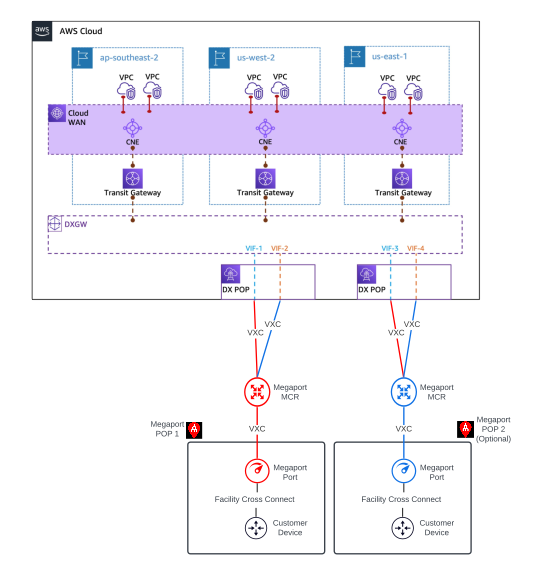
AWS Cloud WAN with Megaport

How to deploy AWS Cloud WAN

Once you’ve defined your core network policy and designed your segmentation strategy, deployment typically follows four high-level steps.

1. Create a Megaport Port or Megaport Cloud Router

Establish connectivity to the Megaport network by creating either a Port or a Megaport Cloud Router (MCR).

A Port provides a high-speed interface that enables point-to-point connectivity between your locations and connected service providers, while an MCR provides virtual routing capabilities within the Megaport platform.

Learn how to create a Port.

Learn how to create an MCR.

2. Create a VXC and configure your AWS connection

Next, create a Virtual Cross Connect (VXC), which provides a Layer 2 Ethernet connection to an AWS on-ramp on the Megaport network.

Once connected, you can configure an AWS Hosted Connection, an AWS Direct Connect service that provides on-demand connectivity over pre-provisioned network circuits.

Learn more about configuring and maintaining AWS hosted connections.

3. Create and configure your AWS VPCs

With connectivity established, create the required VPCs in each AWS Region and connect them to the Transit Gateway.

Learn more about AWS Transit Gateway.

4. Create and configure AWS Cloud WAN

Finally, deploy AWS Cloud WAN and follow AWS’s instructions to configure the core network, segments, attachments, and policies required to connect your regions and environments.

Learn more from AWS on creating a Cloud WAN global network and core network.

As organizations expand their AWS footprint across regions, combining a well-designed connectivity strategy with AWS Cloud WAN can create a more scalable and centrally managed network architecture.

Here’s how to get even more from your AWS environment.