

惯性聚合 高效追踪和阅读你感兴趣的博客、新闻、科技资讯
阅读原文 在惯性聚合中打开

推荐订阅源

酷 壳 – CoolShell
酷 壳 – CoolShell
H
Hacker News: Front Page
P
Palo Alto Networks Blog
T
ThreatConnect
Apple Machine Learning Research
博客园_首页
T
True Tiger Recordings
P
Privacy & Cybersecurity Law Blog
B
Blog
IT之家
IT之家
Last Week in AI
Last Week in AI
F
Full Disclosure
Hacker News: Ask HN
Hacker News: Ask HN
C
Comments on: Blog
Microsoft Azure Blog
C
Cybersecurity and Infrastructure Security Agency CISA
Microsoft Security Blog
博客园 - 【当耐特】
N
News and Events Feed by Topic
NISL@THU
NISL@THU
腾讯CDC
雷峰网
雷峰网
Security Latest
Security Latest
李成银的技术随笔
M
Microsoft Research Blog - Microsoft Research
L
LangChain Blog
L
Lohrmann on Cybersecurity
cs.CL updates on arXiv.org
C
Check Point Blog
Y
Y Combinator Blog
Recent Announcements
博客园 - Franky
N
News | PayPal Newsroom
V
V2EX
A
About on SuperTechFans
The Register - Security
月光博客
月光博客
奇客Solidot–传递最新科技情报
奇客Solidot–传递最新科技情报
Google Online Security Blog
MyScale Blog
MyScale Blog
Cisco Talos Blog
Cisco Talos Blog
Vercel News
Vercel News
WordPress大学
WordPress大学
C
Cyber Attacks, Cyber Crime and Cyber Security
The Hacker News
The Hacker News
IntelliJ IDEA : IntelliJ IDEA – the Leading IDE for Professional Development in Java and Kotlin | The JetBrains Blog
爱范儿
爱范儿
A
Arctic Wolf
L
LINUX DO - 最新话题
freeCodeCamp Programming Tutorials: Python, JavaScript, Git & More

Megaport Blog

Early Warning Signs Your Network Needs a Refresh Introducing Megaport DDoS Protection A Guide to 400G Connectivity A Guide to NAT Gateway A Guide to Cloud Storage How the Data Center Is Evolving in 2026 What to Expect When Attending Your First Network Operator Group (NOG) Nine Ways to Connect to Cloud Using Private Connectivity Migrate Your On-premises to the Cloud: A Step-by-Step Guide How to Lower Your Egress Fees in 2026 How to Achieve Data Sovereignty in Europe Redefining the Edge with Cisco and Megaport How to Reduce Latency in Your Multicloud Environment Introducing Megaport High-Speed Cross-Cloud Encryption Are Businesses Leaving the Cloud? Using Meraki and Megaport Virtual Edge for Multicloud Networking Equinix Metal® is Going Away: Here’s What You Can Do Introducing Megaport On-ramp as a Service Megaport’s Full Solution Portfolio Is Coming to India New Bare-metal GPU Instance Now Available with NVIDIA RTX Pro 6000 A Look Back at 2025: Megaport's Biggest Updates Megaport Expands Into India With Extreme IX Your 2026 Predictions From AWS re:Invent 2025 Top NaaS Trends for 2026 What is IPsec? When to Move From Public Internet to Private Connectivity Megaport and Latitude.sh: Bringing Compute and Connectivity Together Improve Your Microsoft ExpressRoute Resilience with Megaport Comparing Ways to Connect to AWS What is API-First Networking? The Hidden Cost of Running Cloud-Hosted SD-WAN for IaaS Overcoming NaaS Integration Challenges Introducing SCION with Anapaya and Megaport How to Use Network as a Service to Future-Proof Your Network Introducing 400G Ports All the As-a-services, Compared Introducing Megaport IPsec Tunnels High Score: Megaport Hits 1,000 Locations A Guide to Colocation Data Centers Maximizing Peering Through Flow Analysis Build Resilient Networks for AI Production Workloads Introducing Packet Filtering on Megaport Cloud Router Building Resilient Government IT: Strategies for Secure, Compliant, and Scalable Connectivity Future-Proofing Government IT Telstra Programmable Network Is Being Discontinued. Here’s How to Migrate The Future of WAN Design Depends on Network as a Service (NaaS) Cisco Webex Edge Connect Launches on Megaport Voice and Video Exchange How to Prepare for APRA CPS 230 Comparing the SD-WAN Licensing Needs of Major Vendors A Guide to Improving Network Performance How Latitude.sh, Wasabi, and Megaport Unlock Cost-Effective Multicloud Four Ways to Connect Your Clouds SD-WAN and MPLS: Weighing the Similarities, Differences, and Benefits A Guide to Network as a Service (NaaS) How to Arrange Bilateral Peering Sessions Comparing Major SD-WAN Vendors Software Defined Networking in Healthcare Deploying A Global Network in Minutes With Megaport AWS Direct Connect Gateway (DGW) Data Transfer Outbound Rules Bilateral and Multilateral Peering: What’s the Difference? Multi-Region SD-WAN: Why Megaport SDCI is the Right Choice Microsoft Azure is Going Secure by Default. Are You Ready? How Megaport and Vultr Are Solving the Enterprise AI Challenge Introducing Megaport NAT Gateway A Guide to AWS Security Tools How to Deploy Amazon Bedrock Using AWS Direct Connect and Megaport Azure Private Link, Explained Introducing 100G MCRs Simplifying Hybrid and Multicloud Network Connectivity How to Fix Poor AWS Latency A Look Back at 2024: Megaport’s Biggest Updates Your 2025 Predictions From AWS re:Invent 2024 Six Ways to Get a More Resilient Network in 2025 Multicloud Security: Challenges and Solutions The Real Cost of High Network Latency Why Brazil is Your Key to Unlocking Business Growth in Latin America Why You Need Integrated Network Security Six Key Differences Between Major Cloud Providers How to Automate Your Megaport Infrastructure With APIs Why Italy is Europe’s Next Cloud Expansion Hotspot How to Lower Your Cloud Costs Peering: How Local Is Local? Introducing Megaport AI Exchange Two Scenarios for Hybrid Multicloud Deployment With IBM Cloud and Microsoft Azure How to Connect Equinix and Digital Realty Megaport Enables Microsoft Azure ExpressRoute Metro for More Resilient Network Connectivity Executives, Here’s What Your Network Team Wants You to Know Easy Ways to Interconnect Your Network The Role of the Data Center in Your Network 100G VXC Expansion: Now Available From 597 Data Centers Worldwide Top 10 How-To Guides To Improve Your Network Comparing Encryption in Transit Options Comparing Generative AI Offerings From Major Cloud Providers A Sustainable Business Strategy Starts With Your Network Solutions to Common API Issues With Megaport Transforming Financial Connectivity: Introducing Megaport Financial Services Exchange (FSX) Megaport Enhancing Connectivity in Adelaide Megaport’s Latest Portal Features and Functionalities Automate Your Network Deployments With The New Megaport Terraform Provider A Recap of the Megaport World Tour 2024
What is SASE? An Introduction
2021-09-29 · via Megaport Blog

What is SASE, how does it work, and why do you need it? We look at the solution that many analysts are calling the future of network security.

In 2021, enterprises are witnessing a networking revolution. Increased data processing requirements and capabilities, a new generation of software-defined solutions to core networking challenges (enter SD-WAN), and increased automation and intelligence to better power mission-critical applications and workloads are resulting in rapid modernization occurring at the edge.

But as workforces become increasingly distributed, mobile, and remote, and the nature of networking becomes less linear, keeping data secure from the edge to the cloud presents a daunting challenge, whether it be in a single or multicloud environment. How can companies secure their networks while taking advantage of new innovations like SD-WAN, which drastically increase and automate data throughput?

Enter Secure Access Service Edge, or SASE.

What is SASE?

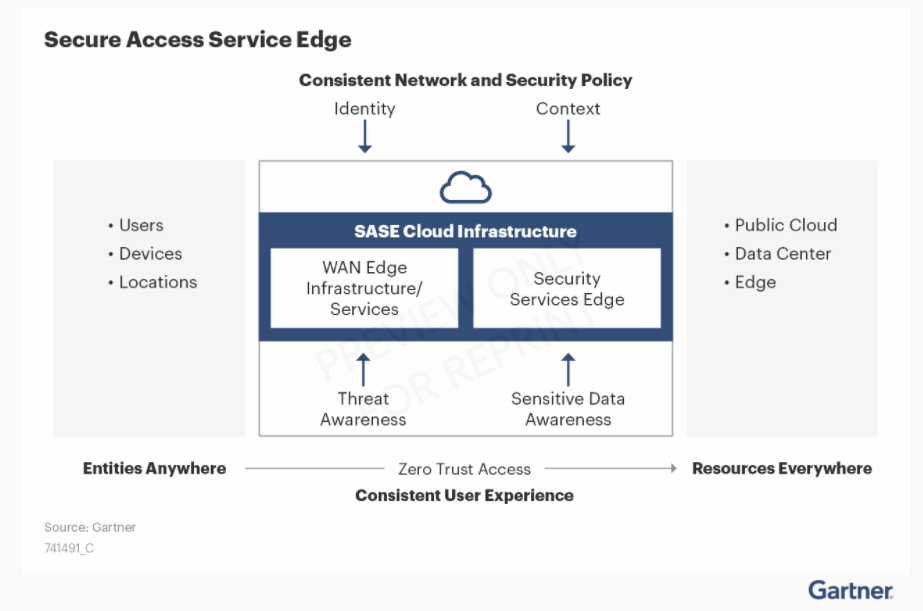
The term SASE refers to a framework for converging the best elements of software-defined networking and SD-WAN with modernized edge security. The end result is a transformed network architecture that is dynamic, flexible, and secure, and can provide the performance needed for today’s 24x7 applications and resources hosted across public, private, and hybrid clouds.

Leading SD-WAN vendors like Cisco, Fortinet, and Versa have all introduced SASE solutions to their suite of products, with a strong focus on simplifying edge modernization and transforming the network to meet the demands of the cloud era head on. And the uptake has been meteoric, with SASE already penetrating up to 20% of its market.

How does SASE work?

Depending on the use case, there can be a lot of elements to a SASE solution, and what is included in the solution can vary greatly between different providers. But as a general rule, every SASE architecture will provide elements of these five main components:

  1. SD-WAN: This software-defined approach to wide area networking forms the foundation of SASE. If you want to take a deeper dive into how SD-WAN works, we covered it in great detail here.
  2. Cloud Access Security Broker (CASB): according to Gartner, CASBs are on-premises or cloud-based security policy enforcement points, placed between cloud service consumers and cloud service providers to combine and interject enterprise security policies as the cloud-based resources are accessed.
  3. Zero Trust Network Access (ZTNA): according to Gartner, ZTNA is a product or service that creates an identity- and context-based, logical access boundary around an application or set of applications. The applications provide topology to avoid discovery, and access is restricted via a trust broker to a set of named entities.
  4. Firewall as a Service (FWaaS): Cloud-delivered firewalls digitally protect your architecture from cyberattacks at multiple points with several filtering and threat prevention measures.
  5. Secure Web Gateway (SWG): These gateways filter and prevent data breaches across the network by applying further web filtering and access control measures.

You can essentially split SASE setups into two main categories:
  1. Self-hosted/Self-managed: This SASE setup is architected and maintained by the end user, which will usually consist of SD-WAN from a provider along with built-in security functions.
  2. Provider managed: A provider platform—examples in this category include zScaler, Palo Alto Prisma, or Netskope—contains the SASE architecture in the cloud, and the customer is then simply responsible for maintaining the connection to the platform.

Gartner Secure Access Service Edge (SASE) Cloud Infrastructure Diagram

Source: Gartner, “2021 Strategic Roadmap for SASE Convergence”, Neil MacDonald, Nat Smith, Lawrence Orans, Joe Skorupa, 25 March 2021

What are the benefits of SASE?

Improved security

Possibly the biggest benefit of a SASE architecture is the security improvements it provides. SASE’s Zero Trust security model requires identity verification for any user, securing their data both in migration and at their endpoints. Plus, FWaaS and SWG features help protect user architectures from being invaded by cyberattackers on multiple levels.

Additional to these intrinsic features, SASE gives users the ability to customize their architecture with other security properties like web application and API protection, and inline encryption/decryption, to name a few.

Is your cloud data secure? Here are three questions you can ask to find out.

Simplified cloud architecture

SASE’s consistent policy enforcement and unified software stack makes network management easier than ever, with no sacrifice to the depth of features it provides. Teams will benefit from full visibility and control over their network via a single pane of glass, as well as a predictable user experience from any location worldwide.

Reduced costs

By replacing multiple appliances and on-prem infrastructure with a single stack of software, capex, opex, transport, and asset costs can all be reduced significantly. Plus, making network changes and upgrades is more affordable with an integrated SASE architecture than it is with a sprawled network of separate elements.

Better performance

SASE’s centralized network management and consistent policy application makes it easy to accommodate fluctuations in traffic for a reliable user experience. SASE also makes it easy for users to scale their network in line with their digital growth and technology upgrades, future-proofing their setup and sustaining this optimized performance over time.

Learn why internet peering could be the key to unlocking a high-performance network.

Megaport and SASE

Megaport offers Network as a Service solutions that can help accelerate SASE objectives and remove obstacles to deployment. For example, solutions like Megaport Virtual Edge (MVE) seamlessly integrate with leading SD-WAN architectures, complementing the software-defined overlays with an equally modernized, simplified and powerful underlay – delivering a truly end-to-end transformation of the network for the SASE era.

If you’re already set up with Megaport Virtual Cross Connects (VXCs) near one of our Megaport enabled locations, a self-hosted connection using Megaport will optimize your SASE architecture and enable you to benefit from the best possible security, speed, and performance.

Learn more about MVE here.

Talk to Megaport about how we can optimize your SASE architecture

Megaport can help you optimize your SASE architecture by deploying a purpose-built private network backbone, improving data security and network performance. Reach out to your account representative to learn more.

In our next SASE blog post, we’ll look at how you can use MVE as part of your SD-WAN to optimize your SASE architecture, and provide some use cases for how you can orchestrate your SASE architecture to improve security, reduce costs, and boost performance for your enterprise.

[1] Source to be given

[2] Gartner IT Glossary, “ZTNA,” 27 September 2021  (https://www.gartner.com/en/information-technology/glossary/zero-trust-network-access-ztna)

[3] Gartner IT Glossary, “CASB” 27 September 2021 (https://www.gartner.com/en/information-technology/glossary/cloud-access-security-brokers-casbs )

GARTNER is a registered trademark and service mark of Gartner, Inc. and/or its affiliates in the U.S. and internationally and is used herein with permission