




惯性聚合 高效追踪和阅读你感兴趣的博客、新闻、科技资讯
阅读原文 在惯性聚合中打开

推荐订阅源

F
Full Disclosure
Recorded Future
Recorded Future
T
Tenable Blog
S
Securelist
C
CERT Recently Published Vulnerability Notes
T
Threatpost
S
Schneier on Security
A
Arctic Wolf
The Hacker News
The Hacker News
C
CXSECURITY Database RSS Feed - CXSecurity.com
Know Your Adversary
Know Your Adversary
P
Privacy International News Feed
Threat Intelligence Blog | Flashpoint
The Register - Security
Cisco Talos Blog
Cisco Talos Blog
AWS News Blog
AWS News Blog
K
Kaspersky official blog
T
True Tiger Recordings
T
Threat Research - Cisco Blogs
V
Vulnerabilities – Threatpost
P
Palo Alto Networks Blog
T
The Exploit Database - CXSecurity.com
小众软件
小众软件
B
Blog
Cyber Security Advisories - MS-ISAC
Microsoft Azure Blog
Cyberwarzone
Cyberwarzone
C
Cybersecurity and Infrastructure Security Agency CISA
T
Tor Project blog
Spread Privacy
Spread Privacy
Malwarebytes
Malwarebytes
P
Proofpoint News Feed
F
Fox-IT International blog
F
Fortinet All Blogs
P
Privacy & Cybersecurity Law Blog
G
GRAHAM CLULEY
量子位
Latest news
Latest news
OSCHINA 社区最新新闻
OSCHINA 社区最新新闻
博客园 - 叶小钗
Project Zero
Project Zero
T
Tailwind CSS Blog
N
Netflix TechBlog - Medium
Martin Fowler
Martin Fowler
IntelliJ IDEA : IntelliJ IDEA – the Leading IDE for Professional Development in Java and Kotlin | The JetBrains Blog
I
Intezer
博客园_首页
腾讯CDC
H
Hackread – Cybersecurity News, Data Breaches, AI and More
D
Darknet – Hacking Tools, Hacker News & Cyber Security

Megaport Blog

Early Warning Signs Your Network Needs a Refresh Introducing Megaport DDoS Protection A Guide to 400G Connectivity A Guide to NAT Gateway A Guide to Cloud Storage How the Data Center Is Evolving in 2026 What to Expect When Attending Your First Network Operator Group (NOG) Nine Ways to Connect to Cloud Using Private Connectivity Migrate Your On-premises to the Cloud: A Step-by-Step Guide How to Lower Your Egress Fees in 2026 How to Achieve Data Sovereignty in Europe Redefining the Edge with Cisco and Megaport How to Reduce Latency in Your Multicloud Environment Introducing Megaport High-Speed Cross-Cloud Encryption Are Businesses Leaving the Cloud? Using Meraki and Megaport Virtual Edge for Multicloud Networking Equinix Metal® is Going Away: Here’s What You Can Do Introducing Megaport On-ramp as a Service Megaport’s Full Solution Portfolio Is Coming to India New Bare-metal GPU Instance Now Available with NVIDIA RTX Pro 6000 A Look Back at 2025: Megaport's Biggest Updates Megaport Expands Into India With Extreme IX Your 2026 Predictions From AWS re:Invent 2025 Top NaaS Trends for 2026 What is IPsec? When to Move From Public Internet to Private Connectivity Megaport and Latitude.sh: Bringing Compute and Connectivity Together Improve Your Microsoft ExpressRoute Resilience with Megaport Comparing Ways to Connect to AWS What is API-First Networking? The Hidden Cost of Running Cloud-Hosted SD-WAN for IaaS Overcoming NaaS Integration Challenges Introducing SCION with Anapaya and Megaport How to Use Network as a Service to Future-Proof Your Network Introducing 400G Ports All the As-a-services, Compared Introducing Megaport IPsec Tunnels High Score: Megaport Hits 1,000 Locations A Guide to Colocation Data Centers Maximizing Peering Through Flow Analysis Build Resilient Networks for AI Production Workloads Introducing Packet Filtering on Megaport Cloud Router Building Resilient Government IT: Strategies for Secure, Compliant, and Scalable Connectivity Future-Proofing Government IT Telstra Programmable Network Is Being Discontinued. Here’s How to Migrate The Future of WAN Design Depends on Network as a Service (NaaS) Cisco Webex Edge Connect Launches on Megaport Voice and Video Exchange How to Prepare for APRA CPS 230 Comparing the SD-WAN Licensing Needs of Major Vendors A Guide to Improving Network Performance How Latitude.sh, Wasabi, and Megaport Unlock Cost-Effective Multicloud Four Ways to Connect Your Clouds SD-WAN and MPLS: Weighing the Similarities, Differences, and Benefits A Guide to Network as a Service (NaaS) How to Arrange Bilateral Peering Sessions Comparing Major SD-WAN Vendors Software Defined Networking in Healthcare Deploying A Global Network in Minutes With Megaport AWS Direct Connect Gateway (DGW) Data Transfer Outbound Rules Bilateral and Multilateral Peering: What’s the Difference? Multi-Region SD-WAN: Why Megaport SDCI is the Right Choice Microsoft Azure is Going Secure by Default. Are You Ready? How Megaport and Vultr Are Solving the Enterprise AI Challenge Introducing Megaport NAT Gateway A Guide to AWS Security Tools How to Deploy Amazon Bedrock Using AWS Direct Connect and Megaport Azure Private Link, Explained Introducing 100G MCRs Simplifying Hybrid and Multicloud Network Connectivity A Look Back at 2024: Megaport’s Biggest Updates Your 2025 Predictions From AWS re:Invent 2024 Six Ways to Get a More Resilient Network in 2025 Multicloud Security: Challenges and Solutions The Real Cost of High Network Latency Why Brazil is Your Key to Unlocking Business Growth in Latin America Why You Need Integrated Network Security Six Key Differences Between Major Cloud Providers How to Automate Your Megaport Infrastructure With APIs Why Italy is Europe’s Next Cloud Expansion Hotspot How to Lower Your Cloud Costs Peering: How Local Is Local? Introducing Megaport AI Exchange Two Scenarios for Hybrid Multicloud Deployment With IBM Cloud and Microsoft Azure How to Connect Equinix and Digital Realty Megaport Enables Microsoft Azure ExpressRoute Metro for More Resilient Network Connectivity Executives, Here’s What Your Network Team Wants You to Know Easy Ways to Interconnect Your Network The Role of the Data Center in Your Network 100G VXC Expansion: Now Available From 597 Data Centers Worldwide Top 10 How-To Guides To Improve Your Network Comparing Encryption in Transit Options Comparing Generative AI Offerings From Major Cloud Providers A Sustainable Business Strategy Starts With Your Network Solutions to Common API Issues With Megaport Transforming Financial Connectivity: Introducing Megaport Financial Services Exchange (FSX) Megaport Enhancing Connectivity in Adelaide Megaport’s Latest Portal Features and Functionalities Automate Your Network Deployments With The New Megaport Terraform Provider A Recap of the Megaport World Tour 2024 Top 5 Cloud and Networking Announcements From Cisco Live 2024
How to Fix Poor AWS Latency
2025-01-08 · via Megaport Blog

By David Sloan, Solutions Architect

Find out how to reduce your latency and get better network performance from the leading cloud service provider.

In the modern business world, AWS is everywhere. According to HG Insights, the leading hyperscaler has over 50% market share, with 2.38 million businesses worldwide using AWS cloud services in 2024.

One of the top questions we hear AWS users ask is how they can make their AWS connection faster. This is hardly surprising; with an increasing need for businesses to support distributed workforces and incorporate AI, high-performing cloud networks are becoming more difficult to achieve. Thankfully for AWS users, there are a number of tools you can use to improve your AWS network.

With a redundant network comprising a huge number of connectivity points, architecting your AWS connections for super-low latency isn’t only possible, it’s encouraged. Here’s our guide to fixing poor AWS network latency, including a list of AWS tools and features to help you achieve your fastest network yet.

Want to reduce your AWS costs too? Check out our handy guide.

Why is my AWS connection slow?

When data moves from point A to point B, the journey it takes is complex. Point A has to make a request; point B has to respond. Encryption tools, firewalls, and any number of other security tools may be at play to protect the data on its travels. And different network paths and routers have to carry the data packets to their destination.

This means there could be a number of factors impacting your AWS network performance:

  • Connectivity method: Using public or static connections will result in different performance to private, elastic connections (we cover this in more detail below). Interconnecting your network will also support low latency – for example, utilizing direct cloud-to-cloud connections for your multicloud workloads.
  • Geographical distance: The further your servers are from your endpoints, the longer data will take to get there. This is where edge networking can be valuable.
  • Data volume: If you’re sharing bandwidth with others via a public connectivity method, or if you’re on a fixed bandwidth that doesn’t account for demand peaks, your network performance will suffer.
  • Server performance: If your application servers are slow to respond, you’ll experience slower network speeds.
  • Hops: Every time a data packet switches from one midpoint to the next, it’s “hopping”; the more hops your data has to take, the slower your network tends to become.

If you want to learn more about how latency is measured, AWS goes into more detail in this blog.

If you’ve already audited these factors and want to further optimize your network performance, AWS also has some great tools that can streamline your traffic and supercharge your network speeds.

How do I make my AWS connection faster?

AWS services that reduce network latency

AWS Global Accelerator

With Global Accelerator, AWS promises up to a massive 60 percent improvement in the performance of your network traffic and applications. Thanks to its ability to offer such consistent throughput, this tool is especially useful if your business offers applications in gaming, media, mobile, or finance.

AWS Global Accelerator works by provisioning global static public IPs, which provide you with constantly available entry points. You can then add or remove any other AWS application endpoints, from Application Load Balancers to EC2 instances, on the back end of these IPs.

With this setup, AWS Global Accelerator can route your traffic to your closest AWS edge location, then route it to your closest regional endpoint using the AWS global network.

Improving your AWS network availability and opening up your routing options is how Global Accelerator delivers latency, throughput, and jitter reductions of up to 60 percent. However, it’s worth noting that this reduction is in the context of the connections Global Accelerator serves, which are usually public and internet-based.

If you go one step further and use private connectivity, you’ll unlock plenty of other possibilities for improving your AWS connection speed.
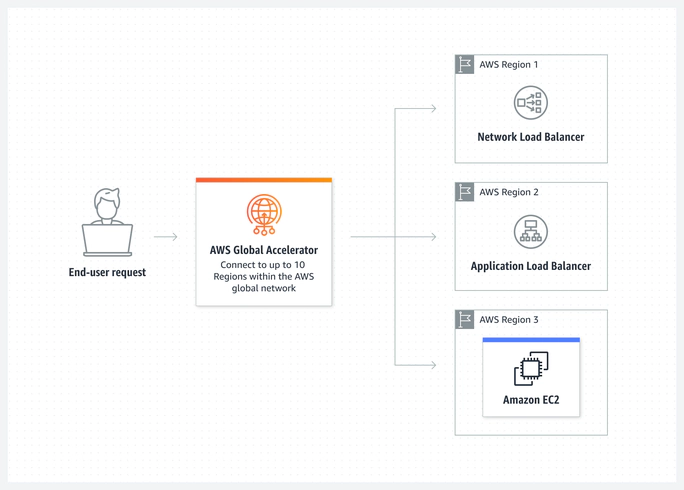
AWS Global Accelerator

Source: AWS

AWS Direct Connect

AWS Direct Connect offers an alternative to using the public internet to connect to AWS, instead providing a private network connection between your on-prem networks and any AWS service you need to access.

Along with reduced costs and better security, Direct Connect improves the reliability of your AWS connections for consistently low latency, with the availability of dedicated connections up to 400 Gbps.

There are two types of Direct Connect connections:

  • Dedicated connection: provisioned by and associated with a single customer through the AWS Direct Connect console, CLI, or API.
  • Hosted connection: provisioned on behalf of a customer by an AWS Direct Connect Partner on request.

To get started with Direct Connect, you’ll need to connect via a location (often referred to as an on-ramp), which is the secure midpoint between you and your AWS services. AWS recommends you use more than one location for better availability.

Learn more about connecting to AWS using Direct Connect locations.
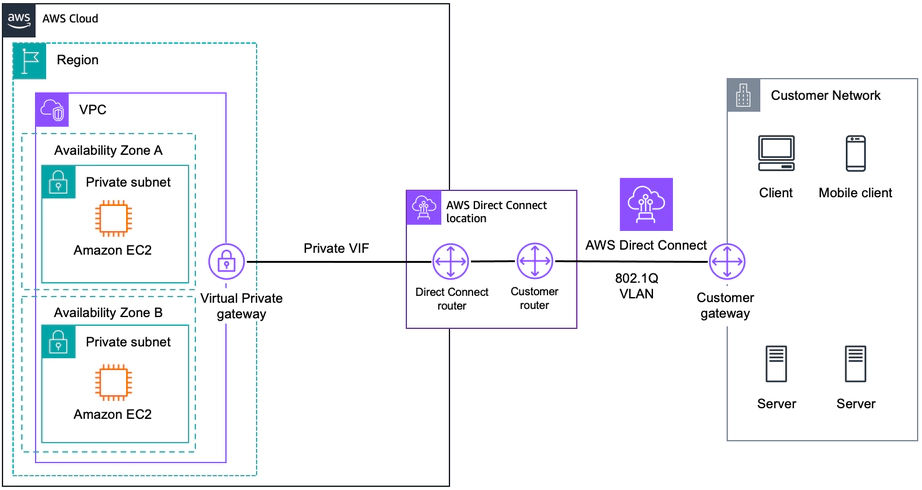
AWS Direct Connect
AWS Direct Connect

Source: AWS

Amazon CloudFront

Is website or content delivery a core component of your business operations? Amazon CloudFront is a low-latency Content Delivery Network that reduces website and application delivery time, including for dynamic, static, streaming, and interactive content.

Amazon CloudFront uses cache control headers to discern static and dynamic content and cache this content close to your end users, leveraging over 600 global Points of Presence (PoPs) for super-fast data delivery. Over 600 embedded PoPs are also available, which are deployed in the last mile of ISP networks to enable highly scaled capacity in peak traffic events.

Helping you optimize performance across an entire website or application, Amazon CloudFront also easily integrates with other AWS services and offers a pay-as-you-go setup to simplify adoption.

To get started using Amazon CloudFront, you’ll want to store the definitive versions of your files in “origin” servers, like an Amazon S3 bucket or Amazon EC2 instance, then register your origin servers with Amazon CloudFront using their API to receive a CloudFront.net domain name you can use for distributing your content from your servers.
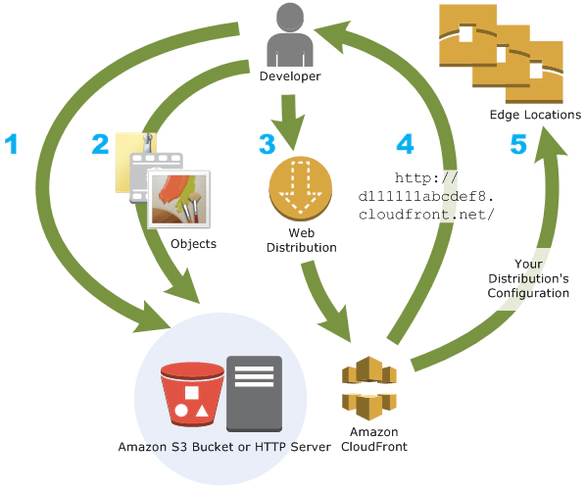
Amazon CloudFront
Amazon CloudFront

Source: AWS

AWS Local Zones

Local Zones, in the words of AWS, “are a type of infrastructure deployment that places compute, storage, database, and other select AWS services close to a large population and industry centers. You can deliver innovative applications requiring low latency closer to end users and on-premises installations.”

Essentially, a Local Zone extends an AWS region to your end users and workloads for faster AWS connectivity. Local Zones also support AWS Direct Connect. Using a Local Zone removes the need for you to host new AWS-managed equipment, including via AWS Outposts, for your ultra-low-latency applications.

To use a Local Zone, you’ll need to enable it via the Amazon EC2 console or a command line interface. Then, create a subnet in the Local Zone to launch resources in the Local Zone subnet.
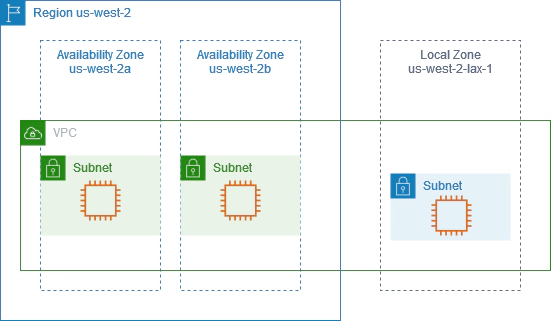
AWS Local Zones
AWS Local Zones

Source: AWS

Use a private, elastic connectivity method

With the right connectivity method, these AWS tools will have a far greater impact on your network latency.

Using the public internet leaves your network at the mercy of traffic fluctuations which can severely impact speed and performance. Meanwhile, traditional telco providers can be a problematic alternative, forcing customers to lock into contracts where bandwidth can’t be scaled up to support peak demand periods. The result is slow, unreliable network performance regardless of which cloud provider tools you use.

Using a flexible private connectivity method like Network as a Service (NaaS) bypasses the public internet, switching you to a private network path you can deploy on-demand on the provider’s network.

Most providers offer features that won’t just improve your AWS latency, but will transform your entire network. For example, when you provision connectivity with Megaport, you’ll benefit from:

  • Better performance: Avoid bottlenecks and downtime caused by internet traffic fluctuations. With your own connection to AWS on our private underlay, your connectivity will be fast and consistent.
  • Scalable bandwidth: Provision connections and turn up bandwidth (in some instances, up to 100 GB on-net and up to 25G for partner AWS direct connects) on-demand via the Megaport portal to deliver the performance you need in peak periods, then turn it down when no longer needed to start saving instantly.
  • “Always on” redundancy: With over 900 locations worldwide and a service uptime aim of 100 percent, you’re protected from downtime on our redundant architecture.
  • Point, click, connect: Manage all of your connections in one simple portal and spin up new connections in just a few clicks.
  • Cross-cloud: Spin up virtual routers across 280+ on-ramps to route traffic directly between multiple clouds.
  • NFV solutions: Deploy virtual PoP solutions to bring your software-defined network to the edge in minutes.
  • Data center interconnection: Create a Layer 2 connection between any two data centers on our extensive global network with a scalable connection of up to 100G.
  • Egress charges: Egress charges on Megaport on-ramps are significantly lower per Gbps.
  • Dedicated internet: Consolidate your different network functions in-house and bypass third-party vendors with your own dedicated, highly redundant link to the internet.

Find out more about how NaaS works with our exclusive webinar.

Conclusion

Use one, or use them all; with AWS, you can leverage any combination of these tools to reduce your network latency. When underpinned by elastic private connectivity, you’ll benefit from a faster network from end to end for a more productive business – and a more profitable bottom line.