








By Aurelian Bonciog, Solutions Architect, DACH
Managing SD-WAN at scale? Multi-region setups streamline operations, cut down tunnel overload, and improve network efficiency with a structured backbone.
In centralized SD-WAN solutions, managing traffic flows quickly becomes a challenge. Every change to centralized policies not only takes time but also carries the risk of errors that can impact the entire network – definitely not something to tackle on a Friday afternoon!
The main issue lies in the increasing complexity of centralized policies. As infrastructure scales, these policies can easily reach tens of thousands of lines. This complicates traffic engineering, makes control harder to manage, and significantly reduces efficiency. Without flexible and dynamic control capabilities, both performance and network management fall short of their potential.
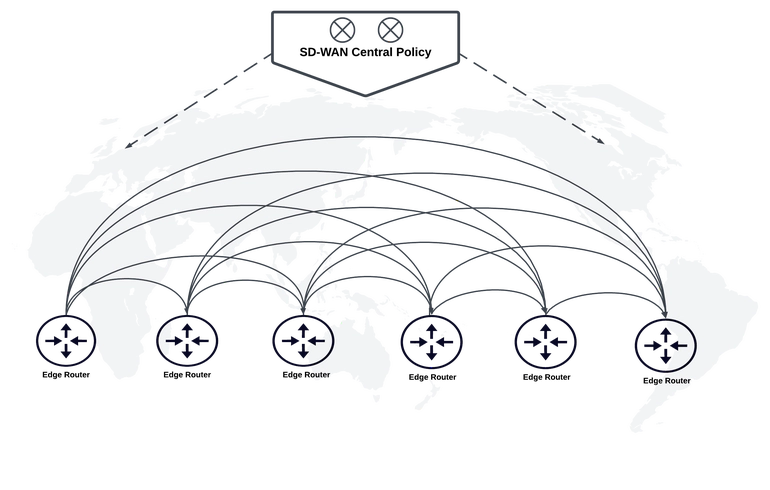
Another major challenge in many leading SD-WAN solutions is the full-mesh design. In this setup, each router automatically establishes IPsec tunnels with every other router in the network. The number of tunnels grows exponentially:
Formula: Number of Tunnels = (n ∗ (n - 1)) / 2
For example:
Imagine you have 100 locations, each with 2 routers, for a total of 200 routers. The total number of tunnels would be:
(200 ∗ 199) / 2 = 19,900 tunnels
This means every router must maintain 199 tunnels simultaneously. In networks with hundreds or thousands of locations, this quickly becomes a massive challenge – not just for hardware but also for traffic engineering. The sheer number of tunnels makes it increasingly difficult to monitor and control traffic flows. Prioritizing or rerouting traffic becomes more complex, often leading to inefficient routing, increased latency, and suboptimal performance.
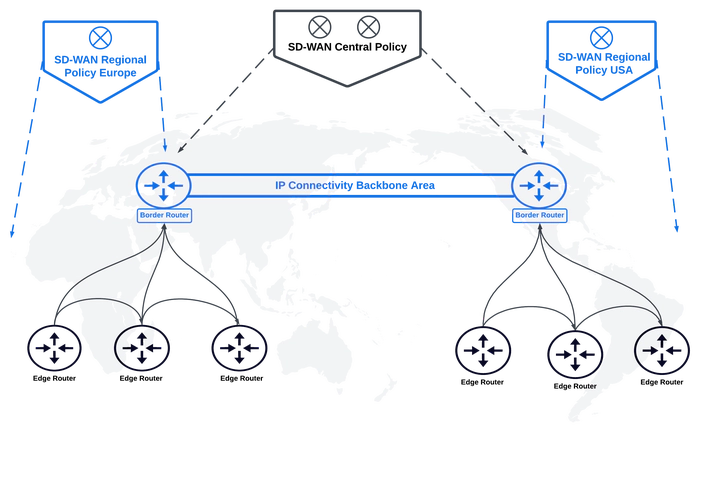
To address these challenges, SD-WAN providers introduced multi-region setups starting in 2020. Based on the principle of “divide and conquer,” centralized policies are broken down, and border routers are introduced to create a backbone area:
● Regional segmentation: The network is divided into logical regions. Regional policies manage each area individually, making operations far more manageable.
● Tunnel reduction: Instead of a global full-mesh design, routers connect only to regional border routers, drastically reducing the number of tunnels and easing the burden on hardware.
● Efficient backbone area: Each region is connected through a central backbone area, which efficiently manages traffic between regions.
The backbone facilitates communication between regions and can be implemented via MPLS, cloud providers, or SDCI solutions from NaaS providers like Megaport. This clear separation between the backbone and regional policies allows localized adjustments without impacting the global network. At the same time, the strain on resources like CPU and bandwidth is significantly reduced.
To implement a backbone area for multi-region SD-WAN setups, there are three commonly used approaches, each with their own benefits and challenges. The choice of approach depends on factors such as cost, scalability, flexibility, and specific business requirements. Let’s take a closer look:
This traditional approach uses physical border routers to connect regions via private circuits, such as MPLS. ISPs provide a dedicated and reliable backbone infrastructure, offering a high level of stability and predictable performance.
● High reliability and security: MPLS connections are private and isolated from public networks, ensuring consistent performance and strong protection against external threats.
● Guaranteed QoS (Quality of Service): ISPs offer Service Level Agreements (SLAs) that ensure bandwidth availability and low latency for critical applications.
● High costs: MPLS circuits are expensive, especially for global networks with extensive reach. The cost can quickly escalate as more bandwidth or additional circuits are needed.
● Limited flexibility: Expanding or modifying the backbone requires significant planning and lead time, making it less suitable for dynamic or fast-growing environments.
This option is ideal for organizations prioritizing stability and security, but may not be the best fit for businesses seeking flexibility or cost-efficiency.
A modern alternative involves using cloud providers like AWS, Microsoft Azure, or Google Cloud as the backbone. These providers offer global infrastructure that enables businesses to interconnect regions with a high degree of flexibility and scalability.
● Scalability: Resources can be rapidly provisioned or scaled up/down based on business needs, making it an excellent option for dynamic workloads.
● Global reach: Cloud providers operate data centers worldwide, providing extensive coverage and easy access to regional locations.
● Flexibility: Adding new locations or regions is relatively straightforward, and services like AWS Transit Gateway simplify cross-region connectivity.
● Latency and visibility: Depending on the geographic distribution and routing paths, latency can vary, and monitoring traffic across the cloud backbone may be less transparent compared to dedicated circuits.
● Dependence on cloud infrastructure: Businesses are reliant on the availability and performance of the chosen cloud provider. Any outages or disruptions can directly impact the backbone.
● Inter-region traffic costs: Transferring data between regions within the same cloud provider can become expensive, particularly in high-volume scenarios.
● Security concerns: While cloud providers offer robust security options, additional measures may be required to ensure sensitive data remains protected as it travels across public cloud environments.
This approach works well for organizations looking for flexibility and rapid scalability but may introduce challenges related to cost and security for complex, high-volume environments.
Using Software-Defined Cloud Interconnect (SDCI) solutions like Megaport provides the most flexible and dynamic approach for building a backbone. Megaport enables businesses to establish private, low-latency connections between regions, cloud providers, and on-premises locations.
● Low latency and high performance: Megaport’s dedicated interconnects provide direct and optimized routes, minimizing latency and ensuring efficient data transfer.
● Cost efficiency: Unlike MPLS, Megaport operates on a pay-as-you-go model, allowing businesses to pay only for the bandwidth they actually use.
● Multicloud integration: With Megaport, connecting to multiple cloud providers or regions can be done in minutes through an intuitive portal, enabling seamless multicloud strategies.
● Dynamic scalability: Using tools like Terraform, bandwidth and services can be adjusted dynamically to meet changing demands.
● Centralized security services: Features like Firewall Service Chaining simplify the deployment of security solutions across the backbone.
● Integration with physical data centers: Megaport allows easy extension of SD-WAN domains to physical data centers or Internet Exchanges.
● Hardware independence: Unlike cloud provider solutions, Megaport operates independently of cloud provider infrastructure, offering greater flexibility and reducing vendor lock-in risks.
● Reliance on SDCI providers: While highly flexible, businesses depend on the SDCI provider’s infrastructure and service availability.
● Network architecture adjustments: Implementing an SDCI-based backbone may require reconfiguring certain aspects of the existing network to align with the provider’s framework.
● Customized security: As traffic traverses third-party interconnects, security policies and measures must be adapted to maintain data integrity and compliance.
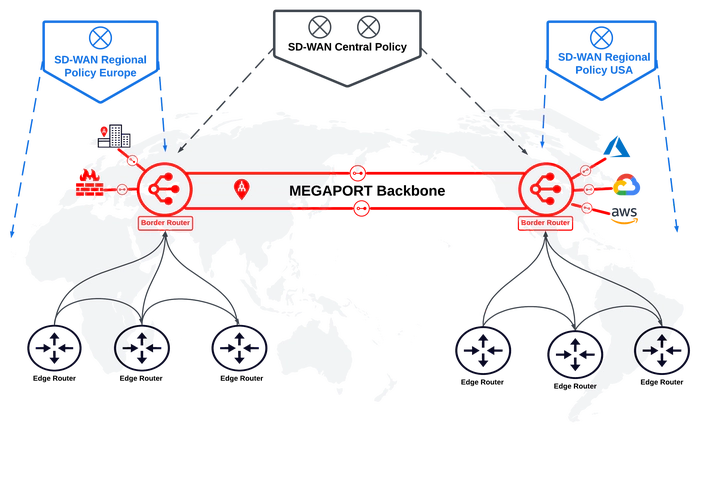
This approach is particularly well-suited for organizations prioritizing agility, cost-effectiveness, and multicloud integration, while still maintaining robust network performance and scalability.
Each of these approaches offers unique benefits and trade-offs. For businesses seeking stability and predictable performance, backbone via ISP remains a trusted choice. For organizations that need flexibility and global reach, backbone via cloud provider is an attractive option, albeit with potential cost and latency challenges. However, for those aiming to balance cost, scalability, and advanced functionality like multicloud integration, backbone via Megaport SDCI emerges as the most compelling and future-proof solution.
By understanding your specific network requirements, growth plans, and operational priorities, you can select the backbone strategy that best aligns with your business goals.
此内容由惯性聚合(RSS阅读器)自动聚合整理,仅供阅读参考。 原文来自 — 版权归原作者所有。