







Data egress fees add up quickly, but you can avoid those fees with a low-cost private network connection from Megaport.
Nobody likes bill shock, whether you are a parent getting the news that your child rented Frozen 17 times, or a CIO who promised her CEO that the cloud would reduce technology OPEX.
We can’t help you change your children’s movie-watching habits, but we do know networking and cloud costs. Egress charges (the cost for data leaving your cloud provider) will typically make up a large chunk of your cloud expenses. On average, data egress is charged at 10 cents per gigabyte. Moving 25 terabytes out of the cloud to your on-prem or another cloud provider could cost $2,500 in egress fees through a public internet (even via a VPN).
Cloud providers will discount egress costs if enterprises connect directly over a private layer 2 link rather than the public internet or VPN. Microsoft Azure ExpressRoute is one such provider. They even have an optional Unlimited Data plan, which, although expensive compared to the metered access, can make sense for certain organisations or projects.
| ExpressRoute Type | Standard Metered | Standard Unlimited |
|---|---|---|
| 1 Gbps | $436 pm | $5,700 pm |
| Egress data included | Zero | Unlimited |
This is where Megaport can help. With our expansive Software Defined Network and access to more cloud on-ramps than anyone else (197 as of August 2020), a customer can access the Azure Local SKU from any of our 700-plus Megaport-enabled locations. An Azure Local VXC (Virtual Cross Connect) can be provisioned on-demand through the Megaport self-serve portal with completely flexible terms and zero setup fees.
Below is a list of the ExpressRoute Local enabled on-ramps accessible via the Megaport fabric.
| Azure Metro | Megaport Location | Local SKU — Azure region |
|---|---|---|
| Amsterdam | Equinix AM5 | West Europe |
| Berlin | NTT GDC | Germany North |
| Chicago | Equinix CH1 | North Central US |
| Denver | CoreSite DE1 | West Central US |
| Dubai2 | du datamena | UAE North |
| Dublin | Equinix DB3 | North Europe |
| Frankfurt | Interxion FRA11 | Germany West Central |
| Geneva | Equinix GV2 | Switzerland West |
| Hong Kong | Equinix HK1 | East Asia |
| London | Equinix LD5 | UK South |
| London2 | Telehouse North Two | UK South |
| Melbourne | NextDC M1 | Australia Southeast |
| Osaka | Equinix OS1 | Japan West |
| Oslo | DigiPlex Ulven | Norway East |
| Paris | Interxion PAR5 | France Central |
| Quebec City | Vantage | Canada East |
| San Antonio | CyrusOne SA1 | South Central US |
| Seattle | Equinix SE2 | West US 2 |
| Silicon Valley | Equinix SV1 | West US |
| Singapore | Equinix SG1 | Southeast Asia |
| Singapore2 | Global Switch Tai Seng | Southeast Asia |
| Stavanger | Green Mountain DC1 | Norway West |
| Sydney | Equinix SY2 | Australia East |
| Sydney2 | NextDC S1 | Australia East |
| Tokyo | Equinix TY4 | Japan East |
| Toronto | Cologix TOR1 | Canada Central |
| Washington DC | Equinix DC2 | East US, East US 2 |
| Washington DC2 | Coresite Reston | East US, East US 2 |
| Zurich | Interxion ZUR2 | Switzerland North |
One of Megaport’s Denver customers recently faced a challenge. The local Azure on-ramp in Denver allowed only unlimited data from the Azure West Central region, but the customer needed to pull data regularly from the South Central region. The volume of data egressing required a 10 Gbps connection, so an Azure Standard Unlimited connection (which allows unlimited egress from any Azure region in the US) would have cost them an eye-watering $51,300 per month according to Microsoft’s pricing table.
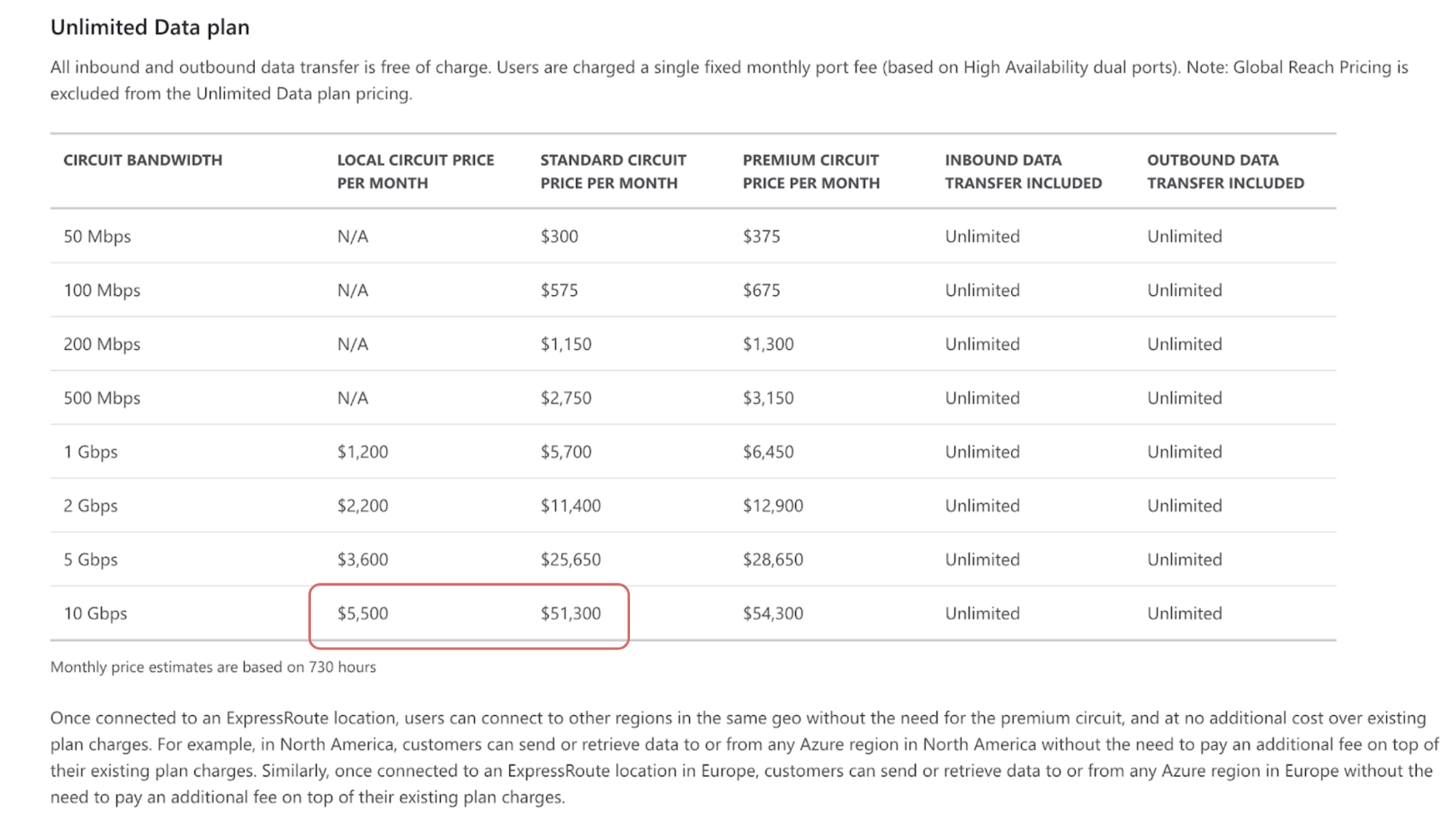
Azure Unlimited Data plan pricing 2020
Working with the Megaport team, the customer achieved a more cost effective solution. Via a Megaport 10 Gbps VXC from their co-lo in Denver to San Antonio ($1,900 per month), the customer was able to connect into the South Central Azure on-ramp with a Local SKU ($5,500 per month). This equates to a monthly saving of $43,000 — an 86% reduction based on the original option.
That’s equivalent to the cost of a lot of children’s movie rentals.
To learn more about how Megaport can help both reduce and provide predictable Microsoft Azure transport costs, please visit The Easiest Way to Connect to Microsoft Azure.
此内容由惯性聚合(RSS阅读器)自动聚合整理,仅供阅读参考。 原文来自 — 版权归原作者所有。