







By Chris Cabel, Senior Director, Global Cloud Solutions
Megaport and AWS explore how Network as a Service (NaaS) transforms WAN design with cloud-native agility, on-demand provisioning, and GenAI-ready flexibility.
Co-authored by:
Rishi Katdare, Leader – AWS Core Networking & GTM, AWS
Mokshith Kumar, Sr. GTM Specialist Solutions Architect – AWS Core Networking, AWS
As enterprise architectures grow more distributed and cloud-native, traditional methods of building and managing Wide Area Networks (WANs) are reaching their limits.
Businesses now need to establish and scale regional and global connectivity at a pace that matches their application deployments. They also need the flexibility to adapt quickly, without being locked into rigid, long-term telco contracts.
This has fueled the rise of “network cloudification”, a model that draws from the principles of cloud computing and applies them to the networking layer. At the heart of this trend is Network as a Service (NaaS), which introduces a programmable, on-demand approach to wide-area connectivity.
And NaaS has already earned its place as the foundation for modern networks. According to Wipro, a typical successful NaaS implementation results in:
In this post, we’ll explore what this means in practice for network engineers, and how NaaS changes the way we think about WAN design and cloud access.
The evolution of modern WAN architectures continues to drive demand for modern networking solutions like NaaS, which is becoming more popular than ever.
Gartner predicts that by 2028, 15% of enterprises will adopt on-premises NaaS, a significant increase from less than 2% in 2023. This reflects a growing shift toward subscription-based networking models.
A survey by Nokia and Pulse also found that 47% of enterprise technology leaders plan to adopt NaaS, with 10% having already implemented such services. Only 14% had no plans to adopt NaaS, indicating a strong interest in the model.
Looking long-term, ABI Research forecasts that by 2030, over 90% of enterprises will consume at least 25% of their network services via NaaS, speaking to its increasingly central role in enterprise networking strategies.
In traditional WAN models, provisioning connectivity often involves long lead times, static routing configurations, manual changes, and high penalties for bandwidth reconfiguration. This model made sense when network topologies were relatively fixed and predictable.
But with today’s hybrid and multicloud architectures, application traffic patterns are far more dynamic. New VPCs, regions, or providers may be introduced within days, and the network must follow suit.
Traditional WANs also struggle to handle the unpredictable network demands of GenAI workloads, which require high bandwidth for model training and low latency for inference.
This is where programmable networking becomes essential. Modern NaaS platforms expose APIs and self-service portals that allow engineers to spin up or tear down connections on demand, dynamically route traffic, modify bandwidth in near real-time, and integrate connectivity into IaC workflows.
This model aligns with how infrastructure is managed elsewhere in the stack: as code, rather than through ticket-based operational processes.
Network cloudification refers to the process of decoupling networking from legacy hardware and telco dependencies, and instead delivering connectivity using cloud-native principles. Just as compute and storage moved into abstracted, scalable, usage-based services, networking is undergoing the same transformation.
This shift has several implications for WAN architecture. With NaaS, organizations can establish Points of Presence (PoPs) closer to users and branch offices, reducing latency. Many NaaS providers offer a global backbone that acts as an overlay network, allowing enterprises to bypass the public internet for better performance and reliability.
Instead of managing separate tunnels into each cloud, NaaS simplifies multicloud routing with unified policy management. A key driver for this is avoiding vendor lock-in, as NaaS offers usage-based billing and the flexibility to scale services as needed, unlike the rigid multi-year contracts of traditional providers.
For network engineers, the network cloudification model unlocks practical improvements in day-to-day operations. This includes quickly provisioning temporary WAN paths for dev/test environments, automatically rerouting traffic for disaster recovery, and integrating new sites in hours instead of weeks.
It also allows for creating microsegmented paths for enhanced security and intelligently managing traffic for GenAI workloads with dynamic bandwidth allocation.
These architectural benefits become even more powerful when a NaaS platform is deeply integrated with a leading cloud provider. The partnership between Megaport and AWS is a perfect example of this, transforming how businesses connect to the cloud.
By treating Megaport’s private Software Defined Network (SDN) as a direct extension of the AWS backbone, enterprises can build secure, high-performance connections from their data centers, branch offices, and remote locations straight into the AWS ecosystem.
This collaboration is all about simplifying the enterprise cloud journey. As Rishi Katdare, Leader for AWS Core Networking & GTM, puts it:
“Together, AWS and Megaport simplify enterprise cloud journeys. With instant Direct Connect provisioning and a flexible NaaS fabric, customers can reduce time-to-value for migrations, strengthen business continuity, and optimize operational costs.”
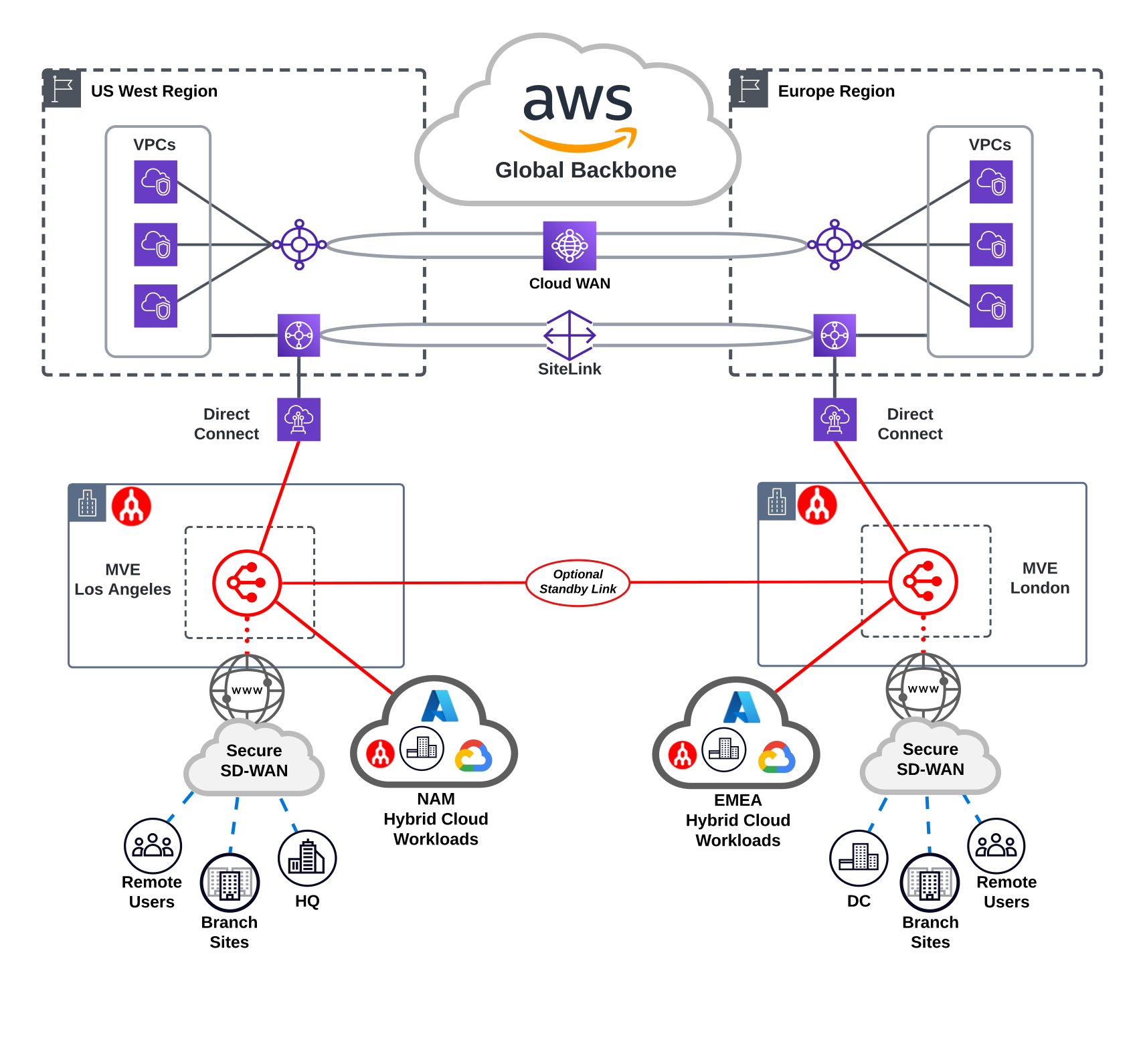
Let’s look at how this works in practice. The diagram below shows how Megaport acts as the on-ramp to the AWS Global Backbone. Using Megaport Virtual Edge (MVE), our virtual routing service, you can create a virtual PoP at the network edge to connect your branch sites, remote users, and SD-WAN fabric directly to the nearest AWS Direct Connect location.
From there, traffic flows securely over the AWS backbone using Cloud WAN and SiteLink to connect VPCs across different regions. This creates a unified, high-performance network that extends from your enterprise edge right into the heart of your cloud environment, all managed with the flexibility of a NaaS model.
Despite the advantages, adopting a NaaS-based architecture requires some rethinking. Engineers must rely on NaaS provider tooling for visibility and troubleshooting, making it essential to integrate these with existing monitoring systems. It’s also important to ensure that NaaS solutions integrate cleanly with existing SD-WAN, firewalls, and cloud gateways.
Finally, with programmable control comes the need for strong versioning and access controls, similar to what DevOps teams apply to infrastructure.
The convergence of cloud-native principles and networking has already begun to reshape how organizations build and manage their connectivity. As workloads shift between clouds, regions, and edge locations—particularly with the explosive growth of GenAI applications—the network must be just as agile and responsive as the rest of the IT stack.
For network engineers, embracing network cloudification and NaaS models means building connectivity that is programmable, scalable, and designed for continuous change. The rise of GenAI workloads further accelerates this transformation.
It’s not just about faster provisioning – it’s about shifting the role of networking from static infrastructure to dynamic, service-driven architecture.
As the cloud evolves and GenAI becomes increasingly central to enterprise operations, so too must the network. The future belongs to intelligent, adaptive networks that can keep pace with the demands of next-generation AI applications while maintaining the agility and efficiency that modern businesses require.
此内容由惯性聚合(RSS阅读器)自动聚合整理,仅供阅读参考。 原文来自 — 版权归原作者所有。