






By Gary Taylor, Solutions Architect
In 2024, an interconnected network is a must-have. Here’s how to get one and supercharge your business operations.
Globally distributed networks, remote workforces, multicloud architectures – all of these setups have something important in common (besides the fact they’re the norm now). They all leverage multiples to maximize business benefits. Multiple locations, multiple endpoint types, multiple cloud providers.
But as your network becomes increasingly complex with a growing number of endpoints, another challenge appears: interconnecting these different endpoints to keep your network delivering high performance and reduced costs.
In this blog we’ll cover what an interconnected network looks like, how to get one, and how to make it easy to integrate additional services and endpoints as your business continues to expand. The best part? Network interconnection can be an entirely virtual process, so you can provision quickly with minimal investment and start benefiting almost immediately.
When your network is siloed across disparate systems, a range of issues can proliferate across your network, causing a headache for your team.
These disparate systems might include:
When these systems aren’t integrated, they can present challenges like:
The result of these challenges is a loss of oversight and the inability to make smart, cost-efficient operational decisions about your network.
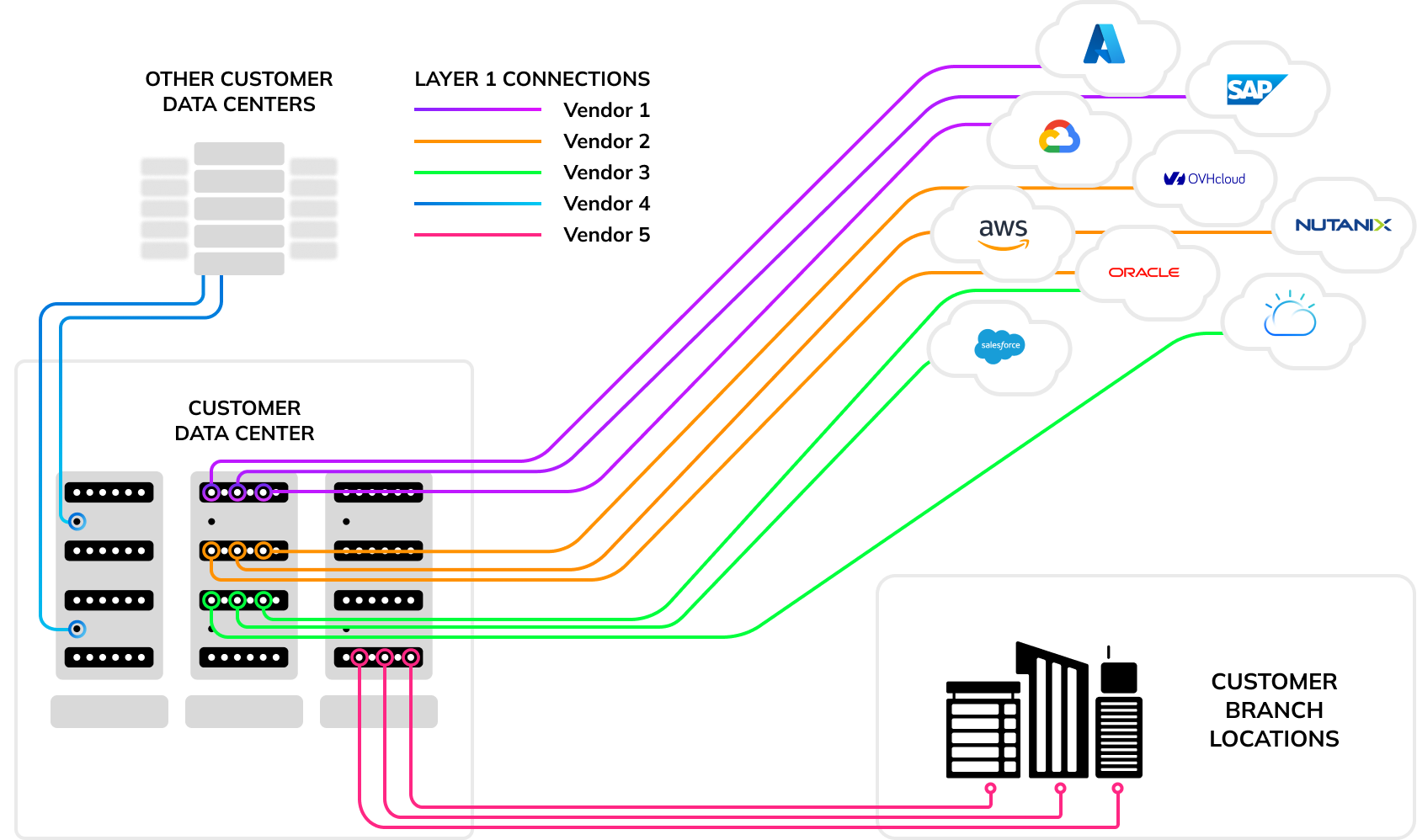
An example of what a network looks like with only partial interconnection.
Interconnecting your network endpoints, regions, providers, and applications restores your network oversight, creating a domino effect of benefits for your team:
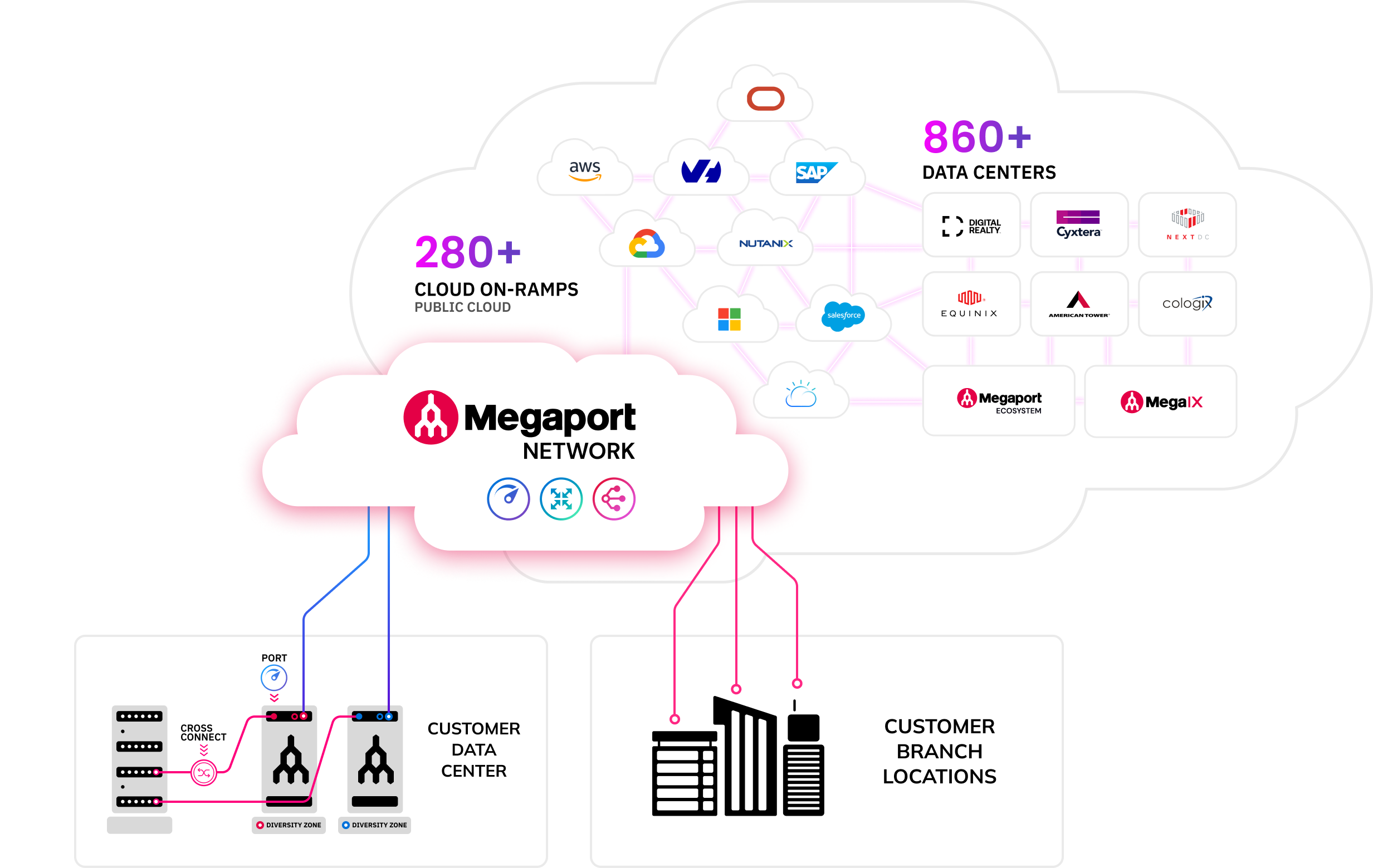
An example of what a fully interconnected network looks like with Megaport.
The sooner you integrate your network, the easier it will be to manage and scale – but it’s never too late to start. Here’s your interconnection checklist.
Interconnecting your private on-premises infrastructure and your public and private cloud service providers—in other words, creating a hybrid cloud architecture—is a must for organizations managing and migrating data between these two endpoints.
Hybrid cloud connectivity creates a direct channel between your physical and cloud data, allowing you to spin up the different resources you need on-demand and create portability between these workloads.
Perhaps the biggest benefit of a hybrid cloud infrastructure is being able to use your cloud-native applications for your on-premises workloads, speeding up testing, deployment, and time to market. But it also gives you greater freedom to store different types of data in different public and private storage points without sacrificing latency and performance.
Megaport Global WAN simplifies the process of connecting your physical and virtual PoPs.
Most businesses have a multicloud architecture in 2024. Cloud-to-cloud simply refers to the transit of information directly between multiple clouds, as opposed to hairpinning data across your network via a data center or other physical PoP. While public cloud-to-cloud connectivity is an option if you want to DIY your setup, the public internet can have a number of drawbacks including compromised security, high latency and jitter, and poor resiliency.
Setting up private cloud-to-cloud connectivity between your cloud-based workloads can have an immediate and measurable impact on your network latency, costs, and ease of management. It also creates more possibilities for getting the best of each provider while still testing and deploying at speed – for example, using an application from one cloud in tandem with an application from another cloud on a single platform to improve its features.
Rather than architecting over the public internet, private cloud-to-cloud generally offers faster and more consistent bandwidth, and makes it easier for you to keep your data secure. Cloud-to-cloud also sets the stage for cross-cloud use cases, where you can start building your own applications on top of multiple cloud providers at the same time to achieve your ideal network setup.
Network Function Virtualization (NFV) refers to the replacement of network appliance hardware with virtual devices. Industry-leading vendor solutions can then be deployed on the virtual infrastructure (think the likes of Fortinet, Palo Alto, Cisco, and Aviatrix) to optimize your core firewall security, your routing, or your SD-WAN network by bringing private networking and its benefits to the edge.
Using NFV to bring your network applications to the branch localizes connectivity functions across your distributed network, reduces latency and jitter, and enables end-to-end provisioning and management.
The exact impact of interconnecting your edge differs from industry to industry, but the value is usually significant. For businesses in retail, the benefits could look like always-on Point of Sale systems and instant branch-to-warehouse stock updates; or in healthcare, they could look like fewer critical network outages and HIPAA-compliant data that’s protected from end to end.
Look for a NFV provider that is already partnered with your preferred SD-WAN providers for easy integration with your current network setup.
If your organization is geographically dispersed, or employees and customers need to access your systems across several locations, your applications and data will move through multiple data center locations or providers. Hairpinning data between these crucial endpoints can slow down your entire operations.
Instead, data center interconnection integrates your data center endpoints on a single connectivity underlay, allowing resources to be shared directly between them regardless of location or provider. This could be as simple as a single metro Ethernet Virtual Connection (EVC) loop to leverage multiple providers and connect them directly with your branch; or it could be as intricate as a global end-to-end architecture that interconnects dozens of branches, data center locations, and providers.
Look for data center interconnect providers that have super-high bandwidth options, as well as an established global ecosystem of provider partners to ensure you’re covered for future business expansions.
If you’re already using some of the services listed above, chances are that direct internet solutions are quietly playing a part in their successful deployment.
There’s a reason that dedicated internet solutions are preferable to traditional internet offerings for private enterprise operations: Download and upload speeds aren’t impacted by competing traffic, and the bandwidth you need is available right when you need it. This faster and more highly available connectivity will extend beyond your team to your customers, improving customer experience and quality of service.
Dedicated internet solutions achieve this superior connectivity by being interconnected with the rest of your network, rather than sitting as a separate layer, consolidating management and reducing latency.
Look to your existing as-a-Service providers for dedicated enterprise internet solutions so they’re easier to incorporate with your other solutions. Be sure to check the solution is also backed by strong availability SLAs to protect uptime.
You may not be using AI enough to think you need AI interconnection services just yet. In fact, it’s such a new space that offerings are still sparse. But with AI’s use exponentially increasing across every conceivable business function, it’s worth considering interconnecting your AI workloads, infrastructure, and providers so they fit organically into your business applications and functions.
A good AI interconnection provider will do more than successfully combine your AI workloads with your network layer. It should also offer a marketplace which features a variety of AI providers and access to GPU as a Service (GPUaaS) resources, third-party AI models, storage, and compute, all on one scalable platform.

If you’re early in your interconnection journey, there’s no need to interconnect everything at once. The best way to prioritize is by discussing the following with your network and IT teams:
The good news is, if you go through a single Network as a Service (NaaS) provider that offers all these services on our list, you can complete all your network interconnection steps in tandem.
When you use a vendor-neutral NaaS provider for your network, look for:
With Megaport, you can transform how you connect your business infrastructure.
With our global NaaS platform you can build secure, scalable, and agile networks in just a few clicks, accessing 1,100 + enabled locations and 380+ service providers worldwide. Our ISO-IEC 27001-certified network is engineered for global resiliency, on-demand flexibility, and unmatched performance – and you can manage it all in one simple portal.
Our extensive solutions suite can set you up for every interconnection use case on your wishlist:
Megaport’s hybrid cloud solutions can take your on-premises infrastructure direct to the cloud in just a few clicks. Use our flexible network underlay to connect your private infrastructure to any service provider across our network, several ways to provision secure, resilient, and scalable connectivity.
Megaport hybrid cloud solutions enable you to build your perfect hybrid cloud network in minutes, with direct connectivity between all your on-premises and virtual endpoints.
Cloud-to-cloud solutions with Megaport allow you to spin up virtual routers to handle traffic between multiple clouds. Provision connections between hundreds of the world’s leading service providers across 333 + cloud on-ramps.
Megaport’s NFV solutions mean you can deploy virtual PoP solutions, including SD-WAN gateways, virtual routers, and virtual firewalls, anywhere in the world. Set up a range of virtual PoP use cases to bring your software-defined network to the edge in minutes – integrated with the industry’s leading SD-WAN, router, and firewall providers.
Megaport’s Data Center Interconnect (DCI) is a secure point-to-point service that creates a Layer 2 connection between any two data centers. Our expansive ecosystem has over 1,100 + enabled data centers across over 125 + unique data center providers, and you can provision bandwidth on our scalable backbone of up to 100G.
With Megaport Internet, you can get a dedicated internet solution with all the benefits of Megaport’s scalable network fabric in just 60 seconds. Consolidate your different network functions in-house and bypass third-party vendors with your own dedicated, highly redundant link to the internet.
Megaport AI Exchange (AIx) interconnects all of your AI infrastructure, workloads, and providers on our private, global, scalable network backbone. Go beyond just cloud and data center connectivity use cases, integrating AI into your network management—including GPUaaS providers, third-party models, and storage and compute—to give you more value from your virtual ecosystem.
Point, click, connect: There are so many possibilities when you connect with Megaport. Chat to our team to get started.
此内容由惯性聚合(RSS阅读器)自动聚合整理,仅供阅读参考。 原文来自 — 版权归原作者所有。