





Today, the cloud impacts all departments of the organization, not just the IT crew. Here’s how cloud centers of excellence drive cloud success.
For many organizations, unstructured and ungoverned cloud adoption is hindering growth and innovation. According to Gartner®, this is often “as a result of not only ‘shadow IT’ adoption, but also business units moving faster to adopt cloud than central IT is ready to support.”¹
But in a time where the cloud is a non-negotiable, rather than just a nice-to-have, how can you make the most of it?
In their recent report, How to Deploy a Cloud Center of Excellence (2022), Gartner explains how a cloud center of excellence (or CCoE) can prove to play an invaluable role in driving business-wide cloud success, whether your organization is small or large, regional or global, new to the cloud or boasts an expansive cloud footprint.
The cloud practice is growing rapidly in popularity – in fact, a recent survey by ESG Research found that among IT professionals across the globe, only 1% reported not having a CCoE nor having plans to create one.
Whether you’re a part of the 1% who hasn’t explored CCoEs yet or you want to enhance your business’ current operations, this blog will share what exactly a CCoE is, its various benefits, and how your organization can successfully execute one.
Its name may conjure a vision of a bustling headquarters, where cloud engineers gather around on computers to directly work in the cloud, but it’s actually less tangible and more sophisticated than that.
Instead, a CCoE is a unique, best-practice approach and framework for scaling successful cloud adoption and digital transformation. And while it may be launched and led by a single cloud architect, it ultimately “evangelizes” cloud computing by inviting and encouraging several business departments to improve their cloud knowledge and skill set. Gartner notes that in order for a CCoE to be effective, it must “spread cloud competence across the organization, not concentrate it.”1
A CCoE may look different depending on the industry and size of your business, but the CCoE’s primary functions remain the same: To oversee practices, provide cloud governance, establish policies, and lead the transformation activities that are necessary for a successful enterprise cloud journey. This will ultimately benefit the business as a whole, resulting in optimized network performance, reduced costs, and bolstered security for your business’ (and customers’) precious cloud-stored data.
But if your business already has an established cloud infrastructure in place managed by the IT team, why should taking this next step matter to you? Essentially, because there has never been a more important time to reevaluate how you address the challenges of managing, optimizing, and protecting your suite of clouds. This is because cloud computing is “no longer relegated to early adopters and risk-takers. Today, it serves as a necessary foundation for successful IT and business.”
Multicloud infrastructures are becoming more complex, especially with remote workforces that rely on the cloud for mission-critical operations, meaning organizations need to establish formal frameworks such as the CCoE that inform all staff members on how to engage with it correctly.
Leading cloud hyperscaler Amazon Web Services (AWS) explains in its blog how a CCoE brings together various departments—that would otherwise be siloed—which creates uniformity in adopting and undergoing cloud practices across the entire organization, beyond just the IT squad.
Such departments and roles that can both benefit from and provide value to being involved in the CCoE journey include:
Together, these departments work together in the CCoE model, each with a crucial and unique role in improving organizational cloud adoption and efficiency.
There are numerous benefits to adopting a CCoE within your organization, no matter the size or stage in your cloud journey. These include:
There are a variety of responsibilities and activities that CCoE stakeholders actively participate in to ensure the framework delivers consistent and reliable outcomes and the benefits listed above. These include:
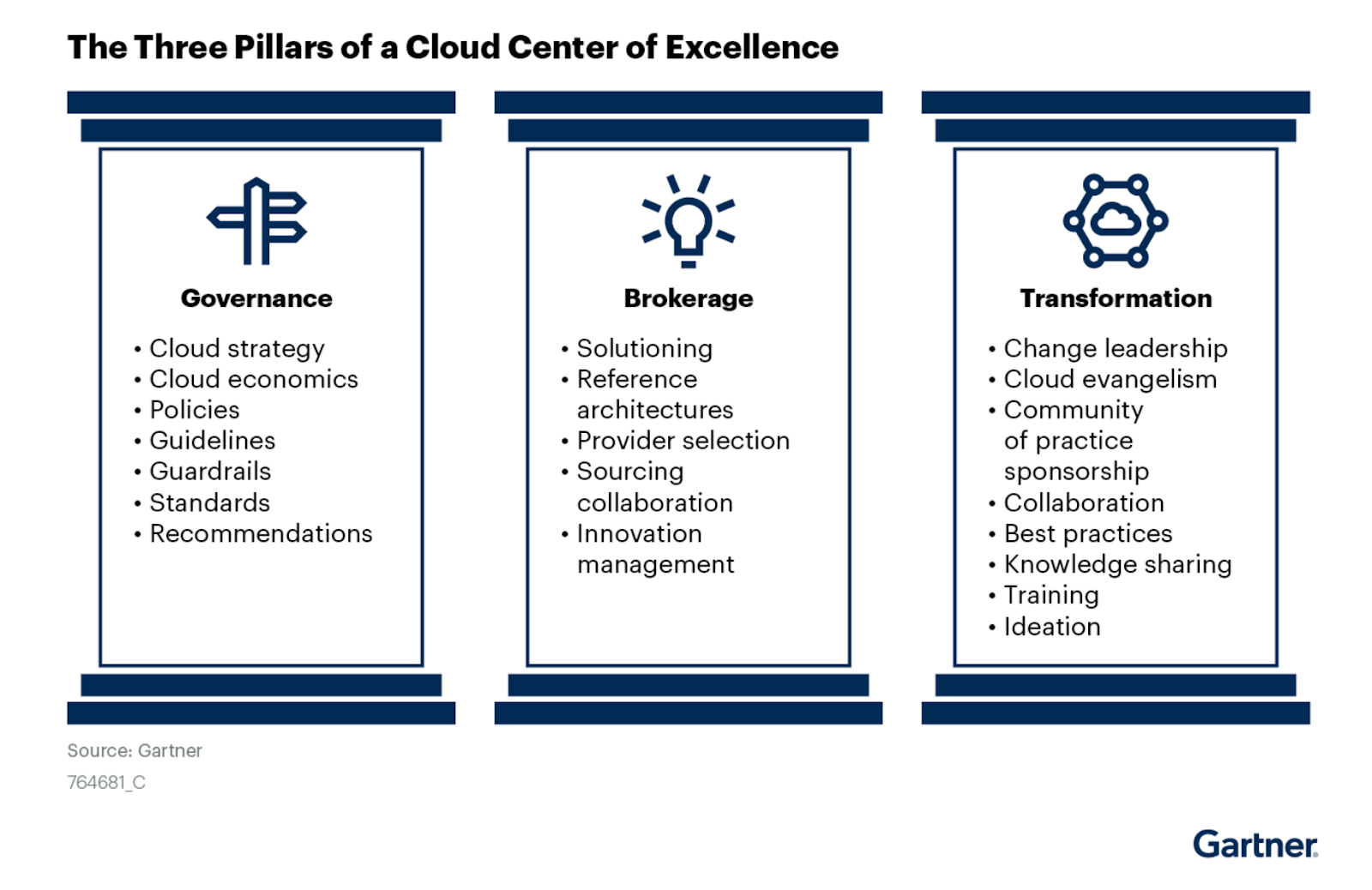
Gartner explains that the CCoE has three core pillars. These aim to form the “why” of your organization’s CCoE strategy, and should “be the primary vehicle for leading and governing cloud adoption”.
The three pillars are:
Each pillar plays a key role in successful cloud adoption within an organization.
A functioning CCoE can’t be built in a day. It requires months, potentially years, of dedicated planning and strategy to execute, which will continue well past its implementation. However, there are some steps your business can take to begin developing your unique center.
First, IT teams should work with executives to determine not only the suitability but also the capacity for a CCoE. This goes beyond just budget: Is there enough headcount to manage? Does it tie in with the organization’s broader, long-term business strategy, and how can it complement and positively serve it? What are the strengths and weaknesses, opportunities and threats in implementing such a framework? Such questions will be key in drafting the initial charter that proposes the CCoE, which can then be used in outlining the framework’s budget and being granted funding.
Your business will need to assemble a team by identifying the key stakeholders within the existing structure. As mentioned earlier, the CCoE expands cloud activity and interest beyond simply the IT team. Down the line, you may need to hire additional, dedicated team members to support the management.
There will also likely be a need for team training and identifying knowledge gaps to then inform the next stage: Creating the roadmap. Set a vision and outline objectives, and communicate this across the organization to ensure each department understands the unique and valuable role they play. As the CCoE team grows and your business’ cloud needs change (say, you add another branch), this roadmap can be reviewed and updated.
So, should your business have a CCoE? Ultimately, it depends. The answer to that question will be determined by your cloud reliance, cloud budget, and overall organizational goals and strategy. The framework is a great, modern solution for those ready to optimize their established cloud infrastructure, but will suit and benefit some industries and organization structures more than others. One thing is clear: Network architects deserve a seat at the table when it comes to deploying or executing a CCoE, and this is where we’re here to help.
Our customers increasingly use CCoEs to deal with complex multicloud deployments across distributed networks that can span numerous regions.
For one Megaport customer, a technology manufacturer, they were able to deploy global connectivity quickly and easily with a CCoE via Megaport’s Software Defined Network (SDN) to support greater security and cost controls, and enable cloud-native applications in both Microsoft Azure and Google Cloud.
“If you need something to change, it’s all software, and that’s not much hassle,” the company’s lead architect said.
“Within a week, you can start from nothing to having a connection to the cloud.”

And with Megaport Cloud Router (MCR), you can enjoy a fast, secure, and scalable way to connect your suite of clouds with a dedicated private connection, offering full cloud-to-cloud connectivity. This means your data can move between your various cloud architectures directly, without having to stop off at a data center first (known as hairpinning) – reducing latency and time, as well as giving you control over your bandwidth and architecting your multicloud network for redundancy.
Without physical infrastructure, customers can leverage cloud-to-cloud networking, private peering between leading public cloud, IaaS (Infrastructure as a Service), and SaaS (Software as a Service) providers, and direct connectivity to any provider on the Megaport SDN. Customers can spin up Virtual Cross Connects (VXCs) on demand with easy multicloud management via the Megaport Portal.
This all adds up to a faster, more flexible multicloud network, ready to support your cloud center of excellence.
¹ Gartner, How to Deploy a Cloud Center of Excellence, Lydia Leong, 25 April 2022
GARTNER is a registered trademark and service mark of Gartner, Inc. and/or its affiliates in the U.S. and internationally, and is used herein with permission. All rights reserved.
此内容由惯性聚合(RSS阅读器)自动聚合整理,仅供阅读参考。 原文来自 — 版权归原作者所有。