While some hyperscalers have recently announced the removal of egress fees following mounting pressure, the devil is in the details – storage and transit fees still add up, and egress costs can still creep up on you if you don’t read the fine print. Combine this with hidden costs caused by lower efficiency, higher latency, and lower bandwidth—unfortunate aspects of using the public internet—and wasted budget can easily pace increasing cloud expenditure.
Flexera reports that “for the second year in a row, managing cloud expenses has emerged as a more pressing challenge than security, highlighting an intensified focus on FinOps practices and tools for optimizing cloud costs and enhancing efficiency.”
This challenge grows while many cloud-based service plans tout these economic cost savings:
Utility-based pricing: This pricing model enables enterprises to pay as they use computing services, based on a flat rate.
Clear choice of cost models: Cost models can be customized to enterprise specialties – for example, an app developer may need fast networking while a gaming company may need high graphics capabilities. Different cost models may offer differing memory, CPU amounts, and so on. Pricing can vary depending on the volume of data transferred into and out of the cloud.
Fewer direct purchases of physical equipment and deferred data center costs: Through monthly fees and contracts, the cloud customer pays indirectly toward cloud companies’ physical equipment and cloud storage, and reaps the know-how and breadth of their security features and updates.
When it comes to cloud waste, several culprits are to blame for ballooning expenditure:
Overprovisioning or overestimating cloud needs: This can be caused by lax oversight on cloud OpEx, especially if engineers and developers are making cost decisions instead of receiving guidance from financial teams. Duplicate purchases for similar cloud services may also be a contributing factor.
“Always-on” cloud computing: While sometimes necessary, defaulting to an always-on mentality with your cloud environments is a recipe for cash loss.
Orphaned volumes and snapshots: “Orphans” become detached or redundant from the instances they once supported, and left unchecked will continue to incur storage costs.
Dark data: Like orphaned volumes and snapshots, dark data—data which goes unused and unaccessed—incurs unnecessary storage costs. This data can accumulate from legacy systems, incomplete integrations, changing business strategies, and lack of data governance, to name a few causes.
Unused instances and idle resources: When virtual inventory isn’t properly managed, cost-incurring instances that are no longer needed can be forgotten – unless they rack up enough on your next bill to give you sticker shock.
Missed price reductions: Failure to properly provision data usage or plan expenditure often leads to reliance on short-term or on-demand cloud agreements, which (depending on the provider) can be far more costly than long-term contracts offering discounts and perks.
Misconfigurations: IT teams lacking proper visibility into their network setup may be overlooking suboptimal volume types, outdated instances, and migration setups with excessive hops. This oversight can also extend to inconsistent cloud optimization or maintenance.
Rigid network underlay: Using the public internet or traditional network underlays can bloat expenditure as teams constantly react to increased security threats, downtime, and bottlenecks – often with no agility. The resulting network interruptions can also impair employee productivity and customer experience, worsening the financial impact.
Lack of understanding: The cloud can be incredibly complex. Lack of familiarity with all the factors that can contribute to your cloud bill means hidden costs may be lurking.
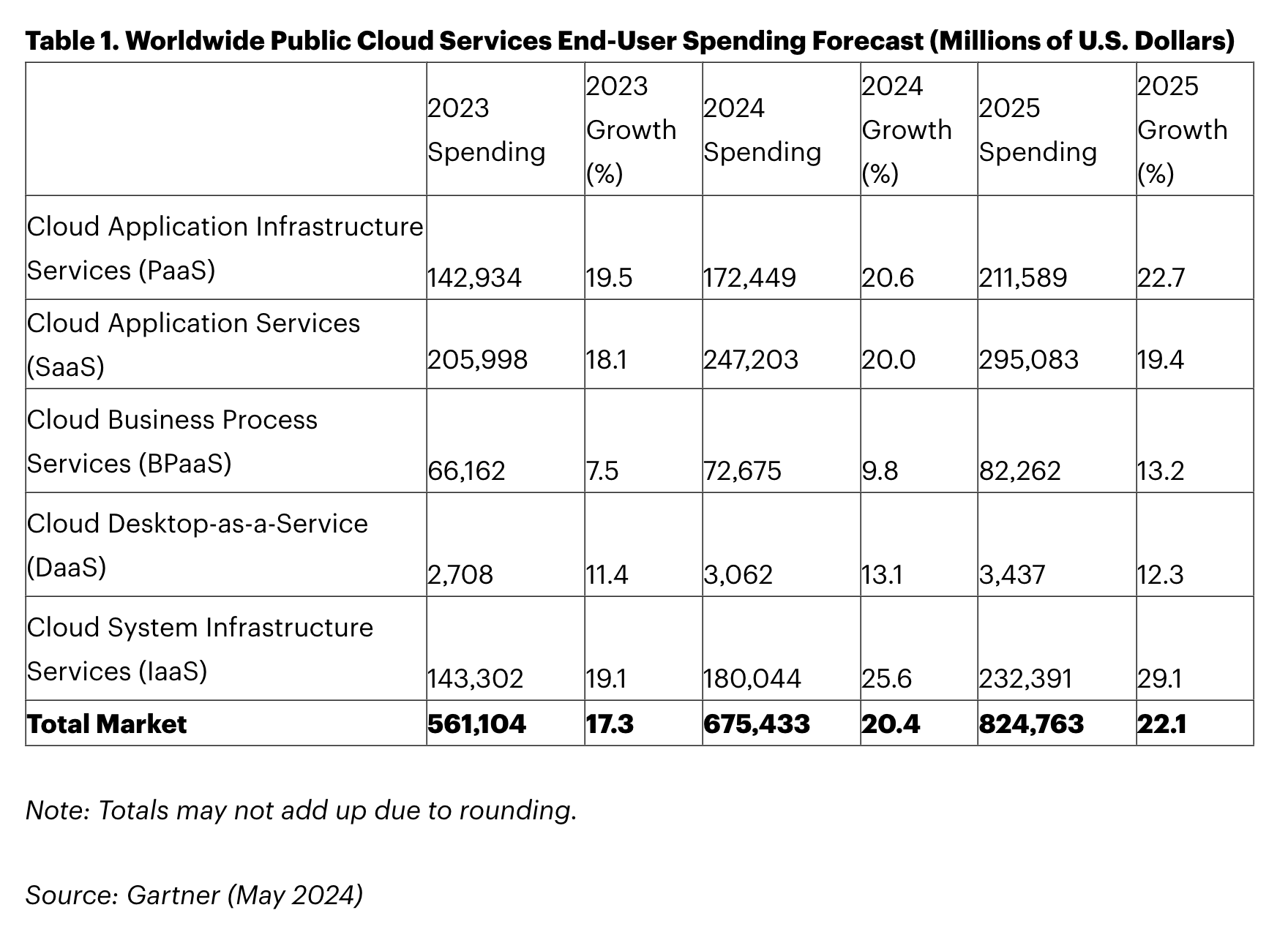
The below table from Gartner outlines the worldwide spend on various public cloud services (in millions of USD), including infrastructure, security, and applications. Year-on-year spending growth is expected to increase from 20.4% to 22.1% from 2024 to 2025, calling for enterprises to review and remove unnecessary costs sooner rather than later.
How to lower cloud costs
There are several ways you can save money and effectively manage cloud costs. Some are best practices to educate your team with and learn; some will require a larger intermittent effort.
Audit and forecast: Most major cloud providers offer tools to help you make sense of where you’re spending money. Use these tools to evaluate costs versus benefits for each of your services to clarify expenditure, guide forecasting, and prevent future overspend.
Get to know your providers: How much do they charge? What is their billing structure? And is there a way for you to get a better deal than you currently have? Take the time to use pricing tools and review T&Cs to see where you could seek discounts and deals from your vendors.
Scrutinize your cloud bill: Bandwidth, storage, compute, add-on features, and managed services can all contribute to your cloud bill. Take the time to comb through each item, flag what you don’t recognize, and audit where you can save with each of your cloud providers.
Use a private network underlay: A third-party Network as a Service (NaaS) provider removes the cost concerns associated with using traditional telcos or the public internet for your cloud connectivity, and helps you optimize your network performance and resiliency.
Review configurations: Keep instances up to date, ensure your data paths are optimized, set auto-scaling limits in line with your budget, and automate where possible to identify and minimize misconfigurations. Don’t forget to remove instances or gateways you no longer need.
Set up spend alerts: Most providers allow you to set up notifications when you exceed a certain spending threshold, so you can keep tabs on your data spend. Beyond the usefulness of this feature for day-to-day cost management, it could save you if a forgotten instance is left running.
Keep inventory of features and extensions: From network firewalls to disaster recovery services, taking stock of every cost-incurring feature you’re using from each cloud provider makes it easy for you to scale down right when you’re able to. Discern what really needs to be always on and turn the rest off until you need it.
Maintain cloud governance: Rally your IT and network teams to build and enforce cloud usage policies that prioritize cost management. Keep an eye on business units that may be meeting short-term goals through excessive cloud spend – audit and manage resource use versus needs.
Inspire a frugal mindset: By conducting cost forecasts and cloud spending audits with your IT and network teams, you’ll encourage a cost-savvy culture. Bonus points for delegating people or teams to maintain cost oversight.
The rise of mobile workforces combined with increasing customer expectations of instant, reliable connectivity has solidified a mass shift to NaaS. in recent years, empowering companies to eliminate or reduce their dedicated infrastructure CapEx and instead switch to an OpEx mindset. Outsourcing constant evolving (and expensive) network hardware and features can significantly improve ROI.
Compared with traditional or public internet-based connectivity methods, NaaS allows you to:
monitor and manage your networking services from a single pane of glass
track your ongoing usage and billing
order, deploy, and co-manage services on-demand, as well as hit pause and play on your connections as needed.
NaaS offerings go far beyond on-prem to cloud connectivity, too – with the right provider, you can potentially unlock hundreds of use cases.
Using Megaport to reduce cloud costs
When you use a NaaS provider like Megaport to privatize your network connectivity, you’ll also get other benefits like:
Provision in a few clicks: You can spin up most of our services in under 60 seconds.
Manage cloud performance: Using Megaport allows you to increase and decrease bandwidth as needed – up to as much as 100 Gbps in some locations.
Interconnect your network: Interconnect all of your virtual and on-premises endpoints and workloads across 930+ enabled locations and 410+ service providers, for a complete multicloud- and edge-optimized network.
Scale your cloud use: Use our elastic network fabric to scale up and down on-demand and pay only for what you use.
Simplify network management: Oversee, provision, and manage all of your connections through a single pane of glass.
There’s no substitute for strong financial oversight, audits, and budget accountability. But virtualizing connectivity with a private NaaS underlay like Megaport can be a leading part of that vigilance.