







Security teams are under pressure to demonstrate measurable progress against an increasingly complex cybersecurity landscape. Framework expectations evolve, insurance requirements tighten, and executive stakeholders demand defensible evidence that investments are improving risk posture. Yet most organisations still rely on static assessments — point-in‑time documents that provide limited visibility and quickly lose relevance as environments change.
This gap creates several challenges for technical security leaders:
Security buyers need something more dynamic: a persistent, data-driven‑ method to evaluate maturity, align resources, and provide transparent evidence to stakeholders. This is where Arctic Wolf’s Cyber Resilience Assessment (CRA) provides distinct value.
Arctic Wolf designed CRA to give organisations continuous visibility into their security posture, mapped directly to recognised security frameworks and enriched with actionable guidance. Rather than a static artifact, CRA becomes a living model of organisational resilience — supporting strategic decision making, tracking progress, and identifying‑ where the next security dollar will deliver meaningful impact.
Arctic Wolf’s CRA is built to be both technically comprehensive and operationally simple. It enables security leaders to analyse their environment, prioritise investments, and demonstrate improvement through a unified, intuitive workflow.
CRA lets customers assess their environment against industry-standard frameworks such as CIS. From the unified portal, users can launch the assessment from the Security Journey menu or via the dashboard widget. What appears is a high-resolution view of security maturity: a scored index, visual group-level‑attainment, and clear representation of outstanding potential.
If an organisation has a Cyber Resilience Index of 768, for example, the dashboard illustrates how that score breaks down across control groups. Areas with room for improvement are immediately visible in gray, helping teams quickly determine where action is required.
This framework alignment removes guesswork. Instead of debating priorities, security leaders can anchor discussions around a standardised, universally accepted security model.
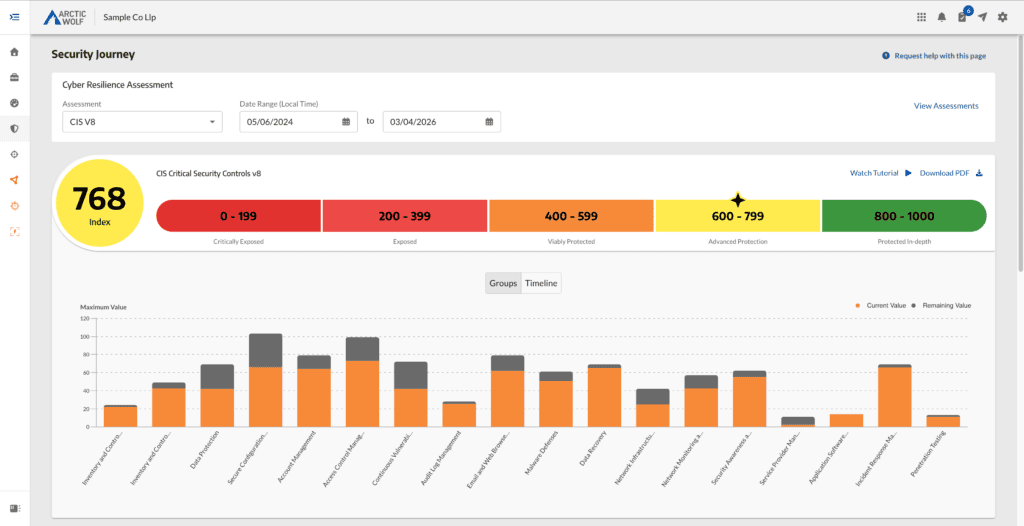
Security Journey Cyber Resilience Assessment
Every assessment within CRA is dynamic. Security teams can drill down into each control group, view the underlying elements, and understand the maximum potential impact of each control. These impact values provide practical guidance: they reflect the relative value of improving one control versus another.
If the Access Control Management group has a current score of 60 and an outstanding potential impact of 38, the platform makes that gap explicit — turning abstract risk into quantifiable opportunity. Teams can immediately see where improvement will yield meaningful gains.
As users update controls, whether through new technology adoption or process improvements, the CRA interface shows the resulting impact before changes are saved. This immediate feedback loop encourages an iterative approach to security maturation and reinforces the idea that resilience is a continuous journey.
CRA enables assessments to be explored from multiple angles:
This flexibility is critical for technical buyers managing complex environments. It allows them to see not only how mature each control is, but also how their technology stack contributes to coverage. Gaps become visible, enabling clearer decisions around tool consolidation, upgrades, or new investments.
Security is not a solo effort, and CRA reflects that reality. Organisations can invite collaborators, including internal stakeholders or external partners, granting either read-only or full editing permissions. This makes the assessment a shared system of record, ideal for multiteam planning, executive reviews, or Partner‑assisted security transformation.
Every change made to an assessment is captured in the History tab, providing an audit-ready‑ log of updates, contributors, and timestamps. This historical record simplifies regulatory reporting, renewals, and compliance audits.
To support communication beyond the platform, CRA allows users to download the current state as a summary PDF, making it easy to share assessments with leadership teams, boards, and external stakeholders.
Beyond the assessment itself, Arctic Wolf generates a tailored Cyber Resilience Guide using the organisation’s self-reported maturity data. This guide identifies high‑priority‑ gaps, outlines business impact, and recommends targeted security reviews that align with Arctic Wolf advisory services.
For technical security buyers, this acts as a strategic blueprint; reinforcing where to focus next, what actions yield the highest ROI, and how to communicate priorities to executives.
Cyber insurers increasingly require evidence of foundational controls, and CRA addresses this with an Insurability Rating. Based on a curated subset of controls critical to insurers, the rating helps organisations understand how their current maturity may affect eligibility, premiums, or coverage terms.
Because this rating is built from existing assessment data, it does not require additional effort. It gives security leaders concrete clarity on how targeted improvements could strengthen their insurability and reduce financial exposure.
Cyber resilience requires more than a checklist. It demands continuous visibility, measurable progress, and the ability to adapt as new threats and expectations emerge. Arctic Wolf’s Cyber Resilience Assessment gives security leaders a powerful, intuitive framework for understanding their posture, prioritising investments, and demonstrating improvement. It transforms traditional assessments into an iterative, data-driven‑ process aligned with recognised frameworks and enriched with practical insights.
CRA empowers technical security buyers to:
With CRA, the path to greater cyber resilience becomes measurable, transparent, and easier to navigate.
To see the assessment in action and understand how it can accelerate your security journey, watch the demo video:
Disclaimer: This content is for informational purposes only and does not guarantee specific security, insurance, or compliance outcomes. Results may vary based on organisational context.
此内容由惯性聚合(RSS阅读器)自动聚合整理,仅供阅读参考。 原文来自 — 版权归原作者所有。