











Security operations teams are facing a familiar, but growing, challenge. As threat actors leverage AI and automation to move faster, alerts continue to expand in volume and complexity. Even mature security teams struggle to keep up with investigation timelines, maintain institutional knowledge, and ensure consistent response quality.
At the same time, buyers are demanding more from their security platforms. They want solutions that go beyond detection. They expect tooling that improves analyst efficiency, reduces cognitive load, and delivers actionable context without requiring constant manual effort.
Arctic Wolf’s Aurora® Superintelligence Platform is designed to address these challenges. It combines massive real-world security data with specialized AI agents and humans in the loop to help deliver the speed, content, and trust that customers need. In addition to the Aurora Agentic SOC, The Aurora Security Assistant is a customer-facing generative AI capability that delivers natural language interaction, contextual awareness, and real operational utility. Aurora Security Assistant aims to help teams move faster, understand incidents more clearly, and take action with greater confidence.
Aurora Security Assistant is not just a chatbot layered onto your security data. It is deeply integrated into Arctic Wolf’s broader platform, which combines real-world security telemetry, AI-driven analysis, and human expertise across SOC workflows.
This architecture matters. Instead of providing generic answers, the assistant can interpret questions in context and deliver responses that are relevant to the user’s environment and workflows.
Through a conversational interface, users can ask questions in plain English and receive clear, structured responses. For example, a user can ask about multi-factor authentication (MFA) attacks and receive:
This transforms how teams access knowledge. Instead of searching documentation or relying on tribal knowledge, users get immediate, actionable insights within the same portal where they already manage security operations.
For technical users, this represents a shift toward embedded intelligence. The assistant reduces friction in daily workflows and ensures that both experienced analysts and less-specialized users can operate effectively.
Aurora Security Assistant also delivers value in active investigation workflows.
Security analysts often spend significant time pivoting between tools, extracting indicators of compromise, building queries, and validating findings. This process is time-intensive and prone to inconsistency, particularly during high-pressure incidents.
Aurora Security Assistant changes that dynamic by operating directly within the context of a ticket. For example, when given a ticket regarding a PowerSploit attack with credential dumping, it can:
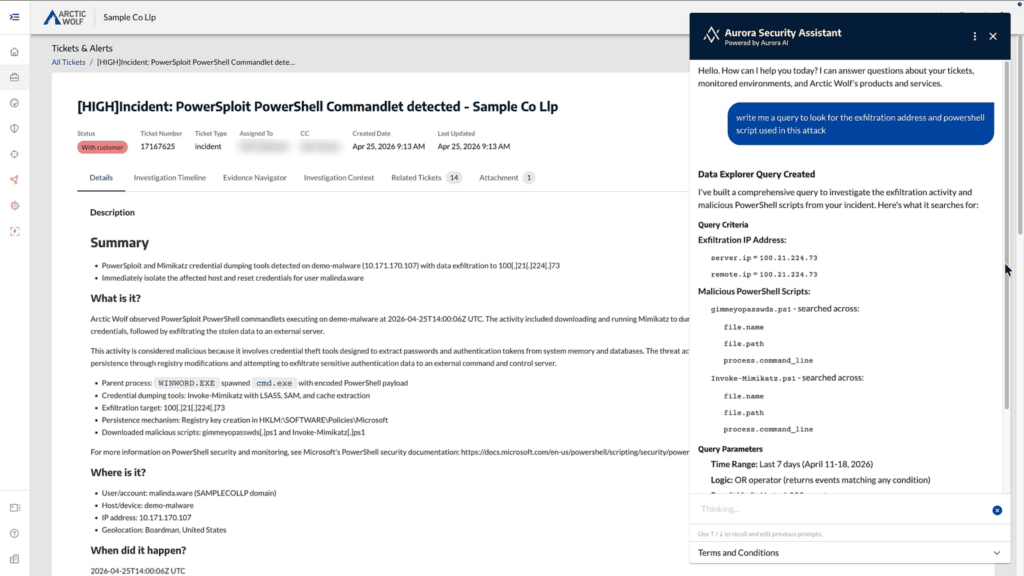
A look at tickets and alerts.
This workflow is designed to eliminate several manual steps. Analysts no longer need to translate alert data into queries or switch contexts between systems. Instead, they can immediately investigate related activity with validated logic.
Once in Data Explorer, the query can be executed, refined, or saved for future use. Starting from this base query, analysts can adjust timeframes, expand scope, or increase complexity as needed.
If you are evaluating SOC efficiency, this capability is significant. In many cases, Aurora Security Assistant can help reduce mean time to investigate, standardizes analysis, and helps ensure that critical steps are not missed.
Another key challenge in security operations is time. Analysts should have easy access to information that empowers them to take action, especially around administrative tasks and reporting. The Aurora Security Assistant provides a practical path forward by enabling guided, self-service within the platform.
Users can ask how to perform specific tasks, such as configuring a travel exception for a user. The assistant responds with clear, step-by-step instructions tailored to the Arctic Wolf environment.
This has several benefits:
For organizations with lean security teams, this is especially valuable. Aurora Security Assistant allows non-expert users to quickly search documentation, find answers, and execute tasks all within the Unified Portal. In effect, the assistant acts as an always-available layer of operational knowledge, embedded directly into the workflows where decisions are made.
Aurora Security Assistant represents a broader evolution in how security platforms deliver value.
Rather than focusing solely on detection or response, Aurora Security Assistant enhances the entire operational lifecycle:
All of this is delivered within our Unified Portal, eliminating the fragmentation that often slows down security operations.
As the assistant continues to evolve, its capabilities will expand to cover additional use cases, prompts, and skill areas. This positions it as a long-term force multiplier that grows alongside the organization’s security maturity. For more information and the latest skills, please refer to the product documentation.
If you are technical, the value of Aurora Security Assistant is best understood in context. It is not just about AI. It is about applying AI in a way that directly improves how security work gets done. From accelerating investigations to enabling self-service and reducing operational friction, Aurora Security Assistant helps teams move faster without sacrificing accuracy or control.
To see these capabilities in action, watch the full demo:
This blog may include forward‑looking statements. These reflect our current views and are subject to change. They are not guarantees, and actual results may vary.
此内容由惯性聚合(RSS阅读器)自动聚合整理,仅供阅读参考。 原文来自 — 版权归原作者所有。