
惯性聚合 高效追踪和阅读你感兴趣的博客、新闻、科技资讯
阅读原文 在惯性聚合中打开

推荐订阅源

IntelliJ IDEA : IntelliJ IDEA – the Leading IDE for Professional Development in Java and Kotlin | The JetBrains Blog
C
CXSECURITY Database RSS Feed - CXSecurity.com
博客园_首页
H
Hackread – Cybersecurity News, Data Breaches, AI and More
T
ThreatConnect
钛媒体:引领未来商业与生活新知
钛媒体:引领未来商业与生活新知
博客园 - 聂微东
H
Help Net Security
T
Threat Research - Cisco Blogs
Blog — PlanetScale
Blog — PlanetScale
A
Arctic Wolf
G
Google Developers Blog
量子位
U
Unit 42
I
InfoQ
V
V2EX
F
Fox-IT International blog
P
Privacy & Cybersecurity Law Blog
V
Visual Studio Blog
J
Java Code Geeks
大猫的无限游戏
大猫的无限游戏
C
CERT Recently Published Vulnerability Notes
博客园 - 三生石上(FineUI控件)
T
The Exploit Database - CXSecurity.com
T
Tailwind CSS Blog
SecWiki News
SecWiki News
Know Your Adversary
Know Your Adversary
MyScale Blog
MyScale Blog
宝玉的分享
宝玉的分享
The Hacker News
The Hacker News
Project Zero
Project Zero
Application and Cybersecurity Blog
月光博客
月光博客
Recent Commits to openclaw:main
奇客Solidot–传递最新科技情报
奇客Solidot–传递最新科技情报
G
GRAHAM CLULEY
C
Cisco Blogs
I
Intezer
Simon Willison's Weblog
O
OpenAI News
Recorded Future
Recorded Future
T
Tenable Blog
W
WeLiveSecurity
腾讯CDC
Stack Overflow Blog
Stack Overflow Blog
T
The Blog of Author Tim Ferriss
www.infosecurity-magazine.com
D
Docker
C
Cybersecurity and Infrastructure Security Agency CISA
PCI Perspectives
PCI Perspectives

IBM Research

Qiskit Global Summer School 2026: Registration now open | IBM Quantum Computing Blog How researchers built a record-setting quantum circuit | IBM Quantum Computing Blog IBM charts a new research path with MIT IBM is modeling the universe with quantum computing How to use sample-based quantum diagonalization on IBM hardware Quantum-centric supercomputing simulates 12,635-atom protein | IBM Quantum Computing Blog A decade of quantum on the cloud | IBM Quantum Computing Blog Ponder This Challenge - May 2026 - The Powers of a Binary Matrix Where the frontiers of high-speed racing and computing meet Introducing the IBM Granite 4.1 family of models Building the future of computing, together Next-generation algorithms could move fusion from the lab to the grid Bringing quantum-centric supercomputing to Illinois What’s new at IBM Quantum - Q1 2026 | IBM Quantum Computing Blog Release News: Qiskit v2.4 is here! | IBM Quantum Computing Blog How IBM Quantum is enabling healthcare and biology research | IBM Quantum Computing Blog Mid-training is essential for LLM reasoning, IBM study shows IBM demonstrates extreme scale for content-aware storage with a 100-billion vector database Ponder This Challenge - April 2026 - The Unlabeled Clock IBM Research and ETH Zurich open a new era of innovation IBM’s newest time-series models cover a full range of enterprise prediction tasks Toward a transparent supply chain for AI Quantum computers take a step into real materials science Donating llm-d to the Cloud Native Computing Foundation Cleveland Clinic & IBM debut new quantum simulation workflow | IBM Quantum Computing Blog Turning turbulence into transcripts Like the information in a dream: IBM’s Charles H. Bennett receives ACM Turing award Doubling down on open-access quantum computing Unveiling the first reference architecture for quantum-centric supercomputing Realizing Feynman’s vision for the future of simulation IBM is working today to secure communication from tomorrow’s quantum risks Building PyTorch-native support for the IBM Spyre Accelerator Quantum simulates properties of the first-ever half-Möbius molecule, designed by IBM and researchers A look back at the International Year of Quantum TerraStackAI: Bringing Earth and space AI to Red Hat and the world Ponder This Challenge - March 2026 - Path game on a hole-riddled chessboard IBM demonstrates High NA EUV process capability on track for insertion below 2 nm nodes at SPIE 2026 Quantum Advantage Tracker: the race to advantage
New Classroom Accounts expand quantum access for educators | IBM Quantum Computing Blog
2026-05-28 · via IBM Research

Key takeaways:

  • Announced during the first IBM Quantum Education Day, Classroom Accounts allow educators to give students hands-on access to real quantum computers.
  • Educators can onboard and manage 5-100 students with no credit card required, simplifying access to IBM Quantum Platform resources.
  • Students gain real-device experience with allocated compute time to enable iterative learning and experimentation beyond simulators.
  • Integrated with IBM Quantum Learning Modules, Classroom Accounts provide a complete, scalable pathway to teaching quantum computing in classrooms.

Introducing Classroom Accounts, a new resource that helps educators give entire classes of students hands-on access to IBM quantum computers.

Launching today as part of the first ever IBM Quantum Education Day, Classroom Accounts help instructors integrate real quantum computers into their teaching without the friction of traditional onboarding. Request a Classroom Account here.
1778871920621.jpg

IBM has spent over a decade giving students and educators open access to quantum computers over the cloud. But access alone is just the first step.

With Classroom Accounts, we build on that foundation by making it even easier for students to start running circuits and exploring core quantum concepts on IBM Quantum Platform.

The moment where quantum computing really clicks in on a student is when they use real devices.

What are Classroom Accounts?

A Classroom Account is a trial account purpose-built for educators. It enables them to provide and manage access to IBM Quantum resources for large cohorts of students within a single course.

With a Classroom Account, educators can:

  • Invite and onboard 5-100 students into a shared classroom environment
  • Provide access with no credit card required for educators or students
  • Give entire classrooms hands-on experience with real quantum computers
  • Support coursework via the same platform used in cutting-edge R&D
  • Create private open plan instances for each student and create instances in batches

Each Classroom Account provides (1) access to IBM Quantum Platform under the Open Plan, (2) 10 minutes of system usage per student each month, and (3) a 365-day validity period. Educators can easily renew and manage classroom access as neededPlease note: Classroom accounts and instances are not eligible for the recently announced 180-minute Open Plan promotion, but users may create a separate, standard Open Plan account to qualify. Details here..

Who are Classroom Accounts for?

Classroom Accounts are a valuable resource that can be useful across a range of academic settings. These include:

  • Undergraduate courses introducing quantum computing concepts
  • Graduate-level classes and laboratories requiring hands-on experimentation
  • Instructors teaching multiple sections of the same course
  • Programs incorporating quantum computing into STEM curricula
  • Remote or hybrid classrooms where centralized access is essential

How do educators get started?

Educators can request a Classroom Account by filling out the form linked here.

Classroom Accounts are intended to support the practical realities of teaching. They help educators:

  • Simplify access for students with fewer administrative barriers to entry
  • Provide hands-on learning at the course level, enabling entire classes to run experiments on real quantum hardware rather than relying on simulators
  • Support iterative learning, where students test, refine, and build on their work over time
  • Manage classrooms more effectively through centralized access for instructors and students, making it easier to support large classes or multiple sections
  • Connect teaching with real-world tools, giving students experience with an environment used by real quantum developers

With a solid foundation exploring real quantum computers—guided by an instructor and working alongside their fellow learners—students will be well prepared to move from structured course work to independent exploration and experimentation.

These learning experiences will position them for future work developing quantum algorithms, hardware, and more as we enter the era of quantum advantage and large-scale fault-tolerant quantum computing.

How to use Classroom Accounts on IBM Quantum Platform

Once approved, you can begin inviting students and provisioning access directly from IBM Quantum Platform.

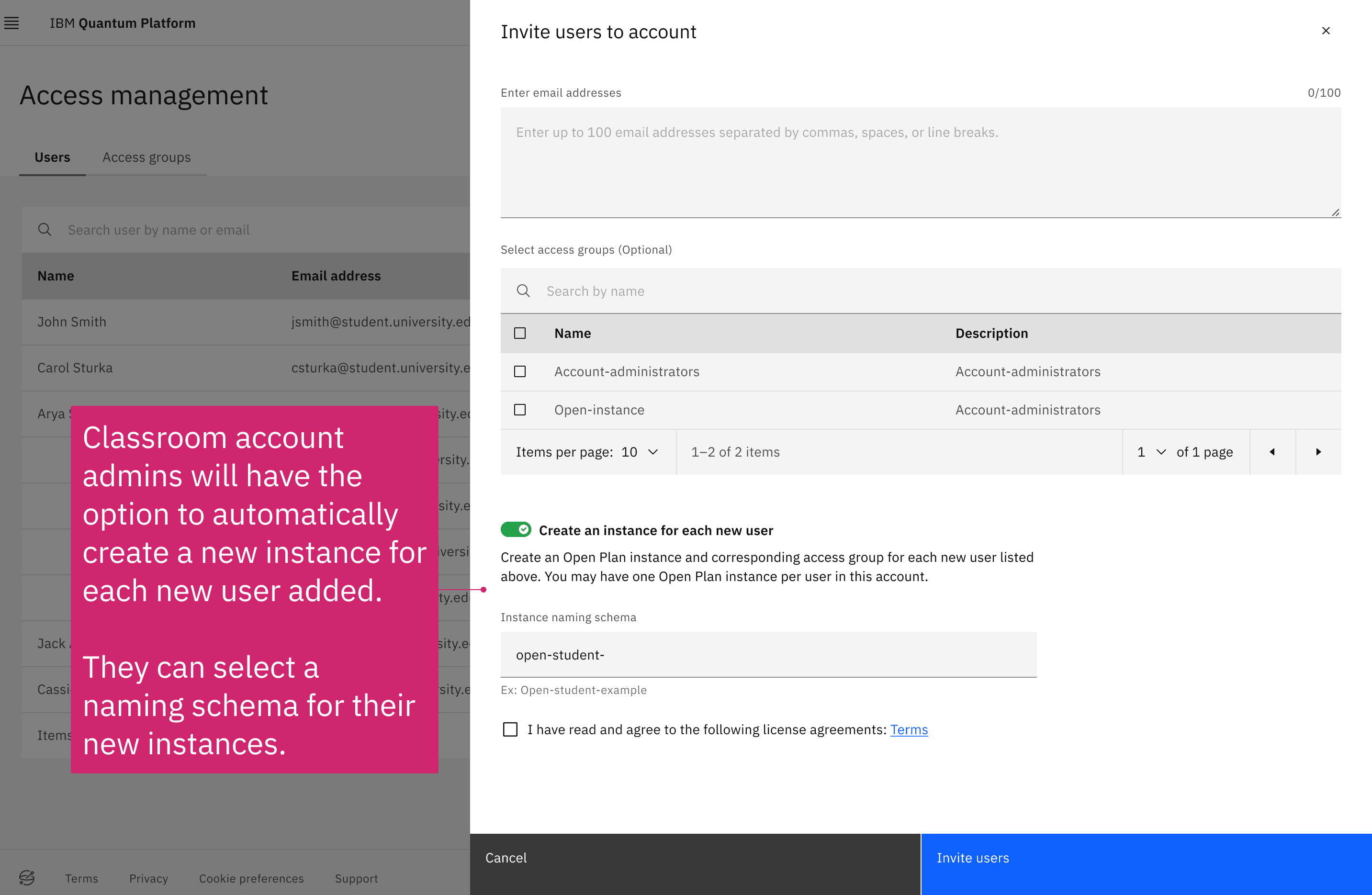
The onboarding flow is designed to scale with your classroom. From the Access management page, you’ll be able to invite up to 100 students at once and automatically create an instance for each user—all in one easy step:
Blog - Batch instance creation-v4.png

Inviting users and creating instances: Classroom Account admins can invite multiple users at once and automatically create a separate Open Plan instance for each student. Admins can also define a naming schema to keep instances organized.

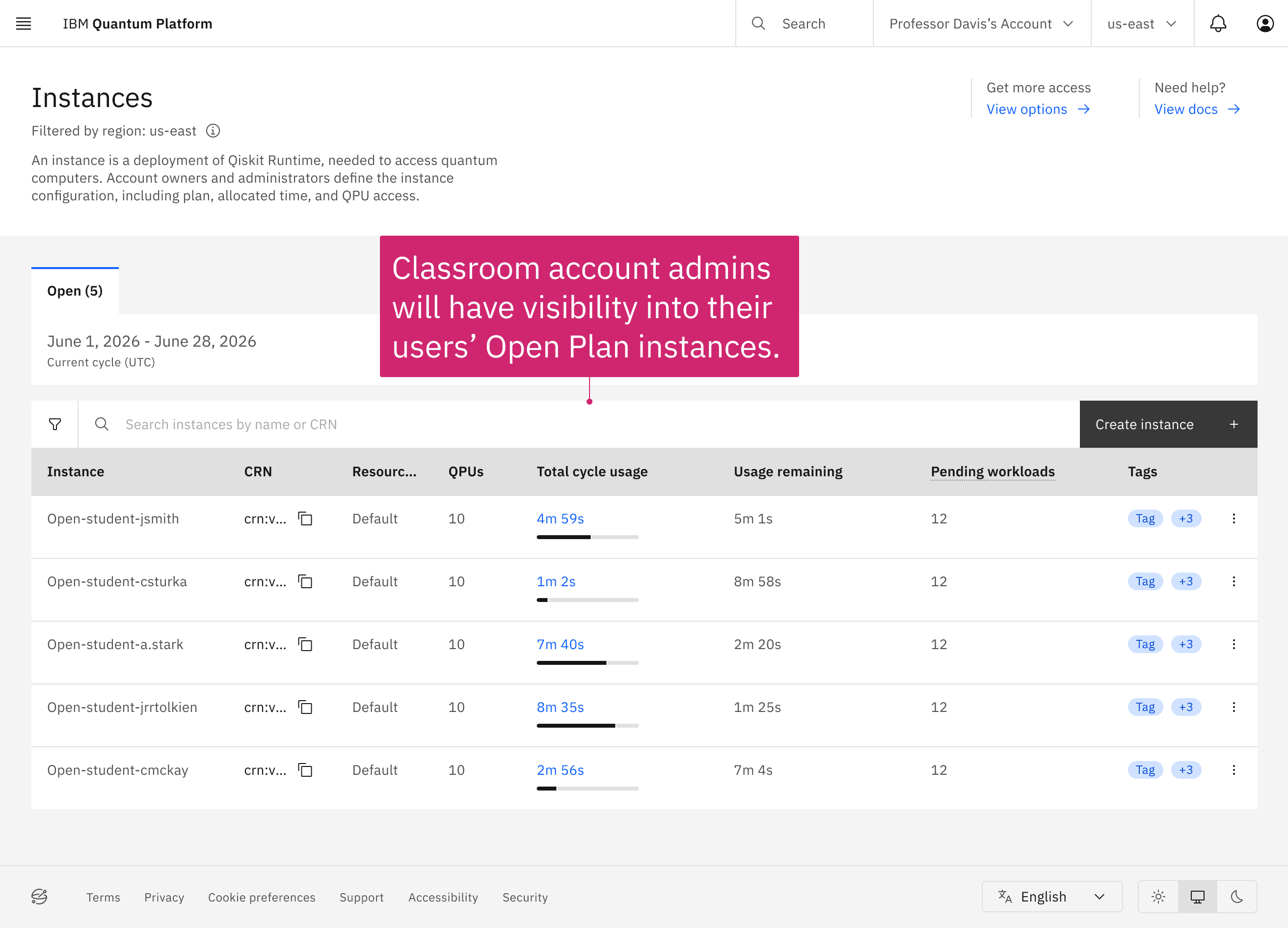
After students are added, you can view and manage their instances directly from the Instances page.
Blog - Instance management-v4.png

Viewing student instances and usage: Classroom Account admins have visibility into each student’s Open Plan instance, including usage, remaining allocation, and workload status.

This centralized view allows you to:

  • Track how much compute time each student has used
  • Monitor activity across the entire class
  • Quickly identify students who may need support

Together, these features aim to reduce administrative overhead for instructors and keep students focused on learning and experimentation from day one.

There's something very special about actually sending a job to a real quantum computer, getting the numbers back and…trying to interpret them.

— Damien Pope, Outreach Scientist at Perimeter Institute for Theoretical Physics

Beyond the accounts: Classroom modules

Classroom Accounts pair with our growing library of educational modules, available under the Modules tab on IBM Quantum Learning. Modules are self-contained, interactive learning activities designed for physics, computer science, chemistry, and other subjects where quantum computing can enrich the curriculum.

We currently offer 12 modules, with more on the way. You can use the modules we have as they are, or use them as inspiration to create Qiskit classroom modules of your own.

Together, Classroom Accounts and Modules provide a complete on-ramp: the access, the materials, and the community to bring quantum computing into any relevant classroom.

Get started today

Quantum computers have never been more powerful or performant. And now, with Classroom Accounts, they’re more accessible than ever before. Submit your application today to take full advantage of that accessibility:

We can’t wait to see how educators and students will use Classroom Accounts to expand access to quantum computing and support the next generation of learners.