





Studying and designing novel materials is a central application of quantum mechanics. Chemists, material scientists, and physicists focus on subtle interactions in quantum materials and to uncover them they rely on sophisticated computational and experimental techniques. Computer simulations that connect microscopic quantum interactions to measurable material properties complement experimental data to connect structure to function — but classical computers can struggle to simulate those properties. Fortunately, scientists today have a new tool in their toolbox: quantum computers.
In a new preprint, a team of researchers from Oak Ridge National Lab’s (ORNL’s) Quantum Science Center (QSC), Purdue University, Los Alamos Laboratory, the University of Illinois at Urbana-Champaign, the University of Tennessee, and IBM used quantum simulation to compute the energy-momentum spectrum of a well-studied magnetic material, KCuF, showing strong agreement with the spectra measured via neutron scattering (see Figure below).
The quantum simulations employed the IBM Quantum Heron processor, while the experimental data was acquired from neutron sources at the Spallation Neutron Source (SNS) at ORNL and at the Rutherford Appleton Laboratory in the United Kingdom. This work serves as another realization of Richard Feynman’s vision: the use of a well-controlled, programmable quantum system to simulate the properties of a quantum system of interest.
"This is the most impressive match I've seen between experimental data and qubit simulation, and it definitely raises the bar for what can be expected from quantum computers,” said study co-author Allen Scheie, condensed matter physicist at Los Alamos National Laboratory. “I am extremely excited about what this means for science."
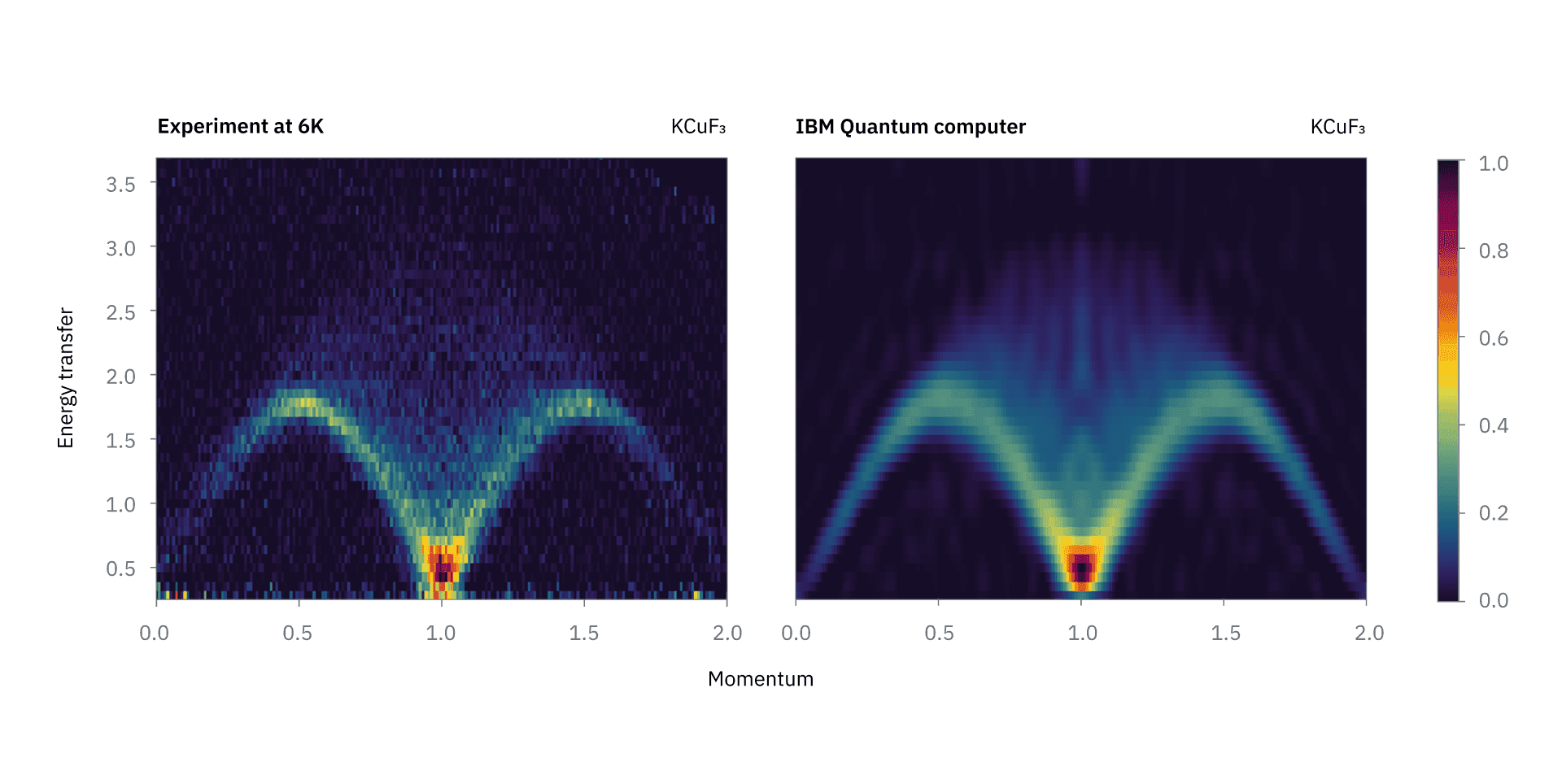
By bombarding a sample of KCuF with neutrons and measuring the scattered neutrons’ energy and momentum, experimentalists can probe the material’s dynamical and structural properties. Neutrons weakly interact with the system, so they provide very clean data on the true state of the material, according to principal investigator Arnab Banerjee, assistant professor of physics and astronomy at Purdue University. When a neutron hits a sample, it doesn’t change the material’s state or temperature beyond the simplest levels of perturbation. “That means you can rely on the neutron scattering results to get a dependable theoretical model and get insights about the material,” said Banerjee.
However, because the quantities measured by the experiment encode the dynamics of many spins that are entangled, they can be notoriously difficult to compute classically. “There is so much neutron scattering data on magnetic materials that we don't fully understand because of the limitations of approximate classical methods,” Banerjee said.
Quantum computers have long been expected to enable material simulation that is challenging for classical methods. Despite progress in quantum hardware and resource estimation, it has been unclear whether current, pre-fault tolerant quantum computers with their limited gate budget are capable of simulating real materials. Simulating the energy-momentum spectrum from neutron scattering was a particularly good candidate, because the interaction of spins in the materials with neutrons can be easily mapped to quantum circuits.
“A spin is a qubit is a spin,” Banerjee said. “Quantum computing provides the same observables as neutron scattering.” And despite this efficient mapping, the feasibility of such a simulation on current devices remained a question mark. “When we embarked on this project, it wasn’t clear to us how many qubits and gates would be required for this simulation,” said IBM research scientist Bibek Pokharel, one of the study’s lead authors.
But as the study showed, progress in scale and the quality of quantum processors was crucial for the simulation accuracy achieved in this work. “These results were really enabled by the low error rates across all fifty qubits used for the simulation,” said study co-author Abhinav Kandala, principal research scientist at IBM. The hardware progress was further supplemented by a noise-robust algorithm, and the use of classical computing resources at the Illinois Campus Cluster to reduce the circuit depth of the quantum circuits. This approach aligns with IBM’s broader vision of quantum-centric supercomputing: Coupling high-performance computing (HPC) and quantum resources will prove more capable and useful for scientific problems than either technology on its own. “Put together, it was pretty amazing to finally see that you could actually use a quantum computer as a new computational tool that now has sufficient spectral resolution to capture features in real experimental data,” Kandala noted.
While quantum computers are well-suited to simulate spin Hamiltonians, with appropriate encodings they can also simulate a broad class of Hamiltonians relevant to many quantum materials. This makes a single quantum processor, with universal gates, capable of simulating a host of materials. “Quantum simulations of realistic models for materials and their experimental characterization is a major demonstration of the impact quantum computing can have on scientific discovery workflows,” said Travis Humble, director of QSC at ORNL. Indeed, the researchers leveraged the same processor's programmability and universal gate set to simulate the properties of another family of cobalt-based materials with more complex interactions.
This work further validates that quantum computers can find useful applications as reliable quantum simulators, even before the advent of fault-tolerant quantum computing.
Moving forward, the researchers plan to apply this type of simulation to quantum materials with higher dimensionality and complexity than KCuF. Banerjee is optimistic that further real-world materials characterizations and their simulations will create a feedback loop that improves simulations to the point that they can be used to design new materials.
此内容由惯性聚合(RSS阅读器)自动聚合整理,仅供阅读参考。 原文来自 — 版权归原作者所有。