








If you want your gear to last, you need to take care of it. That is as true for tech as it is for yard machines and power tools. For nearly every tool and gadget, there’s at least one thing you can do to make sure you’re caring for it in the best way possible.
Comparatively speaking, a pair of headphones is pretty low-maintenance. Essentially, it amounts to keeping them clean and out of harm's way. To me, the best way to accomplish that is to hang them up on a headphone hook or stand.
Look, I’m not going to tell you that this is an empirically correct take. Frankly, I think it’s a little weird that it bothers me so much when I see a pair of headphones or a gaming headset sitting on its side on a couch or a coffee table. But it does. It’s messy, like you don’t have a place for your device, even though it may be something that you use every day, and makes you look like you don’t appreciate what you have. And that’s your prerogative. It’s your stuff and it’s your life. But it’s also my prerogative to judge you. And I’m going to. So please hang up your headphones so I don’t have to be embarrassed on your behalf.

There is no good way to put down headphones on a table. Many have rotating cans so they can lie flat with the ear cups face down. I would argue against doing that for an extended time, as it may stretch out the ear cups, depending on how they were positioned, and expose the body of the headphones to damage if you place something directly on top of them. Cup-side up is way worse because it exposes the speaker drivers.
You could argue that laying them “on their side” without turning the cans is preferable, but then you open up the possibility of accidentally pressing onboard buttons on the sides.
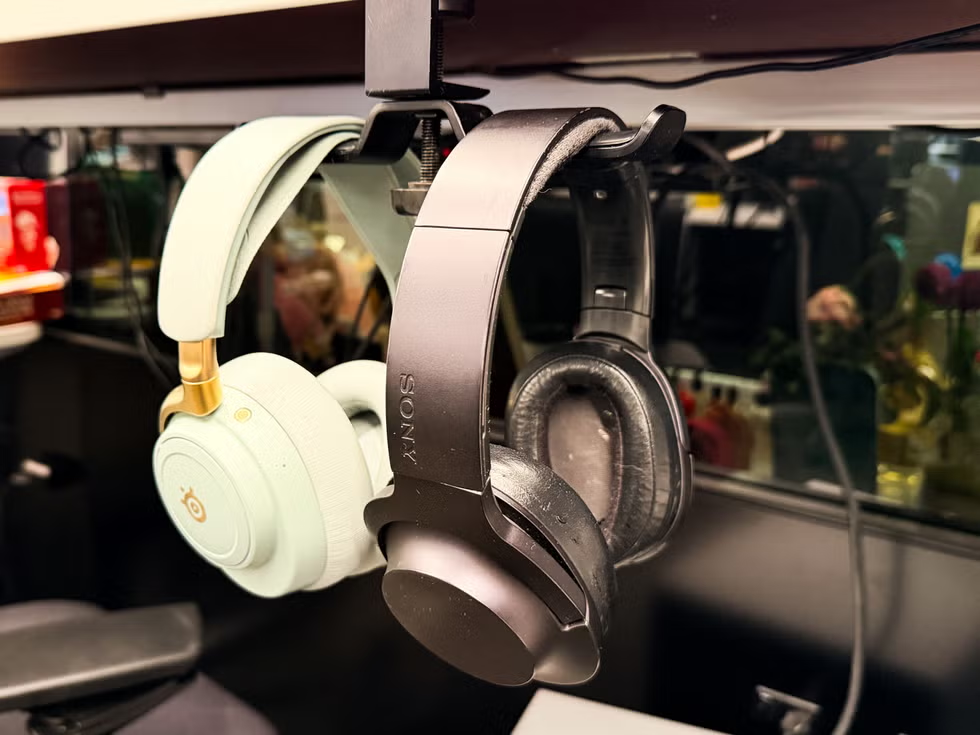
And I find that, on the spectrum of options for properly caring for your headphones, hanging them up hits a Goldilocks zone between proper care and easy access. It solves that core problem of needing a home for your headphones. When you take them off, where do they go? On the stand or on the hook. And when they’ve been hung up, they can hang naturally, as they were designed to do. They will not stretch out, or get worn out, or get knocked around (hopefully).
The alternative is to store them in a hard case that protects them from dust and damage, which is technically more secure. I can only speak for myself, but personally, there isn’t a snowball’s chance in hell that I’m going to take the time to gently arrange my headphones in a case, then put them on a shelf every time I take them off. If I’m spending a day at home playing video games or locking in to work on a personal project, I may take them off and put them back on four or five times a day. Using a case becomes completely impractical.
Hanging your headphones, on the other hand, is an act of convenience. Not only do you know where to find them, but they’re easy to grab whenever you need them. All of a sudden, your headphones feel like a part of your workspace or gaming setup.

As I’ve mentioned, there are two types of headphone hangers out there—headphone stands, which are little bars with either a flat or curved bar to hold your headphones; or headphone hooks, which clamp onto the front of your desk so you have a small bar just underneath.
Both options work fine, but there are a few factors that will likely steer you toward one or the other. Stands are a bit more showy, but take up way more real estate on your desk or a shelf. Hooks are more subtle and utilitarian, but a tight metal clamp might damage a wood desk surface over time.
The good news is that you can get very cheap versions of either. I’ve bought two deskhooks for my desk at home over the years, as well as a stand. All three cost between $6 and $20. (As a disclosure: As an audio reviewer, I’ve also been sent a few branded stands over the years, like the SteelSeries one in some of my photos.)
There is some room to upgrade, especially with headphone stands. There are options made from nicer materials and in more aesthetic shapes similar to a human head. But this is one of the few products where, as far as I can tell, the cheapest version of the product is not only fine, but has nearly the same utility and durability as its more luxurious counterparts.
So in the end it doesn’t matter what you choose—headphone hook or headphone stand—just pick something. It’s a small upgrade that will make a subtle, but substantial difference in how you (and your tech) live.


Now 7% Off


Now 50% Off

Now 40% Off

Now 8% Off

Mike Epstein is a Senior Commerce Editor at Hearst Enthusiast Group, producing reviews for buying guides Popular Mechanics, Runner’s World, Bicycling, and Best Products. Prior to joining Hearst, he was a video game and technology critic for over 10 years, with bylines at IGN, Gamespot, Variety, Lifehacker, Kotaku, GamesRadar, Flavorwire and Digital Trends, among others. Now, he’s a jack of all trades, helping reviewers share everything they know about all kinds of technical gear, from snowblowers, to running shoes and bicycles, and every kind of gadget imaginable.

Rachel is the Deputy Editor of Reviews for Hearst's Enthusiast and Wellness Group where she supports Popular Mechanics, Runner's World, and Best Products. Her background is in service journalism and earlier in her career she worked as a daily newspaper reporter and book editor. She spent more than a decade as a staff editor and writer at TripAdvisor and Penguin Random House and her byline has appeared in Time Out New York, the New York Daily News, and New York Magazine. Outside of work, Rachel can be found planning her next trip, visiting museums and galleries, and walking her wirehaired dachshund in Central Park.
此内容由惯性聚合(RSS阅读器)自动聚合整理,仅供阅读参考。 原文来自 — 版权归原作者所有。