


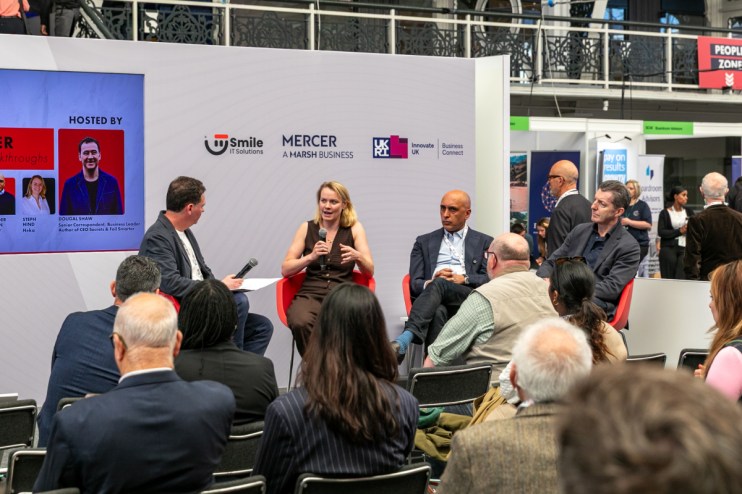
At SCALE EXPO & SUMMIT on 22 April, business journalist Dougal Shaw brought together three entrepreneurs to talk about setbacks and comebacks – the theme of his new book, Fail Smarter.
Failure is not something most of us talk about at business events. When you’re pitching to investors, winning over customers, or convincing talented people to join your startup, the success narrative is everything. But according to Dougal Shaw, keeping our mouths firmly shut about failure is a problem, and it’s costing British businesses their best chance to scale.
At SCALE’s flagship event at the Business Design Centre, Dougal chaired a panel that cut straight through the shiny surface of entrepreneurship to examine what failure really looks like, and what the most resilient founders do with it. Joining him were Steph Hind, co-founder of employee wellbeing benefits platform Heka; Gurinder Dhillon, founder and CEO of electric vehicle leasing company Auto Car; and John Stapleton, serial food entrepreneur and investor, founder of New Covent Garden Soup Company and Little Dish.
Four lessons in turning setbacks into breakthroughs
1. When everything closes overnight
Steph Hind closed her first investment round the week before Christmas 2019. Six weeks later, Covid hit. Heka’s entire model at the time was built around physical health and wellness experiences (gyms, yoga studios, sports classes) all of which shut down simultaneously.
“Every gym, every physical location we had on the platform closed,” she said. “And literally overnight you had people being like, what are you going to do for us now?”
Steph was 26, recently in her first office, with new staff who had joined on the strength of her conviction. The pressure was acute.
“You’ve built this business. They want to know the answers to the questions that you don’t know. But if you don’t go in full of conviction, then everybody’s going to be flapping and panicking.
Her response was to reframe the question. Rather than fixating on the worst that could happen, she asked what was the best that could happen if she was willing to take the risk. Heka pivoted to a whole-person health model. The platform now offers around 25,000 experiences, from financial learning to National Trust membership, and is stronger for having been stress-tested at the start.
Setback into breakthrough
When a crisis strips your business model down to nothing, it also removes the constraints of how things have always been done. The pivot you’re forced to make may be better than the one you would have chosen.
2. Knowing when to quit and start again
Gurinder Dhillon’s first business, a food delivery company called Food Corners, was ahead of its time. “We built our kitchens, had all the chefs inside, had 50 drivers and amazing sales, but couldn’t find a profit.” After four years, he acknowledged that he was stubbornly pursuing a future for the business that didn’t exist.
Stubbornness is when all the facts have changed, but you keep plowing on.
He moved into black cabs, building a fleet of 250 vehicles. But when Uber arrived, rather than wait for the tide to turn or fight against the disruptor, he read it as a signal. He sold the black cab business and started again with a single car. “I think the bravest decision ever was to torpedo a really successful business and say you’re going to start again.” Over ten years, he rebuilt to 8,000 vehicles and became Uber’s biggest partner in Europe.
The key, he argued, is the competitive intelligence that only comes from time in the market. “It’s not timing the market, it’s time in the market. You gain expertise from compound interest and spending time building your knowledge in that area.” That depth of domain expertise is what lets you see disruption coming and make a move before others do.
Setback into breakthrough
Domain expertise earned through failure is a competitive moat. The longer you’ve been in an industry, the earlier you’ll see the next wave — and the more credibly you can ride it.
3. The s**t sandwich
John Stapleton’s business card lists three companies: New Covent Garden Soup Company (success), Glencoe Foods (failure), Little Dish (success). He calls it the s**t sandwich.
It represents the success, the failure, and then, happily, the success afterwards.
After selling New Covent Garden in 1997, John took the model to America with total confidence.“I became a bit of an arrogant s**t at that stage because I thought I had it figured out.” He hadn’t. Different consumer habits, a fragmented distribution network, a prolonged distraction from an acquisition approach, and it all unravelled. “It came crashing around my ears and it was a horrible experience.”
What followed was a long period of introspection. His mind, he said, played tricks on him.
I began to think maybe New Covent Garden was a success despite me, rather than because of me
But out of that process came the clarity that drove Little Dish.
The major reason why Little Dish was a success was because the US business was a failure
Setback into breakthrough
Success is a poor teacher because you can never isolate what made it work. Failure is precise. It shows you exactly what you missed and if you’re honest about it, that knowledge compounds into your next attempt.
4. How investors view failure
When the conversation turned to how investors respond to founders who’ve failed, the panelists were in agreement: the best investors aren’t put off by failure, but they probe it carefully. They want to understand what you learned, how you behaved when things went wrong, and whether the people around you were treated with integrity. “Were people left in debt and out of pocket, or did you manage to settle up? If you can fail well, and that helps you move on,” John noted.
Setback into breakthrough
Storytelling is an underrated skill in the context of failure. As a founder, you need to construct a narrative around the setback you’ve experienced, so that it demonstrates growth. Smart investors are backing a person’s evolution, not just their idea.
Join us for Fail Smarter on 2 June
Dougal Shaw will be bringing the themes of Fail Smarter to a dedicated SCALE Session on 2 June, with a special guest entrepreneur featured in the book. Join us at the SCALE Hub to unpack what it really takes to build resilience into your business and why the founders who’ve fallen hardest often scale the fastest. Hear directly from an author who has spent years interviewing entrepreneurs about their toughest moments, and how they used them to fuel their scaleup journey.
Register for the Fail Smarter SCALE Session
Spaces are strictly limited. City AM readers get 15% off with code: CITY 15
Your ticket includes a free copy of Fail Smarter by Dougal Shaw