


惯性聚合 高效追踪和阅读你感兴趣的博客、新闻、科技资讯
阅读原文 在惯性聚合中打开

推荐订阅源

Microsoft Azure Blog
The Register - Security
S
Securelist
Simon Willison's Weblog
T
The Exploit Database - CXSecurity.com
V
Vulnerabilities – Threatpost
NISL@THU
NISL@THU
P
Privacy & Cybersecurity Law Blog
V2EX - 技术
V2EX - 技术
O
OpenAI News
N
News and Events Feed by Topic
AI
AI
P
Proofpoint News Feed
Schneier on Security
Exploit-DB.com RSS Feed
Cloudbric
Cloudbric
Help Net Security
Help Net Security
C
Cyber Attacks, Cyber Crime and Cyber Security
Threat Intelligence Blog | Flashpoint
Security Latest
Security Latest
Application and Cybersecurity Blog
L
LINUX DO - 热门话题
Cyberwarzone
Cyberwarzone
Scott Helme
Scott Helme
The Hacker News
The Hacker News
Hacker News - Newest:
Hacker News - Newest: "LLM"
www.infosecurity-magazine.com
Google DeepMind News
H
Hacker News: Front Page
C
Cisco Blogs
Webroot Blog
Webroot Blog
K
KPMG report finds enterprise disconnect between AI and its ROI | CIO
Hacker News: Ask HN
Hacker News: Ask HN
cs.CL updates on arXiv.org
The Last Watchdog
The Last Watchdog
PCI Perspectives
PCI Perspectives
AWS News Blog
AWS News Blog
Recent Commits to openclaw:main
Know Your Adversary
Know Your Adversary
Latest news
Latest news
Forbes - Security
Forbes - Security
I
Intezer
Project Zero
Project Zero
C
CERT Recently Published Vulnerability Notes
T
Tenable Blog
TaoSecurity Blog
TaoSecurity Blog
S
Security @ Cisco Blogs
N
News | PayPal Newsroom
H
Heimdal Security Blog
W
WeLiveSecurity

City AM

As it happened: Stocks mixed as Trump warns takes ‘two to tango’ on Iran peace As it happened: Stocks mixed as Trump warns takes ‘two to tango’ on Iran peace Replace Reeves if Starmer goes, voters tell Labour Right to Buy has been a huge success, of course the left hates it Regional bond revolution risks making Britain more unequal and less prudent Labour may not agree with Blair, but the public does… The world can’t keep consuming more than it produces If performance matters more than privilege then prove it Wayve: London robotaxis will make passengers forget there’s no driver Mandelson Files add insult to injury, but the patient was already beyond saving Blackstone Raises its Largest Asia Private Equity Fund at $13.1 Billion Pension master trusts join forces to tackle outdated transfer systems Iran ‘pulls out of talks with US’ and threatens to strike Israel Anthropic files for IPO as race with OpenAI heats up ‘Be more Trumpian’ – Mandelson discussed dire economy and ‘lack of verve’ with key Starmer ally Deloitte UK appoints first chief AI officer in drive for ‘AI-enabled’ services Private credit is crowded — but disciplined capital still knows where to look Squash players turn to social media to cash in on LA Olympic Games opportunities Interactive Brokers Integrates AI into Client Portfolios – Informed by Agentic Technology, Controlled by the Client WWEX Group and Auctane Complete Merger, Creating Leading Logistics Provider ShipStation Global Sadiq Khan: London tech boom can weather ‘dizzying’ AI risks New mixed gender trophy introduced for coming Hundred season Labour voters lead AI adoption as public remains split on impact North Highland Names Anthony Shaw Global Chief Executive Officer Vyond Appoints SaaS Industry Veteran Scott Ernst as Chief Executive Officer Winston Taylor Completes Historic Transatlantic Combination M&S chief’s pay slashed by £3m after cyberattack turmoil Inside Celonis, the German tech unicorn that won over a fifth of the FTSE 100 Stop and think before asking for a bigger salary Brits back Blair’s growth calls – yet are squeamish over welfare cuts Number of claims management firms halves after FCA clampdown Richard Desmond hit with £40m bill over ‘fanciful’ lottery feud Pub bosses warn tax hikes driving youth unemployment crisis UK manufacturing survives Iran war impact Labour sheds union member support to Reform, poll shows Private equity-backed Ryan triumphs in bidding for European tax adviser Svalner Atlas Wise shares plummet as money transfer firm faces fraud investigation KBRA Releases Research – European Fibre ABS: From Build-out to Securitisation Everbridge Expands Presence in Germany with New Munich Office Iran war triggers slump in selfies, ME Group warns Landlords rush to protect income over Renters’ Rights Act fears Ascensia Diabetes Care Expands CONTOUR® Portfolio with CONTOUR®COMFORT Pen Needles to Bring Greater Stability and Control to the Everyday Injection Experience Corient Completes Acquisitions of Stonehage Fleming and Stanhope Capital Group; Global Assets Surpass US$500 Billion Autobrains and Uber to Launch Agentic AI Robotaxi Program in Munich built on NVIDIA DRIVE Hyperion Easyjet fires back at ‘highly opportunistic timing’ as Castlelake weighs takeover bid House prices fall again as property market ‘deteriorates’ Exclusive: Roland Garros star and ATP chief in £450,000 tennis fund raise Milburn NEET review: Anger crackles from the page but will Labour act? Deloitte and KPMG challenge PwC’s iron grip on FTSE 100 clients City policy chairman: 10 years on from Brexit, the UK still needs the EU Fintech firms grew four times faster than traditional banks in 2025 Revolut, Wayve and Elevenlabs join European tech sovereignty push UK music tech faces scale-up crunch as growth funding collapses House prices will fall by two per cent this year – the most since the financial crisis BCG, Bain and Alvarez & Marsal to ramp up entry level hiring despite AI fears NATO military chief presses UK to accelerate defence pledges Ministers back SNP probe as Sturgeon refuses to apologise for Murrell Key Mandelson file withheld by Cabinet Streeting suggests North Sea drilling and NI cuts in latest pitch Manchester City and Spygate prove lawyer gulf is opening in football ‘Defining moment’: UK’s largest train operator enters public ownership Trump yet to make ‘final determination’ on Iran war despite discussions Chaos at Heathrow as burst water pipe causes train cancellations Neil Woodford criticises BP board for ousting ‘shouty’ chairman Easyjet attracts takeover interest from US private credit firm Burnham would end asylum hotel contracts if he was PM, allies say Universal Music rejects Bill Ackman’s $65bn takeover bid How do professional footballers keep their divorces private? Fortegra Completes Acquisition by DB Insurance Training Maestro Size set for profitable Sunday at Sha Tin Trust in Patch to deliver the goods at Sha Tin Iran and Russia to target Fifa World Cup, threat experts say I’m 50 – but I feel young dining at Simpson’s in the Strand London was once a destination for the young, now it’s a compromise Business services staff face redundancies at City law firm Can Newcastle go posh? Our honest review of city’s first five-star hotel IFF Enters Into Agreement to Sell Its Food Ingredients Business to CVC Bank of England’s Bailey: Interest rates hike may not be needed Reeves’ savings package to have minimal impact on inflation rise Natwest and Barclays sweeten mortgage costs as Iran peace hopes ease interest rate fears Arsenal Champions League final tickets on resale sites for £200,000 KPMG Australia boss resigns amid whistleblower scandal KBRA Releases Research – Spanish RPL RMBS: Resilient Performance and an Established Asset Class Ocado shares rocket after striking Asda home deliveries deal Uber wants your journey on tape as safety concerns mount Burnham hits back at Blair with more state control for ‘good growth’ Top banks urge Rachel Reeves to expand small business lending scheme Private equity boom slows down as the deal bar rises for City firms £450m City block approved after developers lop three storeys of plan Champ Rugby: Bedford vs Worcester shows strength of second tier Reeves’ summer of fun won’t deliver growth I’m a social landlord, but London housing needs the private sector Moving abroad won’t save you from the British tax man Beetlejuice musical review: I’ve never heard West End fans scream this loud Asana Acquires StackAI, Adding Cross-System Execution for Human-Agent Teams AAHI’s SLA-SE Adjuvant Technology Powers Lilly’s Acquisition of Curevo’s Next-Generation Shingles Vaccine Bidgely’s EmPOWER AI London Convenes Leaders to Map the Future of Electrification, Load Flexibility, Customer Experience and Energy Affordability Music venues are in dire straits: V&A show asks how we can help KBRA Assigns Preliminary Ratings to Oban Cards 2026-1 PLC Property rich, pension poor: Meet the ‘sleepwalking’ generation
On this day: Britain votes to leave the EU
Eliot Wilson · 2026-06-23 · via City AM

 |  Updated: 

UK flag and EU flag waving side by side, symbolizing Brexit referendum discussions and future political relations.
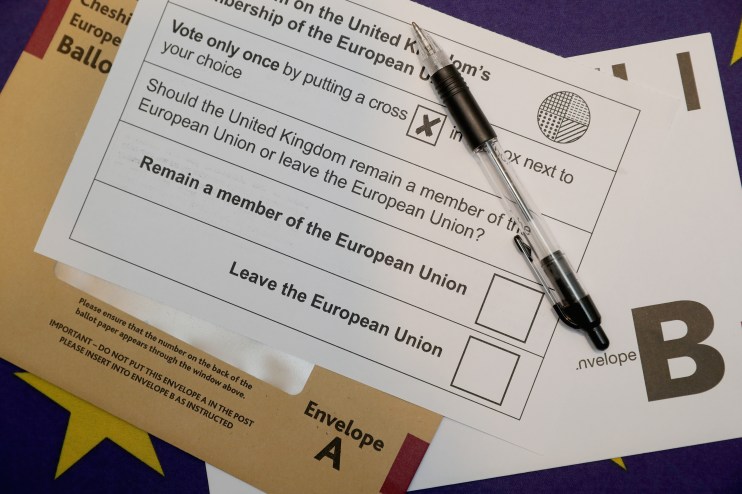
KNUTSFORD, UNITED KINGDOM - JUNE 01: In this photo illustration a European Union referendum postal voting form, waits to be signed on June 1, 2016 in Knutsford, United Kingdom. The United Kingdom will hold a referendum on June 23, 2016 to decide whether or not to remain a member of the European Union (EU), an economic and political partnership involving 28 European countries which allows members to trade together in a single market and free movement across it's borders for cirtizens. (Photo by illustration by Christopher Furlong/Getty Images)

The Brexit referendum was 10 years ago today. A decade on, very little has been resolved, says Eliot Wilson

There have only ever been three UK-wide referendums. Appealing directly to the electorate on a single issue through a plebiscite fits awkwardly with parliamentary government, as Enoch Powell told the House of Commons in 1972: “The essence of our own responsible parliamentary democracy is that the Government are held totally responsible to the House of Commons, and the House is held totally responsible to the electorate.”

Referendums pass the buck. When Labour returned to power in 1974, it was split on the issue of the Common Market, and Harold Wilson had promised a referendum on the future of Britain’s membership to paper over his party’s cracks. In June 1975, the electorate voted 67-33 to stay in; there would not be another national referendum for more than 30 years.

The 2011 referendum on the Alternative Vote system was a concession by David Cameron to his Liberal Democrat coalition colleagues, but it was an unloved child. Turnout was only 42 per cent and two-thirds of those opted against the new voting system.

Ten years ago today, however, on Thursday 23 April 2016, came a simple Yes/No vote on whether the UK should remain in the European Union. David Cameron had seen, first as a special adviser to Chancellor Norman Lamont in 1992-93, how the Conservative Party had spent nearly 20 years in internecine warfare over Europe and wanted to end it.

In 2012, with his Chief of Staff, Ed Llewellyn, and Foreign Secretary William Hague, Cameron raised the possibility of a referendum on EU membership as a concession to his party’s Eurosceptic wing, and to spike the guns of Nigel Farage’s increasingly successful UK Independence Party. In 2013, he announced that a referendum on renegotiated terms of membership would be in the Conservative manifesto at the next general election.

Exceeding expectations, the Conservatives gained 24 seats and won the election outright. In February 2016 Cameron declared that the referendum would be held on 23 June: Her Majesty’s Government would formally advise the electorate to vote to remain in the EU, but, as in 1975, collective responsibility on the issue would be waived and ministers could campaign to remain or leave.

For some Remainers, the very fact of the Brexit referendum is the original sin, the moment when the troubling of their lives began. But that view is formed in the light of the result; most would have been relaxed if Britain had voted to stay in the EU and the Eurosceptic fox had been shot.

Inevitable

I take the view that, whatever the outcome, a crisis, a definitive judgement on EU membership was inevitable. It was more than 40 years since the confirmatory referendum of 1975, and the nine-member Common Market was a pale shadow of the 28-strong, highly bureaucratic and centripetal European Union of 2016.

In the 2014 elections, UKIP had won 24 of the UK’s 87 seats in the European Parliament. This reflected a growing disenchantment with the EU, but also a rising tide of frustration that the organisation had transformed itself, yet for the opinion of the UK electorate had never been directly and specifically tested in 40 years. It added to an already-noxious sense of exclusion from public discourse, of voices ignored for saying the unfashionable thing. To assume that situation was sustainable was to ignore a fizzing fuse.

The result was narrow but seismic: 51.9 per cent voted to leave the EU and 48.1 per cent to remain. It seemed shocking then: the government and all the mainland British political parties supported Remain, except UKIP and the neutral Conservatives; so did the majority of big business, The Guardian, The Financial Times and The Daily Mirror, most trades unions, NATO and the World Bank.

Many saw what they wanted to see. But the opinion polls had pointed to a close and volatile contest. Although Remain had dominated 2015, by the following year the two sides were trading places regularly, Remain’s lead fluctuating between one and 19 per cent. Leave lagged slightly, but more than once outscored its opponents by 10 per cent. Matthew Elliott of Vote Leave was a formidable organiser and strategist, and Boris Johnson and Nigel Farage were the most eye-catching campaigners in politics. This energy contrasted with a fatal and seemingly presumptuous calm among some Remainers who took victory for granted.

What can we say about the Brexit vote ten years on? There are two separate elements. On Britain’s relationship with the EU, it is simply too early to tell: the UK did not formally leave until 31 January 2020. The losing side will point to estimates of economic loss attributable to Brexit – the only hypothetical question some politicians will ever address – but the situation is dynamic, not fixed. Too little coordinated effort has been made systematically to reimagine the UK outside the EU, but even the real 10-year mark in 2030 will only provide initial indications on such a profound change.

The issue of the UK’s membership of a supranational political and economic alliance – which is what the EU is – became a proxy for many other arguments. Clashes between globalism and protectionism, between social conservatives and liberals, town and country, London and the rest, graduates and non-graduates, all found a voice within the Brexit process

Brexit has had a more profound effect. The English Civil Wars set father against son, brother against brother; more prosaically, so too did Brexit. The issue of the UK’s membership of a supranational political and economic alliance – which is what the EU is – became a proxy for many other arguments. Clashes between globalism and protectionism, between social conservatives and liberals, town and country, London and the rest, graduates and non-graduates, all found a voice within the Brexit process.

We have become a more polarised electorate, quicker to anger and slower to listen. Brexit became a language of grievances: of those who felt excluded and passed by; and those for whom an attachment to Europe and its culture was a building block of their identity. The presenters of the podcast The Rest Is Politics, Rory Stewart and (ironically) Alastair Campbell, talk of the imperative to “disagree agreeably”, but Brexit’s fault lines have led to an atmosphere of bone-deep antagonism. Simply, we have lost the ability to tolerate each other.

That intense, antagonistic temper has put the traditional British party system under extreme pressure from which it may not recover. Political parties are a way of corralling those with broadly similar beliefs and identities, but from the first steps towards European collaboration in the early 1950s, opinions on Britain’s involvement cut messily across party boundaries.

Opposition to the EU allowed first UKIP then the Brexit Party and now Reform UK to amass votes on a single issue but permitted supporters to read their own instincts into the movement. The inevitable tension on other issues remain unresolved: is it free-market or protectionist, libertarian or authoritarian, collectivist or entrepreneurial? It has yet to be forced to decide.

This has been the wider legacy of Brexit, a work in progress. It took one issue, membership of the EU, on which almost all parties had at least some internal divisions, and made it for a time the supreme shibboleth, the determinant of inclusion or exclusion like the Test Acts of Restoration England. It has forced us to look at political parties and identities in a new, unfamiliar and uncomfortable way.

The political system may emerge battered but essentially unchanged, the traditional indicators of Left and Right re-emerging. But they may not, and it is impossible to say what might appear in their places.

Elikot Wilson is an author and historian