







These highlights were written by the reporters and editors who worked on this story.
Kevin Heath had hoped there would be solar panels by now on his family farm in southeastern Michigan, roughly 50 miles outside Detroit.
About six years ago, he agreed to lease part of his land for a solar project. It would help him pay off debt and keep the farm in the family, he said. But the opportunity was thwarted when, in 2023, following pushback from some local residents, his township passed an ordinance that banned large solar projects from land zoned for agriculture.
In the fight over solar development, Heath said he was bombarded by just about every argument from critics — including claims that solar fields are a health hazard. “I’ve heard them say that, but I’ve never heard anybody prove that,” Heath said.
“The health and safety issue,” he added, “that is just a joke.”
Michigan has big prospects in solar farming — measured by the expected growth in the capacity of its farms to add electricity directly to the grid. According to the U.S. Energy Information Administration, most of the nation’s new capacity from this type of solar farm is planned this year for four states, including Michigan. The others, with their hot deserts and big-sky plains, seem more obvious: Texas, Arizona and California.
To some, in Michigan and beyond, this growth feels dangerous. They pressure public officials to stop, stall or otherwise complicate new solar projects with an array of arguments that now go beyond just land use to include public health.
There is little reputable evidence to back their claims. But health concerns have helped power a solar backlash that undercuts efforts to broaden energy sources even as customer costs are rising.
Restrictions on solar development are proliferating nationwide, “often rooted in misinformation or unfounded fears,” including ones that involve “potential environmental and human safety risks,” according to an article published late last year in the Brigham Young University Law Review.
To generate electricity, solar projects harvest energy from the sun. “And that’s really not that different from what a field of corn or alfalfa does,” said Troy Rule, the Arizona State University law professor who authored the article. “In fact, arguably, it’s even more environmentally friendly.”
Still, a state board in Ohio rejected an application for a solar project last month, citing local opposition, even though its staff initially said it met all requirements. Along with other concerns, according to the board, opponents “testified about the potential impacts on the health of residents.”
A bill in Missouri would halt commercial solar projects in the state, including those under construction, through at least 2027, as a state agency develops new regulations. The bill’s emergency clause says this is “deemed necessary for the immediate preservation of the public health, welfare, peace, and safety.”
And, on the eastern edge of Michigan, St. Clair County adopted a novel public health regulation last year that set limits on solar development and battery storage. The move was encouraged by the county’s medical director who, in a memo, warned of the threat of noise, visual pollution and potential sources of contamination. Some local residents have long pressed leaders to act, saying that intrusive noise could worsen post-traumatic stress disorder and other ailments.
Public officials don’t always examine the validity of health claims, according to Rule. And local deliberations rarely compare the impact of solar farms to common agricultural practices, which can lead to runoff from fertilizers and herbicides, for example, or waste lagoons from concentrated animal feeding operations.
People have many reasons for taking issue with large-scale solar development, said Michael Gerrard, an environmental lawyer and founder of Columbia University’s Sabin Center for Climate Change Law. But as for the feared health impact, he said, “there’s no basis for that.”
“People try to come up with a rationale to justify their dislike of things they dislike for other reasons,” Gerrard added.
President Donald Trump’s administration, meanwhile, is adding to the skepticism that renewable energy is worthwhile. Among other moves, it’s phasing out federal tax credits for the solar and wind industries.
It all takes a toll on the effort to build out solar infrastructure. Last year, new solar installations in the U.S. dropped by 14%.
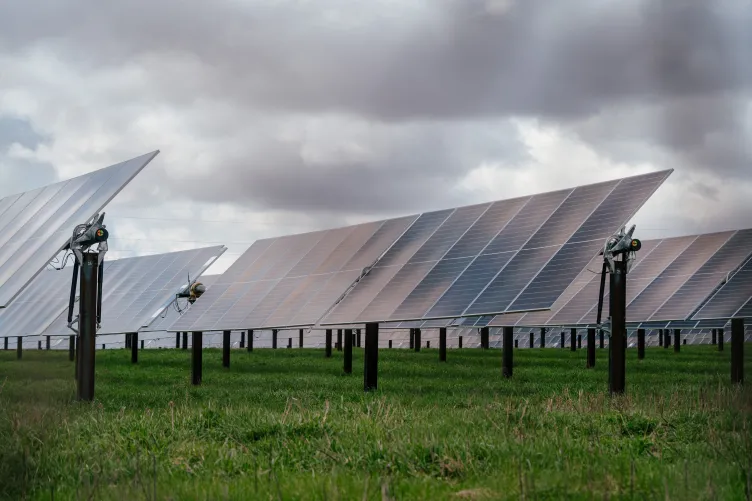
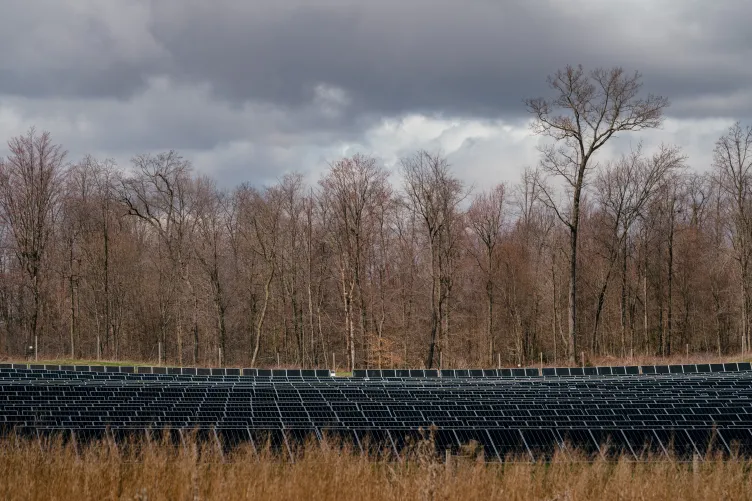
Large solar developments can transform hundreds, or even thousands, of acres of rural land, paneling them with crystalline silicon and tempered glass.
It’s a big change, and people have questions.
Locals worry that electromagnetism and even glare can pose a health risk. They wonder if toxic materials could leach into the soil and contaminate groundwater, if not while the solar site is operational, then some decades in the future, when it reaches the end of its life. That certainly has been the case with orphaned oil wells, which also were built with promises of safety.
But researchers point out that the most common types of panels have only small amounts of such materials, if any. They are encased and unlikely to leach into the soil. Rather than sitting in landfills when a site is decommissioned, most of the materials used in solar panels can be recycled (though the process can be costly).
Craig Adair, vice president of development at Open Road Renewables, which has pursued renewable energy projects in several states, has fielded a range of concerns over the years — from how soil could be contaminated to the possibility of electromagnetic fields causing cancer.
“Those questions, in just about every case, have an answer,” Adair said. “There is rigorous academic study, and there are examples of projects that have been operating.”
While the future farmability of the land is often a concern, many researchers — and farmers — say that a solar lease will help preserve it.
With proper planning on the front end, equipment can be removed from a decommissioned solar site and green space restored, said Steve Kalland, executive director of the NC Clean Energy Technology Center, which, along with its partners, provides technical assistance to local governments in the Carolinas.
And a person’s exposure to the electromagnetic field, or EMF, from a solar farm is roughly the same as what they would encounter from ordinary household appliances, according to researchers. EMF levels also decrease rapidly with distance.
Chronic exposure to noise is also a recurring complaint from critics. In challenging a proposed project from Adair’s company in Morrow County, Ohio, one woman said in a brief to the state siting board that she was troubled about how noise from the facility might affect people with neurological noise sensitivities, including her daughter.
A piece of equipment called an inverter is usually the source of noise on a solar site. It converts the current into the form that’s used on the grid.
But noise, as well as glare, are typically buffered with vegetative landscaping and setbacks, or the distance between the property line and the nearest structure. Inverters can also be placed far from the ears of neighbors.
Noise modeling for the Morrow County project showed that its inverter “will basically be inaudible to the public,” Adair said, and if it ever generated noise above a certain limit, the permit would require the company to bring it back into compliance.
The problem, Adair said, is that evidence-based answers and solutions can get lost in the fervor. They can be drowned out by “opposition activists wanting to try to scare local politicians into opposing a project, even if the concerns that they’re raising are not legitimate concerns,” he said.
Last month, the Ohio Power Siting Board denied a permit to Adair’s Morrow County project. Its order acknowledged that the proposal offered positive benefits, but, it said, “these benefits are outweighed by the consistent and substantial opposition.”
It didn’t specifically cite health concerns as the reason for the denial, but rather, “the varied and numerous concerns raised by both the local government entities and public in the project area.”
But, Adair said in an email, those local governments “cited (unfounded) public health concerns as a reason for their opposition to the project.”
Open Road Renewables plans to apply for a rehearing from the board, Adair said. The company has eight permitted solar projects in Ohio, but because of a siting process that he said is subject to “manipulation and misinformation,” Adair said it won’t initiate any more.
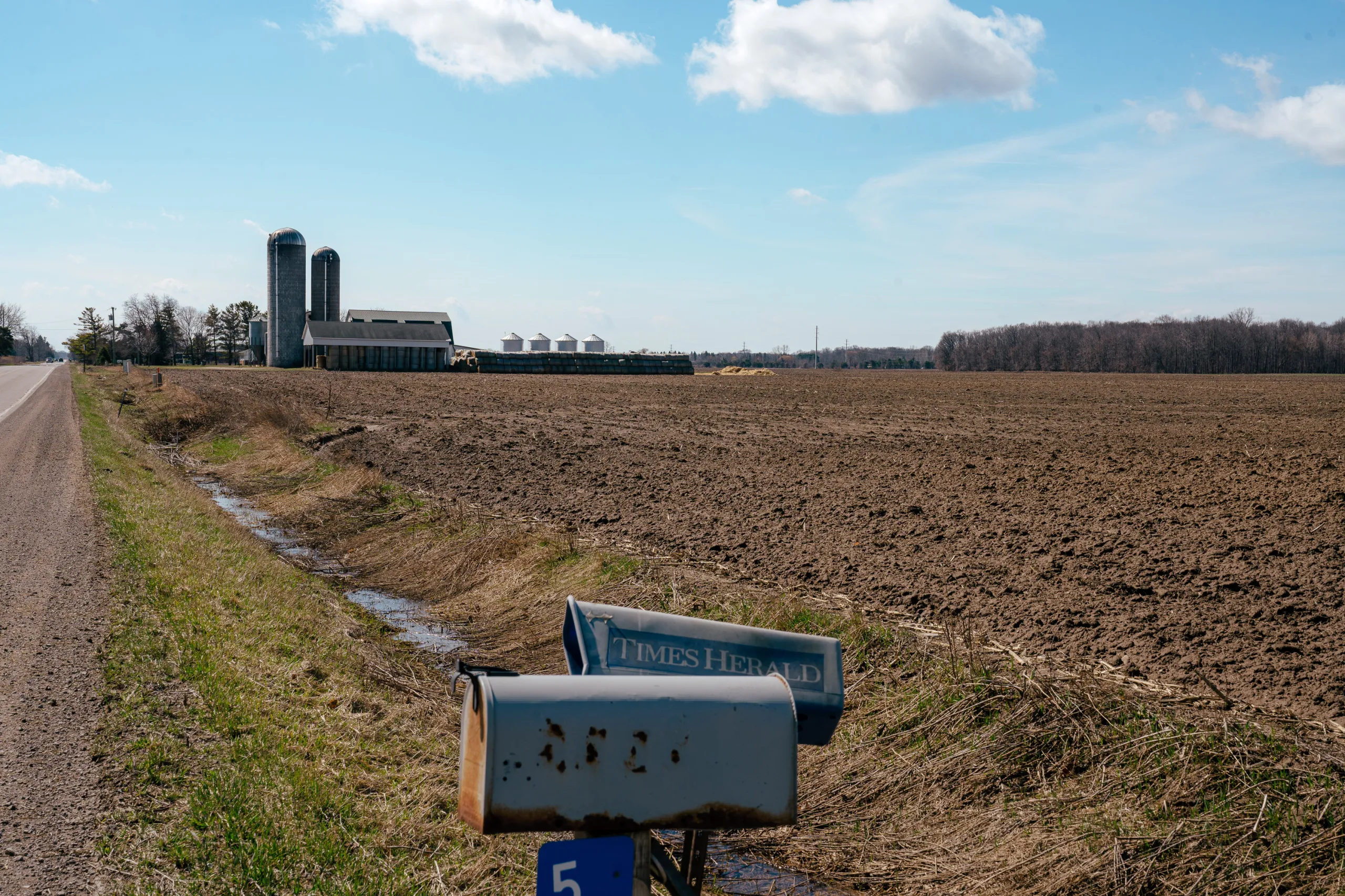
In Michigan’s St. Clair County, it isn’t just a number of residents who are worried about large solar facilities. The Health Department’s medical director echoed their concerns.
In two memos to other county officials, Dr. Remington Nevin said that large solar sites are a public health risk for the area’s predominantly rural residents. The state’s solar standards, he wrote, weren’t enough to protect them from “environmental health hazards, the spread of sources of contamination, nuisance potentially injurious to the public health, health problems, and other conditions or practices which could reasonably be expected to cause disease.”
Any detectable tonal noise, he added, must be considered an unreasonable threat to public health. He recommended new regulations.
The county administrator at the time, Karry Hepting, noted that Nevin’s initial memo “does not address the question or provide support for what are the potential health/environmental risks,” according to internal emails provided to ProPublica. “It appears we will need to hire an outside expert to get the level of detail and supporting data necessary to consider potential next steps,” she added. Hepting said that she’d begun researching prospects.
But County Commissioner Steven Simasko — now the county board’s chair — wrote in an internal email that he accepted Nevin’s medical opinion “as a good standard for the protection of the public health of our citizens” and disagreed with the need for outside input.
Simasko told ProPublica in an email that he believed it wasn’t the role of the administrator to get involved in a public health matter, and that he objected “to essentially paying for a second public health medical opinion” more to Hepting’s liking.
Hepting, who has since retired from her post at the county, disputed Simasko’s depiction of her motivations in a message to ProPublica. “Nothing could be farther from the truth,” she wrote. “It had nothing to do with shopping for a different opinion. Mr. Nevin’s initial memo did not address the initial question posed by the Board. It did not state what the health risks were and what negative health impacts exist. It basically said it’s a risk because he said so.”
To legally justify the adoption of health regulations, Nevin said in his second memo, it wasn’t necessary for his department “to prove, with a precise scientific or medical rationale, that eligible facilities pose an unreasonable threat to the public’s health.” Instead, expert opinion, public comment and the consent of the local government were reason enough, he wrote.
In the end, county officials were persuaded to act. The commissioners approved the Health Department’s new policy for solar energy and battery facilities, including a nonrefundable $25,000 fee to cover the cost of reviewing a proposed project. It also said that policy violations were punishable by up to six months in prison.
An electric utility promptly sued, and a solar company joined the case. The Health Department, they argued, has no authority to issue what are, in effect, zoning regulations. What’s more, they said in legal filings, the county can’t override the solar standards established by the state.
In its legal filings, the county said the health regulations were adopted properly and supported by “substantial, competent, and material evidence.” Facilities that don’t meet its standards “pose a threat to public health,” the county argued.
In response to ProPublica’s detailed queries, a public information officer said that the Health Department would not comment due to litigation.
Nevin said in a podcast interview last year that he wasn’t opposed to solar projects. “The purpose,” he said, “is to identify risks, unreasonable risks, to the public’s health posed by the construction or operation of the facilities, and then take reasonable, measured steps to attempt to mitigate those risks, ideally in a fashion that would continue to allow the facility to be constructed and to operate.”
Solar capacity in Michigan continues to grow, despite local pushback, but so far, only 2.55% of the state’s electricity comes from solar. In Ohio, it’s nearly 6%, according to the Solar Energy Industries Association, a trade group. In Texas, it’s nearly 11%. Michigan is requiring electricity providers to reach an 80% clean energy portfolio by 2035, and 100% by 2040.
Michigan has more local restrictions on renewable energy than any other state, according to the Sabin Center. “Practically nowhere in the country has seen more conflict” about where to allow large solar farms that add electricity directly to the grid than rural Michigan, according to a 2024 article in the Case Western Reserve Law Review authored by a Sabin Center senior fellow.
That includes the conflict in Milan Township, where Heath grew up on an 1,100-acre farm. “I always wanted to farm,” Heath said. He saw leasing part of his land to a solar company as a way to stay afloat and keep the land in the family.
In 2020, Milan Township passed an ordinance that would allow the project to go forward, with Heath’s brother, the township supervisor, abstaining.
But opposition mounted. Critics built a website that argued, among other things, that the project would unleash dangerous electromagnetic radiation. Heath and his siblings were rebuked by their neighbors, Heath said, to the point that his brother, Phil, told the township attorney he was thinking about resigning as supervisor. That same night, he died of a heart attack at age 67.
A few months later, with a new supervisor in place, the township board banned large solar development from land that’s zoned for agriculture. The terms were restrictive enough to effectively ban such a project not only from land owned by Heath and his sister, but from all but the small portion of the township that’s zoned for industry.
Stephanie Kozar, Milan Township’s clerk, said in an email to ProPublica that most residents opposed solar projects on agricultural land, and that the initial ordinance passed during the coronavirus pandemic, before officials had adequately informed residents about potential changes. The updated policy, she said, would “protect the township and allow for responsible development of clean energy in the area.”
To overcome severe local restrictions, the state set standards in 2023 for noise, height, fencing, setbacks and other elements of a large solar project. It also created a pathway where developers, in certain cases, can get a permit from the Michigan Public Service Commission, the state’s regulating authority, rather than from local governments.
In an order, the commission laid out details for how the process would work. But nearly 80 local and county governments, including Milan Township, challenged it in court, arguing the commission was overstepping its authority.
In support of the state, Heath and his sister are represented in a friend-of-the-court brief filed by a legal team affiliated with the Sabin Center, along with local attorneys.
Also part of that brief is Clara Ostrander, who had hoped a solar project would help protect two farmsteads in Milan Township that have been in her family for over 150 years. “We need a responsible neutral party like the Michigan Public Service Commission to review these projects based on facts, not fear or falsehoods,” she testified to state officials ahead of the bill’s passage.
Even with the state process, rising energy demand and eye-popping electricity costs, no new large solar installation has yet been built in Milan Township.
And in February, as snow melted around the “No Industrial Solar” signs that stud the long country roads, a circuit court judge ruled that St. Clair County’s health regulation is “invalid, null, and void.”
But county officials soon opted to appeal, unanimously. “This is very important for the health of St. Clair County and the residents,” said one commissioner before casting his vote.
此内容由惯性聚合(RSS阅读器)自动聚合整理,仅供阅读参考。 原文来自 — 版权归原作者所有。