





Across the country, Republican-led state legislatures are passing a slate of laws that effectively shield oil and gas companies from legal claims that they are responsible for the destruction and mounting toll caused by climate change. Fifteen laws have either been passed or are currently being debated in 11 states. Together, they threaten to remove long-standing tools for the public to hold corporations accountable.
A ProPublica investigation has found that most of these bills are part of a coordinated effort, orchestrated by a constellation of groups that share staff or have funding ties to the prominent conservative activist Leonard Leo, who is credited with placing conservative justices on the U.S. Supreme Court. These groups have drafted state legislation, planned its dissemination and engaged a well-connected lobbying firm to get them signed into law.
The effort is unfolding as courts are weighing more than 30 significant lawsuits by states, counties and municipalities accusing fossil fuel companies of misrepresenting the risks their products posed to consumers and seeking to recoup the costs of disasters and other climate impacts like wildfire losses or coastal flooding that their products helped cause. A goal of the legislation is to block these cases from going forward and prevent new ones from being filed.
The strategy to establish state laws that will make it all but impossible to sue oil and gas companies was laid out in detail by a group of lobbyists and political operatives in December, during a panel presentation at the annual States and Nation Policy Summit of the American Legislative Exchange Council — the influential organization that brings together state lawmakers, corporate leaders and conservative activists to draft and promote legislation.
During the session, one of the panelists, Will Hild, the executive director of a nonprofit called Consumers’ Research, described the climate cases as a liberal effort to use the judicial system to exact a new tax on energy companies in the form of civil judgments. Another panelist, Oramel H. Skinner, the former solicitor general for Arizona and the executive director of the nonprofit Alliance for Consumers, warned that those judgments will trickle down to make citizens’ lives less affordable and ultimately make many of their choices — whether to own pickup trucks or purchase a side of beef — illegal.
ProPublica reviewed an audio recording of the event obtained by the nonpartisan watchdog group Documented.
Hild and Skinner had come to the session with a ready-made fix: a set of pre-written bills and plenty of funding.
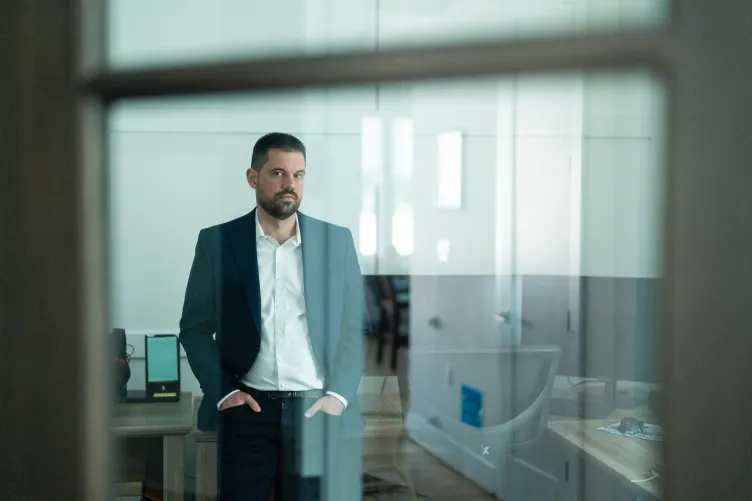
Consumers’ Research and the Alliance for Consumers are both funded by organizations connected to Leo. ProPublica examined lobbying records across 25 states, federal tax disclosures for more than a dozen organizations and notes from other closed-door strategy sessions among ALEC members and found that several Leo-supported groups are part of a national strategy to give legal immunity to companies for their climate emissions.
Since 2021, Leo has been deploying a $1.6 billion gift through a series of nonprofits and other organizations that obscure the source and the recipients of donations — so-called dark money groups. Much of that money has been routed through a nonprofit judicial advocacy group Leo founded — now called The 85 Fund — which both receives and disseminates Leo’s funding. Many of these nonprofits are increasingly focused on issues related to climate change.
The panel session’s moderator, Michael Thompson, is a senior vice president at CRC Advisors, Leo’s for-profit Virginia-based political and corporate consulting firm. He also sits on ALEC’s Private Enterprise Advisory Council. Hild’s organization, Consumers’ Research, received more than 65% of its funding in 2024 through a dark money group called Donors Trust. The 85 Fund contributed more than $67 million to Donors Trust in 2024. Consumers’ Research also works closely with — and contracted more than $670,000 of work in 2024 to — CRC Advisors. Another panelist, Paul N. Watkins, was a legal fellow at Consumers’ Research. According to tax filings, his law firm received more than $2.2 million in 2024 from the group. As recently as 2024, Skinner was also counsel for Leo’s 85 Fund, according to the nonprofit’s tax filings.
“For decades, the left has leveraged immense resources to capture the institutions that shape our society — the legal system, universities, medical and scientific bodies, the entertainment industry, and our biggest corporations,” Leo wrote to ProPublica in a text message. “That takeover resulted in a radically woke culture that does not reflect the will of the American people, or the pillars of limited constitutional government that made our country great. That is why our enterprise supports organizations that are committed to crushing liberal dominance and restoring balance in the institutions that shape society.”
At the ALEC session, Skinner presented a model bill that would effectively bar cities and towns from bringing public nuisance lawsuits against corporations and others when the issue is a broad public harm like climate change. In several cases, plaintiffs have argued that the impacts of climate change — the buckling of a road from extreme swings in temperature, for example — are a “nuisance” caused by fossil fuel companies.
Nuisance claims are common in the American legal system, giving individuals, companies or communities a way to sue when someone else’s actions damage their property, degrade the health or safety of the environment around them or interfere with their rights. Under these laws, parties can ask for financial compensation or seek court orders to remedy problems, such as pollution. Skinner, however, argues that nuisance laws should only be used to address local, easily fixable problems, like excessive noise from a bar. His bill would curtail the use of public nuisance suits in climate cases by limiting liability for manufacturers and other businesses and giving state attorneys general the sole authority to bring them.
“Think really hard about every lever you have in your states to shut off the ability for this woke lawfare machine to churn,” Skinner told the audience. “The left’s goal is to reshape society around you using the courtroom.”
The second draft law, called the Energy Freedom Act, was produced by the policy nonprofit associated with Hild’s organization. It would, among many provisions, shield businesses from liability related to emissions of greenhouse gases if those releases did not violate the federal Clean Air Act.
Critics of the bills say they subvert the rights of local communities. They send the message that “you can pollute with impunity,” said Carly Phillips, a senior scientist with the Union of Concerned Scientists. “It’s really a thumb in the eye of places that are affected by climate change.”
The push to block climate suits across the states comes as several of the cases against the oil industry approach, or have already entered, the perilous legal phases of discovery, when plaintiffs will have the opportunity to seek confidential industry documents and depose oil executives. The stakes for oil companies are enormous. By some estimates more than $10 trillion in damages can be attributed to U.S. emissions.
There’s a reason why state and local governments have increasingly brought these suits. The frequency and cost of climate-influenced disasters, including severe storms, drought and flooding, continues to mount — between $350 billion and $450 billion in each of the last three years — stretching government budgets. Significantly, the science that makes it possible to attribute how much any one disaster was influenced by climate change has steadily advanced. To cite one example, the March heat waves across the U.S. would have been virtually impossible without the emissions that have caused climate change, according to the European science group World Weather Attribution, and were about four times as likely to happen as they were a decade ago.
Boulder, Colorado, is among the places facing increasing droughts, more extreme precipitation and larger wildfires — all of which are significantly propelled by climate change linked to the emissions from the use of fossil fuels. The state has estimated the costs of these perils will run into the many hundreds of millions of dollars. In 2018, Boulder County sued Exxon Mobil and the Canadian oil company Suncor Energy, accusing the companies of “intentional, reckless and negligent conduct.”
Among its claims, the county alleged the oil companies engaged in a conspiracy to mislead the public and violated consumer protection rules by mischaracterizing the dangers of their products. They accused the oil companies of creating a public nuisance by altering the environment and leaving the county to pay to abate growing hazards such as the flooding that tests roads and bridges. Exxon Mobil and Suncor Energy have never filed a response in Colorado but asked for the case to be dismissed.
Ever since, the lawsuit has been mired in a dispute over whether Colorado courts were the correct venue, with the state Supreme Court ultimately ruling last May that they were. Suncor filed to the U.S. Supreme Court to reconsider, and this fall it will weigh the company’s petition asking whether federal environmental law preempts the state law.
The high-profile national court case is just one facet in an increasingly tense fight over liability for the fossil fuel industry. In January, the American Petroleum Institute, the largest fossil fuel industry group in the United States, said fighting the climate liability lawsuits was one of its top priorities in 2026. Lobbying records for the group from last year show that it advocated for legislation to protect oil producers from climate lawsuits at the state level. The Trump administration; other industry groups, including the Chamber of Commerce; and several of the nonprofit advocacy groups associated with Leo have argued that state courts are the wrong venue for claims that ultimately concern emissions that drift widely across borders, and they wish to see other cases moved or dismissed. They say that because the federal government already has the authority to regulate those emissions, the federal courts, not the states, should hear the claims.
In an interview, Hild told ProPublica that he sees the suits as an illegitimate effort to enact policy through the courts and to “regulate the entire U.S. economy from a single state.”
In an email, Skinner wrote: “Our effort is not one focused on climate change. But it is true that left-wing activists and their dark money donors have put vast sums of money and years of groundwork into pushing a coast-to-coast campaign of climate-focused public nuisance lawsuits.”
Neither Watkins nor Thompson responded to requests for comment.
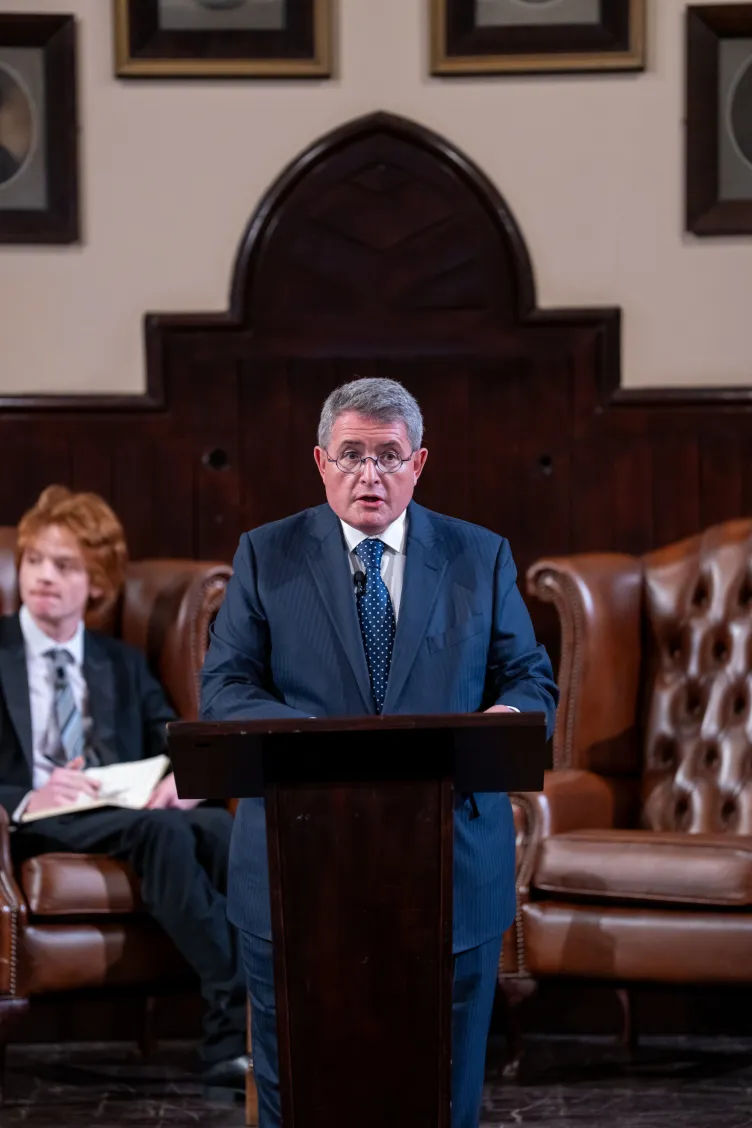
When Skinner and Hild finished their presentation at ALEC they made a QR code available to download the language of the model bills and directed the audience to a woman named Catherine Gunsalus, who was in the back of the room. She would be able to answer any questions, they said.
Gunsalus until recently worked for the Heritage Action Fund, the political and lobbying arm of the Heritage Foundation, the Trump-aligned think tank that is most recently known for promoting the Project 2025 agenda. Records show that Gunsalus has also lobbied in collaboration with another Leo-affiliated group, Americans for Public Trust.
In April 2025, she formed a lobbying firm called Varidon Strategies and began registering in states almost immediately afterward, according to records. By mid-summer, Varidon was representing Alliance for Consumers Action Fund; Consumers’ Research; The Honest Election Project, an affiliate of The 85 Fund; as well as other Leo entities in 25 states. In the majority of those filings, Varidon used an email address at the domain of Holtzman Vogel, a Virginia-based law firm that is often retained by Leo’s organizations.
Gunsalus did not reply to a detailed list of questions.
In the four months since the ALEC summit, there has been substantial activity in the states where Varidon has registered. On Jan. 5, representatives in Missouri introduced the loosely related Eliminate Criminal Profiteering Act, which could stop revenues flowing to law firms from settlements in the sort of nuisance suits often used in climate cases. Two days later, legislators took up the Public Nuisance Reform Act, which proposes narrowing the definition of what could be considered a nuisance.
That same month, similar bills were introduced in Indiana, Oklahoma and Tennessee. In February, eight more followed in Oklahoma, Iowa, South Carolina, Utah, Louisiana and Kansas. Skinner, who is registered to lobby in Kansas, was invited to testify in a hearing about that state’s bill and launched a new “End the Lawfare” website targeting the “left-wing” agenda. As of April 2, versions of the model legislation offered at the ALEC meeting have been introduced across 11 states altogether. In Utah, the governor has signed two related bills into law, and in Tennessee and Indiana, bills are awaiting their governors’ signature.
The more states there are with some sort of waiver in place, the narrower the pathway for cities and states to seek redress as environmental conditions worsen, and the costs continue to rise. Hild and Skinner and the Leo network’s bills also serve another purpose: teeing up a conflict that pits states against one another, a conflict that only the Supreme Court or Congress can finally resolve.
As Hild put it at the ALEC gathering, “This is economic civil war.”
此内容由惯性聚合(RSS阅读器)自动聚合整理,仅供阅读参考。 原文来自 — 版权归原作者所有。